That morning, Sergey sent me just two words:
“Are you home?”
I didn’t see the message right away. My phone was lying on the windowsill while I was busy outside, gathering trimmed branches from the path and trying to decide whether to keep the old lilac bush by the fence or finally remove it in the fall.
Sergey and I had been divorced for almost a year and a half.
For the past ten months or so, he hadn’t asked where I was, how I spent my weekends, or whether I happened to be at home.
So I stared at the screen for a few seconds before replying:
“Why?”
The message remained unread.
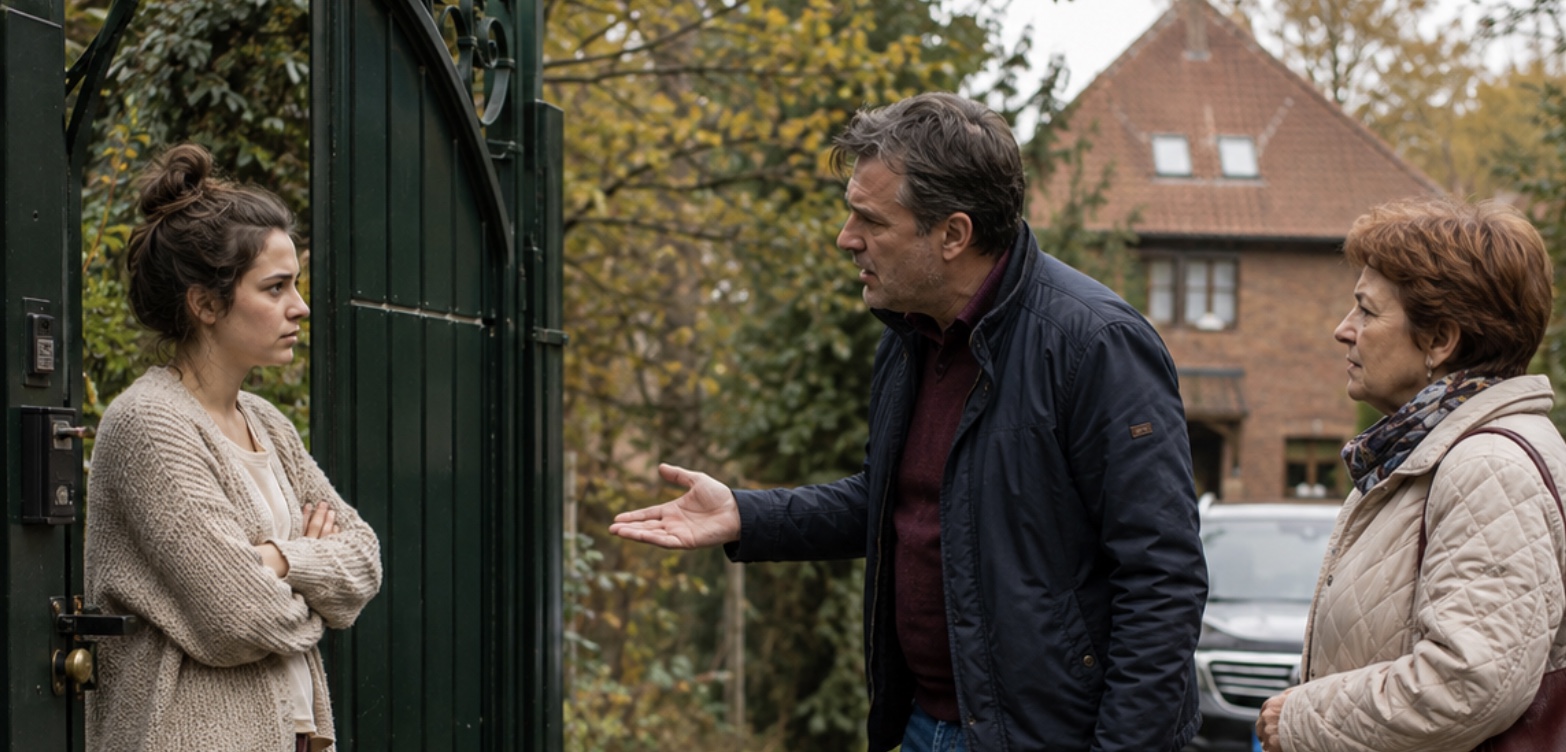
About twenty minutes later, a familiar car stopped outside the gate.
 
Sergey got out first.
Then the passenger door opened, and I saw Lydia Pavlovna.
My former mother-in-law looked around the property, adjusted the bag hanging from her shoulder, and asked her son:
“Where’s the other entrance?”
Sergey answered quietly and pointed toward the house.
That was when I realized they clearly hadn’t come just to say hello.
After the Divorce, We Barely Spoke
Sergey and I had been married for twelve years.
Our divorce wasn’t particularly dramatic. There was no long court battle, no endless accusations, and no fighting over every spoon and chair we owned.
We didn’t have children together.
The apartment had been purchased during our marriage, so after the divorce we went to a notary and signed an official property settlement. I kept the apartment and paid Sergey the agreed compensation.
It was a substantial amount for me. I had to dip deep into my savings, but I wanted the matter settled once and for all.
Sergey received his money, completed the necessary paperwork, and soon bought himself a small apartment in another part of town.
After that, there was really nothing left for us to discuss.
We sent each other brief birthday messages. Once, he asked me to find some documents for an old appliance that had accidentally been left behind. A couple of other times, we exchanged messages about minor practical matters.
Lydia Pavlovna never called me at all.
And that suited me perfectly.
Because her constant involvement in our marriage was one of the main reasons Sergey and I had eventually separated.
 
It wasn’t because I had one big argument with my mother-in-law.
The problem was the same pattern repeating for years: Lydia Pavlovna would decide something, Sergey would agree with her, and then I would be informed after the decision had already been made.
When we were newly married, those things seemed insignificant.
My mother-in-law might stop by during the day while Sergey was home and rearrange things in the kitchen because, according to her, “it made more sense that way.”
Once, the two of them moved a chest of drawers from one side of our bedroom to the other.
When I came home that evening, I asked:
“Why did you move it without me?”
Sergey looked genuinely surprised.
“Move what?”
“The dresser.”
“Mom said there’d be more room to walk if we put it here. If you don’t like it, we’ll move it back.”
We returned it to its original place that same evening, but Sergey still couldn’t understand why I had been upset.
A month later, Lydia Pavlovna decided she should keep some clothes at our apartment so she wouldn’t have to bring them whenever she stayed over, even though she spent the night with us only a few times a year.
Sergey cleared a shelf in our wardrobe for her.
“You could have at least asked me,” I said.
“It’s one shelf. What difference does it make?”
Then there were relatives invited to spend weekends at our place even when we already had plans.
There was the vacation Sergey almost invited his mother on without asking me first.
There were Lydia Pavlovna’s suggestions to replace the living room curtains, buy a different dining table, move the sofa, and change the way we arranged the furniture.
The problem wasn’t even the suggestions themselves.
Anyone can suggest anything.
The problem was that Lydia Pavlovna talked about our home as if every decision had already been made, while Sergey’s usual response was:
“Mom wouldn’t suggest anything bad.”
The final incident said everything I needed to know.
Lydia Pavlovna was renovating her apartment. The flooring in the hallway and one of the rooms needed replacing.
One evening, Sergey casually announced:
“Mom’s going to stay with us for a while.”
I was putting groceries away in the kitchen.
“How long?”
“Until the renovation is finished.”
“A week?”
He hesitated.
 
“Maybe a month. Maybe a little longer.”
I put a package of cereal onto the shelf and turned toward him.
“You already agreed?”
“Of course. What was I supposed to tell my own mother?”
“That you’d discuss it with me first.”
Sergey frowned.
“I need permission in my own apartment?”
That sentence turned out to be more useful than dozens of conversations we’d had before.
The apartment belonged to both of us.
We both paid for it.
We both lived there.
We had exactly the same right to decide who stayed for a week and who moved in for a month.
But in Sergey’s mind, at that moment, the apartment somehow belonged only to him.
Lydia Pavlovna arrived a few days later and stayed for seven weeks.
During that time, she invited one of her friends over, rearranged part of the kitchen because she found the existing setup inconvenient, and once declared that the small table in the living room should be removed because “nobody uses it anyway.”
By then, I had stopped arguing with my mother-in-law.
I talked to my husband instead.
And I realized I was never going to hear anything new from him.
A few months later, we filed for divorce.
He Didn’t Hear About the House From Me
Last autumn, my cousin’s aunt passed away.
She had lived alone and had no children, and we had been close since I was young.
She left behind a house about forty kilometers outside the city.
It was an ordinary two-story brick house.
 
Downstairs there was a kitchen, a living room, and one small bedroom. Upstairs were two more rooms.
The property sat on a plot of a little under eight hundred square meters, with several apple trees, an old greenhouse, and a shed full of tools.
I contacted the notary within the required time.
Once the inheritance process was completed and ownership was officially transferred to me, I started spending weekends there.
At first, I considered selling it.
Then spring arrived.
I spent a few warm days at the house and decided there was no need to rush.
I had the heating checked, ordered mosquito screens, and called someone to repair one of the steps on the porch.
Upstairs, I went through old boxes, donated some things, and kept others.
I liked being able to take my time.
Nobody told me where to place a wardrobe, why I didn’t need another chair, or why different curtains would look better.
I never told Sergey about the house.
But our town isn’t that large, and we still had mutual acquaintances, so it was impossible to keep something like that quiet forever.
At the beginning of June, he messaged me:
“I heard you inherited your aunt’s house.”
“Yes,” I replied.
“The one outside the city?”
“Yes.”
That could have been the end of the conversation.
Instead, Sergey asked:
“Are you going to sell it?”
I told him I hadn’t decided yet.
The next day, he messaged again.
He asked how far it was from the main road, whether it had heating, and if the road was usable in winter.
Eventually, I couldn’t resist.
“Are you planning to buy it?”
Sergey replied with a laughing emoji.
“Just curious.”
A few days later came another question:
“So you spend all your weekends there now?”
“Often,” I wrote.
He didn’t answer immediately.
Then:
“Must be nice. The city is unbearable in summer.”
 
I didn’t think much of it at the time.
That was a mistake.
The following week, Lydia Pavlovna called me.
I still had her number saved, and I stared at the screen for a long time before answering.
I thought perhaps something genuinely important had happened.
Instead, she cheerfully said:
“Well, how are you? Have you completely forgotten about us?”
I didn’t even know how to respond.
We hadn’t been family for a year and a half, and even before that, we had hardly parted as close friends.
Lydia Pavlovna chatted about the weather, asked whether I was still working at the same place, and then casually brought up the house.
“Seryozha told me you inherited a nice house.”
“It’s fine.”
“Is it large?”
“Large enough for me.”
“Is the ground floor warm?”
That question struck me as strange.
“Yes.”
She paused.
“Is there a bedroom downstairs, or just the living room?”
I said there was a small bedroom.
“And where’s the bathroom?”
“Lydia Pavlovna, are you planning to buy the house?”
She laughed.
“Oh, why would I need it? I’m just asking. I don’t like stairs, so I was wondering.”
Wondering what, exactly, I chose not to ask.
We said goodbye, and that was the end of it.
 
At least, that was what I thought.
They Appeared at the Gate on Saturday
When Sergey and his mother got out of the car, I didn’t immediately walk over to meet them.
The gate was locked because I had been working behind the house, and I usually kept it closed when I was alone on the property.
Sergey approached the gate.
“Hi. Open up.”
“Why are you here?”
He smiled as though my question was nothing more than a formality.
“To see the house.”
Meanwhile, Lydia Pavlovna was studying the ground-floor windows.
“It’s beautiful,” she said. “I thought it would be smaller.”
A large bag hung from her shoulder.
For some reason, that bag caught my attention more than anything else.
People don’t usually bring luggage that size when they’re visiting for ten minutes.
“You couldn’t have warned me?” I asked.
Sergey shrugged.
“I texted you this morning.”
“You wrote, ‘Are you home?’ I asked why, and you never answered.”
“I was driving.”
Lydia Pavlovna had already moved right up to the gate.
“That room downstairs—is that its window?”
She pointed toward the side wall.
I looked at her, then at Sergey.
“Why does it matter?”
“I just want to understand.”
“Understand what?”
My former mother-in-law seemed genuinely surprised that I didn’t follow.
“How everything is arranged.”
Sergey grabbed the gate handle.
“Open it. We’ll look inside.”
The locked gate didn’t move.
“I didn’t invite you.”
He released the handle.
“Oh, come on. We drove all this way. We’ll only stay half an hour.”
“Why?”
And that was when something happened that Sergey clearly hadn’t planned for.
Lydia Pavlovna turned toward him and said irritably:
“Seryozha, I told you we should have explained everything beforehand. Now we’re standing here like strangers.”
“Mom, we’ll go inside and look around in a minute.”
“Look around at what?” I asked.
 
They both went silent.
Lydia Pavlovna looked away first.
Sergey sighed.
“Mom wanted to get out of the city sometimes during the summer. Me too. We thought that since your house is mostly empty…”
“What do you mean by ‘get out of the city’?”
“Stay here sometimes. Not permanently.”
He said it as calmly as though he were asking to leave a bicycle in my shed for a couple of days.
For a moment, I genuinely didn’t know what to say.
“You decided you were going to stay in my house?”
“Nobody decided anything,” Sergey said quickly. “We came to look and talk.”
Lydia Pavlovna immediately stepped in.
“What’s the problem? Nobody would bother you. The house is large and you’re alone. I’d be perfectly happy with the small room.”
Then she unzipped her bag.
On top, I saw a pair of house slippers and a folded towel.
“You brought things with you?”
She looked offended.
“What things? It’s nothing. Just in case. We thought we might stay until evening today.”
Sergey gave his mother an annoyed look, but it was already too late.
“And after that?” I asked.
“What do you mean?”
“Why do you need a room?”
Lydia Pavlovna sighed.
“I already told you. To come here occasionally. Summer in the city is exhausting. Seryozha also said we could stay here on weekends.”
I looked at my ex-husband.
“You said that?”
“I said I thought we’d work something out.”
“With me?”
 
“Who else?”
“And when exactly were you planning to work it out with me? After bringing your mother here with slippers?”
Sergey started getting irritated.
“Why are you immediately making this into a big deal? We’re not moving in.”
At that exact moment, Lydia Pavlovna pulled a small tape measure from the side pocket of her bag.
I went silent.
She seemed to realize how bad that looked because she quickly explained:
“I only brought this to measure the room. Sergey has a really nice fold-out chair. If it fits, it could be useful for you too.”
That made everything completely clear.
They hadn’t come to ask whether they could occasionally visit.
They had already discussed who would sleep where and what furniture they were going to bring.
Apparently, They Thought the Divorce Was Just a Formality
Sergey grabbed the gate handle again.
“Please open it. Why are we talking through the fence?”
I stepped closer, but the key stayed in my pocket.
“Sergey, this is my house.”
“I know.”
“Then explain why you’re discussing with your mother what furniture you’re going to bring here.”
“I’m not discussing anything. It was just an idea.”
“For whom?”
“For guests.”
“For your mother?”
 
He hesitated for one second.
That was enough.
Lydia Pavlovna said irritably:
“What difference does it make whose house it is? We’re not strangers.”
“Sergey and I are divorced.”
“So what? You spent twelve years together. Does divorce mean you’re supposed to pretend you never knew each other?”
“No. But it does mean you don’t get to assign rooms in my house.”
She pressed her lips together.
“I’m not assigning anything.”
“You were just about to measure a bedroom for a chair.”
“Because Sergey said the chair might be useful for you.”
Sergey interrupted her.
“Mom, enough.”
 
Then he looked at me.
“You’re twisting everything again as if we came here to take your house away.”
“No. If you had come to take the house away, this would be a very different conversation. You came here assuming you could decide who gets to stay in it. That’s exactly the kind of thing we divorced over.”
“Oh, don’t start.”
“I didn’t start anything. You came here and continued it.”
He stepped away from the gate and ran a hand through his hair.
“Fine. Forget the bedroom. Just let us see the house.”
“Why?”
“We’re curious.”
“You can ask our mutual acquaintances for pictures. Apparently, they know more about my house than I realized.”
Lydia Pavlovna was no longer pretending to smile.
“You’ve always been like this. Any normal person would say, ‘Come in, there’s plenty of room.’”
Suddenly, I remembered that old argument about the wardrobe shelf.
“What, you can’t spare one shelf?”
Then the vacation.
“Mom won’t get in your way.”
Then the renovation.
“I have to ask permission in my own apartment?”
The wording had changed over the years.
The meaning never had.
If empty space existed, then somehow it automatically belonged to whoever wanted to use it.
 
I looked at Lydia Pavlovna.
“There is plenty of room. But I’m the one who decides how it’s used.”
Sergey smirked.
“Right. Everything belongs to you now.”
“This house does belong to me.”
He said nothing.
Legally, there was absolutely nothing for him to argue about.
I had inherited the house after our divorce. It had nothing to do with our former marital property, and Sergey knew that perfectly well.
But he hadn’t come there to argue about legal ownership.
He had been counting on the old argument:
“We’re family.”
Except that after a year and a half, I had finally stopped thinking of us as “we.”
The Key Never Left My Pocket
For several minutes, we stood on opposite sides of the gate.
The neighbor across the road was working on his car and doing an impressive job of pretending he couldn’t hear anything.
Finally, Sergey said:
“So you’re not even going to let us onto the property?”
“No.”
“Seriously?”
“Completely.”
 
“Just like that?”
“What part is supposed to be difficult?”
Lydia Pavlovna shook her head.
“I told Sergey even back then that you’d become a completely different person after the divorce.”
For a second, I almost asked what kind of person she meant.
Then I decided I didn’t care.
Sergey took the bag from his mother.
“Come on, Mom.”
She didn’t move.
“I spent more than an hour getting here.”
“And what am I supposed to do about that?” I asked. “Open my house because you drove here for an hour without being invited?”
“You could at least offer us tea.”
“You could at least call and ask whether you were welcome.”
Sergey exhaled sharply.
“Enough.”
He carried the bag back to the car and put it in the trunk.
Lydia Pavlovna stayed near the gate for a few more seconds, then slipped the tape measure back into her pocket.
“You’ll only waste that room by leaving it empty,” she said before leaving.
For some reason, that was the funniest thing she had said all morning.
Not:
“Sorry, we misunderstood.”
Not:
“Sergey told me you wouldn’t mind.”
Even while leaving, she was still worried about an unused room in someone else’s house.
“I’ll find a use for it,” I replied.
She got into the car.
Sergey remained beside the driver’s door.
“You could have handled this like a normal person,” he said.
That was familiar too.
During our marriage, “like a normal person” usually meant that I was supposed to agree.
I asked:
“Do you remember what you said when your mother was going to stay with us during her renovation?”
His expression changed immediately.
“What does that have to do with anything?”
“Everything. Back then, you made an agreement with her first and planned to tell me afterward. Today you did exactly the same thing.”
“We just came to visit.”
“With slippers, a tape measure, and plans for a bedroom.”
Sergey didn’t answer.
He got into the car, shut the door, turned around, and drove away.
I stood by the gate for another minute before going back into the yard.
 
The key had remained in my pocket the entire time.
Sergey Messaged Me Again That Evening
The first message came about two hours later.
“You went too far.”
I read it and put the phone away.
Then another arrived:
“Mom actually wanted to have a normal relationship with you.”
An hour later:
“Nobody was trying to take your house.”
I finally replied to the third message.
“I know. You were planning to use it without asking me.”
Sergey typed for a long time.
Then the typing indicator disappeared.
A minute later, it appeared again.
Eventually, he sent:
“You could have just said no.”
I looked at the screen and actually laughed.
That was exactly what I had done.
Apparently, it took a forty-kilometer drive, a locked gate, and his mother arriving with a tape measure for Sergey to understand one simple word:
No.
We didn’t message again that day.
The following weekend, the neighbor across the road saw me near the gate.
“Were those relatives visiting last time?” he asked.
“Former relatives.”
 
He nodded.
“I thought that woman was about to start measuring something.”
I smiled.
“She didn’t get the chance.”
 
He chuckled and walked away without asking any more questions.
Lydia Pavlovna never called me again.
About a month later, Sergey messaged me about something completely unrelated, as though that Saturday had never happened.
I replied just as calmly.
By the end of the summer, I really did renovate the small ground-floor bedroom.
I removed the old cabinet, ordered a bookcase, placed a desk beside the window, and put an armchair against the wall.
I changed the curtains too.
I chose them myself.
No family meeting required.
When everything was finished, I suddenly remembered Sergey’s fold-out chair—the one they had been planning to bring.
And the funny thing was, it really wouldn’t have fit.