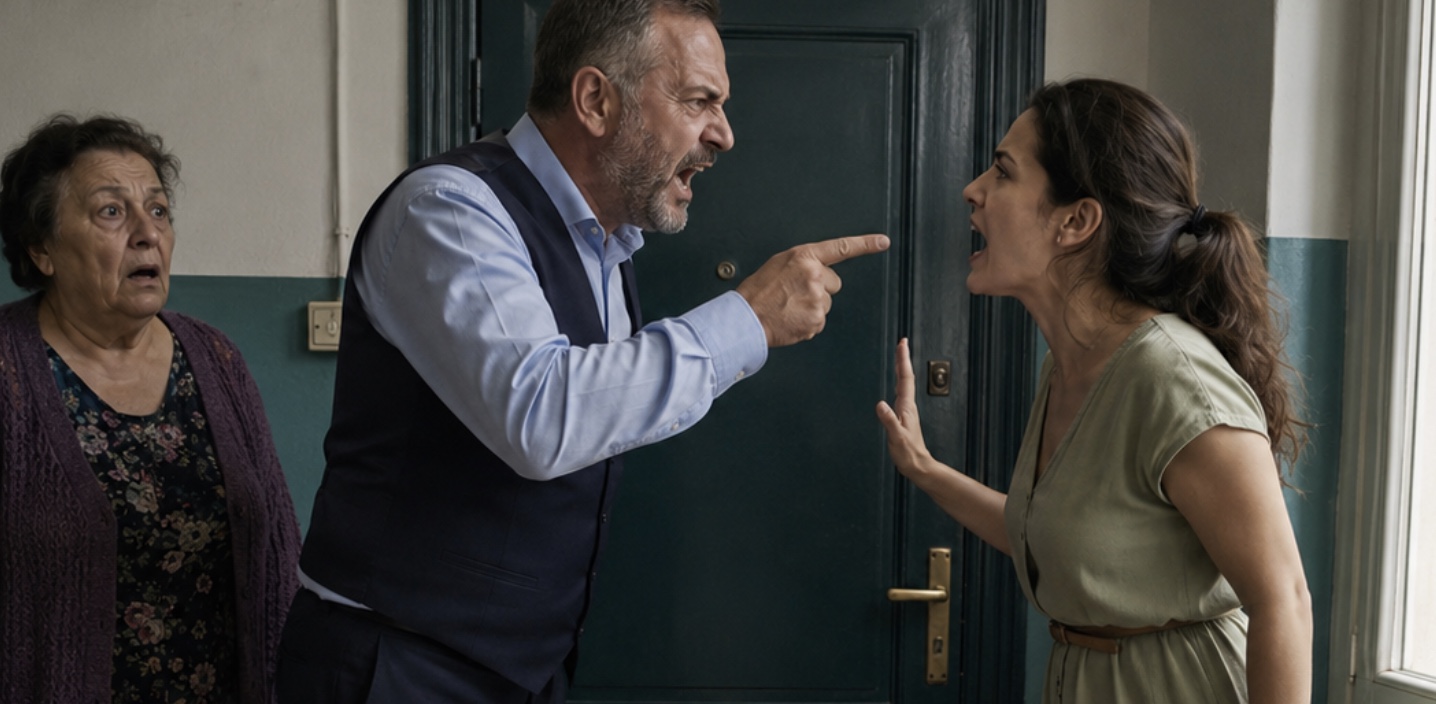
— Either my mother moves in here and gets registered in this apartment, or we get divorced.
Artyom said it evenly, as though he were reading out the weekend weather forecast.
Marina stood by the stove with the kettle in her hand. The water had boiled a minute earlier. She set the kettle down, turned off the gas, and wiped her hands on a towel.
“Did you hear what I said?”
“I heard you.”
“And what do you have to say?”
“I’ll say the tea is ready. Sit down before it gets cold.”
He sat. His spoon tapped the rim of the cup three times.
For twelve years, Marina had known that sound. It was how Artyom put a full stop at the end of conversations he believed he had already won.
 
Marina sat across from him and pushed the sugar bowl closer.
She was forty-one. She worked at a furniture showroom on Gagarin Street, dealing with orders, discounts, and dissatisfied customers every Friday.
Artyom was forty-four. A site supervisor, always clean-shaven, always wearing white shirts.
Their two-room apartment on Morozov Street was sixty-two square meters. They had finished paying off the mortgage in March. It belonged to both of them, honestly acquired during the marriage, with renovations they had done together.
But Marina also owned a small one-bedroom apartment of her own.
Thirty-four square meters on Polevaya Street, inherited from her grandmother Zoya and registered in Marina’s name four years before the wedding.
For the past nine years, Lida and Sergei had rented it. Quiet tenants with a ginger cat who paid twenty-two thousand on the first of every month.
Artyom called the place “the hole.”
“Who even needs your hole on Polevaya? The entrance looks like a student dormitory.”
He said that every time money came up.
Marina simply saved the rental income in a separate account her husband had no access to. Over nine years, she had put away three hundred and forty thousand.
Artyom took a sip of tea.
“Mom is alone in Zarechny. The house is cold, the doctors are far away, and the bus only comes twice a day. You understand that.”
“I do.”
“Then it’s settled. We’ll move her in and register her here in October.”
“It isn’t settled. In fact, this is the first time in twelve years the subject has even been opened.”
The spoon stopped moving inside the cup.
 
“What are you talking about?”
“I’m talking about the fact that you didn’t ask me. You announced a decision.”
“What is there to ask? She’s my mother.”
“And this is my life. You can’t divide one life between two people without asking.”
He looked at her with that tired, patronizing expression he usually reserved for incompetent employees.
“Marina, don’t start a scene. You’re forty-one. Where exactly are you going to go?”
There it was.
He was certain she was afraid of being alone.
That night, Marina lay awake listening to water running through the pipes from the apartment upstairs.
She didn’t count insults.
She counted numbers.
The next morning, Wednesday, she called Lida.
“Lidochka, our lease runs until September thirtieth. Are we renewing?”
Lida hesitated.
“Marina Sergeyevna, we were actually going to call you. Sergei got a position in Tver. We’re moving. We’ll return the keys on the thirtieth and clean everything before we leave. And the cat hasn’t damaged the carpet.”
Marina stood in the showroom’s back room with the phone to her ear, staring through the glass display.
“All right. I’ll expect you on the thirtieth.”
She didn’t say a word to her husband about the call.
 
On Saturday, Valentina Petrovna arrived.
She was sixty-eight, wearing a plum-colored knitted vest. Two checked travel bags stood in the hallway.
“I just came to have a look,” she announced from the doorway. “Artyomushka said we’re going to sort everything out.”
She walked into the bedroom without even removing her shoes and stopped in the middle of the room.
“This is where I’ll stay. The bed can go by the window, the chest of drawers here. You can take that wardrobe out. It’s old anyway.”
“Valentina Petrovna, this is our bedroom.”
“You two are still young. You’ll be perfectly fine in the living room. Just unfold the sofa. It’s no great hardship.”
Marina looked at her mother-in-law.
Then at her husband, who stood silently in the doorway.
“Artyom, are you hearing this?”
“Mom’s right. The living room is bigger.”
“So we’re supposed to sleep in a walk-through room with the television and the balcony?”
“You’ll put up with it for a month. Then you’ll get used to it.”
Valentina Petrovna was already opening the wardrobe and running a finger along the shelves.
“These shelves are good. I’ll put my things here.”
 
She left the checked bags in the hallway when she went home.
She said they should stay there “so the space would already be claimed.”
That evening Marina called her son.
Kirill was nineteen, a second-year student living in a dormitory in the regional capital.
“Mom, just don’t get worked up,” he said. “Grandma already texted me. She asked if I’d give her my room.”
“You don’t have a room here anymore, son. You moved out.”
“That’s exactly what I told her. Mom… are you and Dad really getting divorced?”
“For now, we’re talking.”
“Dad says you’ll calm down.”
“He says that often.”
On Friday, Artyom put a folded sheet of paper on the kitchen table.
“Sign this. Consent from the property owner for registration.”
Property owner?
The apartment belonged to both of them. That meant her consent was legally required. It wasn’t some meaningless formality.
“Go on,” he said. “Sign your half of the formality.”
Marina picked up the paper.
She read it from the first line to the last, slowly, the same way she read supplier contracts at work.
“No.”
“What do you mean, no?”
“I mean I’m not signing it.”
He breathed out sharply through his nose.
 
“Then I’m filing for divorce. Live however you want.”
“All right.”
“What do you mean, all right?”
“You heard my answer. All right.”
He expected tears.
He always expected tears, because there had been tears before.
On Monday, Marina took two hours off work and went first to the bank, then to the public services center.
Her folder was old and blue, held closed with an elastic band.
Inside were the documents for the apartment on Polevaya Street, the rental agreement with Lida, nine years of payment receipts, and confirmation that the property had belonged to Marina before the marriage.
She ordered a new property extract.
Then she sat on a bench in the corridor holding the paper longer than necessary.
Thirty-four square meters.
One owner.
Her.
At lunch, she told Oksana.
Oksana was forty-three, a cashier from the neighboring department and four years past her own divorce.
She turned her coffee cup slowly between her hands.
“Marish, are you sure? The old woman might live with you for a year or two. People put up with things.”
“People put up with things. Then later everyone asks why they’ve become so quiet.”
“And if he really files for divorce?”
“Then let him.”
“And you’ll end up alone in thirty-four square meters?”
 
“Alone in my own thirty-four square meters. Or three people squeezed into someone else’s sixty-two, where they tell me where I’m allowed to sleep.”
Oksana was silent for a moment.
“You know what’s worst? My ex was also certain I’d be too scared to leave.”
Saturday the twenty-sixth was family dinner.
Nina, Artyom’s sister, came with her husband and a pie.
Valentina Petrovna sat at the head of the table as though she were hosting her own birthday celebration.
Nina cut the pie.
“So, Marinochka, have you decided which room Mom will have? She’s already picked out her curtains.”
“She can keep the curtains. There won’t be a room.”
Silence fell over the table.
Artyom put down his glass.
His mother drew out the words slowly.
“Our Marinochka is very proud. But you can’t spread pride on bread. Artyomushka feeds her, dresses her…”
“Valentina Petrovna, I’ve worked at the showroom for twelve years. I earn my own salary, and I paid half the mortgage myself.”
Nina interrupted, not very confidently.
“Mom, don’t.”
Valentina Petrovna turned toward her son.
“What do you mean, don’t? Artyom, are you the man of your own house or not? Tell her.”
Artyom stayed silent for about five seconds.
 
Then, looking down at his plate, he said quietly,
“I’ve already told her. Either Mom lives here or we divorce. That’s all there is to it.”
He had repeated his ultimatum in front of witnesses, in front of his sister and his mother, and apparently thought that made him strong.
Marina stood up, took her plate to the kitchen, and washed it under a thin stream of running water until it squeaked beneath her fingers.
From the other room Nina spoke loudly enough for everyone to hear.
“Tyoma, why are you doing this? Make up with her.”
“Stay out of it. She’ll come running back in a week.”
Marina dried her hands and returned for her handbag.
“Thank you for the pie, Nina. It really is delicious.”
On September thirtieth, Lida returned the keys.
The apartment on Polevaya smelled faintly of someone else’s laundry detergent, but the floor had been washed and an abandoned potted plant stood on the windowsill.
Marina walked slowly around the room.
She opened the window.
Then she sat on a stool and stayed there for about twenty minutes.
The silence wasn’t frightening.
 
It was simply silence.
October first was a Thursday.
Artyom came home from work at seven and found a suitcase standing in the hallway.
“What is this?”
“You gave me a choice. I’m choosing the second option.”
“What second option?”
“Divorce. The first option was your mother taking over our bedroom.”
He laughed.
It was short and uneven.
“Are you serious? And where exactly do you think you’re going?”
“To Polevaya. The tenants moved out yesterday.”
That was when he truly went quiet.
“Wait. You knew this whole time that the apartment was becoming available?”
“I’ve known since September ninth. You were busy discussing curtains.”
“So you’ve been planning this?”
“I wasn’t planning anything. I simply had somewhere to go. There’s a big difference.”
He stepped toward the suitcase and grabbed its handle.
“Put it back. We’re adults. Let’s talk normally.”
“Normally would have been asking me that Tuesday instead of announcing your terms in my own kitchen.”
“My mother is old. She needs help!”
“She needs help. She does not need my bedroom or registration in my home. Those are different things, Artyom.”
“So what do you suggest? Leaving her abandoned in Zarechny?”
“I suggested hiring someone to help her twice a week and finding her a rental closer to the clinic. You said that was too expensive.”
He didn’t answer.
There was nothing to say.
Marina picked up the suitcase, put on her coat, and paused at the door.
“I’ll leave the keys on the table. File for divorce if you want. I won’t contest it.”
“You’ll come back.”
“Maybe. But not under these conditions.”
The door closed quietly behind her.
She deliberately didn’t slam it, although her hand wanted to.
October was a strange month.
 
Work in the mornings.
Paintbrushes and rollers in the evenings.
Marina painted the walls the color of warm cream. She bought a small table for two and a lamp with a soft-colored shade.
She watered the forgotten plant until it recovered and produced a new leaf.
On the first of the month, the usual twenty-two thousand in rent didn’t arrive in her account.
That was the only thing missing.
In return, no one tapped a spoon three times against the edge of a cup in the evenings.
Kirill came to visit in the middle of the month carrying a backpack and a bag of mandarins.
“Mom, it’s actually nice here. The kitchen’s small, but the window looks into the courtyard.”
“You’ll sleep on the sofa. It’s new.”
“Mom… has Dad called?”
“Fifteen times. During the first few days, he demanded that I come back immediately.”
“And you?”
“I listened. Do you know what he said more often than anything else? That I embarrassed him in front of his mother.”
“Did he ever say he was wrong?”
 
“Not once.”
Kirill peeled a mandarin in silence.
“Grandma never moved in. She stayed with Aunt Nina for two weeks and they had a fight over curtains.”
“Curtains?”
“Nina said that in her home, she decides which curtains get hung.”
Marina didn’t smile.
She simply poured her son some tea and pushed the sugar bowl toward him.
At the showroom, people talked about Marina quietly, although Oksana did most of the talking aloud.
“The girls keep asking whether you regret it.”
“Let them ask.”
“But do you?”
“I regret only one thing. That it took me twelve years to learn how to give a short answer.”
During the last week of October, Artyom changed his approach.
First he sent photographs of the empty refrigerator.
Then he wrote that he had found Marina’s winter boots in the wardrobe.
“Take your things. They’re in the way.”
Marina replied an hour later.
“Put them in a box. Kirill will collect them this weekend.”
There was no response until evening.
Then came a short message.
“Have you really decided to throw everything away?”
She stared at the screen for a long time.
Twelve years couldn’t be erased by a single suitcase.
 
They remained in the paid-off mortgage, the old photographs, the habit she still had of reaching for his favorite tea at the grocery store.
Marina typed:
“No. I’ve decided not to live under threat.”
The phone rang immediately.
“What threat? I said it in the heat of the moment.”
“You repeated it in front of your mother and Nina. You don’t say something twice in the heat of the moment.”
“And how long are you going to punish me?”
“I’m not punishing you. I’m living in my own apartment.”
“Then come home and live normally.”
“Normally for whom, Artyom?”
He hung up.
Ten minutes later he called again, but Marina didn’t answer.
The next day, she went to see a lawyer.
The office was above a pharmacy, between a phone repair shop and a small bakery.
The lawyer’s name was Irina Lvovna.
She listened to Marina, examined the blue folder, and looked through the new property extract.
“The one-bedroom apartment is your premarital property. Your husband has no claim to it. The jointly owned apartment is a separate issue that would have to be settled during divorce proceedings. Do you want me to begin preparing documents?”
“For now, I just want to know that nobody can take my apartment away from me.”
“They can’t. And he cannot register his mother in the jointly owned apartment without your consent either.”
Marina nodded.
She had already known that, but hearing the answer calmly from a professional mattered.
“Tell me something. What if I go back?”
 
Irina Lvovna closed the folder.
“That is no longer a legal question. Just don’t give anyone the original documents, and don’t sign anything you haven’t read carefully.”
“He thinks having a separate apartment destroys trust.”
“Walls don’t destroy trust. Usually, trust is destroyed when one person makes decisions for another.”
Marina remembered that sentence.
Not as advice, but because it gave an exact name to what had happened in the kitchen.
That evening Kirill went to collect the boxes.
Artyom didn’t open the door right away.
Later, Kirill told his mother that his father had been sitting at the kitchen table with two cups in front of him.
One contained tea.
The other was empty.
“He asked whether you were turning me against him,” Kirill said.
“What did you tell him?”
“That I’m nineteen and it’s a little late to start programming me. I also told him the whole family heard his ultimatum.”
“You shouldn’t have gotten involved.”
“Mom, was it okay for him to drag me into it by asking about Grandma taking my room?”
Marina didn’t answer immediately.
Her son was right, although she had wanted to keep him out of the conflict.
“Where is Grandma now?”
“At Aunt Nina’s. But they’ve already fought. Grandma decided to move the wardrobe and hired a handyman without asking.”
“What did Nina say?”
 
“She said that in her home, she decides where the furniture goes. Funny, isn’t it?”
It wasn’t funny.
In just two weeks, Valentina Petrovna had heard from her own daughter the same words she had refused to accept from her daughter-in-law for years.
Two days later, Nina called Marina herself.
“Marin, I used to think you were exaggerating. Mom is a good person, but living with her is impossible. She already told the neighbor the apartment is practically hers.”
“Artyom wanted me to get used to it.”
“I told him he should try it himself first. He got offended.”
“Nina, I don’t want you and your mother fighting because of me.”
“We’re not fighting because of you. We’re arguing openly for the first time. Maybe that’s actually healthy.”
Nina found a one-bedroom apartment for her mother near the clinic.
They agreed to split the rent, with Artyom paying the larger share.
The exact solution Marina had suggested back in September had suddenly become perfectly reasonable.
Valentina Petrovna didn’t agree immediately.
Then she saw the elevator, the pharmacy in the courtyard, and the bench outside the building.
The checked bags moved there.
She chose the curtains herself.
Marina learned about it from Kirill.
 
Artyom didn’t tell her.
Perhaps it was difficult for him to admit that a solution had been found without taking someone else’s bedroom or forcing a registration through.
Still, in early November, he came to see her himself.
On Monday, November second, Artyom arrived at the apartment on Polevaya.
Marina saw him through the peephole: a white shirt beneath his jacket, a bag in his hand.
She opened the door.
“Can I come in?”
“Take your shoes off. I have light-colored floors.”
He did.
That was the first surprise.
Artyom walked into the kitchen, put the bag on the table, and looked at the warm cream-colored walls.
“You painted.”
“I did.”
“Mari, I never filed for divorce.”
“I know. I would have been notified.”
He sat on the stool because there wasn’t a second chair at the table.
“The apartment feels empty. I’ve been eating at the café near the construction site for a month. I send my shirts to the cleaners.”
“What exactly are you trying to say?”
“That I was wrong.”
 
“About what?”
He rubbed his forehead.
It was difficult for him to say it, and Marina could see that.
“I shouldn’t have put the question that way.”
“How should you have put it?”
“We should have discussed it.”
“We’re discussing it now. Where is your mother going to live?”
“Nina found her a one-bedroom place near the clinic. We’re splitting the rent. I pay more. Mom complains, but there’s an elevator and a pharmacy in the courtyard.”
Marina nodded.
It was exactly what she had suggested in September, when he had said it was too expensive.
Artyom looked at her.
“Come home. The apartment is yours too. You paid the mortgage. Everything can go back to how it was.”
“I don’t want it to go back to how it was.”
“Then what do you want?”
“I’m not renting this apartment out anymore. It stays empty when I’m not here, and it stays available for me.”
“Why do you need an empty apartment?”
“So that I always have somewhere to go. You’ve already seen why that matters.”
He stared at the table for a long time.
“So that’s your condition?”
“It isn’t a condition. It’s one of the few things in my life that belongs only to me.”
“And if I tell you that hurts me?”
“It hurts you that your wife isn’t helpless? If that’s the problem, then we really have nothing to discuss.”
Artyom took a jar of apricot jam out of the bag.
His mother had made it.
“Mom sent this. She said you were polite to her and she wasn’t polite to you.”
“She actually said that?”
“Almost. She said, ‘Give her the jam.’”
Marina took the jar and placed it on the shelf.
There was room for it immediately.
 
“Come on Saturday. We’ll talk again.”
“And the keys?”
“There is only one set of keys to this door. Mine. For now, that’s how it stays.”
He left at nine.
Marina washed two cups, hers and his, and placed them side by side on the drying rack.
Then she sat by the window and watched boys kicking a ball beneath the streetlamp in the courtyard.
A week later, Artyom came back carrying a cordless drill and mounted a shelf for her in the hallway.
He worked silently, carefully, checking everything with a level.
Before leaving, he asked whether she needed new light bulbs.
 
The suitcase was still standing in the storage closet, not completely unpacked.
Marina hadn’t made any final decision.
Sometimes she brewed enough coffee for two cups, because occasionally the second cup was needed.
And she wasn’t rushing.
Still, one question remained.
It was the one question she hadn’t asked Oksana or her son.
When a woman answers an ultimatum by quietly packing a suitcase and moving into the apartment she owned before marriage, is she saving her family—or delivering the final blow?
And where exactly is the line between self-respect and pride?
At what point does saying, “I will not give up my bedroom,” stop being dignity and become ordinary stubbornness—the kind that eventually leaves two people drinking tea in two different apartments?