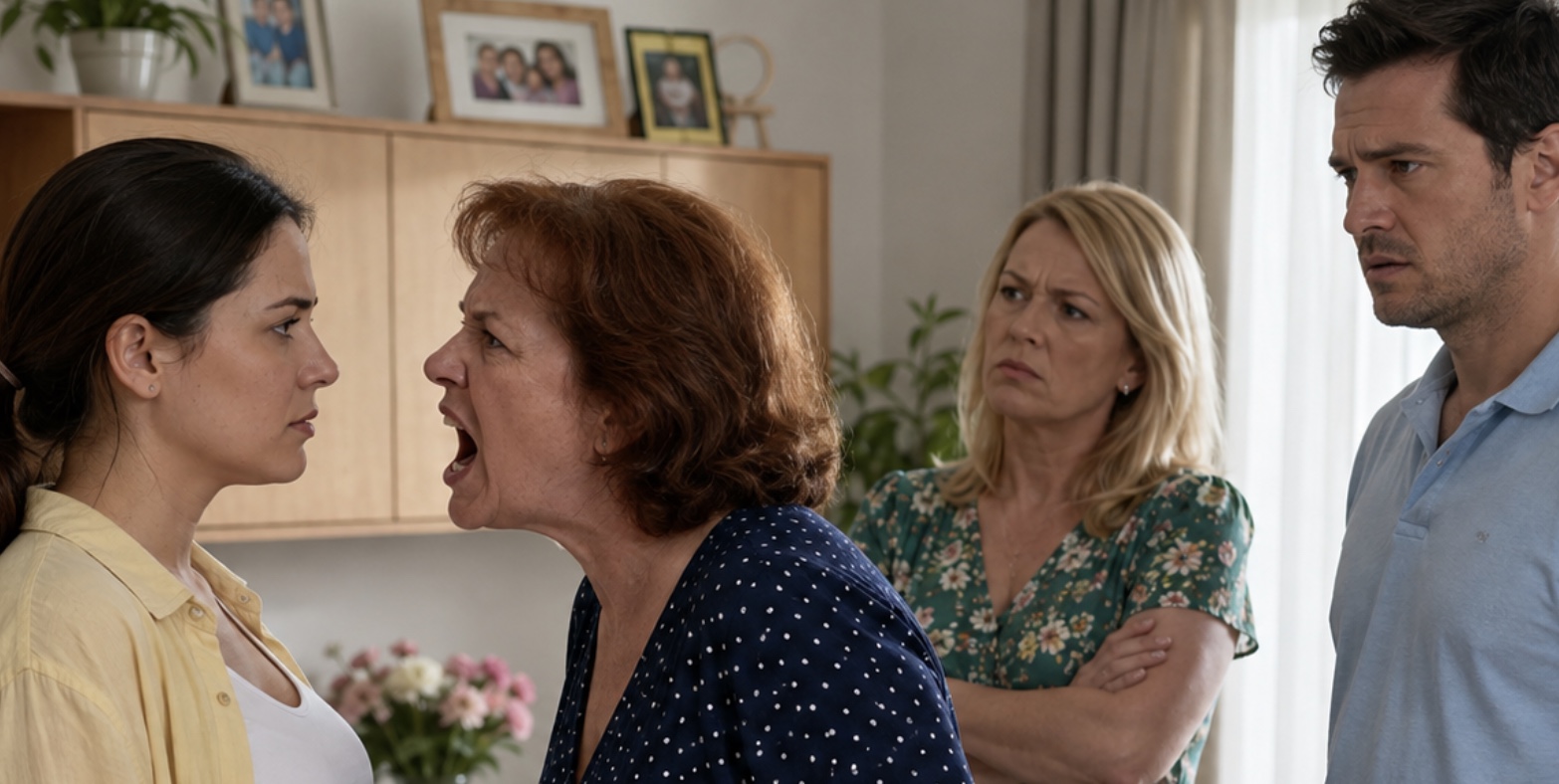
“Pasha, I barely recognize you anymore. Are you actually a man, or are you just here for decoration?”
Elena Mikhailovna said it almost calmly, and somehow that calmness was more frightening than if she had shouted. She sat at the kitchen table with her arms folded across her chest, looking at her son the way a strict teacher might look at a careless student who had once again failed to learn his lesson.
Pavel said nothing. He turned his tea mug nervously between his hands and stared down at the table.
Olga woke because of the voices.
At first, she could not tell whether she had really heard them or whether they were part of a dream. Her head was still throbbing with that dull, unpleasant pressure that had been bothering her for three days. The seventh month of pregnancy was making itself known in all sorts of ways, and migraines were probably among the least troubling surprises.
She had taken a pill, wrapped herself in a blanket, and fallen asleep sometime after lunch. September light filtered weakly through the curtains, soft and gray, almost gentle enough not to irritate her eyes.
Then she noticed the open vent window.
 
That explained why she could hear everything so clearly.
In old apartment buildings, sounds seemed to have lives of their own. They traveled along pipes, slipped through walls, and drifted down from ceilings. Olga had learned that during the three years they had lived there. But now the voices from the kitchen sounded unusually sharp, as though someone had lowered the volume of the entire world and turned theirs up.
At first she could not make out the words.
She lay quietly in the half-darkness, blinking sleep away, slowly piecing fragments into sentences.
“…that’s exactly what I’m saying, Pasha. Alyona needs a proper place to live. Her boy is getting older. He’ll be starting school in two years…”
Alyona.
So Pavel’s sister had come over.
Olga had not even heard the doorbell.
She carefully rolled onto her side. Her stomach no longer allowed quick movements and she listened more closely.
Alyona had been born eight years after Pavel, and that explained quite a lot. Their mother had devoted herself to the younger daughter as though trying to make up for something she believed she had failed to give her first child.
Alyona grew up convinced that the entire world revolved around her difficulties.
And, to be fair, no one around her had ever seriously tried to convince her otherwise.
She married at twenty-two, had a son at twenty-three, and divorced at twenty-four. Every one of those events had been presented as a personal tragedy on a universal scale rather than simply the complicated life of an ordinary person.
Now she was twenty-five.
She lived with her mother in a one-room apartment, occasionally worked as a sales assistant in a flower shop, and spent most of the rest of her time discussing how unfair life had been to her.
“Mom, Olga will never agree,” Pavel said.
His voice sounded weak. Almost childish.
“The money for the apartment came from her parents. You know that.”
 
“Pasha.”
Elena Mikhailovna spoke with the patient tone of someone explaining something obvious to a fool.
“Three years have passed. It’s your shared home now. Your family apartment. And Alyona is your family too. Or have you forgotten that?”
Olga stopped breathing.
She had always known her mother-in-law did not particularly like her.
Olga was too independent.
Too opinionated.
Too different from them.
But she had never imagined it could go this far.
“I’m suggesting a perfectly reasonable solution,” Elena Mikhailovna continued, softer now, almost warmly.
Olga knew that voice.
 
It was the voice her mother-in-law used whenever she wanted to appear thoughtful and sensible.
“You two move in with me for a while. Yes, my apartment is small, but we’ll manage. I can help with the baby. You’ll be on maternity leave anyway, and it will be difficult for Olga alone. Alyona can move into your two-bedroom apartment with Misha. They’ll finally have enough space.”
“And the mortgage?” Pavel asked quietly.
“You’ll figure it out. You have a job.”
That was all.
You’ll figure it out.
So simple. So casual.
Olga slowly sat up in bed.
Even that small movement took effort. The baby seemed to be pressing against every organ at once, her back hurt, and the headache had not disappeared.
Still, she sat upright and listened.
“Pash… I mean, you understand how hard things are for me,” Alyona began.
She had a special voice for moments like these, fragile and slightly broken, with carefully placed pauses.
With that voice, she could get almost anything she wanted.
“Misha is going crazy in that tiny apartment. He needs room to run. Fresh air. And your neighborhood is so nice. There’s a good school nearby…”
“Alyona, he isn’t even in kindergarten yet.”
“Pasha!”
Elena Mikhailovna raised her voice just enough to make it sound final.
“Your sister is asking you for help, and you’re talking about kindergarten?”
Silence followed.
A long silence.
Olga stared at the wall opposite her.
 
Behind it was the hallway.
Beyond that, the kitchen.
Her husband was sitting there believing that his pregnant wife was asleep.
“All right,” Pavel finally said.
“I’ll try to talk to her tonight.”
Three words stayed in Olga’s mind.
I’ll try to talk to her.
Not, “That’s impossible.”
Not, “Have you completely lost your minds?”
Not even, “It’s her apartment and we’re not going anywhere.”
Just: I’ll try to talk to her.
As though the subject were a vacation destination.
Or new curtains.
“Good boy,” Elena Mikhailovna said.
The satisfaction in her voice made Olga shudder.
“She’s pregnant. She’ll understand. What else is she going to do?”
Olga looked at the phone lying on her bedside table.
 
Then she opened the voice recorder.
The conversation continued for a long time.
Elena Mikhailovna began discussing the paperwork.
“For safety, perhaps it should be transferred directly into Alyona’s name. That would be more reliable.”
Alyona sighed and agreed that moving would be exhausting, but what else could she do when life had treated her so unfairly?
Pavel occasionally tried to say something, but his mother interrupted him or talked him out of it almost immediately.
It was easy for her.
Familiar.
She met almost no resistance.
Olga remained seated and listened.
She did not cry.
That surprised her.
She had expected tears, rage, perhaps trembling hands.
Instead, she felt something entirely different.
Coldness.
Clarity.
 
A strange distance from the situation, as though she were watching everything happen to someone else and simply memorizing every detail.
She stood up slowly.
She found socks, jeans, and a loose sweater with a wide neckline, one that did not make her belly feel constrained.
Her jacket hung in the wardrobe.
The keys were already in its pocket from the pharmacy trip she had taken the day before.
She left the recorder running.
Their front door opened almost silently. They had oiled the hinges during the summer when they rearranged the furniture.
Olga put on her sneakers, zipped her jacket over her stomach, and stepped into the stairwell.
She did not call the elevator.
Instead, she walked downstairs carefully, one step at a time, holding the railing.
Outside, the air smelled unmistakably of September: damp soil, fallen leaves, and faint smoke drifting from somewhere beyond the apartment blocks.
Most of the leaves had already fallen from the linden trees.
Olga stood near the entrance for a moment and lifted her face toward the sky.
 
Low.
Gray.
Autumn.
Then she took out her phone, stopped the recording, and began walking.
She did not even know where she was going.
She just kept moving down the sidewalk, slowly, hands in her pockets, her pregnant belly leading the way.
Her mind was strangely quiet.
Her phone vibrated.
A message from Pavel.
“Are you still asleep? Mom and I are having tea. Don’t worry.”
Olga stopped beside a bench and sat down.
She read the message twice.
Then she opened the family group chat.
There were four people in it: Olga, Pavel, Elena Mikhailovna, and Alyona.
 
She attached the audio recording.
Then she typed a short message without capital letters or punctuation, almost as though she were documenting a fact rather than starting an argument.
“Pavel, there’s no need to try talking to me. I’m changing the locks in two hours. Your things are packed and waiting by the door. You can go straight to your mother’s place.”
She sent it.
Then put the phone away.
The group chat exploded almost immediately.
Alyona replied first.
That was predictable.
“What is this supposed to mean??? Are you serious??? We were having a private family conversation!!!”
Then came Elena Mikhailovna’s message, written entirely in capital letters.
“DO YOU EVEN UNDERSTAND WHAT YOU ARE DOING TO PASHA’S FAMILY YOU ARE SELFISH”
Pavel wrote nothing.
For a while.
Olga stared at the screen and counted.
Nearly three minutes passed.
Then finally:
“Olya. Open the door. Let’s talk.”
She put the phone back into her pocket.
The locksmith arrived forty minutes later.
Olga had called him as soon as she reached a small park at the end of the street and found an empty bench. She gave him the address and asked him to come within the hour.
While she waited, she bought water and some small dry bread rings from a nearby shop. Her body still needed food regardless of family catastrophes.
She ate slowly while watching a pigeon peck methodically at something beside the curb.
An ordinary gray pigeon.
An ordinary gray day.
Her phone would not stop ringing.
Elena Mikhailovna called once.
 
Then again.
Then a third time.
Olga rejected every call.
Not out of spite.
There was simply nothing left to discuss.
Everything had already been said.
Or rather, everything had already been recorded.
Forty-two minutes of other people planning her life, her apartment, and her future.
Pavel called once.
Olga watched the screen until the call ended by itself.
Then she sent him a message.
“I’m fine. The locksmith will be here within an hour. Don’t try to force the door.”
His response appeared immediately.
 
“Olya, I didn’t know you could hear us. That matters.”
She gave a bitter smile.
That matters.
As though the problem were that she had heard the conversation rather than what he had actually said.
All right. I’ll try.
By the time Olga returned home, the locksmith was already finishing the job.
He was an older man in a blue jacket, quiet and professional.
He worked quickly, handed her two new keys, accepted the payment, and left without asking a single unnecessary question.
Olga was grateful for that.
She stepped inside the apartment, locked the door, and leaned against it.
Silence.
Her belongings.
Her home.
The familiar smell of coffee, baby cream, and a trace of paint from a shelf they had recently painted in the nursery.
Outside, the courtyard sounded exactly as it always had.
Everything was the same as that morning.
And everything was completely different.
Olga walked into the nursery.
They had been preparing the small room together for the past two months.
There was a white crib.
A mobile with wooden stars.
A neat pile of baby clothes and cloths on the shelf.
 
Olga touched one of the stars with her finger.
The mobile began to turn gently.
That was what all of this was really about.
Not winning.
Not proving a point.
This.
She wanted the child who had not yet been born to grow up in a home where important decisions were not made behind someone’s back.
Her phone vibrated again.
This time it was her own mother.
“Olya, are you all right?”
Her mother’s voice was the same one Olga remembered from childhood, the voice she heard whenever she had been sick, fallen off her bicycle, or come home with a bad grade.
Quiet.
Present.
No unnecessary questions.
“I’m fine,” Olga said.
 
Then, unexpectedly, a single sob escaped her.
Just one.
“I’m fine, Mom. Really.”
“I can come over.”
“No. I’ll manage. I just… I’ll explain everything later, okay?”
“Okay. I’m here.”
Pavel appeared outside the building at around six that evening.
Olga saw him through the video intercom screen in the hallway.
He stood near the entrance with a sports bag and two large sacks.
She really had packed his belongings carefully.
No revenge.
No broken possessions.
She had simply folded everything and put it outside.
Alyona stood beside him, gesturing energetically while saying something.
Elena Mikhailovna stood a few steps away with her lips pressed into a thin line, staring up toward the windows.
Olga could almost physically feel that stare.
Then Pavel turned toward his mother and said something.
Short.
Elena Mikhailovna jerked her head up as if she had not expected his answer.
Alyona began waving her hands even more furiously.
Pavel repeated himself.
 
This time more firmly.
Even without hearing the words, Olga could see it in his posture.
Then he took out his phone and ordered a taxi.
He showed the screen to his mother.
Elena Mikhailovna snapped something at him, turned sharply, and walked toward the gate.
Alyona hesitated, glanced at the windows, grabbed her handbag, and followed.
Olga watched silently.
Seven minutes later, a taxi drove them away.
Pavel stayed behind.
Alone.
He lowered himself onto an old wooden bench near the entrance, setting his bags beside him.
He leaned forward, shoulders hunched.
And sat there.
Olga watched him on the slightly blurry intercom monitor.
He did not call.
He did not knock.
He did not send demanding messages.
He simply sat in the September evening beneath a streetlamp that flickered once before finally staying on.
Somewhere above, a window slammed shut.
A dog barked from a ground-floor apartment.
A boy rode past on a bicycle.
Life went on with complete indifference.
Olga’s phone lit up softly.
A message from Pavel.
“I’m not leaving. I’ll stay here. Not because I have nowhere else to go. I just want you to know I’m here. You don’t have to let me in.”
She read it twice.
 
Then sat down on a stool in the hallway.
Her legs ached.
Her back hurt.
The baby kicked firmly inside her as if reminding her that he was there too.
Olga placed a hand over her stomach.
“I know,” she whispered.
“I hear you.”
On the intercom screen, Pavel raised his head and looked directly into the camera.
He could not see Olga.
Only the small black lens.
But he stared at it as though he could see straight through it.
Olga did not move.
The hardest decision of her life was not demanding an immediate answer.
It simply lay there in front of her.
Heavy.
Real.
Without dramatic speeches or easy solutions.
And she still did not know what she was going to do.
For perhaps twenty minutes, Olga remained seated on the hallway stool.
She watched the screen.
Pavel stayed where he was.
He took out his phone, turned it over in his hands, then put it away.
After a while, he stood and paced in front of the entrance.
Three steps one way.
Three steps back.
Then he sat down again.
He looked like a man who did not know what to do with his hands or his feet but knew one thing for certain.
He was not going anywhere.
Olga tried to understand what she was feeling.
Anger was still there.
Not sharp or explosive.
Quiet.
Dense.
Like sediment at the bottom of a glass.
There was hurt too.
But above everything else was exhaustion.
Not exhaustion from that one day.
Exhaustion from three years of tiny concessions she had made without arguing.
From holidays at her mother-in-law’s home where people seemed to barely notice her.
From conversations where Pavel ended every conflict with, “Mom, come on,” and believed that was enough.
From always feeling slightly out of place in his family.
The outsider.
The strange girl who had somehow taken their Pasha away.
She went into the kitchen and poured herself some water.
Outside, night had finally settled over the courtyard.
Streetlights glowed steadily.
Wet leaves lay dark against the pavement.
Her phone lit again.
This time it was not Elena Mikhailovna.
Not Alyona.
 
It was Katya, a friend she had known since university.
Katya had an uncanny ability to sense when something was wrong.
“Olya, is everything okay? You’ve been strangely quiet today.”
Olga smiled.
For the first time all day.
“It’s a very long story. Tomorrow?”
“Call anytime.”
Three simple messages.
And somehow breathing became a little easier.
At seven-thirty, Pavel rang the intercom.
Olga was standing at the stove warming soup. The baby was apparently hungry and was making his opinion known rather insistently.
She heard the signal, wiped her hands, and walked to the panel.
“Olya.”
His voice was quiet.
There was none of his usual softness in it.
Only exhaustion.
“I’m not asking you to open the door. I just want to tell you one thing. Can I?”
Olga pressed the communication button.
She said nothing.
“I sat out here today and thought about everything. For a long time.”
He paused.
“I finally understood what I actually did wrong. Not what they suggested. What I said. That ‘all right.’ That’s the part I have no excuse for.”
Olga remained silent.
“I’m not going to say Mom confused me. I’m not going to pretend I didn’t have time to think. I understood perfectly well what was happening.”
His voice became rougher.
“I’m just used to agreeing because it’s easier than arguing with her. I’ve done it my whole life.”
Another pause.
“But before, I was agreeing about things that concerned me. Today I agreed on your behalf. And on our baby’s behalf. I had no right to do that.”
Olga closed her eyes.
These were the words she had wanted to hear.
And at the same time, she had been afraid of hearing them.
Because it was easier to remain angry at someone who refused to understand.
It was much harder when that person finally said the right thing.
“I’m not asking you for anything tonight,” Pavel continued.
“If you want me to leave, I will. I’ll find somewhere to stay. I just wanted you to hear this from my voice, not in a text message.”
Silence stretched between them.
 
“Stay there,” Olga finally said.
“I’m coming down.”
She unlocked the entrance and stepped outside.
Pavel was standing beside the bench with the bags at his feet.
When he saw her, something changed in his face.
Not dramatically.
Not theatrically.
Something simply broke.
He took one step toward her and then stopped, unsure whether he was allowed to come closer.
Olga looked at him.
Then at the bags.
Then at his hands, hanging awkwardly at his sides.
“What did your mother say when you sent them away?”
“A lot.”
He smiled without humor.
“That I betrayed her. That I chose an outsider over my own blood. That I’ll regret it someday.”
“And what did you say?”
“I told her that if she ever tries to decide what happens to your apartment again, then as far as I’m concerned, she has no place in my family.”
He paused.
“She didn’t believe me. She thinks I’m just emotional.”
“And are you?”
Pavel looked directly into Olga’s eyes.
“No.”
Olga crossed her arms over her chest.
It was what she always did when she was thinking and did not want anyone to notice.
“Pasha, I can’t just open the door and pretend none of this happened. You understand that?”
“I do.”
“I heard every word. Including your ‘all right.’”
“I know.”
 
“I need time. I don’t know if that means a week or a month or something else.”
Her voice remained even.
“And I need to know that when she calls tomorrow, because she will call tomorrow, you’re not going to start hesitating again and trying to find a compromise where there isn’t one.”
Pavel was quiet for several seconds.
“Today I gave my mother back the keys to her apartment,” he said.
“My copy. I told her I’ll call her myself when I want to talk.”
Olga raised her eyebrows slightly.
“It was the first time in thirty-three years,” he added quietly.
“If I’m being completely truthful.”
Olga let him come inside.
Not because she had forgiven him.
Forgiveness was too slow and too complicated to happen on the doorstep during a September evening.
She let him in because she saw something different.
He was not making excuses.
He was not bargaining.
He was not trying to make her feel sorry for him.
He was simply standing there, carrying his own bags and accepting the consequences.
For the moment, that was enough for her to say:
“Come in.”
Pavel carried his things into the hallway and did not go any farther.
He did not try to hug her.
 
He did not start another conversation.
He simply asked whether she had eaten.
When she told him she had been warming soup, he went into the kitchen and finished what was left.
Quietly.
Carefully.
Then washed his plate.
Olga sat in the living room and listened to the familiar sounds coming from the kitchen.
Small, ordinary household noises.
The baby had stopped moving and gone quiet too, as if even he had become exhausted by the day.
Before going to bed, Olga walked into the nursery.
She touched the mobile.
The wooden stars began turning once more.
Slowly.
Gently.
She watched them and thought about everything that still lay ahead.
There would be difficult conversations.
There would be calls from Elena Mikhailovna.
There would be moments when Pavel would have to choose again.
And Olga did not know what he would choose.
No one could know such things in advance.
But today he had returned the keys.
On his own.
It was not a victory.
It was not a happy ending.
It was simply a full stop.
And after a full stop, something new could begin.
What that new thing would become, only time could tell.
Olga turned off the nursery light and went to bed.
September rustled outside the window.
Anton was born in November.
Healthy.
Strong-lunged.
With a thick layer of dark hair and an incredibly serious expression that made him look surprisingly like his mother.
Olga lay in the hospital room with him in her arms and thought that this was the reason everything had happened.
Not because she wanted to be right.
Not because she wanted to win an argument.
Because of this warm little bundle breathing against her shoulder.
 
Pavel arrived carrying far too many flowers.
He looked as though he had rushed into the shop and bought whatever he could grab.
Chrysanthemums.
Gerberas.
Branches decorated with little berries.
He placed them beside the window, sat near Olga, and stared at his son for a long time without speaking.
Then he leaned slightly closer and said softly:
“Hello, Anton. I’m your father. I’ll try not to let you down.”
Olga did not answer.
She simply placed her hand over his.
Elena Mikhailovna called one week after Olga and the baby returned home.
Her voice sounded different.
No commanding tone.
No certainty that she had the right to decide everything.
She sounded cautious.
Almost unfamiliar.
She asked whether she could come and see her grandson.
Olga thought for a moment.
Then said yes.
Saturday.
One hour.
Her mother-in-law arrived carrying a pie.
She was quieter than Olga had ever seen her.
She held Anton in her arms and looked at his face.
No advice.
No criticism.
No instructions.
She simply sat there and watched him.
 
When she was leaving, she stopped in the doorway and turned around.
“Olya,” she said.
Nothing more.
Olga nodded.
That was enough.
Alyona stayed in the one-room apartment with her mother.
Six months later, she finally found a steady job at a travel agency.
Apparently, she liked it.
She called occasionally and spoke carefully, without the old tone of someone eternally wronged by life.
Life, as it turned out, could be surprisingly effective at curing childishness.
Especially once there was no longer someone nearby willing to solve every problem for you.
Pavel changed too.
Slowly.
There were no dramatic transformations or grand gestures.
Then one day Olga realized that he had learned how to say one simple word.
“No.”
He did not shout it.
He did not argue.
But he said it firmly.
To his mother.
To his sister.
To circumstances.
That turned out to matter far more than any promise he could have made.
Anton grew.
The wooden stars above his crib continued to turn.
And that was enough.