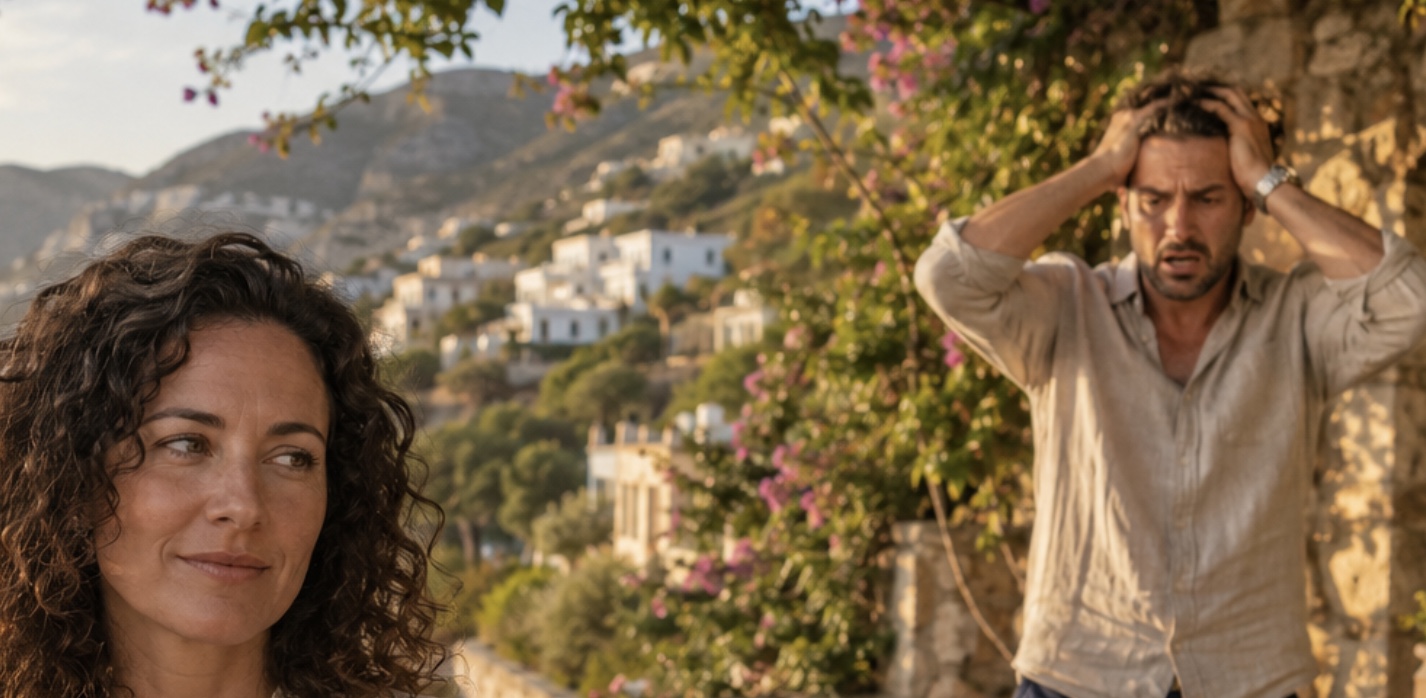
“We’re all coming to spend our vacation by the sea at your place,” my husband’s ex-wife announced cheerfully and with complete confidence through the phone speaker. “Be ready for us on the fifteenth!”
The call came on one of those perfect Saturday mornings when absolutely nothing seemed capable of ruining the day.
Pasha and I were sitting on the veranda of our house in Sukko. The air smelled of juniper, freshly brewed coffee, and a faint salty breeze drifting in from the coast.
My husband was preparing skewers and marinating meat for the barbecue we planned to have that evening. So when his phone rang, he absentmindedly tapped the screen with a spice-covered finger and accidentally put the call on speaker.
The name “Rita” appeared on the display.
I froze with my coffee cup halfway to my lips.
 
Pasha’s back immediately stiffened.
Even our golden retriever, Boatswain, who had been sleeping peacefully beneath the shade of the grapevine, opened one eye.
Rita never called just to ask how things were going.
Whenever she contacted Pasha, it usually meant one of two things: she needed money, or she had another “major emergency” that, in her opinion, only her former husband was capable of solving.
“Rita, hold on,” Pasha said, wiping his hands on a paper towel.
That familiar apologetic note had already crept into his voice—the tone of a divorced father who constantly felt as though he owed everyone something.
I hated that tone.
 
“What do you mean, all of you?” he asked. “And where exactly are you coming?”
“What do you mean, where?” Rita laughed brightly. “To you! Down south!”
She sounded as though we were close friends who had spent the entire year eagerly waiting for her arrival.
“Pavlusha, honestly, why are you being slow? We decided to save money on accommodation this year. Why should we pay strangers for a hotel when my ex-husband owns a house by the sea? Besides, the children need sea air and iodine.”
“The children?” Pasha repeated, completely confused now.
I had an excellent relationship with his two children from his first marriage—thirteen-year-old Denis and ten-year-old Masha.
They had stayed with us for almost an entire month the previous summer.
We had gone to Utrish together, roasted marshmallows over a fire, I taught Masha how to make friendship bracelets, and Pasha and Denis disappeared on fishing trips for hours at a time.
The children were never the problem.
They were always welcome.
But the way Rita had said “all of us” made a cold feeling crawl down my spine.
“Yes, the children,” she continued happily. “Actually, write this down so you can organize the bedrooms properly. There’ll be me, my Igor, our little Vovochka—he absolutely needs the sea for medical reasons, you know. And we’re bringing Svetlana Yuryevna, Igor’s mother. Someone has to watch Vovochka while Igor and I swim and relax.”
She paused briefly, then added:
“Denis and Masha too, obviously. Oh, and we’ll bring Mickey, our Spitz. He sleeps in his carrier, so he won’t bother anyone.”
Very slowly, I placed my cup on the wooden table.
The coffee suddenly tasted unbearably bitter.
 
So let me make sure I understood correctly.
My husband’s ex-wife intended to come to my house with her new husband, their baby, her new mother-in-law, their dog, and the two children she shared with Pasha.
For free.
During peak summer season.
With everything provided.
Pasha looked at me.
Pure panic filled his eyes.
He was a gentle man who hated confrontation. The kind of person who would give away the shirt off his back if it meant avoiding an argument.
That was exactly why, after their divorce, Rita had left him with a single suitcase and an old Toyota while successfully keeping their three-bedroom apartment in central Samara.
Seven years earlier, I had watched Pasha rebuild himself from almost nothing.
When we met, he was exhausted, emotionally crushed, and convinced his life was basically over.
Our meeting had been painfully ordinary—we worked in the same office and started talking near the water cooler.
Then came long conversations after work, hesitant dates, and eventually something serious.
 
I fell in love with his kindness, his honesty, and especially the warmth in his voice whenever he talked about his children.
We married three years later.
Around the same time, we decided to completely change our lives.
My grandmother had left me a nice two-room apartment in Yekaterinburg. I sold it, added every bit of savings I had accumulated over years of working as a financial analyst, and we bought a plot of land with a badly neglected little house in Sukko, not far from Anapa.
That house was built with my blood, sweat, and tears.
For two years, we lived in what felt like one endless renovation.
I chose practically every nail myself.
I sanded the old ceiling beams until my palms were raw.
I argued with unreliable builders, spent nights studying estimates, and calculated again and again whether we had enough money for a proper roof or whether we would need to take out a loan.
Pasha worked just as hard.
He poured the foundation for the extension himself, installed wiring, laid tiles, and repaired everything he could with his own hands.
We had poured our hearts into those walls.
But legally and financially, the house was mine.
I had registered it in my name before Pasha and I officially married.
Not because I distrusted him, but because I had learned from my parents’ painful experience that financial security mattered.
Pasha never objected.
In fact, he had been the one who insisted on it.
“It’s your money,” he had told me. “You need to know you’re protected.”
And now Rita intended to march into the peaceful home I had worked so hard to create—with an entire collection of people who had absolutely nothing to do with me.
“Rita, listen,” Pasha began uncertainly, shifting awkwardly from one foot to the other. “As far as Denis and Masha are concerned, there’s no issue at all. We’re always happy to have them. They can stay the whole summer if they want. I’ll pay for their tickets. But everyone else…”
He hesitated.
 
“You understand this isn’t a hotel.”
“Oh, Pasha, don’t start!” Rita snapped.
The sweetness vanished from her voice instantly, replaced by a sharp metallic edge.
I knew that tone too.
The manipulation was about to begin.
“What do you mean, ‘not a hotel’? I’ve seen the photos on Masha’s phone. You have a two-story house and three guest bedrooms. There’s plenty of space! And anyway, I’m the mother of your children. I’m coming for their sake, so they can be comfortable. Or do you want them sitting in a stuffy city while you two enjoy yourselves by the sea?”
“What does that have to do with anything?” Pasha sighed heavily and rubbed the bridge of his nose. “Rita, we work. Anya is working remotely almost all day, and I’m at the auto shop from morning until night. Who exactly is supposed to take care of all of you?”
“We don’t need anyone to take care of us!” Rita scoffed. “We can manage ourselves. You can make some soup, your Anya can set the table—it’s not going to kill her. We’re practically family!”
I raised an eyebrow.
“Anyway,” Rita continued, “we’ve already bought the tickets. Our train gets into Anapa at six in the evening on the fifteenth. You’ll pick us up at the station. We’ll need two cars because there are so many of us.”
I watched Pasha’s shoulders sink.
Guilt is a powerful weapon.
And Rita knew exactly how to use it.
“I’m the mother of your children.”
“You abandoned your family.”
“You’re a terrible father.”
Never mind that she had been the one who left him for Igor.
Pasha was so afraid she would punish him through the children that he was willing to tolerate almost anything.
He turned toward me with a silent, pleading expression.
I knew exactly what he was asking without him saying a word.
Please, Anya. Maybe we can survive two weeks.
I stood up calmly, walked over to the table, wiped my hands on my kitchen apron, and picked up the phone.
“Hello, Rita,” I said in an even, perfectly controlled voice.
 
For a second, there was silence on the other end.
Clearly, she had not expected me to enter the conversation.
Normally, I never interfered when Pasha spoke to his ex-wife. I believed their past relationship was their business—as long as it did not cross into my personal boundaries.
But this time, the boundary had not merely been crossed.
Someone had driven a bulldozer straight through it.
“Oh, Anechka, hi!” Rita sang with artificial warmth. “I was just discussing our vacation with Pasha. You’ll have us, won’t you?”
“Of course, Rita,” I replied pleasantly.
Pasha’s eyes widened.
He started waving his hands at me in alarm, but I silenced him with a gesture.
“We’re always happy to welcome guests. Write this down.”
“Write what down?” Rita asked cautiously.
“The price list,” I said sweetly. “You said yourself you wanted to save money on a hotel. Staying with us will be cheaper. Family rates.”
There was silence.
“Denis and Masha stay free,” I continued. “That isn’t even a question. They’re Pasha’s children, and this house is theirs to visit whenever they want.”
I paused.
“As for the rest of your group, these are the conditions.”
The silence from the speaker became almost enjoyable.
 
“The upstairs room has a sea view and its own bathroom. You, your husband, and the baby can stay there. In August, that will be six thousand rubles per night.”
I heard Pasha inhale sharply beside me.
“Svetlana Yuryevna can have the guest bedroom downstairs. The bed is smaller, so I’ll give her a discount—four thousand per night. Meals are not included. The kitchen is shared, and everyone cleans up immediately after themselves because we don’t provide housekeeping.”
For several seconds, Rita said absolutely nothing.
Then her voice cracked.
“What… what are you talking about? What money? Pasha! Are you hearing the nonsense this lunatic is saying?”
“Pasha hears everything,” I replied calmly, not giving my husband an opportunity to speak. “But when it comes to accommodation, Pasha doesn’t make the decision.”
I let that sink in.
“You see, Rita, the house belongs to me. I bought it using the money from the apartment my grandmother left me. The property is registered in my name and was acquired before our marriage. Pasha lives here, naturally, but legally he cannot decide who moves into my property.”
Someone on the other end of the call seemed to gasp.
 
“How dare you!” Rita shrieked. “We’re family! I’m the mother of his children! Igor is going to be absolutely shocked!”
“Igor is welcome to be shocked for six thousand rubles a night,” I replied.
Pasha made a strange choking sound behind me, apparently trying not to laugh.
“Rita, you need to understand something very simple. You and your husband are strangers to me. Completely unrelated people. I am not required to finance your vacation, wash your bedding, listen to your baby cry, or host somebody else’s mother-in-law in my house.”
Her breathing became heavier.
“You planned to stay for two weeks, correct? Wonderful. Ten thousand rubles per night for both rooms means one hundred and forty thousand rubles total.”
I paused again.
“And another ten thousand deposit for the dog. Just in case it decides to chew the wallpaper.”
“You… you greedy bitch!” Rita spat. “I won’t let the children come to you at all! Ever!”
“That is your decision,” I said without raising my voice.
My calmness was clearly making her angrier than shouting ever could.
“Although depriving your own children of a seaside vacation because you don’t want to pay for your own accommodation seems like an odd choice.”
I leaned against the table.
“We’ll be happy to have Denis and Masha. Pasha will pay for their tickets. As for the rest of you, if you still want to come, send a fifty-percent deposit to my card using my phone number.”
I glanced at the clock.
“If I don’t receive the payment by tonight, I’ll give the rooms to a family from Tyumen who called yesterday.”
One last pause.
“I’ll wait for your decision. Have a lovely day, Margarita.”
Then I ended the call and placed the phone back on the table.
The courtyard went completely silent.
Only the cicadas buzzed in the oleander bushes, while somewhere in the distance the sea murmured softly.
Boatswain walked over and pressed his wet nose against my knee, as though offering his approval.
I looked at Pasha.
 
He was still standing beside the barbecue, holding a skewer and staring at me as though he had just witnessed something impossible.
His face had gone pale.
For a second, I braced myself.
Here it comes, I thought.
He’s going to tell me I went too far.
That Rita is the mother of his children.
That I embarrassed him.
That I had no right to speak to her that way.
Instead, Pasha slowly placed the skewer on the edge of the grill.
Then he walked toward me.
He took both my hands in his. His palms were warm and still smelled faintly of onions and marinade.
“Anya,” he said quietly. “Forgive me.”
I blinked.
“For what?”
 
“For being a spineless idiot.”
He lowered his forehead onto my shoulder and let out a long breath, as though he had finally put down a sack of cement he had been carrying for years.
“I stood there listening to her and knew everything she was saying was insane. I knew the whole idea was outrageously rude. And still, I couldn’t say no.”
His voice became quieter.
“I was terrified she’d take it out on me through the kids. I was actually ready to let that entire crowd into our house and ruin your whole summer just so she wouldn’t start another war.”
He squeezed my hands.
“Thank you.”
I wrapped my arms around him, feeling how hard his heart was beating.
“It’s okay, Pasha. Sometimes people need very clear directions about where they should go.”
I smiled.
“And apparently a price list is an excellent navigation system.”
That evening, we ate incredible barbecue, drank homemade wine, and watched the sun sink into the sea, painting the horizon deep red.
Rita never called back.
Naturally, no money appeared in my account either.
A week later, however, Denis called Pasha.
He said his mother had gotten into an argument with Uncle Igor because they had been forced to book rooms at some cheap boarding house near Anapa. Apparently, they couldn’t afford a decent hotel.
Then Denis asked whether he and Masha could still come stay with us in August.
Just the two of them.
We bought their tickets that same evening.
 
That experience taught me something important.
Personal boundaries do not magically appear on their own.
You have to build them the same way you build a house—stone by stone, brick by brick.
And sometimes, in order to protect your peace, your home, and the people you love, you have to be willing to look selfish in the eyes of someone who has grown accustomed to taking advantage of other people’s kindness.