At first, there was always a reasonable explanation: work. Then they started renovating the apartment, and the project dragged on far longer than expected. After that, his wife got sick. Nothing serious, but the trip had to be postponed again.
And then shame took over.
The more time passed since his last visit, the harder it became to simply pack a bag and go back. It was the kind of story thousands of families lived through without even realizing how much time they were losing.
Alexey understood all of this perfectly.
He understood it—and still kept putting off the journey.
At first, he promised himself he would visit the following month. Then he decided he would definitely go in the summer. After that, the trip was postponed for another year.
His phone calls became less frequent too. In the beginning, he called his mother every week. Then once a month. Eventually, their conversations were reduced almost entirely to birthdays and holidays.
His mother always said the same thing.
“I’m fine, sweetheart. Just take care of yourself. Don’t work yourself to death.”
Alexey believed her.
 
Or rather, he desperately wanted to believe her.
It was easier that way.
But about a year ago, he began noticing strange things. Sometimes his mother confused words, dates, and events.
At first, it seemed insignificant.
One day, she suddenly asked him:
“So when are you starting school?”
Alexey laughed.
“Mom, what school? I’m thirty-six.”
Silence followed on the other end of the line.
A few seconds later, his mother seemed to come back to herself.
“Oh, Lyosha, what nonsense I’m saying. I must be tired.”
He convinced himself it was simply her age. Sixty-eight wasn’t young. Her blood pressure fluctuated, her circulation wasn’t what it used to be. Strange lapses could happen.
But one spring day, something happened that Alexey could no longer explain away as ordinary fatigue.
He called his mother.
“Hello. Mom, hi.”
A polite, almost unfamiliar voice answered.
“Hello. I’m sorry, who is this?”
 
Alexey’s fingers suddenly went cold.
“Mom, it’s me. Lyosha.”
A long silence followed.
He even looked at the phone screen to make sure the call hadn’t disconnected.
Nearly ten seconds passed.
“Lyosha…” his mother repeated uncertainly. “Oh. Yes. Lyosha. My son. Forgive me. I must have dozed off.”
After the call, Alexey sat for a long time with the phone still in his hand.
Then he found the number of his mother’s neighbor, Aunt Raya, and called her immediately.
The woman listened to him and sighed heavily.
“Lyosha, you really should come. Tanya’s getting much worse. She forgets things. Yesterday she walked out into the road and just stood there. I asked, ‘Where are you going?’ She didn’t know. Couldn’t remember at all. I had to take her back home.”
“I’ll come,” Alexey said quickly. “This weekend.”
But that weekend, an urgent project suddenly came up at work.
The trip was delayed another week.
Then another.
Alexey called the neighbor again.
“Aunt Raya, I’ll be there soon.”
She sounded tired when she asked:
“Lyosha, what does ‘soon’ mean?”
 
He had no answer.
Then yesterday, Aunt Raya called him herself.
Her voice sounded unusual—not frightened exactly, but empty and exhausted.
“Lyosha, she doesn’t remember you at all anymore. Today she asked me whether she had ever had children. I said, ‘Tanya, you have a son. Alexey.’ She looked at me and said, ‘I don’t have any children. If I did, I would know.’”
An hour later, Alexey was already on the road.
Eight hours behind the wheel.
From the big city to the district center, then along a familiar road, and finally the last few kilometers over a broken dirt track leading toward the village.
He remembered every turn from childhood.
Every little bridge over the narrow streams.
Once, he and his father had driven this same road together in an old car when Alexey was still in school.
Later, as an adult, he came alone.
His mother always waited for him near the bus stop.
 
She always brought pies.
And she always wore a freshly washed headscarf, as if she were not simply welcoming her son home after a long drive, but greeting the most important guest at a celebration.
“My son is here!” she would shout so happily that neighbors came outside and smiled at them.
Today, no one knew he was coming.
When the family house finally appeared ahead, Alexey instinctively slowed down.
It was still standing in the same place.
But in five years, it seemed to have aged dramatically.
The porch had sagged. The lower boards had darkened. Several sections of the fence leaned crookedly, while others had fallen completely to the ground.
The little garden in front of the house was almost swallowed by weeds.
His mother used to plant asters and marigolds beneath the windows every spring.
Now tall nettles grew there instead.
Alexey stopped the car and switched off the engine.
For several seconds, he remained sitting behind the wheel.
Then he got out.
He walked toward the gate but could not bring himself to open it immediately.
He was afraid.
He had never experienced fear quite like this.
He wasn’t afraid for himself.
He was afraid of seeing what his mother had become.
Afraid of understanding just how badly he had failed to arrive in time.
Finally, he pushed open the gate.
 
He followed the overgrown path and climbed the porch steps.
The front door was unlocked.
“Mom?” Alexey called.
No answer.
He stepped inside.
The entryway smelled of dried herbs, old wood, and that unmistakable scent of a home that had been lived in for decades but had now become strangely still.
The main room was clean.
Aunt Raya had probably been coming over to tidy up.
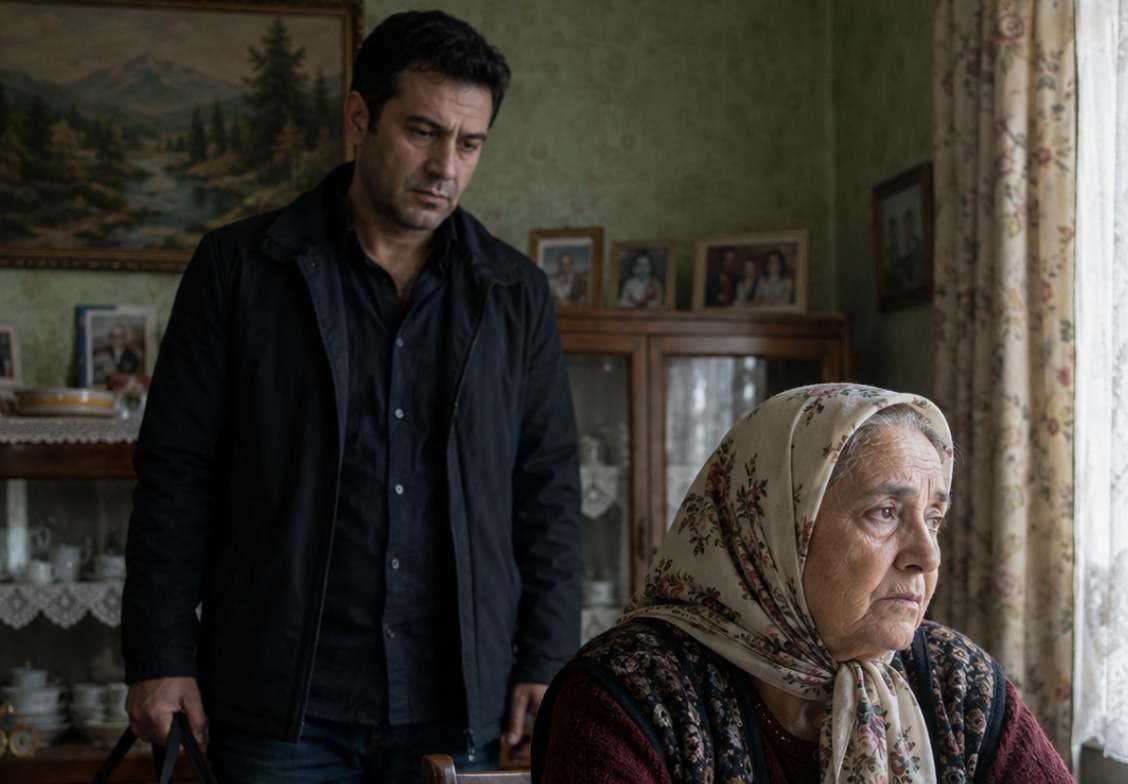
His mother was sitting on a chair by the window.
She wore an old house dress with a warm knitted cardigan over it.
Her gray hair had been carefully brushed and arranged. Again, Alexey thought of the neighbor. Clearly, she had been looking after his mother as best she could.
The elderly woman stared through the glass toward the road and quietly hummed something to herself.
Alexey stopped in the doorway.
 
For several seconds, he simply looked at her.
Then, barely managing to speak, he said:
“Mom…”
His voice trembled.
She turned her head.
And at that moment, Alexey saw her eyes.
They were still light, just like his own.
But now there seemed to be almost nothing inside them. No joy, no sadness, no irritation—only a strange emptiness, as though a light somewhere deep within her had gone out.
“Hello,” the woman said politely. “Who are you looking for?”
Alexey froze beside the door.
His mouth went completely dry.
“Mom, it’s me. Lyosha. Your son.”
She studied him more carefully.
For nearly fifteen seconds, she stared into his face as though trying to find something familiar there.
Then she slowly shook her head.
“No. I don’t have a son. You must have the wrong house.”
“Mom…”
“No, no,” she said, waving one hand dismissively, as though he were saying something absurd. “I would remember something like that. I don’t have children. Maybe you came to see Raisa? She should be here soon.”
Alexey’s legs weakened.
He lowered himself onto a stool.
“Mom,” he said quietly. “It’s me, Lyosha. You took me to school on my first day. Remember? You bought me gladiolus flowers. I broke one on the way there and got upset, and you told me, ‘It’s all right, sweetheart. Now the bouquet looks even more interesting.’”
She listened calmly.
Not a single familiar emotion crossed her face.
She might as well have been listening to a story about complete strangers.
“You’ve confused me with another woman,” she finally said. “I don’t remember any gladiolus. And I never worked at a school.”
“You didn’t work there. You took me there.”
 
The woman shook her head again.
For a moment, a faint crease appeared between her eyebrows.
Alexey thought perhaps a memory was trying to break through.
But a second later, the expression disappeared.
“I don’t have a son,” she said more firmly. “A mother couldn’t forget something like that. If I had a child, I would remember.”
That was the moment Alexey broke.
He covered his face with his hands and began to sob.
Not quietly, not secretly, not like a grown man embarrassed by his emotions.
He cried helplessly, almost like a child.
His shoulders shook. He struggled to breathe. Tears ran between his fingers.
His mother watched him anxiously.
But it wasn’t the concern of a mother watching her son suffer.
It was simple human compassion for a stranger who had suddenly fallen apart in front of her.
“Are you feeling unwell?” she asked carefully. “Would you like some water?”
Alexey lowered his hands.
 
“Mom, look at me again. Please. Look carefully. I’m Lyosha. Your Lyosha.”
She obediently studied his face.
For a long time.
At one point, something seemed to flicker in her eyes—a faint spark of recognition.
Alexey leaned forward.
But it vanished almost immediately.
“No,” she said softly. “You seem like a good man. But you’re not my son. I don’t have children. Please leave.”
“You’re asking me to go?”
“I’m not throwing anyone out. I’m just scared. A strange man comes into my house and tells me he’s my child, but I don’t remember him at all. Are you from some government office? Or the police?”
“No. I’m not from the police.”
“Then please go. I’m tired.”
She turned back toward the window.
For her, the conversation was over.
Alexey slowly stood, walked outside, and sat directly on the porch step.
For a long time, he stared at the ground.
His heart beat heavily and painfully inside his chest.
After a while, Aunt Raya appeared near the house.
When she saw Alexey, she threw up her hands.
“Lyoshenka! You finally came!”
 
“I came,” he answered hoarsely.
“Did you see your mother?”
“I did.”
Aunt Raya sat down beside him and sighed.
“She’s been like this for about six months now. Sometimes she has moments of clarity. Ten minutes, maybe fifteen. Then she remembers you. She sits there crying and says, ‘Where is my Lyosha? Why doesn’t my son visit me?’ Then something switches off again. A while later, she asks me, ‘Who is Lyosha?’ I tell her, ‘He’s your son.’ And she calmly says, ‘I don’t have a son.’ She truly believes it.”
Alexey said nothing.
“Don’t be angry with her,” the neighbor continued. “She isn’t doing it deliberately. It’s an illness. We called a doctor. He said it was dementia. Prescribed some medication, but how much can pills really change now…”
She waved one hand helplessly.
“I’m not angry with her,” Alexey said. “I’m angry with myself.”
“Who goes through life without guilt, Lyosha? Everyone has work, family, responsibilities. That’s life. What matters is that you came. There are people who don’t come even after getting a call like that.”
Alexey stayed with his mother for a week.
He slept in his old room on the sagging sofa he remembered from his teenage years.
Every morning, he came into the kitchen and found his mother sitting by the window.
She would turn toward him and ask the same question:
“Hello. Who are you? Are you staying with Raisa?”
“I’m your son,” Alexey would answer.
She would think for a moment.
“Oh, yes…”
For a second, it seemed as though she might actually remember.
 
But then she shook her head.
“No. I don’t have a son. Though you seem like a nice man. Would you like some tea?”
And Alexey would sit at the table.
They drank tea together.
His mother stared outside.
Sometimes she quietly hummed an old lullaby.
Alexey remembered the melody perfectly.
He had fallen asleep to it countless times as a child.
One day, he softly joined in, singing the familiar words.
His mother immediately stopped and looked at him in surprise.
“How do you know that song?”
“You used to sing it to me when I was little.”
“Me?” She suddenly laughed. “But I can’t sing at all.”
And once again, Alexey understood there was no pretending.
She genuinely did not remember.
On the third day, something happened that Alexey would later call a miracle.
They were in the kitchen.
Alexey was repairing an old stool that had already been wobbly when his father was alive, twenty years earlier.
His mother sat nearby and watched him.
Then, in an entirely ordinary voice, she suddenly said:
“Lyosha, the handsaw is in the shed.”
Alexey froze.
Slowly, he raised his head.
 
Her eyes had changed.
They were alive again.
Present.
Real.
“Mom? Do you recognize me?”
She looked surprised.
“What do you mean, recognize you? You’re my son. How could I not know my own son? Where have you been all this time? Five years without showing your face. I was beginning to think you had forgotten your mother completely.”
Alexey’s eyes immediately filled with tears.
“Mom, I didn’t forget. There was just so much going on… Work, the apartment… I kept postponing it. You understand.”
“I understand,” she replied in her familiar tone. “But you need to eat properly. You’ve gotten so thin. Don’t they feed you in that city?”
And then they talked.
Just like before.
His mother told him about the neighbors. She complained that the garden was completely overgrown. She said her blood pressure had been acting up again. She asked about his wife, his job, his life.
The old mother he remembered was sitting right in front of him.
 
The mother he had known since childhood.
Alexey was almost afraid to breathe too loudly, as though even the smallest movement could destroy those precious minutes.
Then, about fifteen minutes later, she suddenly stopped in the middle of a sentence.
Her expression changed.
It was as though someone had slowly lowered a curtain inside her mind.
“Excuse me… Who are you?” she asked. “Did you come to see Raisa?”
Alexey felt something inside him collapse all over again.
He understood that the brief moment was over.
Perhaps there would be others like it.
Or perhaps this had been the last time he would ever speak to the mother he remembered.
He no longer had the strength to explain everything again.
“I’m… an acquaintance,” he managed to say.
“Oh,” she replied indifferently. “There’s tea on the stove. Help yourself if you want.”
And she turned back toward the window.
Before leaving, Alexey found a woman who agreed to look after his mother.
She lived nearby and had medical training. She could come every day, bring food, clean the house, make sure the medication was taken properly, and prevent his mother from wandering too far away.
Aunt Raya promised to keep visiting too.
Alexey left enough money for several months—for care, groceries, and medicine. He also gave Aunt Raya some money, although she resisted for a long time.
“I’m going to come every month from now on,” he promised. “I mean it. I’m not postponing it anymore.”
Aunt Raya looked at him and sighed.
“Maybe you should take her home with you anyway? There are more doctors in the city. Maybe someone could help.”
“She wouldn’t go,” Alexey said, shaking his head. “She was born here. She has lived here her whole life. Even if she understood everything and remembered everything, she would still refuse.”
“That’s true,” the neighbor agreed. “Your mother has always been stubborn. Runs in the family.”
Before getting back on the road, Alexey entered the house one last time.
His mother was sitting by the window as usual.
Her face was calm.
Her gaze was empty.
“I’m leaving,” he said.
“Have a safe journey,” she replied politely. “You’re a good man. Come again sometime.”
Alexey’s lips trembled.
 
“I will. I promise.”
He bent down and kissed her cheek.
The woman flinched.
A strange man had suddenly shown her such unexpected affection.
She raised one hand slightly, as though she wanted either to push him away or touch him.
Then she lowered it again.
She said nothing.
Alexey left the house, walked slowly to his car, and sat behind the wheel.
For several seconds, he simply remained there with both hands resting on the steering wheel.
Then he started the engine.
And that was when he noticed movement in the window.
His mother had risen from her chair.
Now she stood behind the glass, watching the car.
One hand was pressed against the window as if she were about to wave goodbye.
Or perhaps she wanted him to stop.
Perhaps she was simply saying farewell.
Alexey froze, unable to look away.
Maybe only for a moment, during one brief second of clarity, she had remembered who was sitting in that car.
He lowered his forehead onto the steering wheel.
For the second time that week, he could not hold back his tears.
The journey home took the same eight hours.
Alexey drove along the familiar highway, passed the same turns, crossed the same little bridges over the streams, and watched the same fields and tree lines slide past his windows.
 
But everything looked different now.
It was as though, during those few days, he had crossed some invisible boundary beyond which his old world no longer existed.
Everything seemed quieter.
Colder.
More serious.
And Alexey himself felt as though he had aged several years in a single week.
For thirty-six years, his mother had called him by the same loving names.
Lyosha.
Lyoshenka.
My son.
For thirty-six years, those words had been so natural that he had never stopped to consider how precious they were.
Now, instead, she said:
“You’re a good man.”
“Come again sometime.”
As though he were a neighbor.
A mailman.
An acquaintance who had stopped by for tea.
The thought caused almost physical pain.
And yet Alexey held on to something else.
Somewhere deep inside his mother, he probably still existed.
Beneath layers of tangled memories and beneath the weight of her illness, there was still the little Lyosha she had once led by the hand to his first day of school.
Somewhere inside her, perhaps the gladiolus flowers were still there.
The road to school.
His childhood.
 
Their home.
His father.
Her own life.
After all, she had remembered him in the kitchen.
Even if only for a few minutes.
She had called him by name.
Asked where he had been.
Worried that he looked too thin.
That meant those memories were still inside her.
It was simply becoming harder and harder to reach them.
Alexey understood something else too.
One day, the illness might completely block the last remaining road to those memories.
Maybe in a few months.
Maybe in a year.
And then the mother he remembered might disappear forever, even if she continued walking through the house, drinking tea, looking out the window, and speaking to people.
That frightened him more than anything.
He knew he was too late.
Five years too late.
Maybe much longer.
How many times could he have visited for just two days?
How many weekends, holidays, and vacations had he spent doing something else?
Every time, there had been an explanation.
Work.
The renovation.
Exhaustion.
Family responsibilities.
“I’ll come later.”
And somehow that endless “later” had quietly turned into five years.
But now Alexey was thinking about more than his mother.
He had a daughter of his own.
She had just turned six.
That autumn, she would walk through the doors of a school for the first time.
First grade.
Soon she too would be holding flowers in her hands, adjusting a brand-new backpack, nervous about her first day.
And suddenly Alexey understood something with absolute clarity.
 
He never wanted to look back at her childhood through photographs and realize that once again, he had failed to be there in time.
He would stop saying:
“Later.”
He would stop saying:
“Maybe next month.”
He would no longer postpone what mattered until another summer or another year.
There would always be work.
There would always be unfinished tasks.
Problems would keep appearing one after another.
But the people beside us are not permanent.
Sometimes there is no convenient “later.”
Alexey tightened his grip on the steering wheel and continued driving.
Now he understood a simple truth that, for some reason, he had learned far too late:
A person remains a real part of your life only while you continue making time for them, while you remember them, and while they are still able to remember you.
And when you keep postponing love until later, one day you may discover that “later” no longer exists.