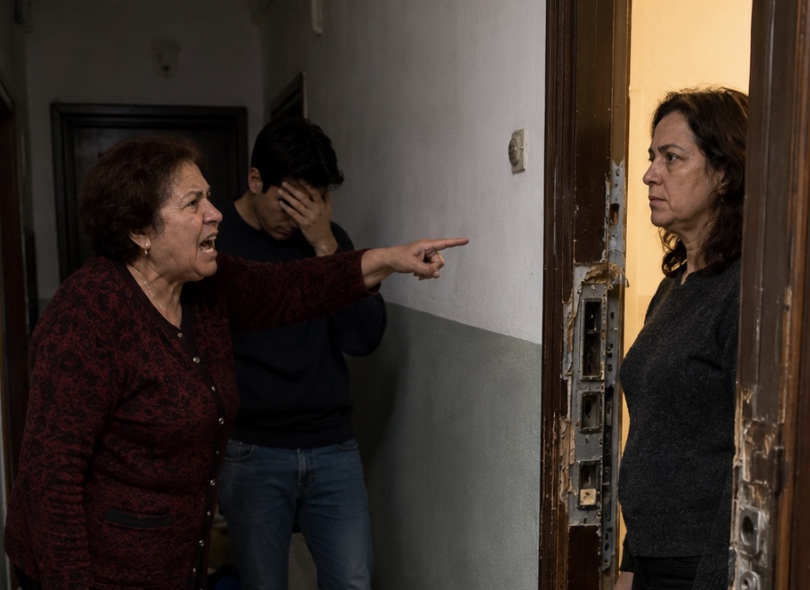
I found out that I could no longer get into my own apartment last Tuesday, at around five in the evening. My husband Denis, who is currently working up north, still believes that his mother and I simply failed to agree on a few household habits.
I was standing on the ninth-floor landing with a heavy travel bag in my hand. My usual key, the one I had used for years, went halfway into the lock and then hit something solid. It refused to move any farther. I pulled it out, examined the grooves, wiped it with my finger, and tried again.
Nothing.
Metal scraped against metal, but the key would not go in.
I pressed the doorbell. The familiar chime rang inside the apartment, followed by the sound of slow, shuffling footsteps.
“Who is it?” came the muffled voice of my mother-in-law, Zinaida Petrovna, from behind the door.
“Zinaida Petrovna, it’s me, Lena,” I replied, leaning my shoulder against the cold doorframe. “Please open the door. Something’s wrong with my key. I can’t turn it.”
There was some movement behind the door. A latch clicked, then the metal security chain rattled.
 
The door opened only a few inches.
Through the narrow gap, I could see the edge of Zinaida Petrovna’s burgundy house robe and half of her face. She looked at me without the slightest trace of surprise.
“Lena? Why are you back so early? Weren’t you supposed to return from your business trip on Friday?”
I blinked, trying to understand why she was even asking.
I was standing outside my own two-bedroom apartment—the apartment I had bought myself with a mortgage three years before I ever met Denis. I had made every payment from my own salary, giving up vacations, new clothes, and countless little comforts along the way.
It was the one place in the world that had always felt completely mine.
“The seminar ended early,” I said, feeling the weight of the bag beginning to ache against my shoulder. “Please take off the chain and let me in.”
Zinaida Petrovna did not move.
She looked down at my bag, then back at my face.
“Oh, Lena… there’s a little problem. Why don’t you stay at a hotel for now?”
To explain how we ended up speaking to each other through a crack in my own front door, I need to go back a little.
As embarrassing as it is to admit, I had helped create this situation myself.
I had always believed that keeping the peace was better than having an argument. I was terrified of being seen as a bad wife, an unwelcoming hostess, or a difficult woman. It was easier for me to stay silent and push my own wishes aside than to ruin an evening or see disappointment on my husband’s face.
That was exactly why, the previous November, I agreed to let Zinaida Petrovna stay with us for the winter.
Denis told me that it was difficult for his mother to spend the cold months alone in her private house. Heating the stove was becoming hard for her, and her blood pressure had been unstable.
 
“Let Mom stay in our spare room for the winter,” he suggested over dinner. “You don’t mind, do you? The apartment is big enough. There’s room for everyone. She’s quiet. You won’t even notice her.”
I nodded.
I swallowed the words I wanted to say—that the so-called spare room was actually my home office, where I worked in the evenings.
Instead, I moved my folders and documents out, cleared shelves in the wardrobe, and put fresh sheets on the bed.
I wanted to be accommodating.
For the first month, things were relatively peaceful. Denis was still home, and his mother behaved cautiously around him.
But after the New Year holidays, Denis was offered a good position at a work site in another region. The schedule was rotational: three months away, one month at home.
He packed his things and left.
Zinaida Petrovna and I remained in the apartment together.
That was when my home slowly began to change.
First, the smell changed.
Before, whenever I opened the front door, I was greeted by the faint scent of lavender fabric softener and freshly ground coffee.
Now there was a heavy wall of unfamiliar odors: onions fried in cheap oil, laundry soap, and some unbelievably sharp pine-scented floor cleaner that my mother-in-law bought in large plastic containers at the market.
 
My apartment had started smelling like someone else’s life.
Then came the rearranging.
Zinaida Petrovna was an extremely practical woman. Every decision she made came with what she considered flawless, undeniable logic.
“Lena, I moved your winter boots and jackets onto the balcony,” she announced one evening. “They were taking up too much space in the hallway closet. I need somewhere to hang my dresses. It makes no sense to keep winter clothes within reach when it’s already April.”
I weakly objected that the balcony was damp and that my suede boots might be ruined.
“Oh, don’t exaggerate,” she dismissed me. “Nothing will happen to them inside plastic bags. You need to be more practical. You attach far too much importance to clothes.”
But the greatest symbol of her growing control over my home was the kitchen.
Zinaida Petrovna had brought an enormous enamel cooking pot from the village.
It was white, chipped around the edges, with a gigantic red poppy painted on the side.
The thing was enormous.
She made thin soups in it, stewed cabbage in it, and sometimes even boiled laundry in it. The pot was constantly sitting on the stove, covering two burners at once.
 
To me, it became a monument to my own inability to say no.
Every morning, I squeezed my tiny copper coffee pot onto the burner at the far edge of the stove, carefully trying not to touch the giant enamel monster.
And still, I endured it.
I told myself it was temporary. Summer would come soon. She would go back to her garden and her house. I only needed to be patient.
But my patience finally broke two days before my business trip.
It was early Saturday morning. I had woken up in a good mood.
I took an expensive hard cheese from the refrigerator and sliced it thinly. Then I placed a woven breadbasket on the table, as I always did, filled with neat slices of fresh white bread.
Zinaida Petrovna sat across from me.
She was drinking hot tea from a saucer, noisily sucking it between her lips.
Her eyes moved toward my cheese. Her mouth tightened with disapproval, but she said nothing.
Instead, she reached toward the breadbasket.
She chose the softest, whitest slice from the center and turned it over in her hands. Then she raised it to her mouth and took a large bite.
She chewed slowly while staring out the window. Her jaw moved with effort.
Then she suddenly stopped chewing and grimaced.
“This bread is awfully tough,” she muttered. “Almost rubbery. Is it from yesterday?”
 
And then she did something that made my stomach turn.
Zinaida Petrovna lifted her palm to her mouth and spat the half-chewed, saliva-soaked piece of bread into her hand.
Then, completely calmly, she tossed the wet lump back into the shared breadbasket.
Right on top of the fresh slices.
She wiped her fingers on the edge of the tablecloth and reached for her tea.
I froze.
The knife in my hand stopped in midair.
I stared at the gray, crushed piece of bread lying on top of the clean slices and felt nausea rising in my throat.
It was not simply a matter of hygiene.
 
There was something deeper in that casual gesture—such complete disregard for me, my home, and my boundaries—that words suddenly felt useless.
Without saying anything, I stood up, picked up the breadbasket with both hands, walked to the trash can, and emptied everything into it.
The fresh bread and the chewed-up piece went together.
“What are you doing?” my mother-in-law cried, half rising from her chair. “Have you completely lost your mind because you earn a little money? Throwing bread in the trash! That’s a sin!”
I said nothing.
I simply walked out of the kitchen, got dressed, and left the apartment.
I wandered through the park for nearly two hours.
On Monday, I was almost happy to leave for that pointless work seminar, simply because it meant I would not have to see her face or that enormous enamel pot for a few days.
And now I was standing outside my own locked apartment.
“What hotel, Zinaida Petrovna?” I asked, staring through the gap between the door and the frame. “What are you talking about? Open the door.”
“Well, you see, Olya came to stay,” my mother-in-law replied in the same businesslike, instructive tone.
Olya was Denis’s sister.
“The kindergarten in their town has been closed for repairs. They’re replacing the pipes. Where is she supposed to go with two children? They’ll be climbing over each other in that tiny one-bedroom apartment. So I told her to come here. Children need space.”
“What does that have to do with me?” I asked very quietly.
 
“Lena, you’re an intelligent woman. Think logically. You don’t need all this space by yourself. You’re at work all day anyway. Rent a hotel room for a week or two, or get a short-term apartment. You earn good money. You can afford it. This is family. Relatives need somewhere to stay. It’s simply more practical.”
“The lock,” I said, staring at the shiny keyhole. “Why did you change the lock?”
“Well, Olya lost her old key when she visited last year. We decided it would be safer to replace the cylinder. Who knows who might have found that key? I’ll make you a copy after they leave. Come on, Lena. Don’t make a scene out here.”
The gap disappeared.
The lock clicked.
The door closed.
I stood alone on the landing.
The stairwell smelled of damp plaster and someone’s fried fish.
I looked down at my shoes, then at the handle of my travel bag, which had already left a deep red mark across my palm.
The old me would have cried.
The old me would have called Denis, complained, and listened to his irritated sighs as he told me, “She’s my mother. Just be patient. Stay at a hotel. I’ll send you the money.”
And I would have walked away, swallowing my anger because I did not want to be considered difficult.
But at that moment, I finally understood something very simple:
My politeness had made me homeless.
My fear of confrontation had reached the point where other people felt entitled to lock me out of my own home.
I took out my phone.
I did not call Denis.
 
I did not call my mother-in-law.
Instead, I opened a browser and searched for one thing.
Forty minutes later, the elevator doors opened on my floor.
A broad-shouldered man in work overalls stepped out carrying a heavy plastic toolbox.
“Hello. Did you call?” he asked in a deep voice.
“Yes,” I said. “I need this door opened.”
The locksmith examined the solid metal door, then looked at me.
“I’ll need proof that you live here and documents showing ownership. I’m not breaking anything without paperwork.”
I pulled out my passport and opened it to the page showing my registered address.
Then I took a property ownership extract from the folder in my bag. I had developed the habit of carrying important documents with me whenever I traveled.
The locksmith studied everything carefully, checked the names, nodded, and handed the papers back.
“This lock is new,” he said after examining the keyhole. “And it’s a good one. Expensive. Drilling the cylinder won’t work because it has protection. We’ll have to cut through it. The door will be damaged.”
“Cut it,” I said calmly.
He opened his toolbox, took out an extension cord, and asked me to hold it while he connected it to a power outlet in the electrical panel.
Then he pulled out a large angle grinder.
 
“Stand back. There’ll be sparks.”
He put on protective glasses and switched the machine on.
The stairwell filled with a deafening metallic shriek.
The spinning disc bit into the door around the lock. Orange sparks exploded in every direction, lighting up the dim landing.
The air filled with the smell of scorched metal and hot dust.
The noise was unbelievable.
A door opened on the floor below. One of the neighbors leaned out to see what was happening.
When he saw me, he simply nodded and disappeared back inside.
The locksmith worked methodically, cutting around the locking mechanism.
The screaming sound stopped and started again several times.
Whatever was happening inside the apartment was completely drowned out by the machine.
Finally, he switched it off.
The sudden silence felt almost painful.
He took a heavy pry bar, pushed it into the cut section, and leaned against it with his full weight.
The metal cracked.
The lock assembly came loose together with part of the door’s outer panel.
The door shifted and opened slightly.
“Done,” the locksmith said, wiping his forehead with his sleeve. “The lock will need replacing. You’ll probably have to repair the door too, maybe replace it entirely. Five thousand.”
I transferred the money to him, thanked him, and watched him leave with his tools.
Then I pushed the damaged door open and stepped into my own hallway.
 
The scene in front of me was almost theatrical.
Zinaida Petrovna stood in the corridor with both hands pressed against her chest. Her face was white.
Beside her stood Olya in a tracksuit.
Two frightened children, around five or six years old, were peering out from behind Olya’s legs.
“You… what have you done?” Zinaida Petrovna gasped. “You ruined the door! I’m telling Denis everything! He’ll never forgive you!”
“Are you insane?” Olya shrieked. “You scared the children! We live here, you know!”
I did not argue.
I simply walked past them into the kitchen.
I opened the lower cabinet where I kept thick black 120-liter construction garbage bags and tore four of them from the roll.
Then I walked back through the hallway, passed the frozen women, and went into the spare room.
It was chaos.
Children’s coloring books and toys covered my work desk. Olya’s clothes were hanging over the back of my chair.
My mother-in-law’s underwear and clothing were stacked neatly inside my wardrobe.
I opened the first black bag.
Then I walked to the wardrobe and swept an entire pile of Zinaida Petrovna’s clothes into it with one motion.
Sweaters, skirts, robes—everything landed at the bottom of the bag.
“Hey! What do you think you’re doing?” Olya rushed into the room and reached for my arm.
I turned sharply toward her.
“Take your hands off me,” I said quietly, looking straight into her eyes.
I did not raise my voice.
 
But something in my tone made her pull her hand back immediately and step away.
I kept packing.
Olya’s sweatpants. Children’s tights. My mother-in-law’s cosmetics from the bedside table.
Everything went into the bags without sorting.
When three bags were full, I tied them shut and dragged them into the hallway.
Then I returned to the kitchen.
The white enamel pot with the giant red poppy was sitting on the stove, exactly where it always stood.
It was still warm.
I grabbed it by the handles and carried it down the hallway, past Zinaida Petrovna, who was leaning against the wall and struggling to breathe normally.
I went into the bathroom, lifted the toilet lid, and poured the entire contents of the pot into it.
Some cloudy soup with floating pieces of cabbage disappeared into the bowl.
I flushed.
Then I rinsed the pot in the sink, shook the water off, and dropped it into the fourth black bag together with my mother-in-law’s winter boots.
I carried all four bags onto the landing and left them beside the elevator.
When I returned inside, Olya was hurriedly dressing the children while muttering insults under her breath.
Zinaida Petrovna was putting on her coat. Her hands were shaking as she struggled with the buttons.
“You have two minutes to leave,” I told her. “Otherwise I’m closing what’s left of this door, and you can go outside in your slippers.”
“You won’t get away with this,” she hissed. “Denis will find out. He’ll divorce you! You’re not a woman. You’re a monster!”
“Then let him divorce me,” I replied. “As long as he registers his address at your place afterward.”
They left.
Olya pulled the children along with her.
Zinaida Petrovna walked out last, repeatedly turning around to look at me.
 
I slammed the door behind them.
There was no functioning lock anymore, only a hole where the mechanism had been, so I secured the surviving upper latch and pushed a heavy shoe cabinet against the door.
Tomorrow, I would call someone and order a new, stronger door.
Then I walked through the apartment.
I opened the window in the spare room as wide as it would go.
I opened the balcony door too.
Cold, fresh spring air rushed through the rooms, pushing out the smell of fried onions, old clothes, and harsh pine cleaner.
I returned to the kitchen.
I took a cloth and carefully wiped down the dining table.
Then I placed my small copper coffee pot on the stove, right where the giant enamel pot with the red poppy had stood for months.
My phone began vibrating in my pocket.
The screen showed one name:
Denis.
Zinaida Petrovna had already called her son.
I switched the phone to silent mode and placed it facedown on the table.
I would speak to him tomorrow.
Or the day after.
 
Or perhaps there was simply nothing left for us to discuss.
I poured myself a cup of hot coffee and took a small sip.
Fresh air was filling the apartment.
The space belonged to me again.
Would you have stayed silent just to keep the family together?