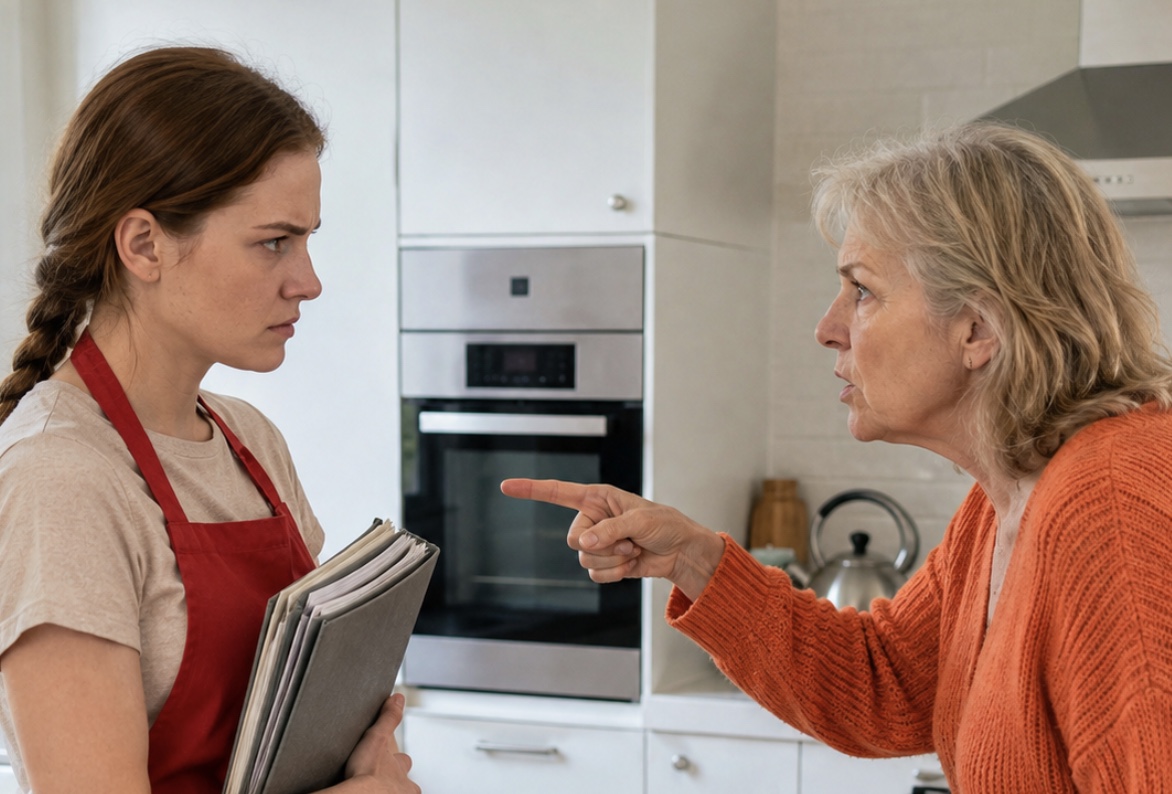
The mother-in-law’s voice crashed into the silence of the kitchen like a fist slamming down on a table.
Marina stood by the window, her fingers clenched tightly around a mug of tea that had long since gone cold. Somewhere deep inside her, something was slowly approaching the boiling point. Not suddenly, not all at once, but gradually—like water heating over a flame.
Lyudmila Sergeyevna sat at the head of the table with the air of someone who had just delivered a final verdict and was now waiting to see how everyone would react. Her hands were folded over her stomach, her chin lifted, her gaze heavy and almost triumphant.
Beside her sat Olya, Marina’s sister-in-law, a young woman who always seemed to wear a guilty expression. She held her baby in her arms. The child was asleep, completely unaware that the entire drama unfolding around the table was, in one way or another, about him.
Anton sat opposite his mother without saying a word.
It was his silence that Marina felt most sharply. More sharply than Lyudmila Sergeyevna’s loud voice, more sharply than Olya’s discomfort.
Outside the window, a November evening was settling over the city. Streetlights glowed in the courtyard. Life went on as usual beyond the glass—people walked their dogs, someone carried shopping bags home, a car rolled slowly past.
None of those people knew that here, in a kitchen filled with yellow light and the smell of fried cutlets, a decision was being discussed that Marina had been carrying inside her for three days.
Since Wednesday.
Since the moment the notary’s office had called and told her something she had never expected to hear.
Aunt Zina had died quietly, just as she had lived.
Marina had not seen her for seven years, perhaps even longer. She was a distant relative on Marina’s mother’s side, a solitary woman who had spent her life working as an accountant at some research institute. After retirement, she got a cat and gradually disappeared into the quiet routine of her neighborhood in the northern part of the city.
Marina rarely thought about her. Occasionally, her mother would mention her in passing.
“Zina called. She wished us a Happy New Year.”
That was about it.
So the call from the notary’s office felt as though it belonged to someone else’s life.
The notary spoke carefully and without emotion, and Marina asked him to repeat himself at least three times before the meaning finally sank in.
Aunt Zina had left Marina her apartment.
A two-bedroom apartment.
In a good neighborhood, five minutes from the subway, in a thirty-year-old building that was still in solid condition.
When the call ended, Marina remained in her office chair for a long time, staring at the unfinished spreadsheet glowing on her computer screen.
Then she stood up, poured herself a glass of water from the cooler, drank it without sitting down, and thought:
This changes everything.
She called Anton immediately from work instead of waiting until evening.
She told him in an even voice, although inside she felt something trembling with excitement.
Anton was silent for a second.
“Seriously? Wow.”
There was the same stunned happiness in his voice that she felt herself.
They agreed they would talk about it properly when they got home, calmly and without rushing.
But Marina already knew what she wanted.
The idea had formed almost immediately because it made perfect sense.
She and Anton lived in a one-bedroom apartment on the outskirts of the city. They had a mortgage and paid the bank a significant amount every month, with years of payments still ahead of them.
Now they had access to a larger apartment in a good neighborhood, close to the subway.
They could rent it out, and the rent would cover almost their entire mortgage payment. That would allow them to pay off their loan several years early.
Or they could move into the inherited apartment themselves, renovate it, finally have more space, and rent out their current place.
Either way, it was an asset.
An opportunity.
Breathing room.
That evening, Marina and Anton sat in the kitchen and talked for a long time. They calmly considered every possibility. Anton agreed with her reasoning, nodded, suggested a few ideas of his own.
They were thinking in the same direction.
Marina had gone to bed that night believing everything would be fine.
They would handle it together.
The next day, Anton called his mother.
And after that phone call, everything changed.
Lyudmila Sergeyevna arrived on Saturday.
She called beforehand and said, “Be home. I’m coming over. We need to talk.”
She did not ask.
She informed them.
During three years of marriage, Marina had become very familiar with that style. Her mother-in-law did not ask for permission, make suggestions, or discuss things.
She announced decisions.
She arrived.
She knew what was best.
Olya was already with her when Marina opened the apartment door. She stood beside her mother in the hallway, holding her sleepy baby.
Marina was surprised but said nothing.
She invited them into the kitchen and put the kettle on.
For the first twenty minutes, Lyudmila Sergeyevna talked about how difficult Olya’s life was.
Marina knew the story.
Olya had married young and had a baby. Her husband was gone—or rather, he had been thrown out because of his drinking, but that detail apparently did not matter.
Now Olya lived with her mother in a two-bedroom apartment that Lyudmila Sergeyevna had originally received during the Soviet years and later privatized.
The baby was growing.
There was not enough space.
Olya had a job, but she did not earn much.
Lyudmila Sergeyevna was not telling Marina any of this simply to explain the situation.
She was building toward something.
Marina could feel it.
She stared into her tea and waited.
The point finally came, plainly and without hesitation.
“You need to give the apartment to Olya,” her mother-in-law said. “She has a child. She needs more room. You and Anton have nowhere to rush. There are only two of you, you don’t have children yet, and you’re doing perfectly fine where you are.”
Marina lifted her eyes.
Olya looked away.
Anton, sitting beside Marina, tensed slightly but said nothing.
“We were planning to use the apartment differently,” Marina replied calmly.
“What do you mean, differently?” Lyudmila Sergeyevna narrowed her eyes.
“We want to rent it out. We need to pay off our mortgage.”
“Mortgage!” Lyudmila Sergeyevna repeated the word as if it were ridiculous. “You’ll manage. You both work. You can pay it. Olya needs help. She’s family.”
“We’re family too,” Marina said.
“Exactly. So start thinking about the family.”
A bitter taste appeared in Marina’s mouth.
She took a sip of tea to stop herself from saying something she might regret.
She was still trying to remain calm.
Still trying to explain.
“Lyudmila Sergeyevna, this is an inheritance. It was left to me. Anton and I will decide what to do with it.”
“You’re young.” Her mother-in-law dismissed the comment with a wave of her hand, as though Marina had said something childish. “What do you know? You got that apartment for nothing. You didn’t pay for it. If something falls into your lap for free, then at least use it to help someone instead of sitting around calculating money.”
“Help whom, exactly?”
“The family. Olya. The child. Do you ever think about anyone besides yourself?”
Marina remained silent.
She was thinking about many things.
She thought about how she and Anton sent money to the bank every single month for the apartment they had chosen and purchased themselves, without anyone helping them.
She thought about the small one-bedroom apartment on the edge of the city, nearly an hour from downtown.
She thought about waking up at six-thirty every morning and coming home around eight in the evening.
She thought about how she and Anton built their plans around what they could actually afford.
And she thought about the most important fact of all.
Aunt Zina had left that apartment to Marina.
Not to “the family.”
To Marina.
She thought all of this.
But she did not say it aloud.
Not until Lyudmila Sergeyevna uttered the sentence that changed everything.
“You, sweetheart, can start giving your opinion when you’ve earned enough to buy an apartment yourself! Until then, keep quiet and listen to your elders!”
The silence that followed was different.
It was not an ordinary pause in a conversation.
It felt dense.
Charged.
Marina placed her mug on the table.
Slowly.
She set it down and released it, and in the absolute quiet, the tiny sound seemed unusually loud.
Then she looked directly at her mother-in-law.
Lyudmila Sergeyevna stared back with the same victorious expression she always wore whenever she believed she had said something that could not possibly be challenged.
Olya suddenly became extremely interested in adjusting the blanket around her sleeping child.
Anton seemed to stop breathing.
Marina could sense it even without looking at him.
Three years.
For three years, Marina had tolerated it.
Advice about how food should be cooked.
Advice about how floors should be washed.
Comments about what Marina should wear to work.
Questions about whether she really needed to work so much.
Hints that perhaps it was time to think about having children.
Complaints that they did not visit Lyudmila Sergeyevna’s country house every weekend.
Remarks about why she was not invited to every single holiday.
For three years, Marina had nodded.
Smiled.
Changed the subject.
Said, “Yes, of course, we’ll think about it.”
Said, “All right, Lyudmila Sergeyevna.”
Said, “Thank you for caring.”
For three years, Marina had chosen peace.
But this apartment was different.
An apartment was not advice about how much salt to put in soup.
An apartment was their life.
Their money.
Their future.
And Aunt Zina had chosen to leave it specifically to Marina.
That meant something, even if they had not seen each other for seven years.
Marina felt something straighten inside her.
Like a spring that had been compressed for far too long.
“Lyudmila Sergeyevna,” she said.
Her voice came out surprisingly steady.
Marina had expected it to shake.
“Let’s talk about this seriously.”
“How much more serious can it get?” her mother-in-law said with a shrug.
“You said I should keep quiet until I earn enough to buy an apartment. Fine. Let’s examine that statement carefully.”
Something in Marina’s tone made Lyudmila Sergeyevna narrow her eyes.
Olya lifted her head.
“The apartment you live in,” Marina continued, “is a two-bedroom apartment in a good building. You privatized it. You didn’t buy it. You didn’t take out a mortgage for it. You didn’t save for a down payment. The government provided that apartment to your family. There’s nothing wrong with that. It’s simply a fact. You received it without purchasing it.”
The kitchen went completely silent.
“The apartment Anton and I live in,” Marina went on, “is a one-bedroom apartment on the outskirts of the city. We bought it ourselves. We took out the mortgage ourselves. We signed the papers ourselves. Every month, we pay the bank with money from salaries that we earn ourselves. We chose it, and we pay for it. That apartment wasn’t given to us or privatized by us. We purchased it.”
Lyudmila Sergeyevna opened her mouth.
Marina did not stop.
“So, with all due respect, I don’t understand why you believe you have the right to tell us how to manage property. Aunt Zina left this apartment to me. Not to Olya, not to you, not to the family as some collective unit. To me. I don’t know why she chose me. Maybe she simply wanted someone in the family to remember her. But it was her decision, and I respect it. And I will decide what happens to the property she left me.”
Lyudmila Sergeyevna slowly straightened in her chair.
“You…” she began.
“Mom.”
Anton’s voice was quiet, but perfectly clear.
Everyone turned toward him.
“Mom, Marina is right.”
One second passed.
Then another.
“What?” His mother’s voice had changed. There was now a sharp, almost hysterical note in it.
“It’s her inheritance,” Anton said calmly, meeting his mother’s gaze. “Marina and I will decide what to do with it. Together. I agree with everything she just said. This is our business.”
Lyudmila Sergeyevna stared at her son as if she were seeing him for the first time.
Or perhaps as though she had suddenly discovered something in him she had always preferred not to notice.
Olya stood up.
The baby stirred in her arms, moved his lips sleepily, then settled again.
“Maybe we should…” Olya began, addressing no one in particular.
Lyudmila Sergeyevna stood as well.
She did not shout.
She did not slam the door.
She simply picked up her handbag and walked silently toward the hallway.
Olya followed her.
At the door, she glanced back at Marina with a complicated expression that was neither angry nor friendly.
Then they left.
The door closed behind them.
Marina and Anton remained in the kitchen for a long time afterward.
The kettle cooled and was reheated twice because Marina needed something to do with her hands.
Outside, darkness had completely fallen.
The apartment was quiet.
But it was a different kind of silence now.
Not the suffocating silence that had filled the kitchen during the argument.
This one felt softer.
“Are you angry?” Marina finally asked.
Anton shook his head.
“At you? No. You said exactly what needed to be said.” He paused, turning a teaspoon between his fingers. “I should’ve told her myself a long time ago. About this and about a lot of other things.”
“She’ll be offended.”
“She will. Then she’ll get over it.”
Marina looked at him.
For three years, she had noticed this side of him too—his tendency to avoid making waves, to stay away from conflict, to choose silence whenever possible.
Sometimes it irritated her.
Sometimes she felt he simply did not want to find himself caught between his wife and his mother.
But today, he had taken a side.
He had done it quietly, but firmly.
With one sentence.
“Thank you,” Marina said.
He smiled faintly.
“For what? You handled it yourself.”
Marina stood up and carried the mugs to the sink.
Then she looked out the window.
Across the courtyard, other windows glowed in the darkness.
Other homes.
Other lives.
Other evenings.
The inherited apartment stood empty on the other side of the city.
Two bedrooms.
A good neighborhood.
Close to the subway.
It would probably be dusty. There would still be old furniture inside, and perhaps the rooms still smelled faintly of Aunt Zina’s medicine.
They would need to renovate it.
Sort through the belongings.
Make decisions.
Marina thought about all of that calmly and practically.
They would go there the following week and look at everything properly.
She would call a real estate agent and ask how much rent they could get for it.
Then she and Anton would calculate what made more sense—moving there themselves or renting it out.
They would decide.
Together.
Lyudmila Sergeyevna would call eventually.
In a week.
Maybe two.
She might still sound offended.
She might make some cutting remark.
She might send Olya over with that permanently apologetic expression.
Marina had no idea how the next conversation would go, and she was not going to waste energy trying to predict it.
She knew only one thing.
Something had changed today.
And it was bigger than the apartment.
Something had changed in the way Marina allowed people to treat her.
In her understanding of where respect for elders ended and respect for herself began.
“Anton,” she called. “Are you hungry? There are still some cutlets left.”
“I am,” he answered from the other room.
Marina turned on the stove.
The frying pan heated quickly.
The cutlets began to sizzle, filling the kitchen with the smell of warm food.
The room suddenly felt cozy again.
Ordinary.
Comfortably domestic in the way a home feels on a cold evening, when the weather outside is unpleasant but inside everything is warm and quiet.
Anton came into the kitchen, sat down, and poured himself another cup of tea.
“You know,” he said, “I think we should go there on Sunday. Take a proper look at the apartment.”
“I was thinking exactly the same thing.”
He nodded.
Marina looked at him for a moment and then turned the cutlets over in the pan.
Everything else was still ahead of them.
The next conversation with Lyudmila Sergeyevna.
Olya’s guilty eyes.
The awkwardness of their next family meeting.
They would have to deal with all of it.
But tonight, Marina had finally said what needed to be said.
And her husband had stood beside her.