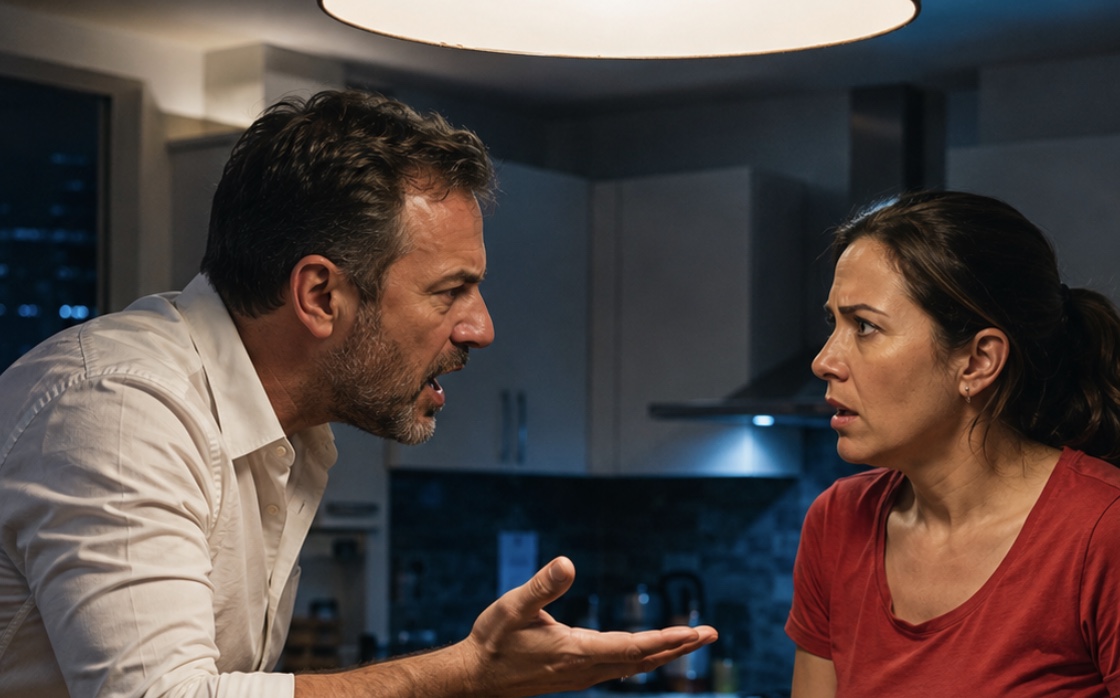
He was shouting so loudly that the windowpanes rattled in their frames.
“Go ahead, block every one of my cards! It won’t help! I’ll withdraw all your money!” my husband yelled, standing in the middle of the hallway, swaying slightly. His shirt was unbuttoned at the collar, his tie hanging crookedly to one side, and he stared at me with such fury that you would have thought I had just destroyed everything he cared about.
I stood in the kitchen doorway and looked at him. I simply looked.
I didn’t shout back. I didn’t cry. I didn’t try to explain myself. I only felt something inside me slowly hardening—not from fear, but from a strange, final clarity that was almost peaceful.
He had no idea that I had already taken care of everything.
We had met eleven years earlier at a corporate party hosted by mutual friends. Back then, Anton had been the star of the evening—loud, witty, and effortlessly confident in the way only people who seem to succeed at everything can be. He worked in renovation and interior finishing, had his own small crew, a solid reputation, and a steady stream of clients.
He earned good money and never seemed afraid to spend it.
At the time, I worked as a content manager for a small advertising agency and earned very little. Anton never once made me feel ashamed of it. He paid for restaurants, vacations, and minor repairs in the apartment we rented together. He did it casually, without complaints or reminders.
“You’re my wife,” he used to say. “Don’t worry about money.”
So I didn’t.
At first.
Then my career began to take off. A small project came first, followed by recommendations, and eventually an offer from a major company. I accepted because I knew immediately that it was the kind of opportunity I had been waiting for.
I worked late nights, weekends, even during vacations.
At first, Anton didn’t mind. In fact, he seemed proud of me.
“My wife is a real career woman,” he would joke at gatherings.
I heard pride in those words, and it made me happy.
But around the same time, something in our lives began to change.
At first, the changes were almost invisible. Then they became impossible to ignore.
Anton started getting fewer jobs. One longtime client hired another contractor. A major renovation project fell through when the developer froze construction. His crew slowly broke apart—one worker moved away, another found a more stable job somewhere else.
“I just need a couple of months,” Anton told me. “I’ll find new clients. The market is slow right now, that’s all.”
I nodded.
I believed him.
And I kept working.
When two months became six and the market still showed no signs of recovering, I ordered an additional bank card linked to my account and gave it to Anton.
It was supposed to make life easier.
Groceries. Household expenses. Utility bills.
By then, I was completely consumed by work. I barely had the time or energy to think about what we needed for dinner or whether the internet bill had been paid. Anton was home most of the time anyway, so it seemed practical for him to handle those things.
He took the card quietly.
He thanked me briefly and looked away.
I didn’t think much of it.
About a month later, he started complaining.
At first, he disguised it as humor, wearing a bitter little smile that seemed to ask me to laugh with him, though there was something uncomfortable underneath it.
“You know what’s ironic?” he said one evening when I came home after nine and found him eating dinner alone. “I cook. I clean. I do the shopping. I’ve turned into a househusband.”
“You’re helping both of us for a while,” I said. “There’s nothing wrong with that.”
“Nothing wrong with it?” His expression tightened. “According to whom?”
I walked over, wrapped my arms around him from behind, and rested my chin on his shoulder.
“Anton, you carried us financially for years. Let me do it now. You’ll get new jobs. You’re good at what you do. People don’t forget craftsmen like you.”
He placed his hand over mine but said nothing.
I thought he had heard me.
I thought I had made him feel better.
The truth is that I was busy, and I desperately wanted him to get better without requiring too much of me.
I’m ashamed to admit that now, but it’s true.
Then the beer appeared.
At first, it was one bottle in the evening while he watched football.
Then two.
Eventually, I began finding empty bottles in strange places around the apartment—under the sofa, inside a cabinet, behind stacks of books. I don’t think he was deliberately hiding them. He probably just forgot where he had left them.
One evening, I was working on my laptop when I heard him talking on the phone in the kitchen. His voice was calm at first, then increasingly tense. Suddenly the call ended.
For a long time, there was silence.
I went out to him.
“What happened?”
“Nothing. A client.”
“What client?”
“Not anymore.”
He stood, opened the refrigerator, and took out a bottle.
“I missed the deadline. He hired someone else.”
I wanted to say something comforting.
But I was exhausted. My head was full of work, and all I managed was something like, “That’s too bad.”
Then I went back to my laptop.
That was one of my mistakes.
One of many.
By autumn, Anton had stopped pretending he was searching for work.
His laptop remained closed on the table. He kept his phone face down. Some mornings I left for work and he was still asleep. On days when I worked from home, I sometimes saw him sleep until eleven or even noon.
Anton used to wake up at six without an alarm.
Money kept disappearing from the card. I saw the transactions in my banking app.
Groceries, of course.
But also payments at bars, cafés, and places whose names meant nothing to me.
I told myself he was meeting potential clients. Discussing projects. Building connections.
I told myself that because I didn’t have the emotional strength to imagine anything else.
We gradually stopped having real conversations.
He slept in the mornings. I came home late in the evenings. I worked on weekends. He watched television or disappeared somewhere.
Sometimes, over dinner, he would talk about the weather, the news, or the neighbors. I would answer, and both of us would pretend everything was normal.
I don’t know exactly when I understood that it wasn’t normal anymore.
Maybe it was the night I saw him in the bar.
It was a Wednesday. For once, I had finished work early.
I decided to walk home and stopped at a small café on our street that I had been meaning to visit for months.
I pushed open the door and looked around.
Anton was sitting in the far corner.
Across from him was a young woman.
She was bright, animated, laughing as she leaned toward him.
Anton was laughing too.
He was laughing in a way I hadn’t seen him laugh with me in a very long time.
I stood near the entrance.
Neither of them noticed me.
I didn’t approach them.
I simply turned around and left.
At home, I sat in the dark kitchen for a long time.
Then I took out my phone and blocked his card.
Not because I wanted revenge.
I simply realized that I couldn’t continue like this anymore.
He came home close to midnight.
I heard him struggling with the lock for a long time. Then the door slammed. His footsteps were uneven, each one followed by a slight pause.
He walked into the kitchen, where I was still sitting.
He turned on the light and stared at me.
“The card is blocked,” he said.
I didn’t answer.
“You blocked my card?” His voice rose. “That’s my card!”
“It’s my card,” I replied calmly. “I gave you access to my account.”
“So now you regret it? Suddenly you’re worried about your precious money?”
“Anton, you’re drunk. Go to bed. We’ll talk tomorrow.”
“No!”
He slammed his palm against the table.
“Now! You think I owe you something? You owe me! I supported you for years!”
“You supported both of us,” I said. “And I’m grateful for that. But that was then.”
“So now you’re the one who gets to decide?”
He stepped closer, and I stood so I could look directly into his eyes.
“You decide who gets money and who doesn’t? Big mistake. I know all your passwords. I know your PIN codes. You think hiding a card will stop me? I’ll get the money anyway. I’ll transfer it to another account. Or I’ll withdraw every last cent!”
His face was red. His hands were trembling.
Then he shouted:
“Go ahead, block every one of my cards! It won’t help! I’ll withdraw all your money!”
I looked at him and thought that this was a man in terrible pain.
A man who had lost himself and had no idea how to find his way back.
A man I had once loved.
And still, I knew I couldn’t do this anymore.
“Anton,” I said quietly. “Go to sleep.”
He kept shouting for a while.
Eventually, he walked into the living room and collapsed onto the sofa without even changing his clothes. I could hear him tossing and turning, muttering under his breath.
Then everything went silent.
I didn’t go to bed.
I sat at the kitchen table with my laptop and changed every password I could think of.
My online banking password.
The email connected to the bank.
My backup email.
My banking app.
I did it calmly, almost mechanically.
I didn’t cry.
I had already cried inside that bar, while standing near the entrance and watching him laugh with someone else.
Afterward, I made coffee and stayed awake until morning.
Anton woke around nine.
I heard him walking through the apartment. The shower ran for a long time.
Then there was silence.
Eventually, he appeared in the kitchen.
He had washed his face, combed his hair, and put on a clean T-shirt. His expression carried something that almost looked like remorse.
“Lena,” he said. “I said a lot of stupid things last night.”
I drank my coffee and looked out the window.
“I wasn’t myself. You understand that.”
“Yes,” I said.
“I want to explain.”
“I don’t need an explanation.”
He went quiet.
Then he sat across from me.
“Lena, come on. Let’s talk like normal people.”
“We already talked,” I said. “Last night you told me exactly what you thought. I heard you.”
“I was drunk!”
“Yes.”
I put down my cup.
“But people often say what they really think when they’re drunk, don’t they?”
He opened his mouth and then closed it again.
“Anton,” I said, “I saw you yesterday. At the bar. With that woman.”
One second passed.
Then another.
Something shifted in his face.
“It was just—”
“It doesn’t matter.”
I stood up.
“Listen to me. I’m sorry things turned out this way for you. I really am. I understand how difficult it was. I know you’re a proud man, and I know accepting money from me was humiliating for you. But you chose drinking instead of dealing with what was happening. You chose bars instead of home. And last night, you stood in front of me and threatened to take all my money. That’s not the foundation of a life together.”
He said nothing.
“I need you to leave,” I continued. “Today. Take whatever you need for the next few days. We’ll arrange a time for you to collect the rest.”
“You’re serious?”
“Completely.”
He stared at me for a long time.
Maybe he was searching my face for hesitation. Fear. Some sign that I might change my mind.
There was none.
“Lena,” he finally said, and now his voice sounded different—quiet, almost childlike. “Where am I supposed to go?”
“That’s your problem now,” I answered gently. “Not mine.”
He left around noon.
He packed a bag with clothes, his charger, and his documents.
At the door, he turned around.
“You’ll regret this.”
It didn’t sound like a threat.
More like one last desperate attempt to hold on to something.
I shook my head.
“Anton. Go.”
The door closed behind him.
I stood in the hallway for a while, listening to the silence that filled the apartment.
Then I went into the kitchen, put the kettle on, and opened my laptop.
In my email was the phone number of a lawyer a friend had recommended.
I called.
“Good afternoon. I’d like to schedule a consultation. It’s about a divorce.”
Outside the window was a gray autumn morning.
Bare branches.
Wet pavement.
An ordinary day on which one life ended and another began.
I didn’t know what that new life would look like.
But I knew that this time, I was choosing it for myself.
Later, when everything was finally over—the court proceedings, the division of property, the last conversations conducted through lawyers—one of my friends asked me when exactly I had realized that I needed to leave.
I thought about it for a moment.
Then I said:
“When he was drunk and screaming that he would take all my money, I almost found it funny. Not because the threat wasn’t serious. But because I suddenly understood that we were both talking about money while actually talking about something completely different. He was shouting about his helplessness. I was staying silent about how exhausted I was. We had stopped truly speaking to each other a long time ago. That moment wasn’t really the beginning of the end. It was simply the moment I finally admitted that the end had already come.”
My friend nodded.
“Were you scared?”
“No,” I said. “I had been scared before—when I was still pretending everything was fine.”