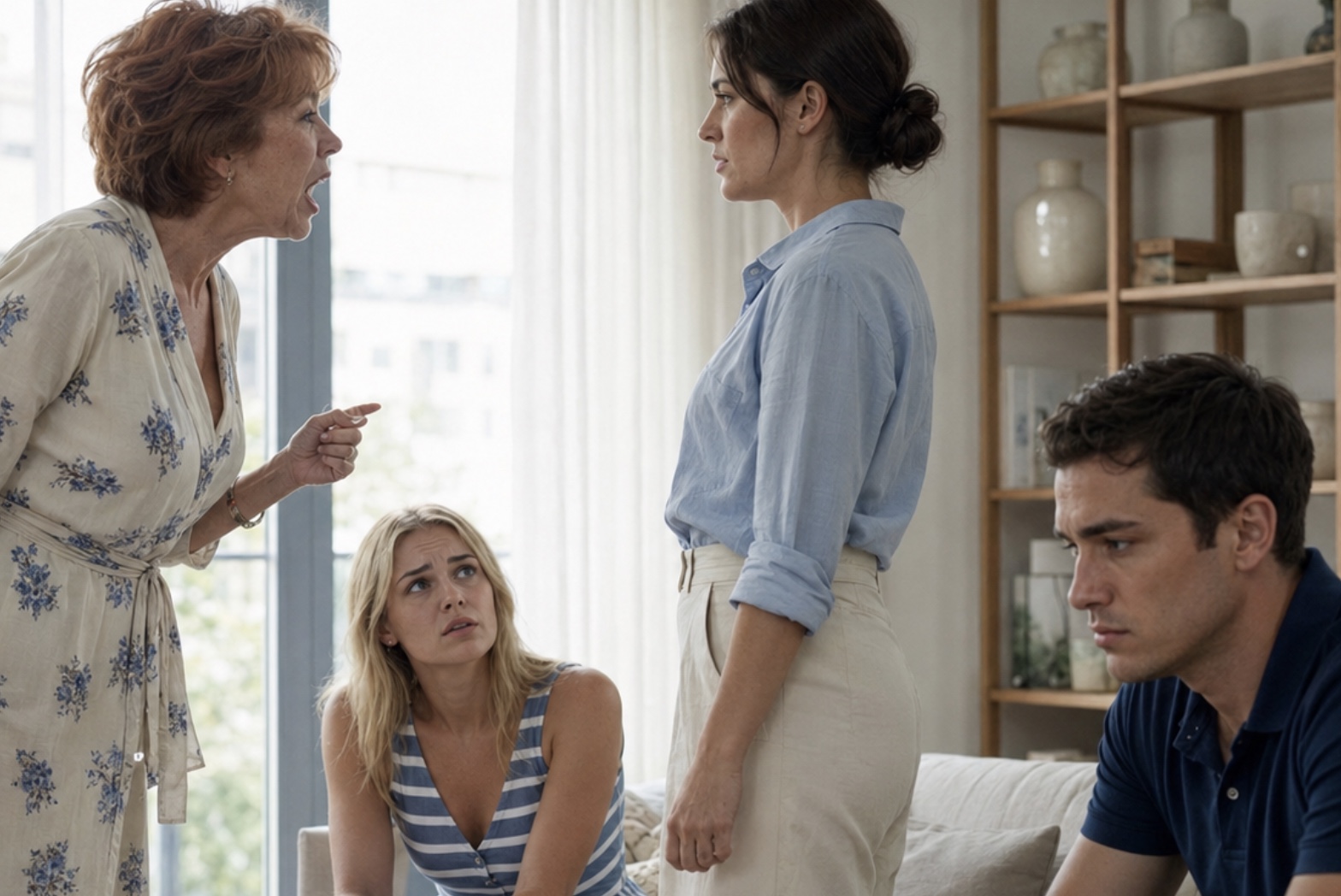
— Why are you sitting there like a stump? Lost your tongue or something? — Vera Pavlovna stood in the middle of the living room, looking at Oksana as though she were a piece of furniture someone had forgotten to move.
Oksana said nothing. She sat in the armchair by the window, staring outside. It was August. Dust covered the poplar trees, and someone across the courtyard was watering flowers on a balcony. An ordinary evening. Yet somehow the apartment suddenly felt too small.
Her mother-in-law had arrived with pies. That was always Vera Pavlovna’s signature move. Cabbage pies no one had asked for, sitting on a plate, slightly misshapen and burned around the edges. Vera Pavlovna had never been much of a cook, but she behaved as if she were the finest homemaker in the world. She was one of those people who loudly announced their virtues while everyone else quietly did the things she only talked about.
Ilya sat at the table scrolling through his phone. He had a special talent for being physically present in a room while somehow being absent from everything happening in it.
Oksana’s grandmother had died three weeks earlier. Quietly, in her sleep, just as she had lived—without unnecessary fuss. Oksana still sometimes reached automatically for her phone, intending to call her, only to remember. Then she would put the phone down again.
According to the will, her grandmother’s apartment now belonged to Oksana. It was a two-room apartment in the city center, with high ceilings and creaking parquet floors that seemed to remember the Soviet era. Her grandmother had lived there for forty years.
News of the inheritance reached Vera Pavlovna at astonishing speed. Oksana had barely had time to understand that she now owned property when her mother-in-law was already ringing the doorbell.
— Here’s what I think, — Vera Pavlovna said, settling onto the sofa with the air of someone planning to stay for a long time. — You need to sell it quickly before the market drops.
Oksana looked at her.
— What market?
— The real estate market, Oksanochka. Don’t you follow these things? Prices are fluctuating like crazy right now, I’m telling you.
Ilya lifted his head from his phone and nodded importantly. Apparently, he had heard the same phrase before—from his mother, naturally.
Vera Pavlovna continued. She always had a plan. A detailed, carefully structured plan with multiple steps—and always financed by somebody else.
This time, her idea was simple: sell the grandmother’s apartment, use part of the money to buy a studio for Alina, her younger daughter and favorite child, who was already twenty-four but still “trying to find herself.” Alina wanted to get married, apparently, but had nowhere to live. Whatever remained could go toward Ilya’s car loan, which he had taken out three years earlier and still had not managed to pay off.
— We’re one family, — Vera Pavlovna said, with the absolute certainty of someone stating a law of nature. — What are you going to do with a two-room apartment anyway? The one-bedroom place is enough for the two of you.
— It reminds me of Grandma, — Oksana said quietly.
— So what? Memories belong in your head, not in square meters. — Her mother-in-law waved the idea away and reached for a pie. — Alina is about to get married. She and Seryozha need somewhere to live. Do you really want the poor girl to spend her life moving from one rented place to another?
Oksana looked at her husband.
He was still staring at his phone.
— Ilya, — she called.
— Mom has a point, — he replied without looking up.
And that was the entire discussion.
The following day Vera Pavlovna returned.
This time she brought Alina with her—a short young woman with carefully painted nails and a habit of stretching out the words “Oh, Mom…” in a spoiled, complaining tone.
Alina had brought printed listings from real estate websites. Studio apartments in different neighborhoods, covered in pencil notes:
“This one is okay.”
“Fresh renovation here.”
“Ceilings are too low in this one.”
Oksana poured herself coffee and watched them calmly, almost as though they were discussing somebody else’s property.
Maybe that was the moment something inside her finally clicked into place.
She did not shout.
There was no point.
She knew people like them. You could yell, cry, explain, beg, argue for hours—they would hear only what they wanted to hear.
Documents were different.
People like Vera Pavlovna understood documents very well.
Stamped papers were a language that left no room for arguments.
On Wednesday Oksana took a day off work and went to the notary.
The office was located in an old building on a quiet street where the air smelled of linden trees in the summer heat. Oksana sat waiting for her number to be called, staring at the ticket in her hand and thinking about her grandmother.
She remembered how Grandma loved tea with gooseberry jam.
And how she always used to say:
“Oksanochka, the important thing is not to rush and not to make unnecessary noise. Quiet people are often right for longer.”
The notary was a woman in her fifties with tired but attentive eyes. She reviewed the will, Oksana’s passport, and the apartment documents.
Everything was in order.
— Your inheritance rights are undisputed, — she explained. — Register the property in your name. There are no obstacles.
Oksana did exactly that.
Then she went to the public service center. The queue there was longer. The hall buzzed with voices and smelled like an official government building mixed with somebody’s strong perfume.
She took a number, waited her turn, and submitted the paperwork.
Done.
Now all she had to do was wait for the updated property registry extract.
On the way home, Oksana stopped at a small café with wooden tables and surprisingly good cappuccino. She ordered coffee, took out her phone, and messaged her sister.
Inna answered almost immediately.
“I’ve been waiting for this call for a long time. Come here.”
Inna lived in Kaliningrad.
She owned a small, cozy pastry shop overlooking a canal. She had opened it four years earlier and had never regretted the decision. Inna was one of those people who never announced their plans before carrying them out.
They spoke on the phone that evening after Ilya had gone to sleep. He had a strange habit of going to bed early and waking up late, one of the many routines he considered untouchable.
— I need someone to handle accounting and paperwork, — Inna said without any introduction. — I’m expanding. I found a good pastry chef, but now I need someone who understands numbers and doesn’t get lost in documents.
— Are you serious?
— Oksana, I never joke when I talk about money. You know that.
Oksana looked into the dark window.
Beyond the glass were the lights of the city where she had spent all twenty-nine years of her life. The city where she had married Ilya five years earlier, believing he was quiet and kind.
He really was quiet.
She had simply misunderstood why.
He was quiet because whenever his mother was around, she did all the talking for him.
— Rent out Grandma’s apartment, — Inna continued. — Use an agency and find decent tenants. Let the apartment become your financial safety net. Then you’ll never have to depend on anyone.
— I’m already registering everything, — Oksana said.
There was a brief silence.
— Smart girl, — Inna replied. — When are you flying here?
On Saturday, Vera Pavlovna organized what she grandly called a “family council.”
The phrase sounded official, almost ceremonial.
She arrived with Alina and Seryozha, Alina’s fiancé—a broad, quiet man who clearly had no idea why he had been dragged into the meeting.
They gathered around the kitchen table.
There were printed apartment listings, pencils, and even a notebook filled with calculations. Vera Pavlovna looked businesslike and pleased with herself, like someone preparing to make a historic decision.
— All right, here’s what we’re going to do, — she began, folding her hands on the table. — On Monday we’ll meet with the realtor and put the apartment on the market. I’ve already spoken to someone. Very experienced, knows the market perfectly. We found a good option for Alinochka in the Severny district—a thirty-two-square-meter studio, nice and bright. Seryozha liked it too, didn’t you, Seryozha?
Seryozha nodded without much enthusiasm.
Ilya sat beside his mother, looking at Oksana like a man hoping a storm would somehow pass without touching him.
Oksana stood up.
Calmly.
Without saying a word, she walked into the bedroom.
Beside the wardrobe stood a suitcase.
She had packed it the previous evening, slowly and carefully, while Ilya watched a television series.
Documents.
Clothes for several weeks.
Her laptop.
Her favorite mug with a lighthouse painted on it.
She rolled the suitcase into the hallway and returned to the kitchen.
Then she placed a fresh extract from the property registry in front of Vera Pavlovna.
Beside it, she put the keys to a rented one-bedroom apartment.
— I’m not selling the apartment, — Oksana said evenly. — It has already been rented out to a married couple through an agency. The lease is for one year. The rent will be transferred directly to my bank account.
Vera Pavlovna stared at the document.
Then at Oksana.
Then back at the document again.
— I’m flying to stay with Inna. I’ll file for divorce online.
The kitchen became completely silent.
Alina made a tiny squeaking sound.
Seryozha stared at the wall.
Then Vera Pavlovna opened her mouth, and everything came pouring out.
Oksana was selfish.
Ungrateful.
“We accepted you into this family.”
Poor Alinochka would have nowhere to live now.
And Ilya had supposedly endured so much.
Ilya suddenly jumped to his feet and stepped toward his wife.
— Oksana, wait. Are you serious? We’re your family…
— I called a taxi, — she said. — It’s already on the way.
She took her jacket from the hook.
Zipped it up.
Grabbed the suitcase.
And left.
Three months later, Oksana sat on the small wooden terrace outside Inna’s pastry shop and watched sunlight shimmer across the water.
Kaliningrad smelled of the sea and fresh baking. Cinnamon and vanilla drifted out from the kitchen.
On the table stood a coffee with milk, a notebook filled with calculations, and her phone.
Several unread messages from Ilya were waiting on the screen.
She had not opened any of them for almost three weeks.
Life had become quieter.
And somehow much more right.
But that was only the beginning.
Vera Pavlovna was not the kind of woman who gave up easily.
She called on the twelfth day.
Oksana was sitting in the small office behind the pastry shop. Inna had given her a room with a window overlooking the courtyard, where an old chestnut tree grew.
There was a desk, a printer, the dry smell of paper, and a faint trace of vanilla drifting in from the kitchen.
Oksana was sorting invoices when the name appeared on her screen:
Vera Pavlovna.
She stared at it for three seconds.
Then answered.
— Yes?
— Do you understand what you’ve done? — her mother-in-law demanded, her voice pulled tight like an overstretched rubber band. — Do you even understand? Ilya isn’t eating. He isn’t sleeping. Do you have any idea what condition he’s in?
Oksana could imagine it perfectly well.
Whenever Ilya was “in a terrible state,” he usually lay on the sofa scrolling through his phone. It was his standard response to practically every emotion, from happiness to grief.
— I’m sorry he’s having a hard time, — Oksana said.
— Sorry?! — Vera Pavlovna had clearly expected a different reaction. — You abandoned your husband! You abandoned your family and ran off God knows where!
— Kaliningrad, — Oksana corrected her. — It’s actually quite clear where I went.
There was a short pause.
Then Vera Pavlovna changed tactics. Her voice softened and became almost intimate.
— Oksanochka, come on. Let’s behave like reasonable people. Come back and let’s talk. Ilya misses you. Maybe we said something wrong, but anything can be discussed. We’re not strangers, after all.
Oksana looked through the window.
The chestnut branches moved gently in the wind.
Calmly.
Rhythmically.
— Vera Pavlovna, I’ve already filed the divorce papers. My lawyer is handling the property matters. If you have questions about assets, please contact her.
Oksana did not slam the phone down.
She simply pressed “End Call” and returned to the invoices.
Her lawyer had entered the story while Oksana was still in Moscow.
Inna had recommended her—a composed woman of about forty-five named Marina Yuryevna, who spoke briefly and always stayed on point.
She immediately explained that the apartment inherited from Oksana’s grandmother belonged solely to Oksana. It was inherited property and therefore did not become marital property simply because Oksana was married.
Ilya’s potential claims were legally weak.
There was not much jointly acquired property anyway: a car bought on credit, which Ilya was technically paying for himself—although not particularly successfully—and some household appliances in their one-bedroom apartment.
— Let them keep the appliances, — Oksana had said. — I don’t need them.
Marina Yuryevna nodded and wrote it down.
Ilya finally contacted Oksana personally about a week after his mother’s call.
The message was long and somewhat confused.
He wrote things like, “You know I didn’t mean for any of this to happen,” and “Mom was only worried about us.”
For some reason, he also mentioned finding one of Oksana’s old sweaters in the wardrobe and feeling sad.
Oksana read the message.
Closed it.
And did not reply.
She had noticed that words affected her much less now.
Words were one thing.
Actions were another.
For five years Ilya had said, “Mom is wrong,” while continuing to do whatever his mother wanted.
That was still his choice.
Whether he made it consciously or simply followed habit no longer mattered.
In Kaliningrad, however, words and actions matched.
When Inna said she would do something, she did it.
She had promised to expand the pastry shop, and she expanded it.
She had told Oksana, “You’ll be happy here.”
And Oksana really was happy, although she had not yet fully admitted it to herself.
The pastry shop was called The March Cat, despite the fact that it was August.
Inna explained the name simply: she had opened the place in March, and on the very first day a stray cat had appeared on the doorstep. So she named the shop after him.
The cat was ginger, shameless, and missing part of one ear.
He still lived at the café and spent most of his time sleeping on the windowsill with the expression of a business owner supervising his staff.
Oksana settled into the work quickly.
Paperwork.
Suppliers.
Taxes.
Rent.
Numbers made sense to her. Documents made sense. Her hands moved through spreadsheets almost automatically.
Inna watched her work with obvious satisfaction.
— You know, — she said one evening as they were closing the register, — I handled all of this myself for three years, and every month I managed to mix something up. A date, an invoice, a payment…
— You won’t anymore, — Oksana replied.
Inna smiled and poured tea.
Outside the windows, evening settled over the canal. Streetlights flickered on, and a small boat moved slowly across the water.
Vera Pavlovna called again.
This time there was no attempt at kindness.
Her tone was sharp and hard—the voice she used whenever she realized charm was not working.
— Listen carefully. I found out your tenants moved into the apartment without Ilya’s consent. He has rights to that property too, you know. We spoke to a lawyer.
Oksana shifted the phone to her other hand.
— What lawyer?
— Our lawyer. He said the apartment counts as marital property.
— Vera Pavlovna, the apartment was inherited. It passed to me under a will and is not jointly acquired marital property. That is covered by Article 36 of the Family Code. Your lawyer, assuming he exists, knows that perfectly well.
Silence.
— How do you even know… — Vera Pavlovna began.
— I work with documents. It’s my profession.
Her mother-in-law continued saying something, but Oksana stopped listening.
She watched the ginger cat jump down from the windowsill, stretch lazily, and stroll toward his food bowl with the confidence of someone whose entire life was under control.
That evening Inna invited her for a walk along the waterfront.
They walked quietly, listening to seagulls and watching the sunset over the water.
August in Kaliningrad was warm and faintly melancholy, like the final page of a very good book.
— She won’t leave me alone, — Oksana said.
— I know, — Inna replied. — People like her don’t stop until they hit a wall.
— So what should I do?
— Nothing. You’ve already done everything. — Inna stopped and looked at her sister. — Oksana, you registered the property. You hired a lawyer. You left. Now just live.
Just live.
The words sounded almost too simple.
Oksana had nearly forgotten that life could be that way.
They remained by the water for a little longer.
The surface shimmered.
The sunset slowly disappeared.
Somewhere behind them, people laughed at the tables of an outdoor café.
And the phone in Oksana’s pocket remained silent.
That silence was probably the best thing that had happened all day.
Marina Yuryevna called on Thursday afternoon.
— Oksana, there’s been a development. Ilya has filed a counterclaim. He wants the apartment recognized as jointly acquired property. He claims that during the marriage the two of you renovated it using shared money.
Oksana set her mug down.
— There was no renovation. Grandma lived there until she died.
— I know. But they intend to claim otherwise. We need witnesses and preferably receipts, photographs—anything that proves the apartment remained unchanged.
— I’ll find them.
And she did.
The neighbor from the third floor, Lyudmila Nikolaevna, was seventy-two, sharp-minded, and blessed with an excellent memory.
She agreed to testify immediately.
She had known Oksana’s grandmother for forty years and had no patience for injustice.
The building management company also recovered records showing that Oksana’s grandmother had paid the apartment bills herself right up until the final month.
There was no record of renovation work.
Marina Yuryevna reviewed everything, paused, and said simply:
— Good. Their entire argument will fall apart at the first hearing.
The court date was set for the end of the month.
Oksana flew to Moscow for two days without warning anyone.
She stayed with an old friend she had not seen in almost a year. Her friend welcomed her with such genuine happiness that Oksana suddenly realized she had forgotten what it felt like to have someone pleased to see her for no reason other than her presence.
She arrived at court wearing a light linen blouse, carrying a folder of documents, her face completely calm.
Ilya sat across the aisle.
He looked thinner and wore a wrinkled shirt.
Beside him sat Vera Pavlovna in a colorful dress, wearing the expression of someone who had come to restore historical justice.
When she noticed Oksana, she leaned over and whispered something to her son.
Ilya looked away.
The judge was an older man with a tired face. He handled the case methodically, without emotion.
Ilya’s side described the supposed renovation and gave an approximate amount allegedly spent.
Marina Yuryevna placed the utility records, the building management statement, and Lyudmila Nikolaevna’s written testimony on the table.
— No renovation work was carried out during the marriage, — she stated evenly. — The apartment was inherited property and is therefore not subject to division between spouses.
Vera Pavlovna could not contain herself and began whispering something loudly.
The judge looked at her over the top of his glasses.
She fell silent.
The hearing lasted less than an hour.
Ilya’s claim was rejected.
Outside the courthouse, Vera Pavlovna caught up with Oksana on the steps.
— You think this is over? — she asked quietly.
There was almost no anger in her voice, which somehow made the words more unpleasant than her usual shouting.
— You think you’re so clever? That you’ve outsmarted everyone?
Oksana put on her sunglasses.
— I don’t think anything, Vera Pavlovna. The court made its decision. Have a good day.
Then she walked down the steps toward the bus stop.
Ilya stood a little distance away, watching her leave.
She sensed his eyes on her but did not turn around.
Not because she was trying to appear cold.
There was simply no reason to look back.
Everything that needed to be said had already been said.
Or, more accurately, done.
The divorce was finalized a month later.
There was no meeting and no dramatic scene. It was processed without them appearing together, exactly as Oksana had wanted.
Marina Yuryevna emailed her a scanned copy of the certificate.
Oksana opened the file and looked at the surname printed there—her maiden name, which she had chosen to take back.
Then she closed the laptop.
A fine rain was falling outside the pastry shop.
The ginger cat sat on the windowsill, watching the street with philosophical calm.
Inna arrived carrying two éclairs and two coffees for no particular reason.
— So? — she asked.
— It’s finished, — Oksana said.
They sat silently for a moment.
It was a good kind of silence.
The kind that did not require explanations.
The tenants in her grandmother’s apartment turned out to be a quiet couple.
He was a programmer.
She was a teacher.
They paid the rent on time and never caused problems.
The money arrived in Oksana’s account on the first day of every month, and each time she saw the notification, she felt a quiet satisfaction.
Not because money solved everything.
It did not.
But the apartment represented security.
Her security.
Her decision.
Her life.
A life no longer organized according to other people’s plans and paid for at her expense.
Gradually, Oksana adjusted to the rhythm of Kaliningrad.
To her surprise, it suited her perfectly.
The city was unhurried without feeling sleepy.
It had canals, red roofs, and the scent of the sea, which somehow reached even the center.
In the mornings she started buying flowers at the market for no reason at all and placing them on her desk.
Before, she would never have allowed herself such pointless beauty.
One evening in September, she called Lyudmila Nikolaevna to thank her.
The older woman immediately waved away the gratitude.
— Oh, nonsense. I loved your grandmother. She would have been proud of you, Oksana. She always said you had a good head on your shoulders.
After the call, Oksana stood by the window for a long time, looking at the darkness above the canal.
She thought about her grandmother.
About the creaking parquet.
About gooseberry jam.
About the way some people leave this world but still manage to leave something very strong behind.
Not objects, exactly.
Something inside you.
A kind of inner backbone.
The certainty that you know where your rights begin and where someone else’s claims end.
Ilya wrote to her one more time after the divorce.
This message was short.
No accusations.
No excuses.
Just:
“How are you?”
Oksana read it.
Thought for a moment.
Then, for the first time in months, she replied.
“Good.”
It was true.
The simplest and most accurate answer she could have given.
He never wrote again.
Maybe he finally understood something.
Maybe his mother had found him a new problem to deal with.
Oksana did not know.
And, truthfully, she no longer cared very much.
In October, Inna offered her an official share in the business—a small percentage, properly documented and legally registered.
— You’ve been working here for three months as though the place partly belongs to you already, — her sister said. — So let it actually belong to you. At least a little.
Oksana asked for a day to think.
She went through the numbers, studied the prospects, considered the risks.
Methodically.
Carefully.
Without rushing.
Then she said yes.
They formalized everything through a notary.
Another quiet office.
Another official stamp.
Another set of documents.
But this time the meaning was completely different.
She was not using paperwork to protect herself from someone else’s demands.
She was using it to build something of her own.
November arrived with cold winds and low gray skies.
In the mornings, mist hung over the canal, making the city look slightly unreal—like an illustration from a childhood book you never quite forget.
Oksana sat on the terrace wearing a warm jacket and holding a cup of hot coffee.
The ginger cat had settled beside her, pressing his warm body against her leg.
She thought about how impossible this scene would have seemed only a year earlier.
A different city.
A business partly her own.
Her sister nearby.
Silence in which she did not have to justify herself to anyone.
Grandma used to say quiet people stayed right longer.
Perhaps she had been right.
The coffee was hot.
The mist over the canal slowly began to lift.
And the day was only beginning.
Snow fell in December.
It arrived unexpectedly, covering the city overnight.
Kaliningrad looked completely different beneath the snow—softer, quieter, almost as though the whole city had put on comfortable clothes and decided to stay home.
Oksana opened the pastry shop at eight in the morning, just as usual.
She turned on the lights.
Started the register.
Checked the delivery.
The cat sat on the counter with the solemn expression of an inspector making sure everything had been done properly.
At ten, Inna arrived carrying a folder beneath her arm and looking pleased.
— Look at this.
She opened the folder on the table.
— We finished November in profit. First profitable November we’ve had in two years.
Oksana studied the figures.
They were good.
— Then we’ll make December even better, — she said.
Inna laughed.
Around noon, Lyudmila Nikolaevna walked in.
It turned out she was visiting her niece in Kaliningrad and had decided to stop by without calling first.
Oksana seated her at the best table and brought her tea and an éclair.
They talked for a long time.
About Grandma.
About Moscow.
About how quickly years passed.
— Your grandmother would have come here, — Lyudmila Nikolaevna said. — She would have liked this place. It’s peaceful, and there’s water everywhere.
Oksana nodded.
Yes.
Grandma would have liked it.
That evening Oksana sat in her small office looking through the window at the courtyard buried beneath snow.
The chestnut tree stood bare and motionless.
Then her phone lit up with a bank notification.
Rent.
December first.
Exactly on time.
Oksana thought again about her grandmother.
About the creaking parquet floor.
The gooseberry jam.
The quiet apartment with high ceilings, where strangers now lived—but good strangers.
And she wondered whether Grandma had somehow understood everything in advance.
Not Vera Pavlovna.
Not the lawsuit.
Something larger.
The idea that every person should have something that truly belongs to them.
A place to return to.
Or perhaps a place from which to begin again.
Snow continued falling outside.
The ginger cat wandered into the office, circled beside her chair, and finally settled heavily across her feet, warm and entirely satisfied with life.
Oksana closed the laptop.
The day had been lived properly.
Like the days before it.
Like, she thought, the days ahead probably would be too.