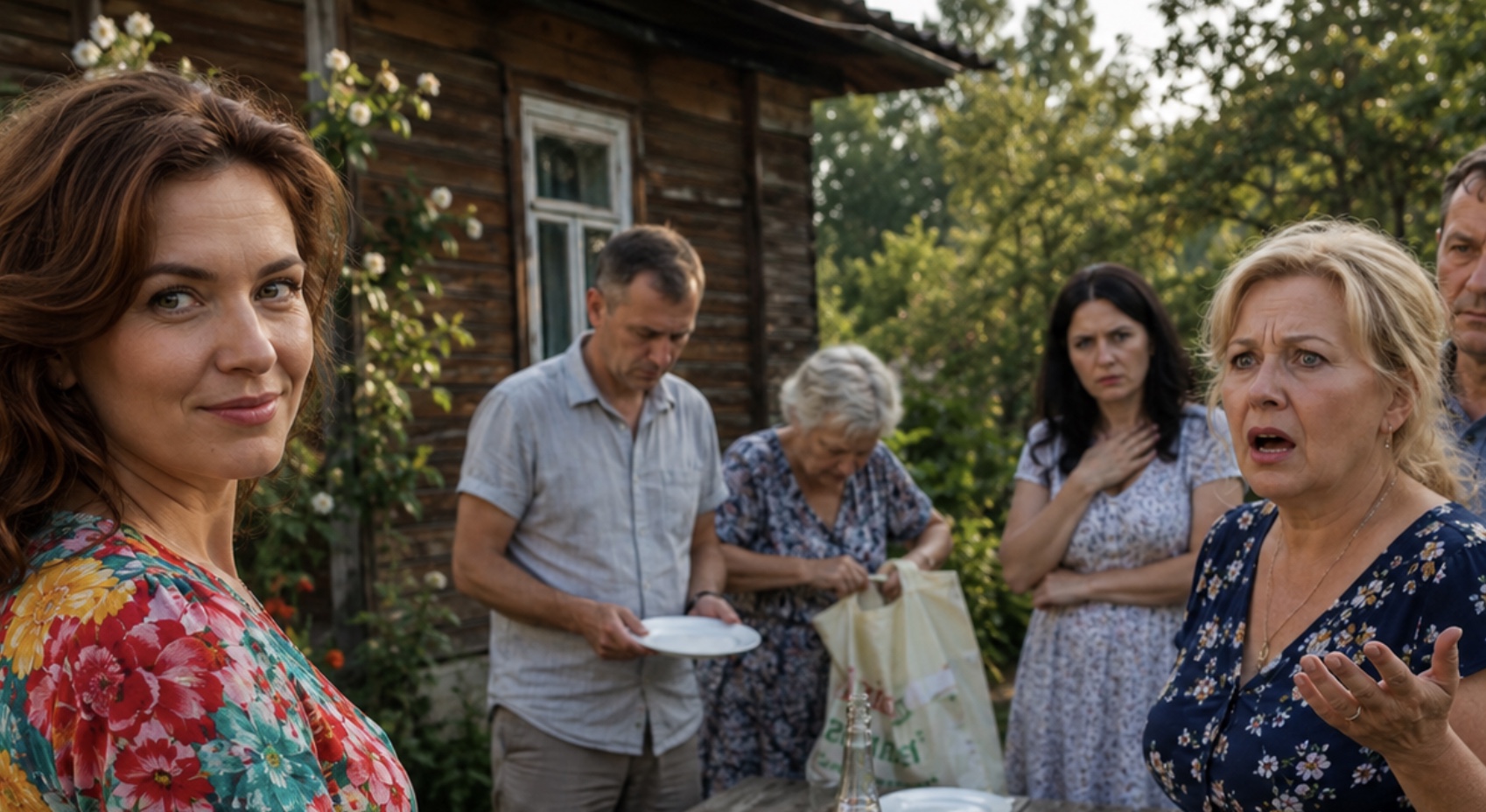
Aunt Valya was the first to set her bag down on the veranda. She looked over the table — completely empty, covered with a checkered tablecloth, without a single plate on it. For a second, her face fell as though she had just seen something improper.
“Tonya, did we come too early or something? The table isn’t even set.”
“Not too early,” I said, wiping my hands on my apron. “I was just waiting for you to unpack what you brought.”
Uncle Gena, Aunt Valya’s husband, had already made himself comfortable in a lounge chair and stretched out his legs with obvious pleasure.
“Oh, come on, Tonya. We’re not here to inspect the place. If there’s something to eat, bring it out. If not, we’ll just sit around and enjoy the fresh air.”
Their daughter Kristina, my cousin’s daughter, was standing in front of the hallway mirror, fixing her hair after the drive. She didn’t even turn around during the conversation. As far as she was concerned, a table at my country house simply set itself, as though some magical self-serving tablecloth came included with my responsibilities as the relative who happened to own a house outside the city.
I stepped into the middle of the veranda and looked at their bags. They were light, nearly empty. The corner of a beach towel stuck out of one.
Then I smiled — so hard that my cheeks almost hurt — and said:
“Well, you must have brought something for the table. I’ll serve you whatever you brought.”
Silence.
Aunt Valya looked at her own bag as though hoping a jar of homemade pickles might somehow materialize inside it.
Uncle Gena stopped rocking in his chair.
Kristina finally turned away from the mirror. What I saw in her eyes wasn’t embarrassment. It was something closer to outrage, as though I had done something unacceptable rather than them.
None of them realized that this would be the last time they ever came to my country house.
But to understand why I said those words at all, we need to go back a couple of months, to when the whole thing began.
I bought the country house in the spring, taking out a mortgage that I tried not to think about too often so I wouldn’t ruin my mood in advance. It was a small plot of land with an old but sturdy house, apple trees along the fence, and a well that frightened me at first but which I later grew to love because of its wonderfully cold water that somehow tasted like childhood.
I put more than money into that house. I put into it the part of myself that had grown tired of city apartments, crowded buildings, and living according to other people’s rules.
Naturally, I told my relatives about the purchase.
Their enthusiasm touched me at first.
“Finally!” Aunt Valya exclaimed over the phone. “Now we actually have somewhere to go on weekends instead of sitting in our concrete boxes all the time.”
I imagined us gathering there as one big noisy family, grilling meat, playing cards on the veranda until darkness fell, then drinking tea the next morning while looking out over the garden beds.
I imagined the house filled with laughter and warmth.
In a way, I wasn’t wrong.
There was certainly plenty of laughter.
The problem was that every one of those cheerful relatives arrived empty-handed.
The first time, I didn’t think anything of it.
Aunt Valya and Uncle Gena came at the end of May. All they brought was a good mood and endless compliments about how wonderful everything looked.
I had shopped in advance — meat, vegetables, wine — and we had a lovely evening.
When they left, Aunt Valya hugged me and said:
“Tonya, you’re wonderful. You really know how to host people.”
I smiled and told myself it was probably just a coincidence. Maybe they hadn’t had time to stop at a store. Everyone was busy. Things happened.
The second time, Kristina arrived with her husband and another couple they knew. I had never seen those people before in my life.
I only learned about their visit the day before, when Kristina called and cheerfully announced:
“Tonya, we’re coming over tomorrow, okay? We miss being out in nature.”
“Of course, come,” I said.
Then, after a short pause, I asked:
“Should I get anything special for your visit?”
“No, you already have everything,” Kristina laughed. “You’re the hostess. You always have everything organized.”
So once again, I did all the shopping myself.
I bought enough food for four people, two of whom I barely knew and whose names I only learned while we were sitting at the table.
The evening was loud and cheerful. They complimented the house, admired the garden, praised the view from the veranda, swam in a nearby lake, and relaxed as though they were on vacation.
Before leaving, Kristina promised they would definitely come again.
“This place is practically a resort,” she said dreamily.
I smiled while watching their car disappear down the road.
Only then did I feel something tighten unpleasantly inside me.
A resort.
For some reason, that word lodged in my mind like a splinter.
As summer gained momentum, so did the stream of visitors.
Relatives came alone, in pairs, and in entire groups — cousins, distant cousins, spouses, friends and partners I had met maybe two or three times in my entire life.
The routine became disturbingly predictable.
The day before, someone would call and ask whether they could come over.
Then came the second question, as though they were all reading from the same script:
“Do we need to bring anything?”
Every time, I answered honestly:
“Bring whatever you think would be useful. I don’t need anything specific. I’d just appreciate it if I weren’t the only person providing everything for the table.”
And every time, the response was essentially the same.
“You already have everything.”
“Why should we bring anything?”
“You’re such a good hostess.”
“Don’t worry about us.”
“We’re just coming to relax.”
I started counting.
Not only the money — although I was definitely counting that too, since the mortgage came due every single month — but also the number of times I heard, “You already have everything,” instead of something simple like, “We’ll bring potatoes,” or, “We’ll pick up meat on the way.”
The number of visits passed ten.
Not once — not a single time — did anyone arrive with anything more substantial than a bunch of wildflowers they had picked near my own property while I was standing at the grill cooking meat I had paid for myself.
My sister’s husband, Uncle Slava, once arrived without warning at all.
He brought three other people with him.
When he saw my surprise, he laughed.
“Tonya, don’t stress. We’re easy. Whatever you’ve got is fine.”
Whatever there was, naturally, was expected to come from me.
That evening, I ended up frying eggs and sausages for the whole group because I genuinely didn’t have anything else in the house. I hadn’t been expecting guests.
They ate the eggs with the expressions of people enduring temporary hardship.
Then, as Uncle Slava was leaving, he shook his head and said something that echoed in my mind for a very long time afterward:
“You really should keep more food stocked up, Tonya. You never know who might drop by.”
You never know who might drop by.
As though my country house wasn’t my private home, bought with my own money and maintained through my own work, but some roadside café that was supposed to feed anyone who happened to turn off the highway.
I began noticing how my mood changed whenever the phone rang and somebody asked:
“Can we come over?”
At first, I had been happy.
Finally, I thought, I would have people to share the happiness of owning my own place with.
Now I immediately became tense.
How many people were coming?
How much food would I need?
How much would it cost?
How many hours would I spend cooking while everyone else swam, played badminton, relaxed, and complimented me on what a wonderful hostess I was?
I tried being direct.
Once, when my cousin Marina called, I finally forced myself to say:
“Marina, please bring something for the table. Meat, vegetables, anything. It’s becoming difficult for me to feed everyone every weekend.”
“Of course we’ll bring something,” Marina replied lightly. “Don’t worry.”
They arrived empty-handed.
When I asked what had happened to the food they had promised to bring, Marina threw up her hands.
They had forgotten.
They had been busy.
Everything had been hectic.
But at least, she said, they had brought excellent moods with them.
And next time, she promised, they would definitely make up for it.
There was no next time.
By the middle of the summer, I realized I was no longer enjoying my own country house.
I would wake up in the morning and, instead of taking a cup of coffee into the garden, I would wonder who might call that day, who would arrive tomorrow, what groceries I needed to buy, and how much I would spend.
The house that was supposed to become my sanctuary had turned into a revolving door and a free boarding house where I was the only employee and everyone else considered themselves guests.
What hurt most was that it wasn’t even really about the money.
Although yes, the money mattered too.
It was about the attitude.
It was about the casual confidence with which people who called themselves family had apparently decided that my hospitality was simply something they were entitled to — an unlimited resource requiring neither gratitude nor contribution.
It was as though buying a country house meant I had signed an invisible contract promising to feed, entertain, and serve every relative who wanted a free weekend getaway, while receiving approving compliments in return.
I talked about it with my friend Olya.
She was the only person who always arrived carrying full bags and then tried to leave extra food in my refrigerator “for later.”
“Tonya, you realize they’re taking advantage of you, right?” she said one afternoon while pouring tea on the veranda. “They probably aren’t even doing it maliciously. They just know you’ll allow it.”
“I don’t allow it,” I protested. “I ask them to bring things. I ask every single time.”
“Yes,” Olya said. “And then when they bring nothing, you still cook for everyone. That’s the problem.”
Her words stayed with me.
I went over every visit in my head.
Even after asking them to contribute and watching them arrive empty-handed, I still went to the store.
I still cooked.
I still grilled.
I still set the table.
Because I couldn’t imagine having guests without feeding them.
It was how I had been raised. It was a habit. Maybe it was also a fear of looking like a bad hostess.
But that habit was slowly eating away at me — my time, my money, and the happiness I was supposed to feel in my own home.
By the end of the summer, I made a decision.
The next time someone asked whether they should bring something, promised that they would, and then still arrived empty-handed, I would no longer pretend everything was fine.
That next time came on the weekend when Aunt Valya, Uncle Gena, and Kristina called with the usual question.
“Tonya, we’d like to come tomorrow, if you don’t mind. Is that okay?”
“Of course. Come over,” I answered, just as I always had.
“Should we bring anything?”
I paused for a second.
Then I replied calmly, without sounding demanding, but firmly enough that there could be no misunderstanding.
“Yes, please bring something for the table. Meat, vegetables, bread — whatever you decide. It would really help me.”
“Absolutely,” Aunt Valya answered cheerfully. “Don’t worry. We’ll bring everything.”
I hung up the phone already knowing that her promise would probably turn out to be meaningless.
And this time, I decided I wasn’t going shopping.
For the first time all summer, I didn’t stock up the day before guests arrived.
They showed up around noon, cheerful and noisy, carrying lightweight bags.
Later, I discovered those bags contained only towels, swimsuits, and sunscreen.
Aunt Valya was the first one to notice the empty table on the veranda.
And that was when the conversation from the beginning of my story took place.
“Well, you must have brought something for the table,” I said with a smile. “So I’ll serve you whatever you brought.”
Uncle Gena gave an awkward laugh, clearly trying to turn the uncomfortable moment into a joke.
“Tonya, are you serious? We thought everything would be like usual.”
“Like usual?” I asked gently, though there was no smile left in my voice. “And what does ‘usual’ mean exactly? Usually I buy everything, cook everything, set the table, and you come here to relax. I specifically asked you to bring something. You said you would. So what did you bring?”
Aunt Valya’s face turned red.
She looked at her bag, then back at me.
“Tonya, you’re the hostess,” she said in exactly the same tone I had heard dozens of times that summer. “A good hostess always has something to put on the table. That’s basic hospitality.”
Kristina, who had been silent until then, joined in.
“Tonya, seriously, this is kind of… strange. We’re family. It’s not like we’re strangers visiting you.”
Something that had been building inside me all summer finally broke free.
Not as shouting.
Not as a scandal.
Just a calm, almost ordinary firmness.
“That’s exactly why I’m telling you this directly,” I said. “Because you’re family. I’m not obligated to run a permanent restaurant for relatives who arrive empty-handed and think that’s perfectly normal. I asked you to bring something, not because I wanted to test you, but because it has genuinely become difficult for me to do everything alone. Since you brought nothing, there isn’t much reason to sit here waiting to be served. You can help me in the garden — there’s plenty of weeding that needs doing. Or, if you don’t feel like working, you can go home. It’s your choice.”
The silence on the veranda became thick and almost tangible.
Uncle Gena stopped smiling.
Aunt Valya opened her mouth, then closed it again without saying anything.
Kristina snorted, turned around, and headed toward the car.
“I used to think you were cool,” she threw over her shoulder.
They left that same day, about twenty minutes after our conversation.
They didn’t even touch the tea or drink any of the cold well water I offered them before they went.
They drove away in silence.
No hugs.
No usual, “Thanks, we had a great time.”
I watched their car disappear around the bend.
And this time, I didn’t feel the unpleasant knot in my stomach that had followed me all summer.
I felt lighter.
As though I had finally taken off a heavy backpack I had been carrying for no good reason.
Of course, the family quickly rewrote the story to suit themselves.
About a week later, my mother called and cautiously asked what had happened.
Apparently Aunt Valya had been telling everyone that I had “sent my relatives away hungry,” that I had “become full of myself after buying a country house,” and that “a proper hostess would never treat guests like that.”
Curiously, no one mentioned the dozens of visits when they arrived empty-handed.
No one mentioned the evening when I had to fry eggs for an unexpected group of people.
No one mentioned all the times I had explicitly asked everyone to contribute something.
In their version of events, only one detail remained — my comment about serving whatever they had brought.
And somehow, that became proof that I was cold-hearted.
I listened to my mother repeat what everyone was saying and didn’t rush to defend myself.
Trying to explain yourself to people who have already decided who is right and who is wrong seemed pointless.
I simply told my mother the truth, calmly and without resentment.
“Mom, I’m not obligated to finance other people’s weekends. If their idea of hospitality is one person giving everything while everyone else only takes, then I don’t want that kind of hospitality.”
Aunt Valya, Uncle Gena, and Kristina never came to my country house again.
From time to time, I heard that they still considered me to be the one in the wrong.
They said things like:
“She invited everyone to her country house and then couldn’t even host them properly.”
“Tonya completely changed after buying that place.”
Whenever I heard those comments, what surprised me wasn’t even the bitterness.
It was how stubbornly people could distort reality simply to avoid admitting that they themselves had behaved thoughtlessly.
The country house, which had turned into a revolving door during the summer, gradually became what I had bought it to be in the first place.
My peaceful retreat.
Olya came over on weekends with bags full of groceries and the same cheerful mood everyone else had always claimed was enough.
Sometimes a couple of old friends visited too.
They always brought something for the table without needing to be reminded.
Not because there was some formal rule.
Simply because that was what people did when they respected someone else’s time, money, and effort.
We sat on the veranda until late at night, talking and listening to the wind moving through the apple trees.
Nobody treated my hospitality like something they were automatically entitled to.
Sometimes, in the evenings, I remembered Aunt Valya’s expression when she first saw the empty table and the confused way she had looked down at her own bag.
I never felt ashamed of what I had said.
I felt peaceful.
It was the particular kind of peace that comes when you finally stop trying to earn other people’s affection by exhausting yourself for them.
The house remained mine.
The garden remained mine.
And the quiet weekends, free from demanding voices and unspoken expectations, became mine too — deserved, honest, and finally undisturbed.