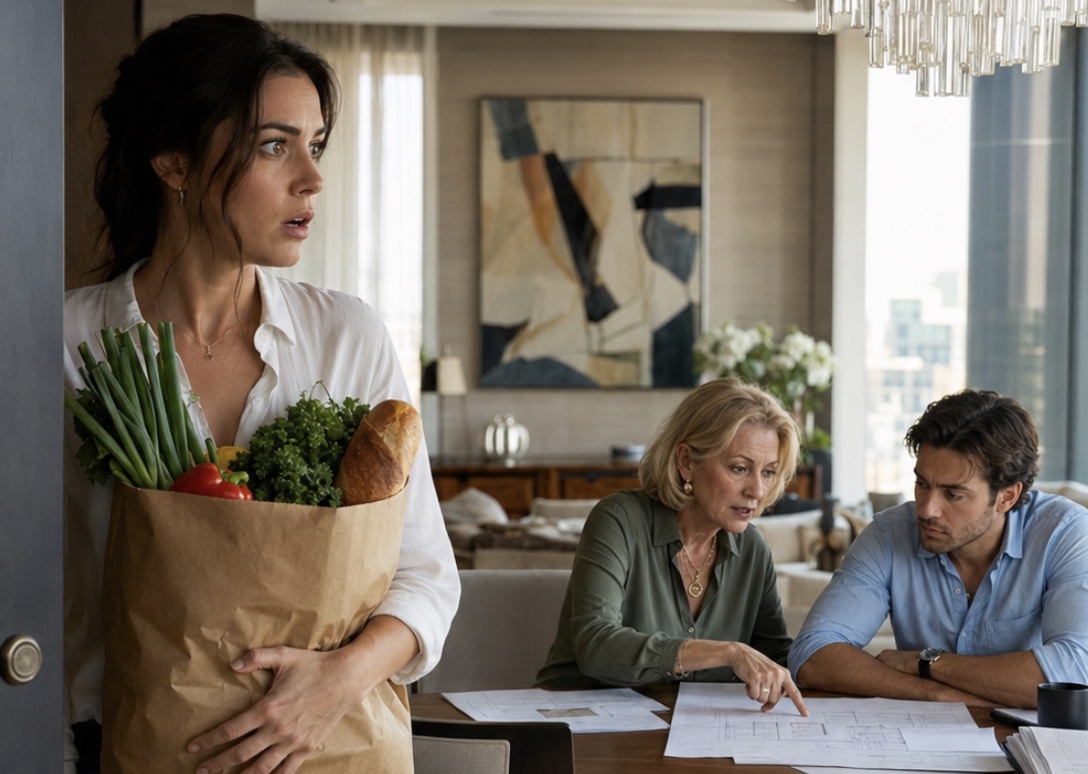
“Getting Inna to move out won’t be a problem. My son will persuade her,” Galina Nikolayevna said confidently from behind the half-open kitchen door. “The important thing is not to pressure her immediately. Tell her it’s only temporary. She’s a reasonable woman. She’ll understand.”
Inna stopped in the hallway, still holding two bags of groceries.
Outside, the July heat was thick and sticky. The apartment building smelled of hot dust and someone’s flowers, while inside the apartment the air was cool because the air conditioner had been running since morning. Inna had returned an hour earlier than expected after a contractor unexpectedly canceled a meeting at the gallery where she worked as an exhibition designer.
She had opened the front door quietly with her own key. Not because she had intended to listen to anyone’s private conversation. Her hands were simply full, and she had held the door with her shoulder to keep it from slamming shut.
Now she stood in the hallway, looking down at her sandals neatly placed beside the cabinet.
Her husband’s voice and her mother-in-law’s voice drifted from the kitchen. Galina Nikolayevna spoke with such confidence that she might have been discussing an unused storage room at her country house rather than another person’s apartment.
“Mom, Inna might not agree,” Roman answered uncertainly.
“She might not if you start mumbling and apologizing. So don’t mumble. Darya and Lyova have nowhere to live. She’s divorced, she has a child, and things are difficult for her. Inna has an entire apartment all to herself. You two can stay with her mother for a while or rent something inexpensive. You have to support your sister.”
Inna slowly placed the bags on the hallway cabinet.
One of them rustled softly as several apples rolled against each other. Without thinking, she steadied the bag with her hand so the sound would not reveal her presence too soon.
Darya was Roman’s younger sister. Inna had always treated her politely, although they had never been close. Darya was constantly facing some urgent crisis. She would borrow an expensive household appliance “for a couple of weeks,” ask Roman to drive her son to a doctor, or suddenly decide that she urgently needed someone else’s car.
Inna had never interfered as long as those requests did not involve her personally.
But judging by the conversation in the kitchen, that boundary had already been crossed.
“She won’t want to stay with her mother,” Roman said. “They have a two-bedroom apartment, her stepfather lives there, and so does her younger brother. That isn’t an option.”
“Then rent a place. Are you a man or not?” Galina Nikolayevna snapped irritably. “Better yet, tell her this: ‘Inna, we need to live separately for a while until Darya gets back on her feet.’ Don’t ask for permission. Present it as a decision. Women respect determination.”
Inna tilted her head slightly.
Not because she was confused, but because she wanted to hear more clearly.
Her face became perfectly still. For several seconds, she did not even blink.
“And how long would Darya stay here?” Roman asked.
“As long as necessary. Three months at least. Maybe six. She needs time to recover. It would be good for Lyova to live close to the park during the summer. Then we’ll see what happens when school begins.”
“Mom, the apartment belongs to Inna. She bought it before we got married.”
“So what? You’re her husband. You live there. That makes it your home too. Perhaps not legally, but morally.”
Without making a sound, Inna took out her phone, switched on the voice recorder, and slipped it into the pocket of her lightweight linen jacket.
Then she picked up the grocery bags and walked into the kitchen.
Roman was sitting at the table in a casual T-shirt. His phone lay facedown in front of him. Galina Nikolayevna sat opposite him, holding a glass of water.
They both fell silent immediately.
Roman turned pale so quickly that it was as though someone had switched off all his confidence.
Galina Nikolayevna, on the other hand, tried to maintain her composure. She raised her chin and adjusted the bracelet on her wrist.
Inna calmly placed the grocery bags on the counter.
“Please repeat the last few sentences,” she said. “Only this time, say them in front of the apartment’s owner.”
Roman stood up, then sat down again almost immediately, as though he could not decide which position would make him look less guilty.
“Inna, you misunderstood.”
“Excellent. Then explain it in a way that will help me understand correctly.”
Galina Nikolayevna recovered first.
“We were discussing a family situation. Darya has been left alone with a child. She’s having a difficult time.”
“I sympathize with Darya,” Inna replied. “But so far, I haven’t heard a conversation about helping Darya. I heard a conversation about removing me from my apartment.”
“There’s no need to cling to individual words.”
“I’m not clinging to words. I’m objecting to your attempt to decide what happens to my home.”
Roman raised both hands.
“No one is deciding anything. We were only thinking about the best solution.”
“The best solution for whom?”
He opened his mouth, but the answer did not come immediately.
Inna took a carton of milk from one of the bags and placed it in the refrigerator. Then she arranged the fruit in a bowl.
Her movements were precise and unhurried.
That calmness irritated Galina Nikolayevna more than shouting would have. She was used to people either defending themselves or raising their voices. Inna did neither.
“Inna,” Galina Nikolayevna continued more sternly, “you don’t have children. You have more freedom. Darya is in trouble.”
“Darya has a mother, a brother, her child’s father, and the option of renting a home. What she does not have is my apartment.”
“That’s a cruel thing to say.”
“It’s an accurate thing to say.”
Roman rubbed his face with one hand. Tiny beads of sweat appeared on his forehead even though the kitchen was cool.
“Inna, this really was meant to be temporary. Darya isn’t planning to stay forever.”
“Then she can temporarily live with her mother.”
Galina Nikolayevna gave a sharp, humorless laugh.
“I live in a one-bedroom apartment. You know that perfectly well.”
“I do. That’s why you decided mine would suit her better.”
“Yours is more spacious.”
“Mine is mine.”
Those three words landed heavily on the table, ending the discussion more effectively than any raised voice could have.
Roman suddenly pushed his chair back in irritation.
“You could at least think about it instead of immediately taking such a defensive position.”
Inna looked at him calmly, but her eyes had turned cold.
“I already thought about it. It didn’t take long because the question is simple. I will not leave my apartment. Darya will not move in here. And you will not discuss my property with your mother as though I were a piece of furniture. This subject is closed.”
“And what if I think you’re being selfish?”
“You’re free to think whatever you want. Your opinion does not give you the right to move your relatives into my home.”
Galina Nikolayevna stood up.
Her handbag was hanging from the back of the chair. She grabbed it so sharply that the strap caught on the corner. For several seconds, she pulled at it angrily, her face reddening.
“There you have it, Roma. Now you see what kind of woman you live with. Remember this day.”
“I’ll remember it too,” Inna said. “Especially the part about your son persuading me.”
Roman flinched.
“You heard everything from the beginning?”
“I heard enough.”
Galina Nikolayevna narrowed her eyes.
“Listening to private conversations is disgraceful.”
“Discussing how to remove the owner of an apartment behind her back is hardly the height of good manners.”
Her mother-in-law left the kitchen first.
Roman remained behind, apparently expecting Inna either to explain herself or to lose control.
Instead, she took a food container from the cupboard and transferred the berries into it. Then she picked up her phone and walked into the hallway.
“Where are you going?” he asked.
“To make a call.”
“To whom?”
“That’s none of your business.”
Inna did not call a friend or her mother.
She called Alina, a lawyer she had met the previous year while working on an exhibition project. Alina was not the kind of person who offered empty comfort. She immediately asked the questions that mattered.
“Was the apartment purchased before the marriage?” Alina asked.
“Yes. I’m the only registered owner. Roman isn’t officially registered at this address. His residence registration is at his mother’s apartment.”
“Where are the ownership documents?”
“In the safe at home. I also have an electronic property record.”
“Does he have keys?”
“Yes.”
“Could he have made copies?”
“I don’t know.”
“Then the first thing you do is remove the property documents, valuables, bank cards, and spare keys from the apartment today, or secure them somewhere he cannot access. Second, don’t have long verbal conversations unless you’re recording them. Third, if his relatives arrive with their belongings, do not let them inside. If they try to force their way in, call the police and report an attempted unlawful entry. Fourth, regarding the marriage: if he refuses to consent to a divorce, you’ll file through the court. He has no realistic claim to an apartment you bought before marriage, but he may still try to make the process difficult.”
“I understand.”
“And don’t tell him more about your plans than necessary. People who have already made decisions on your behalf should not be warned in advance about exactly how you intend to defend yourself.”
Inna ended the call and stood by the living room window for several seconds.
The courtyard below seemed to be melting in the heat. Children ran around the sandbox, a maintenance worker watered the flowerbeds with a green hose, and two women on a bench fanned themselves with advertising leaflets.
Roman was seeing his mother out.
From the hallway, Inna heard Galina Nikolayevna whisper loudly:
“Don’t give in. She’s trying to dominate you right now. She’ll calm down eventually.”
Inna did not calm down.
She began taking action.
That evening, while Roman was in the shower, she opened the safe and removed the apartment documents, the purchase agreement, old payment receipts, certificates, and copies of her passport. She placed everything in a folder inside her work bag.
She added her jewelry, a flash drive containing important files, and a spare bank card.
The next morning, she took everything to a private document-storage locker used by the gallery.
Then she checked whether Roman had access to any of her personal online accounts.
She changed all her passwords that same day.
Not because she was frightened, but because she understood something very clearly: trust ends when a person discusses removing you from your own home with his mother.
For the next three days, Roman behaved with unusual kindness.
He bought groceries, washed his own cups, and repeatedly asked whether Inna was tired.
She watched him without illusions.
She knew the difference between care and strategy.
Real care did not suddenly appear after a failed conspiracy.
On Thursday evening, he brought up the subject again.
“Inna, we need to discuss this calmly.”
She closed her laptop and looked at him.
“Go ahead.”
“I understand that my mother expressed herself too harshly. But Darya really is in a terrible situation. She has a son. She can’t keep moving from one rented apartment to another.”
“You and your mother can help her financially, search for an apartment, move her belongings, babysit, or do anything else that might help. My home is not included among the available resources.”
“You turn everything into a question of property.”
“Because this began with my property.”
Roman sat down across from her.
He had prepared himself. His face carried the patient expression of a man attempting to reason with someone he considered difficult.
“We’re husband and wife. We should have a united approach when close relatives are in trouble.”
“We should. That means you could have come to me and said, ‘Darya is struggling. Let’s think about how we can help her without violating your boundaries.’ Instead, you discussed with your mother how to persuade me to leave. Do you see the difference?”
He frowned.
“You’re dramatizing everything.”
“No. I’m calling things by their proper names.”
“And what if I don’t want to live with a woman who turns her back on my family when they’re in trouble?”
Inna gave him a slight smile.
“Then perhaps you should live with your family.”
Roman stared at her.
He clearly had not expected his own argument to be returned to him so quickly.
“Are you throwing me out?”
“For now, I’m asking you to consider where your family ends and my apartment begins.”
He jumped to his feet.
“So this is it? I’m nobody here?”
“You are here as my husband. Or you were, until you decided that being my husband gave you the right to control something that does not belong to you.”
Roman heard the word “were” immediately.
His expression changed.
He walked to the window, then turned back, but did not create a scene. Roman was not stupid. He understood that applying more pressure at that moment would be dangerous.
Inna’s calmness meant that she had already made a decision.
The following day, Roman stayed late at work and returned home long after his usual time.
Inna did not ask where he had been.
On Saturday morning, he announced that he was going to his mother’s apartment to help install shelves in her storage room.
Inna merely nodded.
As soon as the door closed behind him, she called a locksmith and asked him to replace the lock cylinder.
She did not write any notices, ask anyone’s permission, or pretend to be helpless.
Two hours later, the locksmith arrived, completed the work, and handed her a new set of keys.
Roman’s old keys no longer worked.
Inna had no intention of starting a secret war.
She sent her husband a message:
“The lock has been changed. Your belongings are packed in boxes. You may collect them today before eight in the evening while I am present. You will no longer have keys to the apartment. We can discuss the divorce voluntarily, or through the court if you refuse to cooperate.”
His reply came almost immediately.
“Have you lost your mind?”
Inna typed:
“No. I’ve come to my senses.”
Roman arrived shortly before seven.
He was not alone.
Galina Nikolayevna and Darya were with him. Darya was holding her son Lyova’s hand, and two enormous suitcases and a large checkered bag stood near the entrance downstairs.
Inna saw them through the peephole and gave a quiet, humorless smile.
Even after discovering that the lock had been changed, they still had not understood.
She opened the door but left the security limiter in place, allowing the door to open only a few inches.
“Inna, open this door immediately,” Roman said in a low voice.
“Did you come for your belongings?”
“I came home.”
“Your registered residence is your mother’s apartment. This is my home.”
Galina Nikolayevna pushed closer.
“Stop this ridiculous performance. There’s a child standing on the staircase.”
“You are the ones who brought a child onto the staircase.”
Darya looked angry and exhausted. Her light hair was pulled into a tight ponytail, and her face shone with sweat from the heat. Lyova clutched a toy car to his chest and looked uncertainly from his mother to the partly opened door.
“Inna, you can’t behave like this,” Darya said. “We haven’t come to strangers.”
“You have come to property that belongs to a stranger.”
“I’m your husband’s sister!”
“That does not give you the right to live here.”
Roman pulled the door toward himself.
“Open it properly.”
Inna did not move back.
“Pull it again, and I’m calling the police.”
“Go ahead and call them!” Galina Nikolayevna shouted. “Let them see a wife refusing to let her husband into his own home.”
Inna took out her phone and dialed the emergency number.
She spoke briefly and without emotion: the address, an attempted entry into her apartment without the owner’s consent, several people arriving with luggage, a man pulling at the door, and a child present at the scene.
Roman immediately removed his hand.
“Are you completely insane?” he hissed.
“Be careful with your language. This conversation is being recorded.”
Galina Nikolayevna’s face turned crimson.
“You’re recording us?”
“Since the moment you arrived to move into my apartment.”
Darya turned sharply toward her mother.
“Mom, you said she would agree.”
“She was supposed to!” Galina Nikolayevna blurted out before realizing what she had said.
Inna looked at Darya.
“Darya, let’s speak honestly now. Who told you that I had agreed?”
Darya remained silent.
“Roman? Galina Nikolayevna? Or did you decide on your own that my consent wasn’t necessary?”
Darya looked away.
Lyova tugged at her hand.
“Mom, are we going home?”
The question struck Darya, not Inna.
For the first time, she looked properly at the suitcases, her overheated child, her brother standing before a locked door, and her mother still swelling with outrage.
“Roma,” Darya said quietly but firmly, “you told me Inna knew about this.”
Roman opened his mouth.
“I intended to reach an agreement.”
“You said everything had already been settled.”
Galina Nikolayevna interrupted them.
“This is not the time to argue. Inna is simply trying to show everyone how powerful she is.”
Inna smiled coldly.
“No, Galina Nikolayevna. I will be showing the police my ownership documents when they arrive.”
The neighboring door opened slightly.
Viktor Stepanovich, an elderly man who had lived next door for years, looked out onto the landing. He knew Inna well. She had once helped him arrange a plumber when a faucet in his apartment began leaking.
“Inna, is everything all right?” he asked.
“They’re trying to enter my apartment with their belongings without my consent.”
“I understand. I’ll stay here.”
Galina Nikolayevna turned toward him sharply.
“Don’t interfere in a family matter.”
“When a family matter starts shouting in the stairwell, it becomes a public matter,” the neighbor replied calmly.
The police did not arrive immediately, but they came soon enough.
Two officers came upstairs and listened to everyone’s version of events. Inna showed them her passport and the electronic extract from the Unified State Register confirming that she was the apartment’s sole owner.
Roman began explaining that he was her husband, that he lived there, and that she had no right to “throw him onto the street.”
Inna did not argue.
She simply explained that he was not an owner, was not officially registered at the address, and had been given keys only because he was her spouse. After he attempted to move other people into the apartment without the owner’s consent, his access had been revoked.
His personal belongings had been packed and would be returned to him.
The officers did not attempt to conduct a family trial in the stairwell.
They advised Roman to collect the necessary belongings peacefully and resolve any further disputes through the appropriate legal procedures.
Inna opened the door fully only after Darya and Lyova moved closer to the elevator and Galina Nikolayevna stopped trying to issue orders.
Roman entered the apartment under the watchful eyes of the officers and the neighbor.
Three boxes and two bags stood in the hallway.
Inna had packed his clothes, shoes, documents, chargers, tools, books, and sports equipment.
She had thrown nothing away, damaged nothing, and hidden nothing.
She was not interested in revenge.
She wanted a clean, defensible position.
“You prepared everything in advance,” Roman said quietly.
“Of course.”
“So you were waiting for an excuse.”
Inna studied him carefully.
“No. I saw a reason, and I refused to pretend it was an accident.”
He picked up one of the bags, then stopped.
“We could still fix this.”
“You could have fixed it on the day I entered the kitchen. You could have told your mother that the apartment belonged to me and the discussion was over. Instead, you chose to negotiate.”
“I was thinking about my sister.”
“You were thinking about what you could use to pay for her problems. You chose me. You chose incorrectly.”
Roman did not answer.
He carried one box onto the landing, then returned for another.
Galina Nikolayevna attempted to argue with the officers, but no one was listening to her anymore.
Darya sat on one of the suitcases near the elevator, keeping her son beside her. The anger in her face had been replaced by a heavy realization.
She had not merely been denied entry into an apartment.
She had been used as an excuse for a family takeover by people who had never even checked whether their plan had any legal basis.
When Roman carried out the final bag, Inna held out her hand.
“The old keys.”
He looked at her with hatred.
“They don’t work anymore.”
“Then there should be no problem returning them.”
They stared at each other for several seconds.
Finally, Roman took out his key ring and dropped it into her palm.
Inna removed her old apartment keys and returned the rest of the ring to him.
“These belong to you.”
He wanted to say something, but the officer standing nearby cleared his throat, and Roman restrained himself.
The door closed quietly behind them.
Inna locked the new lock, then secured the second one.
The apartment suddenly felt unusually empty.
Not lonely.
Empty in the way a room feels after someone removes a large, unnecessary piece of furniture that has blocked the path for years.
The following day, Roman sent her a long message.
It was filled with accusations, wounded pride, and claims that she had destroyed their marriage over an “ordinary request.”
Inna read the first few lines and forwarded the entire message to Alina.
The lawyer’s response was brief:
“Do not respond emotionally. Discuss practical matters only.”
Inna followed her advice.
She wrote:
“I am prepared to discuss the divorce through the court or by mutual agreement if you are willing. Your personal belongings have been returned. Your access to the apartment has been terminated. All further communication must be in writing.”
Roman refused to consent to the divorce.
He was convinced Inna would be frightened by the court process, family gossip, and pressure from his mother.
But Inna was not frightened.
She filed for divorce through the court because her husband opposed the separation and attempted to delay the process.
They had no children. There was no significant jointly owned property requiring a complicated division. Inna had purchased the apartment before the marriage, and the documents proved it.
Galina Nikolayevna attempted to pressure Inna through other relatives.
She called Inna’s mother, Nadezhda Sergeyevna, and complained that her daughter had “thrown her husband onto the street.”
Nadezhda Sergeyevna listened until the end and then asked:
“Why was your son planning to move his sister into my daughter’s apartment?”
The conversation ended soon afterward.
Later, Galina Nikolayevna sent Inna a message:
“You’ll regret this. No one needs a lonely woman when she grows old.”
Inna did not reply.
She took a screenshot and saved it in a folder.
By then, she had created a separate archive containing recorded conversations, messages, photographs of the luggage outside her door, and the details of the police call.
She did not intend to wave the evidence dramatically in front of everyone.
Inna simply understood how to calculate risks, and she did not trust people who behaved aggressively first and portrayed themselves as victims afterward.
The first court hearing took place a month later.
Roman arrived in a light-colored shirt, wearing the expression of a man who had been unfairly forced to defend himself.
Galina Nikolayevna waited in the courthouse hallway even though no one had invited her. She stared heavily at Inna but remained silent.
Apparently, Roman had finally explained that a courtroom was not his mother’s kitchen.
The judge asked the usual questions.
Roman said that he did not want a divorce, that the conflict could be resolved, and that his wife was hot-tempered and unwilling to understand his family’s circumstances.
Inna listened with a thin folder resting on her lap.
When the judge asked for her position, she answered calmly:
“Preserving the marriage is impossible. I lost trust in my husband after he and his mother discussed removing me from an apartment that belongs exclusively to me and then attempted to bring third parties there without my consent.”
Roman glanced at her.
“That’s an exaggeration.”
Inna handed over printed copies of the messages and explained that she was prepared to provide an audio recording if necessary. She had become part of the recorded conversation when she entered her own kitchen.
The judge did not listen to the recording immediately but noted the documents.
Roman no longer looked confident.
The court granted them time for reconciliation, but Inna did not reconsider.
She did not meet Roman for private conversations, did not agree to “just talk,” and did not allow Galina Nikolayevna to approach her home.
Her mother-in-law appeared outside the apartment building once and tried to wait for Inna in the evening.
Inna noticed her from a distance, walked past the building to a nearby shop, and called Viktor Stepanovich. She asked him to watch from his window and tell her when Galina Nikolayevna left.
Fifteen minutes later, the neighbor informed her that the woman had entered a taxi.
Inna returned home calmly.
She saw no reason to participate in theatrical confrontations outside her own entrance.
Meanwhile, the summer grew hotter.
The city smelled of heated asphalt and linden blossoms.
Inna worked, met with designers, and prepared the gallery’s autumn exhibition.
She unexpectedly noticed that she became tired more quickly, yet woke more easily in the mornings.
There was no longer a man beside her who could smile over breakfast and later discuss with his mother how to remove her from her own home.
Darya called her in August.
Inna was surprised, but she answered.
“I’m not calling to ask for a place to live,” Darya said immediately.
“That’s good.”
“I wanted to tell you that I didn’t know they had never spoken to you. Roman insisted that you had agreed and were simply uncomfortable handing me the keys in person. I was angry that day, but afterward I understood how the situation must have looked.”
Inna stood near the window in her office at the gallery.
Outside, workers were unloading wooden crates containing exhibition pieces.
“Darya, you are an adult. Before arriving at someone else’s apartment with suitcases, you could have called the owner.”
The line went quiet.
“Yes. I could have. I was wrong.”
Inna had not expected that answer.
“What happened with the apartment?”
“I rented a studio near Lyova’s kindergarten. It’s small, but there’s enough room for the two of us. Mom is unhappy. She says I should have insisted. But I’m tired of living according to her commands.”
“It’s your life.”
“I understand that now. And there’s something else. Roman tells everyone that you threw him out because of me. I told him to stop hiding behind my name.”
Inna’s voice softened slightly.
“You were right to say that.”
“He was offended.”
“He’ll survive.”
Darya gave a short, unexpected laugh.
“You’re tough.”
“No. I’m careful. Some people confuse careful boundaries with cruelty when those boundaries prevent them from taking what belongs to someone else.”
They did not speak again after that, but Inna’s anger toward Darya weakened.
There had not been only one guilty person.
The real problem was a family habit of assuming they could cut a piece out of the quietest person’s life and call it assistance.
The divorce was finalized in the autumn.
By then, Roman was no longer resisting so actively.
Perhaps he was tired.
Perhaps he had finally understood that he would never receive a share of the apartment and that there would be no reconciliation.
After the final hearing, he approached Inna in the courthouse corridor.
“Did you honestly never have doubts?”
She placed the documents inside her bag.
“I had doubts.”
His expression brightened.
“And?”
“I questioned myself. Not you. You had already made everything about yourself clear.”
Roman tightened his jaw.
Some part of him still hoped to hear that she had suffered, missed him, or waited for an apology.
Inna refused to give him that power.
“You’ve changed,” he said.
“No. I’ve always been this person. It was simply more convenient for you to imagine I was softer.”
He wanted to argue, but other people emerged from the courtroom, and their conversation dissolved into the general noise.
Roman walked toward his mother, who was waiting near the window.
Galina Nikolayevna looked at Inna as though she still believed she could change something through the force of her stare.
Inna walked calmly past her.
At home, she opened the door with her new key and paused in the hallway.
It was already evening, but the air still held the last traces of summer warmth.
An empty key bowl stood on the cabinet.
Roman’s key ring used to lie there, along with a keychain bearing the logo of an auto-repair shop, old receipts, loose coins, and forgotten batteries.
Now only Inna’s keys remained.
She walked into the kitchen.
The same table where Galina Nikolayevna had discussed removing her from the apartment was clean.
A plate of peaches and a glass pitcher of water stood on its surface.
Inna poured herself a glass, took several sips, and looked at the city through the window.
She did not feel like a triumphant victor, at least not in any beautiful or cinematic sense.
Victory is rarely beautiful when family is involved.
Sometimes victory looks like cardboard boxes in a hallway, police officers on a staircase, screenshots, court hearings, and conversations no one wants to have.
But afterward, there is silence.
A silence in which no one decides where you will live without asking you.
A week later, Inna called the locksmith again.
Not because she urgently needed protection, but because she had decided to install an additional, more secure lock.
The locksmith arrived in the morning and completed the work quickly.
Inna paid him, tested the new keys, and locked the door from the inside.
There were no announcements.
No requests.
No permission sought from people who had no right to give it.
The owner of the apartment had simply strengthened her own door.
That evening, she stepped onto the balcony with a plate of chilled cherries.
The summer courtyard was noisy below. Someone laughed near the entrance. Children argued over a scooter. A car door slammed in the distance.
Inna watched the ordinary life below and thought about how easily people labeled the simple word “no” as cruelty.
No, I will not move out.
No, my apartment is not an emergency landing place for your adult daughter.
No, marriage does not make a husband the co-owner of property that does not belong to him.
No, I will not become the convenient price paid for someone else’s problems.
She took out her phone.
There were no new messages from Roman.
Galina Nikolayevna had also fallen silent.
Darya had sent her one brief message several days earlier:
“Lyova and I are managing.”
Inna had replied:
“Good.”
And it truly was good.
Inna did not become a generous fairy godmother for someone else’s family.
She did not become a hysterical former wife who screamed in the stairwell and destroyed her husband’s belongings.
She did not become a woman who could be persuaded, shamed, manipulated through a child, pressured by relatives, or controlled through speeches about duty.
She became the person she had always been before marrying Roman:
the owner of her own life.
The only difference was that now everyone else knew it too.