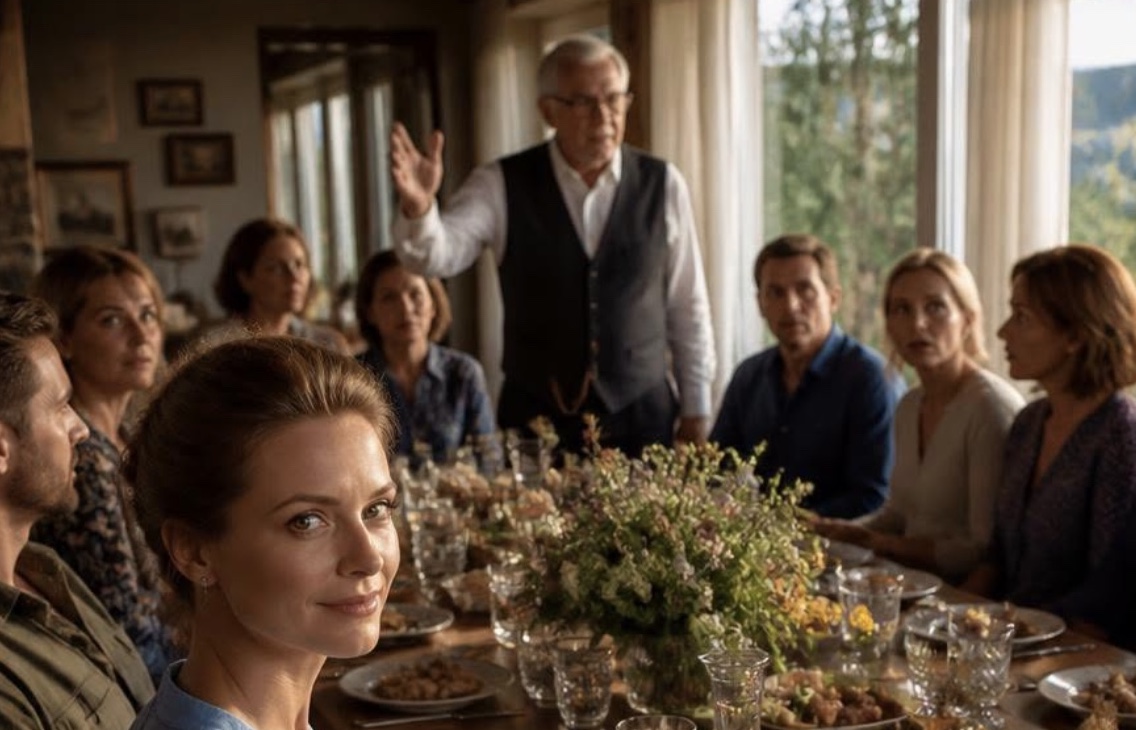
At the family dinner, her father-in-law announced what he had decided to do with the house. Everyone expected an argument. But Lida merely smiled and remained silent, because she knew something no one else at the table knew.
Her father-in-law rose from the table while everyone was still eating. He lifted one hand, and the conversations died away.
Lida set down her fork. She knew Gennady Pavlovich was not the kind of man who stood up to make a toast. If he had risen from his chair, he had something else to say.
“All right, listen,” he began, looking around the table, where about twelve people were seated. “I spent forty years building this house. I built it with my own hands. And I have decided who will inherit it.”
The silence became so complete that they could hear the fruit drink bubbling on the stove.
Beside Lida, Kostya tensed. She felt it when his foot shifted beneath the table and brushed her ankle. He had not done it deliberately. His body had simply reacted before his mind had caught up.
Across from them sat Zoya, the eldest daughter-in-law. She stopped cutting her meat and froze with the knife still in her hand. Her lips parted slightly, but she did not make a sound.
“The house will go to Artyom,” Gennady Pavlovich said.
Then he sat down.
Artyom was the youngest son. He was twenty-four, unmarried, without children, renting a room in Tver and working occasional shifts at a warehouse. He sat at the far end of the table, pushing vinaigrette around his plate, and seemed not to understand what had just happened.
Zoya put down her knife. Slowly and carefully, perfectly parallel to the edge of her plate.
“Wait, Dad,” said Valery, her husband and Gennady Pavlovich’s middle son. “We have spent fifteen years patching the roof, rebuilding the fence, putting up the bathhouse. And the entire house goes to Artyom?”
Gennady Pavlovich looked at him as though Valery had asked what two plus two was.
“I have spoken.”
Lida stared at her plate. Her cutlet was growing cold, and the gravy was beginning to congeal around the edges. She raised her eyes and met Zoya’s stare. Zoya was watching her intently, apparently waiting for Lida to protest as well.
Instead, Lida smiled.
Just slightly, with only the corners of her lips.
Then she picked up her fork again.
After dinner, everyone scattered through the house in the way people do after news like that: technically still together, yet each trapped inside their own thoughts.
Zoya washed the dishes with an expression that suggested the plates themselves were personally responsible. Crockery clattered against the sink. Valery smoked on the porch even though he had quit three years earlier.
Kostya stood by the window in the upstairs bedroom. Lida entered and closed the door behind her.
“Why didn’t you say anything?” he asked without turning around.
“What was I supposed to say?”
“I don’t know. Zoya looks like she’s about to smash every plate in the house.”
“Let her smash them. They’re her plates.”
He turned to face her. He looked confused, like a little boy who had not received a present on New Year’s morning.
“Lida, we’re talking about the house. Dad’s house. We come here every summer. Our children grew up here.”
“They spent their summer holidays here. That isn’t the same thing.”
Kostya rubbed the bridge of his nose. It was a habit that appeared only when he could not decide whether to become angry or agree with her.
“Artyom can’t even afford the repairs. He earns thirty thousand a month.”
“That’s Artyom’s problem.”
“It’s the house’s problem. The place will rot away within five years.”
Lida sat on the bed. The springs squeaked. That bed had squeaked even when she and Kostya had first arrived there as newlyweds, back when she had been too embarrassed to move during the night.
“Kostya, listen to me. Your father has made his decision. He has the right.”
“He has the right. But what about fairness?”
She did not answer. Fairness was a word that had made her palms itch for years.
The house stood at the edge of the village of Sosnovka, a hundred and seventy kilometres from Moscow. It was built from logs, raised on a high foundation, with a veranda that Gennady Pavlovich had added in 1992. The roof was covered with metal tiles—the same roof Valery had repeatedly patched.
Lida remembered the house as it had once been.
The first time she and Kostya came there, she was twenty-three. It was November, mud reached almost to their knees, and the wind blew through the cracks around the windows so strongly that the curtains moved.
Her mother-in-law, Tamara Ilyinichna, was still alive then. She had been a small, wiry woman whose hands smelled of dill and laundry soap. She had placed a bowl of cabbage soup in front of Lida and said:
“Eat. You’re far too thin.”
Lida had eaten. The soup was too salty, but she finished every drop. Tamara Ilyinichna nodded as though Lida had passed an examination.
Thirteen years had passed since then.
Tamara Ilyinichna had died five years before this family dinner. Sometimes Lida wondered whether the entire situation with the house would have unfolded differently if she were still alive.
Then again, perhaps it would not have.
That evening, Zoya came into their room without knocking, as though it belonged to her.
“May I come in?” she asked, already standing inside.
Lida was sitting on the bed, scrolling through her phone. Kostya had gone to see his father, supposedly to help him with the generator.
“Come in.”
Zoya sat on the chair beside the window. She was a large, broad-shouldered woman with heavy hands that she always rested on her knees whenever she was nervous.
They were on her knees now.
“What do you think about all this?” she asked.
“About the house?”
“About the house, about Artyom, about everything.”
Lida put down her phone.
“I think Gennady Pavlovich knows what he is doing.”
“Knows what he is doing? He is giving the house to a boy who last came here two years ago. For half a day. He arrived, ate a bowl of borscht and left.”
Zoya spoke evenly, but her fingers had turned white against her knees.
“And what about us? We come here every summer. Valery rebuilt the fence. I take care of the vegetable garden. The tomatoes are mine, the strawberries are mine, I pruned the apple trees. Thirteen years, Lida.”
“I know.”
“Then why are you silent? You and Kostya aren’t strangers here either. If we all speak to his father together…”
“What exactly would we say?”
“That it isn’t fair.”
That word again.
Lida lightly bit her lower lip.
“Zoya, answer me honestly. Do you actually want this house?”
Zoya blinked. Apparently, it was not the question she had expected.
“We want justice.”
“That isn’t an answer. Do you want the house? Do you want to live in it, heat it, maintain it, repair it and pay the taxes?”
Zoya said nothing.
Something rustled outside the window. Perhaps a cat had run across the roof of the shed.
“We have an apartment in Odintsovo,” Zoya finally said. “We only come here in summer…”
“Exactly. In summer. For two months.”
Zoya straightened.
“Artyom doesn’t even come here in summer. What difference does it make?”
“It makes a great deal of difference. But it isn’t my business. And, Zoya, it isn’t yours either. It is Gennady Pavlovich’s decision.”
Zoya stood. The chair slid backwards and struck the windowsill.
“You’re strange, Lida. You always have been.”
She left without slamming the door. She merely closed it in a way that made it perfectly clear the conversation was over.
Lida lay in the darkness, listening to the house breathe.
Old houses breathe, especially at night. Logs crack quietly, floorboards groan, and the wind hums through the chimney even when the stove has long since been replaced with a boiler.
Kostya returned late. He lay down beside her, smelling of tobacco and something sour—perhaps apples from the garden, perhaps alcohol.
“Are you awake?” he whispered.
“I’m awake.”
“I spoke to Dad.”
“And?”
“He said Artyom is alone. Valery and I both have somewhere to go, but Artyom doesn’t.”
Lida rolled onto her back. The ceiling in that room was so low that she could have touched it by standing on her toes.
“What else did he say?”
“That Mom would have wanted the same thing.”
Silence.
A dog barked somewhere far away—not a village dog, but a duller sound coming from beyond the forest.
“Lida.”
“What?”
“Are you really not upset?”
She thought about it.
Not about the house, but about the day twelve years earlier when their eldest son, Misha, had been christened there. Tamara Ilyinichna had baked pies, and Gennady Pavlovich had made a swing in the yard.
It was wooden, built from birch, and still stood there. Only the ropes had been replaced.
Misha had first used it when he was eighteen months old. He had squealed so loudly that the neighbour’s cat fled across three gardens.
“No,” Lida said. “I’m not upset.”
“Why?”
She turned to him.
“Because it isn’t our house, Kostya. It never was.”
Morning smelled of pancakes and approaching scandal.
Zoya and Valery sat at the table opposite Gennady Pavlovich. Artyom smoked on the porch, and through the window they could see his hand trembling around the cigarette.
“Dad, we want to discuss this calmly,” Valery began.
Gennady Pavlovich spread butter over a pancake. The knife moved evenly from one edge to the other.
“Go ahead.”
“Zoya and I think the house should be divided. Or at least discussed.”
“There is nothing to discuss.”
“Dad.”
“I can hear you. There is nothing to discuss.”
Zoya leaned forward.
“Gennady Pavlovich, we have invested fifteen years in this house. Money, time and physical labour. Do you remember the roof? Valery spent two summers repairing it. We built the bathhouse. I took care of the garden…”
“The vegetable garden is yours,” her father-in-law said calmly. “Take it. The seedlings, the shovel, everything growing in the beds. It is all yours.”
Zoya pressed her lips together. Lida saw a thin vein appear in her neck, pulsing rapidly.
“You can’t be serious.”
“I am entirely serious, Zoya. The house belongs to me. I built it. I decide what happens to it.”
Valery placed one hand on the table. Lida noticed that his knuckles had turned white.
“We’ll speak to a lawyer.”
“Go ahead.”
Two words.
Gennady Pavlovich took a bite of pancake and chewed while staring out the window. In the yard, Artyom put out his cigarette and stood with his hands in his pockets.
Lida drank her tea.
It was made from herbs. Tamara Ilyinichna had once dried so much mint and thyme that there still seemed to be an endless supply. Every summer, Lida found another bundle inside the cupboard, wrapped in newspaper and tied with string.
The woman had been gone for five years, but her herbs remained.
Lida took a sip and caught Artyom’s eye through the glass. He was looking at her, and there was something in his expression she had never noticed before.
Confusion.
Or guilt.
Perhaps both.
After breakfast, Lida went outside.
It was September, but the sun still felt warm enough for summer. The apple trees were heavily laden, their branches bending towards the ground.
Zoya was right: she and Valery had cared for the orchard. They came every spring, whitewashed the trunks, cut away the dead branches and sprayed the trees against aphids.
Lida walked to the swing.
The same birch swing. New ropes, but the crossbar was still the original one—darkened with age, with a crack running through its centre.
Artyom approached from behind. She recognised his footsteps. They were soft, as though he were afraid of disturbing her.
“Lida.”
“Yes?”
“Did you know? That he was going to make this decision?”
“No.”
“But you weren’t surprised.”
“No, I wasn’t.”
He stood beside her, leaning one shoulder against the swing’s support.
“I don’t need this house.”
Lida looked at him.
Artyom was thin and sharp-cheeked, with his father’s eyebrows and his mother’s chin. His lips were narrow, his hands slender. He was twenty-four, yet sometimes he looked twenty and sometimes forty.
It was difficult to say.
“Then why are you keeping quiet? Tell him.”
“I can’t.”
“Why not?”
“Because it would hurt him. He is giving me something. Not an apartment, not money. His house. His entire life.”
Lida took hold of one of the ropes. It was rough and new, carrying the dry smell of hemp.
“Artyom, what do you want?”
He was silent for a long time.
Somewhere nearby, a crow called, its voice carrying across the village all the way to the forest.
“I want my father to stay alive for as long as possible. And I want him to stop thinking I’ll disappear without him.”
“Will you?”
“No. I work. I rent a room. I’m doing fine.”
“Then tell him that.”
“You don’t understand. This is how he shows love. Through objects. Through the house. Mom did the same thing—with pies and jars of jam. She labelled one for each of us. She wrote our names on the lids with a marker.”
Lida released the rope.
Names written on jar lids.
She remembered.
“For Kostya.”
“For Valery.”
“For little Tyoma.”
The letters had been rounded and almost childlike.
“I remember,” she said quietly.
“That’s what I mean. How can I say, ‘Dad, I don’t want it’? It would be like smashing one of Mom’s jars of jam on the floor.”
That afternoon, Rita arrived.
She was Gennady Pavlovich’s sister, seventy-one years old, small and dressed in a knitted cardigan the colour of dusty roses. She carried a walking stick that seemed to serve more as a symbol of authority than an actual necessity.
“Well?” she said from the doorway, looking over everyone as though she had arrived to conduct an inspection. “Who is dying?”
“No one,” Gennady Pavlovich replied.
“You wouldn’t know it from everyone’s faces.”
Rita sat at the table, removed her cardigan and hung it over the back of her chair. Beneath it, she was wearing another cardigan.
Lida poured her some tea.
“Thank you, dear. At least one person here is sensible.”
Zoya snorted from beside the stove but said nothing.
“Gena,” Rita said, looking at her brother. “Valery called me. He says you’re signing the house over to Tyoma.”
“I’m not leaving it to him in a will. I’m transferring it as a gift.”
“Same thing.”
“No. A gift deed cannot be revoked.”
Valery, who was standing against the doorframe, flinched.
Lida saw his mouth open and close. Beside him, Zoya folded her arms across her chest.
“Gena,” Rita said, taking a sip of tea and grimacing, either because it was hot or because it was bitter, “do you remember how our father divided his property?”
“I remember.”
“He made his own decision too. You received the house, and I received the apartment. A one-room flat in Kalinin. I was angry with you for thirty years.”
“You’re still angry.”
“No. I’m seventy-one now. I have high blood pressure and a cat. I don’t have the energy to stay angry.”
Gennady Pavlovich smirked.
For the first time in two days, Lida saw something resembling warmth in his expression.
“Rita, I didn’t ask for advice.”
“I’m not giving you advice. I’m telling you what happened. Our father thought you needed the house more. You had a family, children and a job at the collective farm. I was alone, so he assumed one room would be enough for me. He never asked whether it actually was.”
Silence.
The old clock on the wall ticked. It had a cuckoo that had stopped calling years ago.
“Toma, your wife, told me something afterwards,” Rita continued. “She said, ‘Gena knows his father was wrong, but he will never admit it because the arrangement suits him.’”
Gennady Pavlovich set down his mug.
Not violently, but firmly.
It was a thick ceramic mug decorated with a painted rooster, and it made a dull sound against the table.
“Toma said many things.”
“Toma was a clever woman. Cleverer than both of us.”
Lida went out into the garden.
She needed air, not because the house was stuffy, but because its walls remembered too much, and sometimes the weight of those memories became unbearable.
She walked as far as the fence—the same fence Valery had rebuilt. The boards stood straight, painted green. Near the ground, where snow collected during winter, the paint had begun to peel.
Beyond the fence stretched a field, and beyond that, the forest. The September sky was high and pale. The air smelled of decaying leaves and faintly of smoke. Someone two houses away was burning garden waste.
Lida stood there, thinking about something she had known for a long time but had told no one.
Six months earlier, in March, Gennady Pavlovich had called her.
Not Kostya.
Not Valery.
Her.
He called during her lunch break while she was sitting in her car outside work, eating a cheese sandwich.
“Lida, I need your advice.”
“I’m listening, Gennady Pavlovich.”
“I want to transfer the house while I am still alive. So no one tears the family apart afterwards.”
“To whom?”
“To Tyoma.”
She had stopped chewing. The cheese was hard, and the piece seemed to lodge in her throat.
“Why Artyom?”
“Because he will lose himself, Lida. Valery is strong. Kostya has you; he has someone to support him. Tyoma is alone. Completely alone. Just like Rita used to be.”
“You heard what Rita said about what your father did.”
“I heard. But my father’s mistake wasn’t giving the house to me. His mistake was never explaining to Rita why.”
Lida remained silent.
A fine rain was falling outside the car. The windscreen wipers were still damp from that morning.
“Lida, I’m asking you for one thing. When I announce it, don’t join the fight. Kostya listens to you. No one can control Valery, so let him rage if he wants.”
“You are asking me to remain silent.”
“I am asking you not to destroy what I am trying to build.”
She finished her sandwich and washed it down with water from a bottle.
“All right.”
“Thank you, daughter.”
He had never called her daughter before.
He never called her that again.
That was why she had smiled at the table.
Not because she did not care.
Not because she agreed.
She smiled because she had made a promise. Because an old man who had spent forty years building that house had asked one thing of her, and she had answered, “All right.”
Kostya knew nothing about it.
Zoya certainly knew nothing.
Artyom appeared to suspect that his father had discussed the decision with someone, but he had never asked.
Lida stood by the fence and thought about fairness.
Everyone spoke of fairness as though it meant the same thing to every person.
Valery had contributed his labour.
Zoya had contributed her time.
Kostya had contributed his presence.
Artyom had contributed nothing because no one had asked him.
Or perhaps they had asked, but never in the way he needed to be asked.
She remembered what had happened five years earlier when Tamara Ilyinichna was in hospital.
Artyom had come alone. He had no car, so he travelled by commuter train and bus. Four hours in each direction.
He brought oranges she could no longer eat and remained beside her all day.
Silently.
Valery and Zoya visited too. They drove there, brought supplies and spoke to the doctors.
Kostya called and transferred money.
But Artyom sat beside her.
He simply sat there, holding her hand without speaking.
When Lida looked into the ward, Tamara Ilyinichna was asleep, and Artyom was counting the ceiling tiles.
“Are you all right?” Lida asked.
“Two hundred and eighteen,” he replied.
“What?”
“Tiles. There are two hundred and eighteen.”
That was when Lida understood how long he had already been sitting there.
By evening, emotions had quieted.
Valery drank tea with Rita and no longer mentioned lawyers.
Zoya sat on the veranda, staring at the garden she considered hers. And perhaps, in a way, she was right.
Gennady Pavlovich went to his workshop.
He had a habit: whenever life stopped going according to plan, he carved or planed something. Stools, cutting boards, wooden spoons—pointless objects the house already contained in unnecessary quantities.
Lida found him there.
The workshop smelled of wood shavings and oil. A board lay on the workbench, barely begun, with pencil markings across its surface.
“Gennady Pavlovich.”
“Yes?”
“Rita was right.”
“About what?”
“You need to explain. Not the decision itself, but the reason behind it.”
He did not raise his head. The plane moved smoothly across the wood with a soft whisper.
“I explained. Artyom has nowhere to go.”
“That isn’t enough. Valery feels as though his work means nothing. Zoya feels as though she has been pushed aside. Kostya feels as though he is somewhere in the middle, but no one has told him exactly where.”
Gennady Pavlovich stopped and placed the plane on the bench.
“And you? What do you feel?”
“I feel that you are right. But you are doing it too harshly.”
“I have done everything harshly my entire life. Toma used to say I had a spirit level instead of a heart. Straight, accurate and cold.”
Lida smiled.
This time, genuinely.
“Tamara Ilyinichna loved you.”
“She did. And she was angry with me. The two never prevented each other.”
He lifted the board, examined it, then put it down again.
“Lida, I’ll tell you what Toma said before… before the hospital. She said, ‘Gena, don’t divide the house equally. Equal shares will cause a war. Give it to the one who needs it most, and accept that everyone else will be angry with you.’”
“And you decided Artyom needs it most.”
“I decided Artyom would lose something inside himself without a home. Not physically. In here.” He touched his chest. “He has nothing solid to lean on. The other two do.”
“Kostya is upset too.”
“Kostya has you. That is enough.”
He said it simply, without warmth or flattery, as though stating a structural fact.
Like a wall capable of supporting a roof.
Lida left the workshop and stood outside the door. A wood shaving had stuck to the sole of her shoe. She bent down, removed it and turned it between her fingers.
It was thin and curled into a spiral.
It smelled of pine.
That night, Kostya could not sleep.
He tossed, sighed and got up twice to drink water.
“Kostya.”
“What?”
“Stop it.”
“I can’t.”
“You can.”
He sat up in bed. In the darkness, she could see only his silhouette: broad shoulders and uncombed hair.
“It hurts, Lida. I understand that it’s his right, that the house belongs to him and that we are guests here. But it still hurts. It feels like when we were children and they bought Tyoma a bicycle, while they told me, ‘You’re older. You don’t need one.’”
“How old were you?”
“Twelve.”
“And now you’re thirty-six.”
“So?”
“Nothing. Only that twelve and thirty-six are two different stories.”
He lay down again.
After a pause, he said:
“You know something I don’t.”
“What makes you think that?”
“You’re too calm. That isn’t normal for you.”
Lida closed her eyes.
The ceiling felt low and oppressive, made from wood and carrying the remembered scent of varnish that had long ago faded from the room.
“I have simply accepted it, Kostya. Accepting something doesn’t mean agreeing with it. It means you stop wasting energy on what you cannot change.”
“That sounds very profound.”
“It isn’t. It’s honest.”
He turned towards her, and she felt his breath against her cheek. Warm and quick.
“Are we really never going to come here again?”
“We will, if Artyom invites us.”
“And if he doesn’t?”
“Then we will buy our own country house. A small one. With a fence you can paint yourself.”
“I don’t know how to paint fences.”
“You’ll learn.”
He gave a quiet snort. It was not quite laughter, but something inside him shifted.
Lida felt it in the way his shoulders relaxed.
In the morning, Artyom packed his things and waited on the porch. His backpack was worn and had a patch from some band Lida did not recognise.
“Are you leaving?” she asked, coming outside with a mug in her hand.
“The bus leaves at eleven forty.”
“Do you want us to drive you to the station?”
“No. I’ll walk.”
He hesitated, then took a folded sheet of paper from his pocket.
“What is that?”
“I wrote to Dad. I told him I can’t accept the house.”
“Artyom.”
“I know what you’re going to say. But I can’t accept it. The house isn’t mine. I didn’t build it, repair it or live here. It is his life, not mine.”
Lida put the mug on the porch railing.
It was the same mug decorated with a rooster.
“Have you given him the letter?”
“Not yet. I wanted to ask you first.”
“Me?”
“You’re the only person here who isn’t shouting, sulking or pretending everything is fine. That must mean you understand something.”
Lida took the letter and unfolded it.
His handwriting was uneven, the letters jumping across the page like a child’s.
There were only three lines.
“Dad, thank you. But the house should belong to someone who loves it. I love you, but I do not love the house. Forgive me.”
She folded the paper again.
“Don’t give it to him.”
“Why?”
“Because he isn’t giving you a house. He is giving you a place. Somewhere you can always return to.”
“I already have somewhere. My room in Tver.”
“A room is not a place. A place is somewhere people are waiting for you.”
Artyom took back the letter and slipped it into his pocket. Then he looked at the house, the roof, the veranda and the apple trees.
“He isn’t going to live forever.”
“The house?”
“My father.”
Lida did not answer.
She already knew.
The bus departed at eleven forty.
Artyom left without giving his father the letter.
Valery and Zoya departed after lunch.
Zoya packed jars of jam, pickled cucumbers and tomatoes into the car without speaking. Valery shook his father’s hand, briefly and stiffly, then got behind the wheel.
“Zoya,” Lida called as she was about to open the passenger door.
Zoya turned.
Her face looked tired now, not angry.
“What?”
“The vegetable garden is yours. He said so himself. That means you’ll come back in spring.”
“I don’t need his garden…”
She did not finish. She waved one hand dismissively and got into the car.
But Lida had seen it.
The corner of Zoya’s mouth had twitched.
She would return.
Lida and Kostya were the last to leave.
Lida was packing their things when Gennady Pavlovich came into the room. He did not knock, just as Zoya had not knocked.
No one in that house ever knocked.
“Lida.”
“Yes?”
“Thank you.”
He stood in the doorway, large and heavy, wearing the same checked shirt, now with one extra button undone. His arms hung stiffly at his sides like a soldier’s.
“There is nothing to thank me for, Gennady Pavlovich.”
“There is. You were the only person who didn’t start a war with me.”
“I made a promise.”
“You wouldn’t have fought me even without the promise.”
She zipped the bag. The zipper caught, and she had to pull it twice.
“Tyoma wrote a letter,” she said. “He wants to refuse the house.”
Gennady Pavlovich did not look surprised.
He only nodded.
“I know. I know my son.”
“What are you going to do?”
“Wait until he understands that you don’t need a place when you want one. You need it when you have nowhere else to go.”
Lida lifted the bag.
It felt heavy, and not because of the things inside it.
“And if he never understands?”
“He will. He is my son.”
Gennady Pavlovich stepped away from the doorway to let her pass. As she walked by, he placed one hand on her shoulder.
Only for a second.
His palm was heavy, rough and warm.
In the car, Kostya remained silent for the first twenty minutes. Then he switched on the radio, switched it off, then switched it on again.
“Lida.”
“Hmm?”
“Did you speak to my father?”
“When?”
“Not today. Before all this. Before the family dinner.”
She looked through the window.
Fields, forest, the turn towards the main road.
The village of Sosnovka remained behind them, small and distant, with its church missing a dome and a water tower that had not worked since 1998.
“Yes.”
“So you knew what he was going to say.”
“Yes.”
Kostya tightened his hands around the steering wheel. His knuckles turned white, just as Valery’s had at the table.
“Why didn’t you tell me?”
“He asked me not to.”
“He asked you. But I’m your husband.”
“That’s exactly why.”
Kostya slowed at the junction. They were travelling behind a lorry, and diesel fumes entered through the half-open window.
“What does that mean? ‘Exactly why’?”
“Because you would have confronted him. You would have argued, tried to convince him and become offended. Just like Valery. And your father would have become even more stubborn. Instead, you lived through it yourself. Two days later, you aren’t angry anymore.”
“I am angry.”
“No. You’re hurt. That is different.”
He overtook the lorry on a straight stretch of road, then said nothing for a while.
“Lida, I don’t like you deciding what I should know and when I should know it.”
“I didn’t decide for you. I respected your father’s request.”
“That is the same thing.”
“No, Kostya. It isn’t the same thing at all.”
He glanced at her, taking his eyes from the road for only a second.
And she saw that he was not angry.
He was trying to understand.
It was written on his face as clearly as the white markings on the highway.
They reached home by evening.
The children were staying with Lida’s mother, and the apartment welcomed them with silence.
Not the living silence of the countryside, but the empty silence of the city.
Lida left the bag in the hallway, removed her shoes and walked into the kitchen.
A cup stood on the table, left there before their departure. A small amount of coffee had dried inside it, leaving a pale ring around the edge.
She washed the cup.
Then she put it into the cupboard.
Kostya came in behind her and leaned against the doorframe.
“Do you think we’ll ever buy our own country house?” he asked.
“One day.”
“A small one?”
“A small one.”
“With a fence?”
“With a fence.”
He smiled for the first time in three days.
“I don’t know how to paint fences.”
“I’ll show you.”
He walked over, wrapped his arms around her from behind and pressed his face into the top of her head.
She stood there, gripping the edge of the sink and looking through the window.
Outside, darkness was settling. Streetlights were coming on, and the city hummed with its familiar, steady sound.
Somewhere a hundred and seventy kilometres away, Gennady Pavlovich was probably planing another piece of wood.
Artyom was travelling on a commuter train, crushing the undelivered letter inside his pocket.
Zoya was placing jars on a shelf and calculating how many garden beds she would plant in spring.
Valery was smoking, even though he had quit.
And Lida stood in her own kitchen, inside her own apartment, living her own life, knowing one thing with absolute certainty.
A home is not walls or a piece of land.
A home is when someone wraps their arms around you from behind and breathes against the top of your head, and you realise there is nowhere else you would rather be.
The cup stood in the cupboard.
Clean.