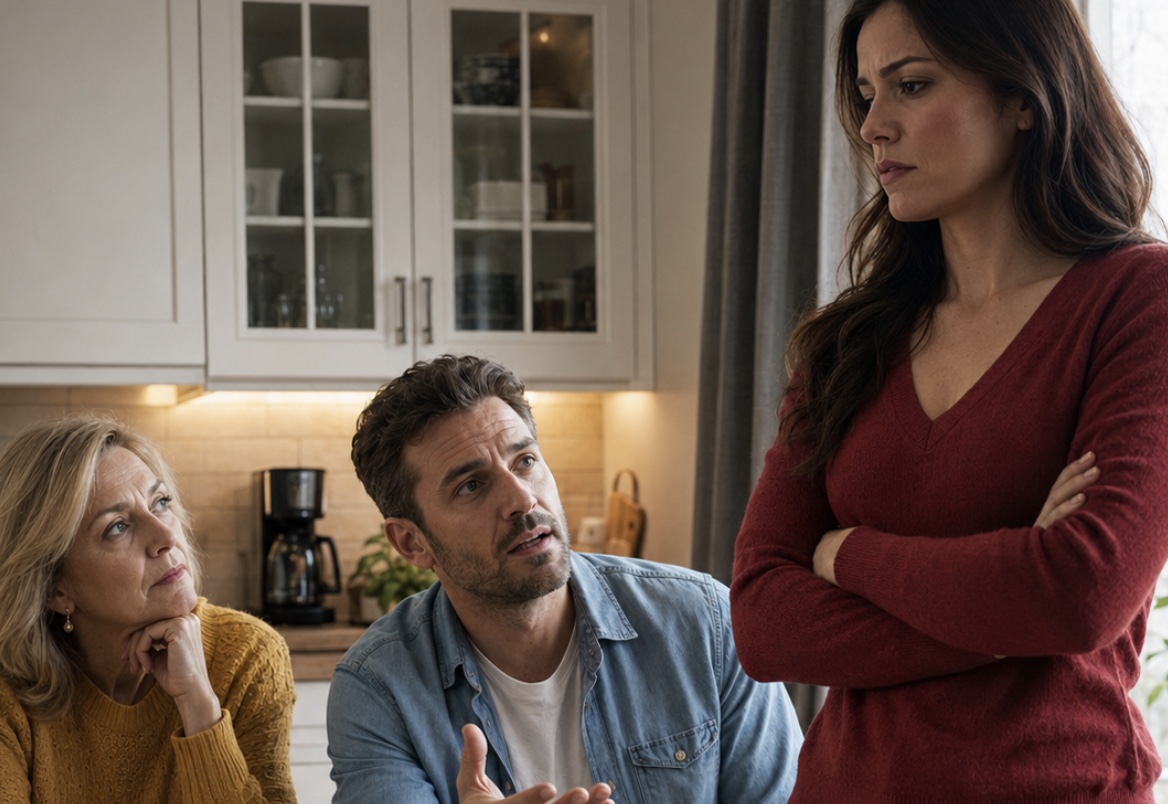
“Sign it—if you truly love my son, of course,” Tamara Ilyinichna said calmly, sliding the folder containing the prenuptial agreement toward Anna, right between the plates of meat and salad.
Anna picked up the document. Her fingers trembled slightly, though she did not yet understand why. Her eyes moved across the first few lines, and a chill spread through her.
According to the agreement, if they divorced, her apartment—the one she had purchased long before she ever met Maxim—would become her husband’s property.
The official wording described it as “compensation for emotional distress.”
Anna slowly lifted her gaze toward her fiancé. She expected outrage. Or at least discomfort. Even the faintest trace of embarrassment.
But Maxim sat leaning back in his chair, casually turning a fork between his fingers.
“It’s just a formality,” he said with a shrug. “Why are you getting so worked up?”
Tamara Ilyinichna nodded approvingly and poured herself more tea. Her thin lips curved into a satisfied half-smile—the kind worn by someone who is already certain of the outcome.
Anna closed the folder.
Her hands were no longer shaking.
They had met at a corporate training event, a three-day project management course held at a countryside hotel with terrible coffee and chairs that creaked whenever anyone moved.
Maxim had been sitting two rows behind her. During the first break, he approached her carrying a paper cup.
“Do you also think the instructor looks like a high school physics teacher?” he asked.
Anna laughed because she had been thinking exactly the same thing.
After that came long walks, quiet dinners, and conversations that lasted late into the night.
Maxim seemed like a reliable, uncomplicated man—the kind who arrived on time, remembered to call back, and did not punish people with silence after an argument.
“Being with you is easy,” he used to tell her. “You’re not like other women. You’re real.”
A year later, he proposed.
Anna sincerely believed that she had finally found someone with whom she could build something mature, stable, and genuine.
By then, Anna already owned a small two-bedroom apartment in a residential neighborhood. She had purchased it with a mortgage years before meeting Maxim.
For four years, she had worked a full-time job while also developing a small online home décor shop. She was accustomed to relying only on herself, and she was quietly proud of everything she had achieved.
Maxim lived with his mother in an aging three-bedroom apartment on the outskirts of the city.
“I admire you,” he often said. “You built everything yourself. That’s rare.”
When Anna first visited her future mother-in-law, Tamara Ilyinichna welcomed her with open arms.
She gave Anna a large jar of homemade cherry jam, asked endless questions about her apartment renovation and curtains, and then whispered to her son while seeing them out—loud enough for Anna to hear:
“She’s a capable girl. A good one.”
But as the months passed, Tamara Ilyinichna’s tone began to change.
Her words became sharper, although she continued to deliver them with the same gentle smile.
“Women are very clever these days,” she would say while pouring tea. “First they lure a man in, and then they throw him out onto the street.”
“A man has to protect himself,” she would sigh over lunch.
“Love is love, but property is another matter,” she would add, looking directly into Anna’s eyes.
Anna tried not to take it seriously.
She told herself it was merely the grumbling of an older woman—an anxious mother afraid of losing her only son.
Nothing important.
Just words.
Everything changed on an ordinary Saturday.
Anna arrived at Tamara Ilyinichna’s apartment earlier than expected because Maxim had asked her to pick up a charger he had left in the kitchen.
The front door was unlocked, so Anna entered quietly, not wanting to disturb anyone.
Tamara Ilyinichna’s voice came from the living room. It was loud and confident—nothing like the voice she used around Anna.
“The important thing is to arrange everything in advance, Valya,” she was saying into the phone. “Otherwise my poor Maxim could be left with nothing if she throws him out. She’s resourceful—bought her own apartment, runs a business. She’ll survive no matter what. But what about him?”
Anna froze in the hallway.
Her heart thudded heavily once and then seemed to fall silent, as though it too were listening.
“No, he agrees,” her future mother-in-law continued. “I explained everything to him. My boy understands.”
Anna collected the charger and left, closing the door carefully behind her.
She said nothing.
But from that day forward, she began noticing things she had previously ignored.
Maxim suddenly started asking questions—apparently harmless ones, yet strangely specific.
“How much do you think your apartment would sell for now?” he asked one evening while scrolling through his phone.
“Have you completely paid off the mortgage, or are you still making payments?” he asked a few days later without looking up from the screen.
“And your shop—is it registered only in your name?” he casually inquired over breakfast.
Anna answered briefly and vaguely.
Inside her, however, a new feeling began to grow.
It was not resentment.
It was fear—cold, quiet, and unmistakably clear.
The worst moment came one evening over dinner when Maxim smiled at her and said:
“We’re going to be a family soon. That means everything should belong to both of us, right?”
Once, those words would have sounded romantic.
Now they landed on the table between them like a warning.
One week before the wedding, Tamara Ilyinichna called and invited them to dinner.
Her voice was unusually gentle, almost sugary.
“Come over, children. We’ll spend a peaceful evening together, just like a family. No wedding stress. I’ll roast the chicken you both love.”
The table had been set with deliberate extravagance.
There was roasted chicken with crisp golden skin, layered beet and herring salad served in a crystal bowl, sliced meats, pickled cucumbers, and the white tablecloth Tamara Ilyinichna reserved only for special occasions.
She had even lit a small candle in a bronze holder.
She smiled throughout the entire evening.
She placed the best pieces of chicken on Anna’s plate, asked about her work, and called her “my dear daughter” twice.
Anna caught herself wanting to believe that the warmth was genuine, even though something inside her resisted.
After tea, Tamara Ilyinichna stood, disappeared into the next room, and returned carrying a beige folder.
She placed it neatly in front of Anna, almost ceremoniously.
“Maxim and I discussed everything and had it prepared properly,” she said without losing her smile. “It’s for the strength of the family. So there will be no mistrust between you. A lawyer reviewed the entire thing.”
Anna opened the folder.
At first, the document looked standard—names, dates, personal information.
Then the words became as dark and threatening as the sky before a storm.
Written plainly in black ink was a condition stating that if the marriage ended, Anna’s apartment would become Maxim’s property.
Every major purchase made during the marriage would also automatically belong to him.
Anna read the paragraph twice.
The words blurred before her eyes—not because she was crying, but because she could not believe what she was seeing.
She looked up at Maxim.
He remained perfectly calm, as though they were discussing wallpaper samples.
“It’s a normal agreement,” he said. “If you’re not planning to divorce me, then you have nothing to worry about. Isn’t that true?”
Tamara Ilyinichna nodded and pushed a pen toward Anna.
And in that precise moment—not earlier, not later—Anna finally understood.
They had already decided everything.
They had discussed it long ago, calmly and confidently, without the slightest doubt that she would obey.
This dinner, with its candle and white tablecloth, had not been an attempt at reconciliation.
It had been a trap.
The candle flame trembled inside the bronze holder, as though it too could feel the tension.
Tamara Ilyinichna drummed her fingers against the tablecloth and pressed her lips together.
“A loving woman wouldn’t cling so desperately to a few square meters,” she said firmly. “If your feelings are real, why should it matter what is written on a piece of paper?”
Anna stared at the beige folder for a long moment.
Then she slowly closed it, pushed it back across the table, and said quietly but clearly:
“A loving man wouldn’t try to take his future wife’s apartment before the wedding. Don’t you agree?”
Maxim flinched as though she had struck him.
His face turned red, and his eyes darted nervously around the room.
“You’re being dramatic again!” he snapped. “It’s just protection. A standard legal procedure. Why are you turning this into such a huge problem?”
But Anna was no longer listening.
Inside her, everything had become peaceful and clear—the way it does when a doubt that has tormented you for a long time finally becomes a decision.
She slowly removed the ring with the small sapphire from her finger and placed it beside the folder.
The stone flashed in the candlelight.
“I will not sign an agreement that takes away everything I earned on my own,” she said evenly. “And I will not marry a man who thinks something like this is acceptable.”
For one second, the kitchen was so silent that the ticking of the wall clock could be heard.
Then Tamara Ilyinichna exploded.
“I knew it!” she shouted, jumping to her feet.
The crystal salad bowl rattled against the table.
“Greedy! Heartless! You used my son, played with his feelings, and now you’re running away!”
“Mom, wait…” Maxim began, but his voice sounded uncertain, as if he did not know which woman he was supposed to stop.
“No, let her hear it!” Tamara Ilyinichna cried, pointing a finger at Anna. “A decent woman would never behave like this!”
Maxim looked at the ring lying on the tablecloth, and something in him seemed to harden.
His expression changed.
“You’ve never trusted anyone,” he said bitterly. “Not me, not my mother. You don’t need anybody, do you? You’re so proud of doing everything alone.”
Anna did not answer.
She stood, walked into the hallway, and began putting on her coat.
Her hands did not shake.
She buttoned the coat slowly, wrapped her scarf around her neck, and took her handbag from the shelf.
Angry voices continued to rise from the kitchen. Tamara Ilyinichna was still shouting, dishes were clattering, and Maxim muttered something indistinct in reply.
Anna had already placed her hand on the door handle when she turned around.
Maxim had followed her into the hallway.
His face was flushed. He looked furious, confused, and strangely helpless.
“Thank you for showing me the truth now,” Anna said calmly. “Instead of after the wedding.”
She closed the door gently behind her.
There was no dramatic slam.
For the first few weeks, Anna barely left her apartment.
Boxes of wedding decorations stood in the corner of her bedroom.
Blank invitation cards that had never been sent remained scattered across the kitchen table.
Her phone rang constantly.
Maxim’s sister sent long messages telling her, “You’ll regret this.”
His aunt left a voice message saying, “Come to your senses, young lady. You’ll never find another man like him.”
Anna read the messages, deleted them, and never replied.
Eventually, the pain began to fade.
Not quickly, but slowly, like floodwater gradually retreating.
And in its place came something Anna had not expected.
Relief.
Clear, pure, almost physical relief.
“It’s unbelievable,” she told her friend one day over the phone. “I almost married into a family where love is measured in square meters.”
Three months later, Anna decided to renovate the apartment.
She chose warm, light-colored walls to replace the old gray ones. She hung new curtains and had the locks on the front door changed.
As the repairman tightened the final screw, he looked at her and asked:
“Are you moving?”
“No,” Anna replied with a smile. “I’m coming back.”
That evening, she made herself a cup of tea, sat beside the window, and for the first time in months, she felt truly at home again.
Safe.