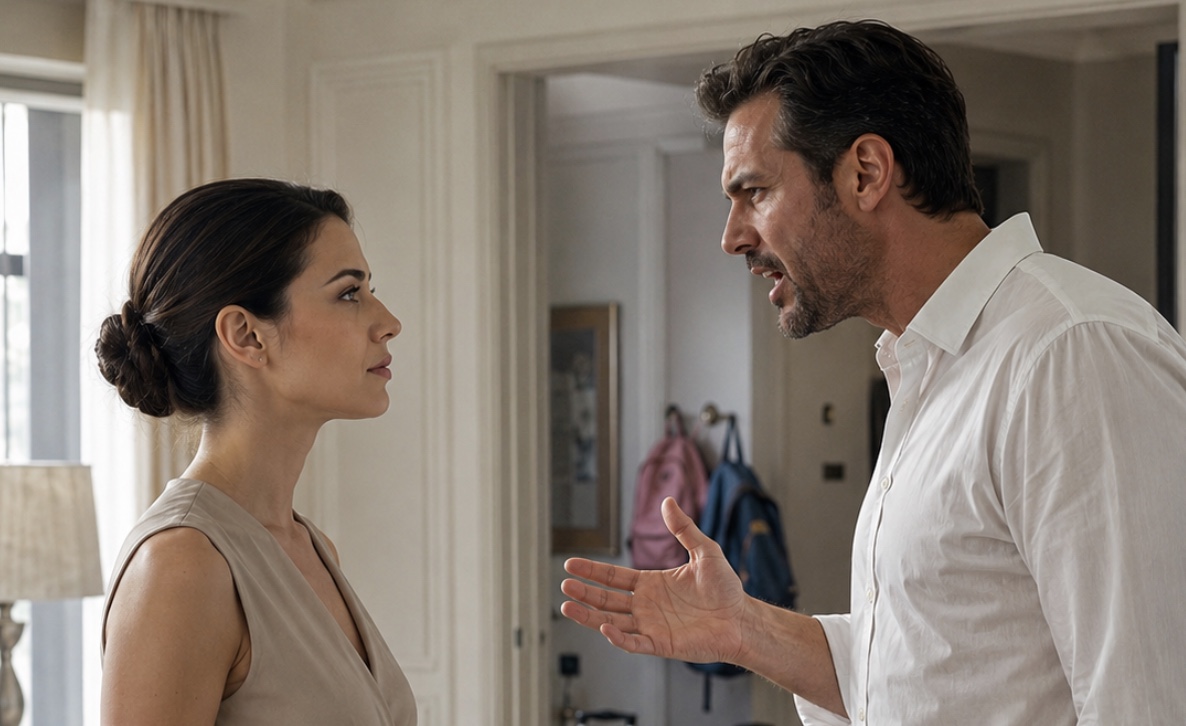
Vera rested one hand on her rounded belly as she carefully stepped over the bags scattered throughout the hallway by the unexpected guests. After seven exhausting hours, she did not want another argument. She wanted only peace and quiet. From the living room came the roar of the television and the demanding voice of a man who was accustomed to having everyone obey him.
“Verochka, where’s our lunch?” Arkady, her husband’s father, shouted without looking away from the screen. “We’ve been traveling, you know. We’re hungry as wolves in winter!”
“It’s coming, Arkady Petrovich,” she answered evenly. “The cutlets are still frying. At least give them time to brown.”
“He likes his cutlets with a crispy crust,” Tamara, his wife, added from the sofa without making any attempt to get up. “And make the tea stronger. Last time you served us colored water.”
Vera took a deep breath and smiled the way people smile when they have decided to endure just one more evening. She turned the cutlets in the pan while keeping an eye on her younger son, who was pulling at the tablecloth. Her older boy, Lyova, tugged at her sleeve and asked when she would help him with his homework.
“Give me ten minutes, Lyova,” she said gently. “First I’ll feed Grandma and Grandpa, and then we’ll sit down and solve your problem.”
“Why do you always feed them first?” the boy whispered so they would not hear.
“Because they’re guests,” Vera replied. “Guests are supposed to be served first, even when they arrive without warning.”
Her father-in-law barged into the kitchen, examined the frying pan, and narrowed his eyes in dissatisfaction. He speared a cutlet directly from the pan, bit into it, and left a gleam of grease on his chin. He chewed noisily, almost whistling through his teeth, as though eating Vera’s food were some kind of favor.
“Dry,” he announced. “My wife used to make them much juicier when our son was little. Learn while you still have someone around to teach you.”
“Thank you for the lesson,” Vera said after a deliberate pause. “I’m writing everything down in a special notebook. Soon I’ll publish a complete collection of your remarks. I’m sure it will become a bestseller.”
“What did you say?” he asked, failing to understand.
“Nothing. Sit down before the food gets cold.”
That evening Anton, her husband, came home from work and immediately brightened at the sight of his parents. He embraced his father, kissed his mother on the cheek, and rubbed his hands together in anticipation of a hot dinner.
Vera watched him, hoping he would notice her swollen feet. Hoping he would see the chaos. Hoping he would notice anything at all.
“Son, you’ve become a real man!” Arkady boomed. “But your wife dried out the cutlets. You need to have a word with her.”
“I will, I will,” Anton laughed as he sat down at the table. “Vera, well… you should try a little harder.”
“I’ll try,” she said, placing a plate in front of him. “I’ll try very hard, Antosha.”
That night, Anton’s parents snored in the children’s room while the boys slept sideways across their parents’ bed. Vera gently touched her husband’s shoulder. She spoke quietly and carefully, as though afraid that one wrong word would make him shut down. She wanted him to understand without forcing her to shout.
“Antosha, I’m not complaining,” she began. “I’m only asking for one thing. Please tell them to call before they come. At least one day in advance.”
“Why should they call? They’re our family, and this is our home,” he mumbled sleepily. “They’re not strangers.”
“They’re family,” Vera agreed. “But I’m seven months pregnant. I work from home, I have video meetings, I have the children, and my back constantly hurts. It’s difficult for me.”
“They’ll stay for a couple of days and leave. You’re strong. I believe in you,” he said with a yawn.
“This isn’t about strength,” Vera whispered into the darkness. “It’s about respect.”
But he was already asleep.
Vera remained awake, staring at the ceiling. Somewhere deep inside her, a foolish little hope still flickered—the hope that he might wake up as a different man the next morning.
The day began with her father-in-law throwing open the bedroom door without knocking and loudly announcing that there was no proper food in the refrigerator. Vera pulled the blanket up to her chin, and both children jumped awake at the sound of his voice.
From that moment on, the day followed an all-too-familiar path.
“What kind of food is this?” Arkady thundered as he pulled containers from the refrigerator. “Where’s the meat? Where’s the pork fat? Are you feeding the children grass?”
“It isn’t grass, Arkady Petrovich. It’s broccoli,” Vera replied, tightening her robe. “It’s considered healthy.”
“Healthy!” he scoffed. “Healthy food is rich and filling. Go out and buy something decent. I’m not giving you money, though. I live on a pension. You understand.”
“I understand,” she nodded. “You have a pension, and I have broccoli. A perfect match.”
She seated her younger son at the table and opened her laptop, hoping to join a work call on time. At that exact moment, the television exploded at full volume. Her father-in-law settled into the armchair opposite her and turned it up even louder, almost as though he were doing it deliberately.
Vera pressed one hand over her free ear and tried to speak to the people waiting on her screen.
“I’m sorry,” she lied into the microphone. “We’re having some minor renovation work done at home.”
She stepped out onto the landing in nothing but her robe and somehow completed the meeting while standing on the cold stairs.
When she returned, she found fruit juice spilled across the kitchen floor, her younger son crying, and her mother-in-law calmly flipping through a magazine. Arkady pointed at the child and laughed.
“You’ve spoiled those boys,” he declared. “In our time, children were taught discipline with a belt. Anton walked a straight line when I raised him.”
“Yes, it’s obvious what a wonderful job you did,” Vera finally snapped. “And yet no one ever taught you to knock before entering a room.”
“Who do you think you’re talking to?” Arkady shouted, rising from the chair so abruptly that it groaned beneath him. “I’m the senior man in this house!”
“The senior authority in this house is the mortgage,” Vera replied calmly. “Anton and I have been paying it for eight years. You are a guest here, Arkady Petrovich. A dear and completely unexpected guest, but still a guest.”
“I’ll show you what kind of guest I am!” Spittle flew from his lips. “Just wait until Anton comes home. He’ll straighten you out quickly enough!”
That evening, Vera waited for her husband as though he were her last possible ally. She told him everything—the spilled juice, the deafening television, the work meeting conducted on the cold staircase in her robe. She held his hand and asked him to listen without interrupting.
“Antosha, I can’t live like this anymore,” she said. “Your father is rude to me. He gives orders, does nothing, and behaves as though this apartment belongs to him. It isn’t fair.”
“He’s an elderly man,” Anton said with a grimace. “What do you expect? Do you think he’s going to change at sixty-five?”
“I want you to stand beside me,” she answered quietly. “Just once.”
“There are no sides here, Vera,” he said, looking away. “We’re a family. Just stay calm, and everything will settle down.”
“Stay calm,” she repeated.
She stood up and removed his plate even though he had not finished eating.
The hope she had carefully sheltered in her hands for two days finally went cold. Something else took its place—something hard and dry, like stone.
The next time Anton’s parents arrived, Vera did not argue.
She welcomed them with such a wide smile that her mother-in-law immediately became suspicious. Arkady, however, looked delighted, convinced that his daughter-in-law had finally learned her place.
“That’s more like it,” he said approvingly as he took off his shoes and marched into the living room. “I assume lunch is already on the table?”
“It will be,” Vera replied sweetly. “But first, I have a little surprise.”
Without rushing, she packed backpacks for the children, gathered her own belongings, and added her laptop charger. She lifted the younger boy into her arms, took Lyova by the hand, and turned at the doorway with a dazzling smile.
“Arkady Petrovich, the children and I are going to stay at Karina’s country house while you’re visiting,” she announced. “Fresh air, milk, everything we enjoy. You can run the household while we’re gone. After all, you’re the senior man here.”
“What do you mean?” he shouted, jumping to his feet. “What about lunch? Who’s going to feed us?”
“You can fill the refrigerator yourselves,” Vera replied. “The shops sell meat. Rich, hearty meat. Cook as much as you like.”
“Where are you dragging those children, you lunatic?” he shrieked. “Tamara, say something to her!”
“Tamara Ivanovna, enjoy your rest,” Vera said with a polite nod toward her mother-in-law. “The television works, and the armchair is still there. You don’t even have to stand up. I hear it’s bad for you. Give Anton my regards.”
Then she closed the door behind her.
At Karina’s country house, everything was quiet. The children ran through the grass, and Vera deliberately kept her phone on silent.
“You really did it,” Karina laughed while pouring tea. “What happens now?”
“Nothing,” Vera said with a shrug. “Let the men fry their own cutlets. It’s time they discovered what life is like without full-service treatment.”
“What if Anton gets offended?”
“Then he can be offended,” Vera replied. “I’ve been enduring this for years. Now it’s his turn to endure something.”
Without a prepared table or tea waiting to be reheated, her in-laws lasted until the following morning.
Arkady found nothing sufficiently “rich and filling” in the refrigerator, took offense at the entire world, and left after slamming the door so hard that someone in the stairwell shouted angrily.
When Vera returned home, however, she was not greeted by a grateful husband. Anton was furious.
“You threw my parents out!” he shouted the moment she entered. “They left feeling humiliated! My father won’t even speak to me!”
“I didn’t speak honestly with myself for three years,” Vera replied. “Somehow, I survived.”
“What you did was cruel, Vera!” He slashed his hand through the air. “You ran away and left me here alone!”
“What’s cruel is watching your pregnant wife conduct a work meeting on a freezing staircase in her robe,” she said quietly. “Going to stay with a friend was self-preservation.”
“You don’t have any…” He stopped himself.
“Finish the sentence,” Vera said, looking directly into his eyes. “I don’t have the right? The right to what? To rest? To silence? To avoid being called an idiot in my own kitchen?”
He did not answer.
A wall rose between them—cold, smooth, and without a single crack. They lived in the same apartment and slept in the same bed, yet became strangers to each other, like two passengers sharing a train compartment.
The months passed. Vera’s belly grew, but the wall between them did not melt.
When she was eight months pregnant and escaping to the country was no longer realistic, Arkady and Tamara arrived again, almost as though they had sensed that this time their daughter-in-law had nowhere to go.
Anton welcomed them with something close to triumph, like a man convinced that events had finally proven him right.
“You see?” he whispered to his wife in the hallway. “You’ll have to put up with them now. Where are you going to go this late in the pregnancy?”
“Right,” was all Vera said.
But fate, as everyone knows, enjoys interfering in other people’s plans without warning—much like Arkady himself.
That same day, Anton missed a step while leaving work and twisted his ankle so badly that he could not put any weight on it. Denis, a colleague who worked closely with him, drove him home and carefully helped him onto the living-room sofa.
“Take care of yourself,” Denis said, placing a cushion beneath Anton’s injured leg. “The doctor said you need to stay flat for an entire week. No attempts at heroism.”
“Thanks for bringing me home,” Anton said through a grimace. “I thought it would heal on its own.”
“Only bruises disappear on their own,” Denis joked. “You’ve got a front-row seat now. Enjoy the show.”
And Anton became a spectator.
For the first time in years, lying helplessly on the sofa in the middle of the living room, he saw his home as it truly was—not merely in the evening when he returned to a hot dinner, but from dawn until night.
He watched Vera, eight months pregnant, conducting work calls while pressed against a wall because his father refused to lower the television volume.
He watched her chop vegetables, cook meals, carry dishes, pick up toys, and separate their fighting sons.
He saw how swollen her feet were, so badly that the straps of her slippers no longer met.
“Verochka, bring me tea!” his father shouted from the armchair. “And make it strong. You keep serving me colored water.”
“Coming, Arkady Petrovich,” she called back, supporting her aching lower back with one hand.
“And fry some cutlets,” he added. “Just don’t dry them out like last time.”
Anton watched as Vera placed a steaming plate in front of his father. The older man did not thank her. He only complained under his breath.
“Dad,” Anton said quietly. “Can’t you pour your own tea?”
“What?” Arkady turned toward him. “I’m a guest! Guests are supposed to be served.”
“She’s pregnant,” Anton said. “Eight months.”
“In our day, pregnant women gave birth in the fields and went straight back to work,” his father replied sharply. “Women have become too pampered. Lie down and mind your own business.”
Anton fell silent.
But now he watched differently. He was no longer looking through his wife. He was paying attention, comparing the reality before his eyes with the image he had carried in his mind for years.
The two pictures looked less alike with every passing hour.
On the second day, Anton waited until the pain in his ankle had eased and quietly called Vera over. He asked her to dress the children and take them outside—to walk in the park, sit on a bench, and buy the boys some ice cream.
Vera looked surprised but did not argue.
“What about you?” she asked. “How will you manage here alone?”
“I won’t be alone,” he replied. “I’ll be with my parents. It’s time we had a family conversation.”
When the door closed behind Vera and the children, Anton propped himself up on his elbows and looked at his father.
Arkady was sprawled in the armchair, tapping the remote control against the armrest, completely unaware that the coming conversation would be brief and final.
“Dad, please turn off the television,” Anton said. “Just for five minutes.”
“What is it now?” Arkady frowned as he lowered the volume. “Has your wife been whispering complaints into your ear again?”
“No one has whispered anything to me,” Anton replied. “I’ve spent two days lying here and watching. And I’m ashamed. I’m ashamed of myself for not seeing it earlier.”
“What exactly did you see?” his father scoffed. “A woman walking around the house? That’s her job.”
“She has an actual job,” Anton said. “Serving you tea while eight months pregnant is not her job. It’s humiliation. And it ends today.”
Arkady slowly straightened in his chair.
Tamara lowered her magazine and froze, looking from her husband to her son.
“Are you raising your voice at me?” Arkady hissed. “At your own father?”
“I’m not raising my voice,” Anton replied calmly. “I’m speaking quietly because I’m certain of every word I’m saying. From now on, there will be rules. No more visits without warning. You call at least a week in advance, and Vera and I decide whether it is convenient for us.”
“What?” his father roared, making the armchair creak beneath him. “My own son is going to dictate rules to me?”
“And you won’t stay overnight here anymore,” Anton continued without raising his voice. “When you visit, I’ll rent you an apartment nearby and pay for it myself. You can spend the day with us like ordinary guests.”
“You little…” Arkady jumped up and pointed at his injured son. “I gave you everything! And now you want to send me to some stranger’s apartment like a dog?”
“A stranger’s apartment?” Anton gave a faint smile. “Exactly. Because this apartment belongs to Vera and me. We pay for it. You haven’t invested a single ruble in this home, yet you give orders as though you built it with your own hands.”
“I’m your father!” Arkady gasped. “That’s sacred!”
“It is,” Anton agreed. “That’s why I’m not putting you out on the street. I’m offering reasonable conditions. Respect cannot be demanded. It has to be earned. So start earning it, Dad.”
“Earn it?” Arkady’s face turned purple, and spit flew from his lips. “You’re completely under that woman’s heel! She has poisoned your mind! You’re not a man—you’re a pathetic rag!”
“Maybe I am,” Anton said. “But my wife is raising two children, carrying a third, managing the home, and working. She has never once spoken to me the way you are speaking now. Think about which one of us is actually stronger.”
“Tamara, pack our things!” Arkady shouted, grabbing his bag. “We’re leaving! Nobody needs us here! I raised my own child, and now he treats his mother and father like luggage to be stored in a rented apartment!”
“I’ll call you a car,” Anton replied without emotion. “I’ll pay for the tickets too. This isn’t a quarrel, Dad. These are simply the new rules. When you’re ready to respect them, you’ll always be welcome.”
“Never!” his father roared, tangling himself in the sleeves of his jacket. “I will never set foot in this place again! You’ll beg me on your knees, and I still won’t come!”
“The door is open,” Anton replied. “In both directions.”
Arkady stormed out onto the landing, dragging his bewildered wife and two bags behind him. His voice thundered through the building as he promised that his son would regret this, that decent children did not abandon their parents, and that the arrogant daughter-in-law had destroyed everything.
The door slammed shut.
Then came real silence—the kind Vera had longed for over many years.
When she returned with the children, Anton held out his hand and asked her to sit beside him.
He kept her hand in his for a long time and spoke quietly, without excuses. He apologized for every evening when he had looked straight through her without seeing what she was going through.
Meanwhile, Arkady sat in the back of a strange, humming car, gripping his bag on his knees and finding no one else to blame.
He replayed his own words in his mind—about fatherhood being sacred, about guests deserving service, about refusing to pay for food—and could not understand how it had come to this.
His own son had looked at him like a stranger.
“I did it myself… I ruined everything myself, you old fool,” he muttered, twisting the strap of his bag between his fingers. “I should have kept quiet. I should have poured my own tea for once. But no, nothing was ever enough. I always had to give orders…”
He imagined the new grandchild being born and realized he might see the baby only on major holidays.
He imagined his son calling once a month, distant and brief.
He pictured their dining table, where he had once sat shouting commands and criticizing everyone, and understood that someday someone else would take his place.
Anyone but him.
“With my own hands…” Arkady whispered, staring down at his rough, knotted fingers clutching the bag. “I had everything. A son, grandchildren, a place at their table. And I crushed it all. Who is going to invite me back now? No one. I threw myself out, you foolish old man. I did it all myself.”