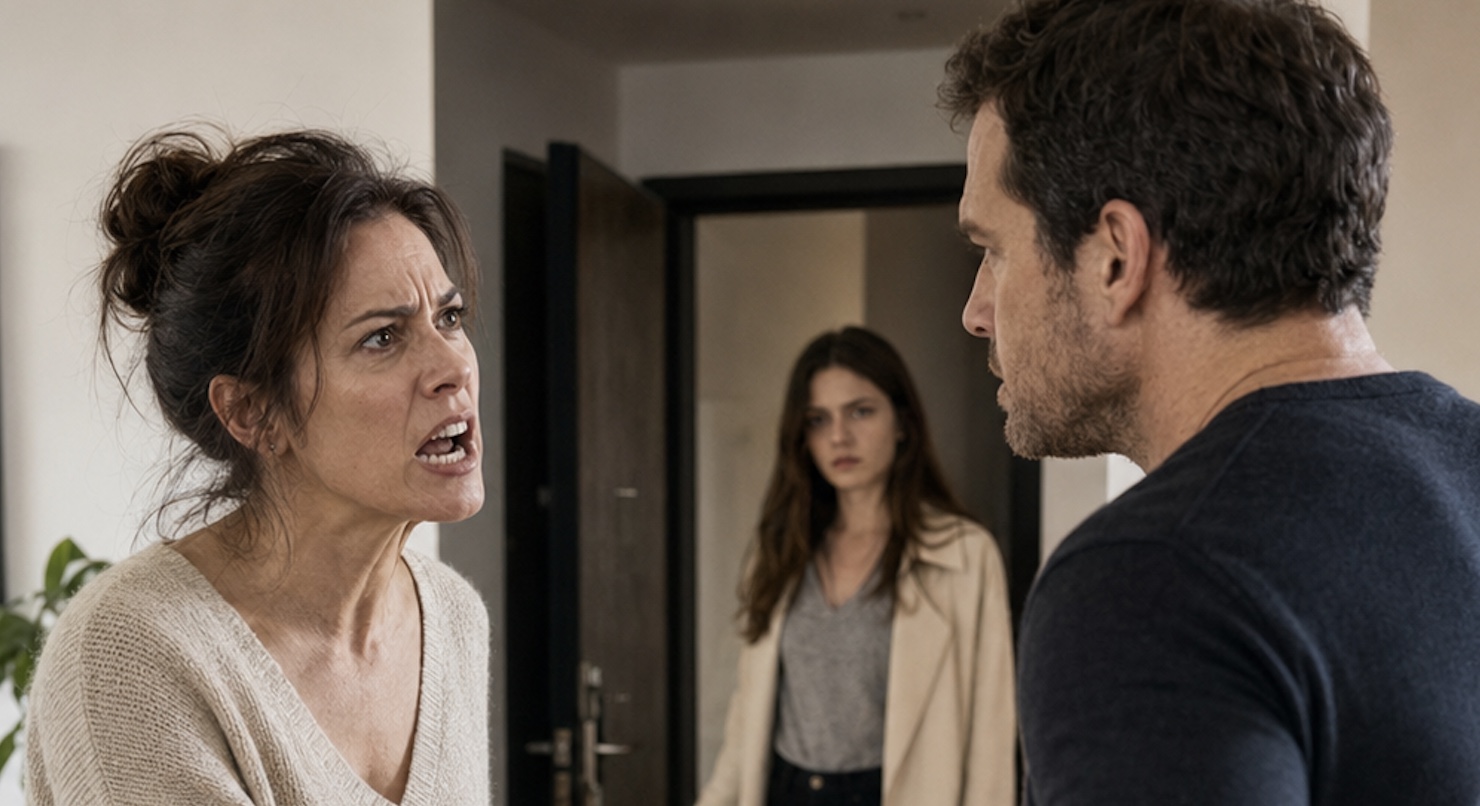
David lifted his eyes from the cup of coffee he had been stirring slowly with a teaspoon. Behind his wife stood an unfamiliar woman of about thirty, wrapped in a towel, her hair wet and her expression perfectly calm. She looked as though she were standing in her own home.
“Lyuda, stop being so dramatic,” David replied indifferently. “Ira just took a shower. It’s nothing serious.”
Nothing serious…
Lyuda slowly closed her eyes, trying to contain the anger rising inside her. Until that moment, she had believed their marriage might still be saved. Now she understood that they had crossed the point of no return.
Their story had begun very differently two years earlier.
Lyuda and David had married quietly, without a lavish ceremony or noisy celebration. There had been no guests, no white dress, no champagne toasts or cries of “Kiss the bride.” Just two signatures at the registry office and a modest dinner at a café near their home.
They lived in Lyuda’s two-room apartment, which she had inherited from her grandmother, Elena Ivanovna, who had passed away two years before Lyuda met David. It was only forty-eight square meters on the third floor of an old apartment building, but it belonged entirely to her. There was no mortgage and no debt.
Lyuda had completed the inheritance process on time, registered all the necessary documents, and paid for a small renovation with her own savings.
Back then, it seemed that life was finally going well.
Lyuda worked as a paramedic at a local clinic, following a schedule of two shifts on and two days off. Her salary was nothing impressive—fifty-two thousand rubles a month—but it was stable.
David sold electronics at a large retail store. He earned slightly more, around fifty-seven thousand rubles, plus commission from sales. He was charismatic and talkative and knew how to connect with almost any customer.
The first months of their life together felt like something from a romantic film.
David washed the dishes, told jokes in the evenings, and grilled meat on the balcony at weekends. He bought flowers for no reason and massaged Lyuda’s shoulders after her exhausting shifts.
Lyuda believed she had been lucky to find such a man.
The first crack in their marriage appeared after David lost his job.
A new manager took over the store and decided to replace much of the staff. Half the sales team was dismissed, including David.
“Don’t worry,” Lyuda tried to reassure him. “We’ll find you something else. You have experience, and you’re good with people.”
“It’s none of your business,” David snapped.
Lyuda searched job listings online, called people she knew, and even arranged an interview for him in a nearby district.
But David became more irritated with each passing day.
“Stop treating me like a child!” he shouted. “I’ll deal with it myself!”
The problem was that he did not seem particularly eager to deal with anything.
He spent his days at home playing computer games and talking to former colleagues. Whenever Lyuda suggested that he go out and look for work, he reacted angrily.
Soon, guests began appearing in the apartment.
At first, the visits were occasional. A friend would stop by for half an hour, or a former colleague would come over for a chat. Lyuda did not object. David was unemployed and probably needed company.
But gradually, the visits became more frequent.
“Who was here yesterday?” she asked one evening after returning from work.
“Sergey. You remember him, don’t you? From the store. We were discussing business.”
“What kind of business? He was fired too.”
“Our business,” David replied sharply.
Lyuda was supporting the household alone.
She paid the utility bills, bought groceries and household supplies, and covered every other expense from her salary. When the washing machine broke, she called and paid for the repairman herself because David was supposedly too busy “looking for work.”
“You’re always unhappy about something,” he told her whenever she raised the subject. “You used to be cheerful and easygoing. Now you walk around with a miserable expression all the time.”
It was difficult to remain cheerful and easygoing while carrying every financial and domestic responsibility alone.
Still, Lyuda tried not to complain. She kept hoping that David would find a job and that everything would return to normal.
One morning, after finishing a night shift, she returned home and noticed an unfamiliar scent in the apartment.
It was a sweet feminine perfume, nothing like anything Lyuda used.
The bed in the bedroom was rumpled differently from the way she had left it that morning. David was nowhere to be seen.
“Where were you?” she asked when he eventually returned carrying a bag of chips and an energy drink.
“I stayed at Sergey’s place,” he answered sleepily. “We were up late, so I decided not to come home.”
Lyuda did not believe him, but she had no proof.
The perfume faded. The sheets could have been disturbed accidentally. Yet the suspicion remained.
Arguments soon became part of their everyday life.
David accused Lyuda of neglecting her appearance, wearing an old robe around the apartment, and allowing work to consume her entire personality.
“You used to sparkle,” he said reproachfully. “Now all you do is nag me.”
“I work,” Lyuda replied. “I earn the money that pays for the food, the utilities, and your chips, by the way.”
“What do my chips have to do with anything?”
“I’m the one buying them. Just like I buy everything else.”
“It’s temporary! Once I find a job, I’ll pay you back.”
But David had no intention of seriously looking for work.
He spent his days gaming and scrolling through social media. In the evenings, he met friends. The money for those outings came from their household budget—which meant Lyuda’s salary.
A sweltering day in July finally changed everything.
Lyuda finished her shift earlier than usual. She had covered for a sick colleague, and the rearranged schedule unexpectedly left her with several free hours.
She arrived home around lunchtime, planning to cook something special and perhaps clean the apartment.
The moment she unlocked the door, she heard water running in the bathroom.
At first, she assumed David was taking a shower.
She walked into the kitchen and put the kettle on. Then she heard voices coming from the bathroom—one male and one female.
Lyuda froze.
She listened more carefully.
David said something, and a woman laughed. It was not loud laughter. It sounded private and intimate.
Lyuda walked into the hallway and stopped outside the bathroom door.
The voices immediately fell silent.
A minute later, the door opened, and an unfamiliar woman stepped out wearing nothing but a bath towel.
Her dark hair was wet, and her face was pink from the hot water. She looked completely relaxed, as if she had simply run into a neighbor in the hallway.
“Oh, hello,” the stranger said. “David told me you’d be at work until this evening.”
Lyuda was speechless.
Behind the woman appeared David, also wrapped in a towel, with droplets of water still clinging to his shoulders.
“Lyuda,” he began in a businesslike tone, “meet Ira. Ira, this is my… Lyuda.”
He hesitated before saying the word “wife.”
Ira extended a damp hand toward her.
“Nice to meet you. David has told me so much about you.”
“What is going on here?” Lyuda managed to whisper.
“Nothing serious,” David said with a shrug. “Ira needed a shower. It’s hot outside.”
Lyuda glanced at the calendar hanging on the refrigerator.
It was the middle of July, and the apartment was stuffy despite the open windows. But taking a shower in someone else’s apartment—and apparently sharing that shower with the owner’s husband—was far beyond reasonable.
“Does Ira often come here to take showers?” Lyuda asked.
“This is the first time,” Ira answered quickly. “David offered when I complained about the heat.”
“I see. And where did you two meet?”
“Online,” Ira replied without a trace of embarrassment. “In a job-search group. We have a lot in common.”
A lot in common.
Lyuda nodded silently and walked into the kitchen. She poured herself a glass of water and drank it in one gulp.
Her hands were trembling with rage and humiliation.
Ira did not leave for another hour.
During that time, she behaved as though she were the hostess. She made tea, found the biscuits in the cupboard, and told jokes. David listened, laughed, and occasionally glanced at his wife.
When the door finally closed behind their guest, Lyuda sat across from David at the kitchen table.
“Explain what is happening.”
“What exactly do you want me to explain?” David unlocked his phone and began scrolling through his feed. “Ira is a nice woman. I enjoy spending time with her.”
“You enjoy spending time with her so much that you take showers together?”
“What’s wrong with that? We’re adults.”
“Married adults.”
“Married…” David finally looked up from the screen. “Lyuda, take a look at yourself. When was the last time we had a normal conversation? When was the last time you laughed?”
“There hasn’t been much to laugh about. I’m the only one working, the only one paying for this apartment, and the only one cleaning it.”
“Exactly! All you ever do is complain, criticize, and look miserable. Things are easy with Ira. She understands me.”
“What exactly does she understand?”
“That I want to start my life over. I want to feel freer and happier.”
Lyuda slowly rose from her chair.
A heavy sensation spread through her chest, as though she had swallowed a stone.
“And what are you suggesting?”
“I think we should live separately for a while,” David said without taking his eyes off his phone. “You could stay with one of your friends for a month or two. We need time to figure out our relationship.”
“In my apartment?”
“It doesn’t matter where you stay. The important thing is to give us some space to think.”
Lyuda stood there, trying to process what she had just heard.
Her husband was suggesting that she leave her own apartment so that he could live there with his mistress.
“I understand,” she said calmly before walking into the bedroom.
There were no hysterics, no tears, and no smashed dishes.
Lyuda opened the wardrobe and pulled out a folder containing her property documents. She examined them with the same detached concentration she used when reviewing medical test results.
There was the inheritance certificate from her grandmother, Elena Ivanovna, and the official property registration extract.
Every document displayed the same name: Lyudmila Vasilyevna Kuznetsova.
“Lyuda, what are you doing in there?” David called from the kitchen.
She returned carrying the documents and spread them across the table in front of him.
“Look carefully. Whose name is written here?”
David glanced at the papers.
“Yours. So what?”
“Then explain to me what gives you the right to throw me out of my own apartment.”
“I’m not throwing you out. I’m just asking you to give us time to sort things out.”
“You and Ira?”
“Well… yes.”
“In my apartment, in my bed, and at my expense?”
David shifted uncomfortably in his chair.
His wife’s logic was impossible to argue with.
“Lyuda, surely we can come to an agreement like civilized people.”
“We can. Pack your things and get out. Right now.”
“What do you mean, get out? Where am I supposed to go?”
“That is not my problem. Go to Ira, Sergey, or your mother. You have plenty of options.”
Lyuda picked up her phone and searched for the number of the local police officer.
David watched as she began dialing.
“What are you doing?”
“Making a necessary call. Hello, Stanislav Petrovich? This is Kuznetsova from building number twelve. There is an unauthorized person in my apartment who is neither registered here nor has permission to live here. Could you come over?”
Her voice was calm and professional.
David tried to snatch the phone from her hand, but Lyuda turned away.
“Yes, he is my husband. My former husband, actually. I’m filing for divorce tomorrow. You know the address. Thank you.”
“Have you lost your mind?” David shouted. “You’re calling the police over a family matter!”
“There is no family matter anymore. There is an intruder occupying someone else’s property.”
“I’m your husband!”
“For now. Until tomorrow.”
Stanislav Petrovich arrived half an hour later.
He was a uniformed man of about fifty, carrying a notebook. He calmly listened to Lyuda’s explanation and examined the ownership documents.
“I understand,” he said with a nod. “Where is the unauthorized resident?”
“He’s sitting in the kitchen.”
Stanislav Petrovich walked over to David and showed him his identification.
“Your documents, please.”
David silently handed over his passport.
The officer copied his details into the notebook.
“Mr. Orlov, on what legal basis are you residing in this apartment?”
“I’m the owner’s husband.”
“Are you registered at this address?”
“No, but—”
“Do you have a rental agreement?”
“What rental agreement? I live here!”
“You used to live here. Now gather your belongings and leave the apartment voluntarily.”
“And what happens if I refuse?”
Stanislav Petrovich studied him carefully.
“Then you will be removed. A formal report may also be filed regarding your unauthorized occupation of another person’s property.”
David tried to argue.
He referred to their marriage, insisted that it was a private family dispute, and asked to be given until the evening.
The officer remained firm. David was required to leave immediately.
An hour later, he stood beside the elevator with two bags.
Ira had disappeared much earlier. She had dressed hurriedly, forgotten her makeup bag on the entryway cabinet, and fled without saying goodbye.
“Lyuda,” David tried one final time, “think about what you’re doing. We lived together for two years.”
“We did. That’s enough.”
“I could change my mind about Ira.”
“It’s too late, David. This door only closes once.”
When the elevator carried him away, Lyuda locked every lock on the front door.
Then she walked slowly through the apartment.
His scent was everywhere—David’s cologne mixed with Ira’s sweet perfume.
Lyuda opened every window as wide as possible.
That evening, she collected the rest of David’s belongings.
She found socks in the chest of drawers, a phone charger near the bed, and trainers in the hallway. She packed everything into bags and left them beside the front door.
If he came back, he could collect them. If he did not, she would throw them away in a week.
She blocked David everywhere—on her phone, in every messaging application, and across social media.
She removed him from her contacts, her friend lists, and her digital life.
It was as though he had vanished.
On Monday, Lyuda took the day off and went to the registry office.
It took her ten minutes to complete the divorce application. They had no children and no jointly owned property. It was a simple procedure.
“The processing period is one month,” the employee explained. “Your husband may file an objection if he does not agree to the divorce.”
“He won’t,” Lyuda replied confidently.
And he did not.
One month later, she received the official divorce certificate. The marriage stamp in her passport was cancelled.
Her colleagues reacted differently to the news.
Some sympathized with her, while others judged her.
Nina from the reception desk even scolded her.
“You let a good man go. David was so friendly and cheerful.”
“Very friendly,” Lyuda agreed. “Especially with strange women in my bathroom.”
A few days later, the same Nina stopped her in the corridor.
“Listen, David has been going around the neighborhood complaining about you. He says you threw him out like a dog without explaining anything.”
“I explained everything. He chose not to listen.”
“Maybe you should have been more patient. Men sometimes need to have their adventures. Eventually, they come home.”
“He is free to have as many adventures as he likes. Just not in my home.”
Nina shook her head, clearly deciding that Lyuda was far too proud.
Lyuda did not argue.
The truth was that she had become prouder.
The apartment grew astonishingly quiet.
There were no computer games blaring from the bedroom, no action films roaring from the television, and no loud phone conversations echoing through the rooms.
The silence did not oppress her.
It wrapped itself around her like a warm blanket.
Lyuda bought a new shower curtain, blue with white clouds. She hung it herself without asking for a man’s help.
It was straight and looked beautiful.
The bathroom smelled only of her shampoo and shower gel.
Her money lasted longer too.
She no longer had to buy beer, chips, or energy drinks. She filled the refrigerator with the food she actually enjoyed—cottage cheese, fruit, and fish.
She began eating properly instead of grabbing rushed meals between chores.
One week later, David tried to return.
He arrived without warning and knocked on the door.
Lyuda looked through the peephole and saw him standing outside with a bouquet and a guilty expression.
“Open the door, Lyuda. We need to talk.”
“No, we don’t.”
“I understand what I did wrong. It’s over between Ira and me.”
“I don’t care.”
“Lyuda, you can’t behave like this. We loved each other.”
“We did. Past tense.”
David remained outside for an hour.
He pleaded with her, apologized, and promised to change.
Lyuda never opened the door.
Eventually, he left, abandoning the flowers on the doormat.
The following day, she changed the lock.
The locksmith arrived quickly and installed a stronger model with protection against drilling.
“Who are we protecting ourselves from?” he asked casually.
“The past,” Lyuda replied.
She called Stanislav Petrovich in advance and warned him that her former husband might attempt to enter the apartment.
The officer wrote down the information and promised to take action if necessary.
“And if he insists on seeing me?”
“Tell him the owner does not wish to communicate with him. That is her legal right.”
David never returned.
Perhaps he finally realized that his attempts were pointless. Or perhaps he found another apartment in which to conduct his romances.
Lyuda did not cry in the mornings.
She did not scroll through old photographs or call mutual friends to ask about him.
The divorce felt like recovering from a long illness. She felt relief rather than grief and gratitude rather than regret.
In the evenings, she read the books she had never found time for while David was there.
She watched films he had dismissed as boring.
She played music without headphones because there was no longer anyone around to tell her to turn off “that nonsense.”
Her colleagues gradually stopped asking about her personal life.
Lyuda looked calmer and more rested.
She worked with her former enthusiasm, but now she looked forward to going home even more because peace was waiting for her there.
“Don’t you miss it?” her neighbor, Aunt Valya, asked one day.
“Miss what?”
“Family life. A man’s shoulder to lean on. Support.”
“There was a shoulder,” Lyuda replied. “But I couldn’t lean on it. It always collapsed.”
Aunt Valya thought about that answer for a moment and then nodded.
“I understand. My first husband was the same. Handsome on the outside, empty on the inside.”
Six months after the divorce, Lyuda sat in an armchair with a cup of coffee and watched the summer evening through the window.
Children shouted in the courtyard, dogs barked, and cars passed along the road.
It was the ordinary life of an ordinary neighborhood.
The apartment was neither large nor luxurious, but it was hers.
Every object stood exactly where she wanted it. Every decision belonged to her alone.
No one brought strangers into her home or demanded that she make room in a place that belonged to her.
“An empty apartment is better than a crowded home without respect,” Lyuda said aloud.
Her voice sounded confident and free of regret.
The streetlights came on outside, making the room feel even cozier.
Lyuda switched off the hallway light and, for the first time in a very long while, did not flinch at the silence.
The silence was friendly now.