Oleg walked in, dropped a grocery bag on the floor beside the entrance, and leaned against the doorframe. Dasha was sitting on the sofa with Sonya asleep in her arms, covered by a thin blanket. The television was playing with the sound turned off. It was around nine in the evening.
“Make dinner for twelve people. My friends are coming over,” Oleg said in the same tone someone might use to dictate a shopping list. “Tomorrow at one. Kostya and Marina, Lyosha and Zhenya, Styopa, and Alina might come too. You’ll figure it out.”
Dasha looked up at him.
She was not surprised. A long time ago, she had stopped being surprised by the way he phrased his requests, always without a question mark at the end.
“Oleg, tomorrow is Saturday. I wanted to call a repairman to look at the pipe in the kitchen. It’s leaking again. And Sonya has been fussy all day. She’s teething.”
“The pipe can wait. And Sonya will fall asleep. You can handle it. You always do.”
He said it as though it were a compliment.
But it sounded more like an appointment to a position she had never applied for.
“Twelve people is a lot, Oleg. Maybe we could order something? Or they could bring some food themselves?”
“Dasha, I’m not going to embarrass myself by asking guests to bring their own food. This is my home. I’m the one inviting them.”
She wanted to say, “Our home. The one we rent.”
But she said nothing.
She carefully laid Sonya down on a cushion, adjusted the blanket, and stood up.
“What exactly do you want me to cook?”
“Whatever you think is best. You know how to cook. Meat, salads, something hot. Just don’t make me look bad in front of everyone.”
Then he went into the bedroom.
Dasha looked at the grocery bag by the door.
Inside were one and a half kilograms of chicken and a packet of pasta.
For twelve people.
She took out her phone and called her father.
“Dad, can you come over tomorrow morning? Bring Mom. I need you both here by ten.”
“Has something happened?”
“No. Actually, it’s the opposite. I think it’s time.”
There was a brief silence on the other end.
Then Viktor said, “We’ll be there.”
Four days earlier, Dasha had been sitting in a café across from Polina.
Polina stirred sugar into her coffee and listened without interrupting. She was good at listening. Six years of living in rented apartments with her husband had taught her a special kind of patience.
“He makes every decision for me,” Dasha said. “Where we go, what we eat, who we invite. He decides everything. I feel like hired staff, Polina.”
“Have you tried telling him that directly?”
“I do tell him. He hears the words, but he doesn’t listen. Those are two different things. Whenever I ask him to discuss something with me, he says, ‘I’m taking care of us.’ Then he gives me that look, as if I’m ungrateful.”
Polina pushed her cup aside and looked Dasha straight in the eyes.
“Dima and I live in a tiny one-room apartment on Severnaya Street. The wallpaper is peeling off, and the upstairs neighbors stomp around until midnight. But in six years, he has never once given me an order. Not once. He has never said, ‘Cook something.’ He says, ‘Let’s make something together.’ Those are two completely different currencies, Dasha.”
“I know.”
“Then why do you keep paying according to Oleg’s exchange rate?”
Dasha fell silent.
Polina placed her hand over hers.
“You’re not staying because you love him anymore. You’re staying because you have nowhere else to go. Am I right?”
“There’s Sonya. We have Sonya.”
“Sonya is a reason to live well. She is not a reason to live badly.”
When Dasha returned home that evening, she sat in the kitchen for a long time, staring at the wall where the wallpaper had swollen from the damp.
The apartment was spacious, with four rooms, high ceilings, and the faded grandeur of an old building. They rented it through a personal connection. The owner, Arkady Semyonovich, was an old friend of Oleg’s family.
The rent was ridiculously low compared to the rest of the city.
Oleg was proud of that.
“I negotiated the deal,” he often said.
As if he were the one paying for everything.
The following day, her father called her.
Dasha had not called him first. He contacted her himself.
“Sweetheart, I need to talk to you. Not over the phone.”
They met in the park near her building.
Viktor sat down on a bench, pulled a folded sheet of paper from the inside pocket of his jacket, and opened it.
“I spoke to Arkady Semyonovich. I reached him through Boris, Oleg’s father. You know they’ve known each other for years. Arkady is in serious trouble. He needs money, and he needs it quickly. He’s willing to sell the apartment you’re renting.”
“Dad, we don’t have that kind of money.”
“You don’t,” Viktor said. “I do.”
Dasha stared at him, confused.
“Grandma Zoya moved in with us six months ago. You know that. Her house in Kalinovka had been standing empty, so I sold it. Your mother and I discussed everything. She agrees.”
“You sold Grandma’s house?”
“It was her idea. She said, ‘Why should I keep walls without my grandchildren? Let those walls become a home for my granddaughter instead.’”
Dasha looked down at the paper.
It was a preliminary sales agreement.
“I’m buying this apartment,” Viktor said. “And I’m transferring it to you as a gift. Not to you and Oleg. To you alone.”
“Dad…”
“Wait. I’m not interfering in your marriage. But I see how you live. Your mother sees it too. Grandma Zoya sees it, even if she stays quiet. This apartment is not simply a gift. It is solid ground beneath your feet. What you do after that is your decision.”
Dasha wrapped her arms around him.
She did not say anything.
Neither did he.
There was no need for words.
On Saturday morning, Dasha woke up at seven.
Sonya was still asleep. Oleg was snoring in the bedroom. He had gone to bed late after watching something on his tablet until two in the morning.
By nine, Dasha had prepared breakfast.
Not for twelve people.
For four.
For herself, Sonya, her mother, and her father.
There were cottage-cheese pancakes, sliced meat and cheese, fresh vegetables, and tea in a large ceramic teapot she had bought at a craft fair before she was married.
The table was covered with a clean tablecloth.
Everything looked neat, peaceful, and calm.
Viktor and Nina arrived at exactly ten.
Nina immediately picked Sonya up. The little girl reached for her grandmother and laughed.
Viktor placed his briefcase beside the entrance. The documents were inside.
“Everything is finished,” he said quietly, looking at his daughter. “We went to the notary yesterday, and here it all is. The ownership papers, the property extract, the deed of gift. The apartment belongs to you.”
Dasha took the folder, opened it, and read through the papers.
Then she closed it and placed it on the shelf in the hallway.
“Thank you, Dad.”
“Thank Grandma Zoya. And your mother.”
Without turning around, Nina called from the kitchen, “I don’t need thanks. I need my daughter and granddaughter to have a roof over their heads. Their own roof. A real one.”
They sat down to eat breakfast.
It was warm and quiet.
Sonya sat in her high chair, smearing cottage cheese across her cheeks. Nina poured more tea. Viktor spread butter on a slice of bread and told them how Grandma Zoya had recently learned how to make video calls and now checked every evening to make sure he had eaten dinner.
At half past ten, footsteps sounded in the hallway.
Oleg came out of the bedroom.
He looked half asleep. He was wearing a wrinkled T-shirt, and the imprint of his pillow was still visible on his cheek.
He saw the set table.
He saw his in-laws.
He saw that breakfast had been prepared for four people.
He stopped in the doorway.
“What is this?”
“Good morning, Oleg,” Nina said evenly. “Sit down and eat. The pancakes are still warm.”
“I asked what this is.”
He remained standing.
His eyes were fixed on Dasha.
“Where is the food? I told you yesterday, twelve people. They’ll be here in two hours.”
“I didn’t cook for twelve people,” Dasha said.
Her voice was calm. Not quiet, not loud. Simply steady.
“What do you mean, you didn’t cook?”
“I mean exactly that. I didn’t cook. I made breakfast for my family. For my parents. For my daughter. And for myself.”
Oleg slowly turned toward his father-in-law.
Viktor continued eating without looking up.
“Viktor,” Oleg said, using that particular tone he always adopted when he wanted everyone to understand who was in charge. “I respect you, but this is not a good time for a visit. We’re having an event today. I’m asking you and Nina to leave.”
Viktor carefully placed his knife on the edge of his plate.
He wiped his mouth with a napkin.
Only then did he look at Oleg.
“Oleg, I am not leaving. Neither is my wife. We are visiting our daughter in her apartment.”
“In whose apartment?”
“In Dasha’s.”
The silence that followed was brief but heavy.
“What are you talking about?” Oleg gave a short laugh, but it came out uneven. “We rent this apartment from Arkady Semyonovich. I arranged it with him.”
“Arkady Semyonovich sold the apartment,” Viktor said. “To me. Four days ago. I have transferred it to Dasha as a gift. The papers are here, in case you want to see them.”
Oleg stood motionless.
Then he turned toward Dasha.
“You knew?”
“Yes.”
“And you didn’t tell me?”
“No.”
“Why?”
“Because you wouldn’t have asked for my opinion. You would have given me an order. Just like you did last night about dinner.”
Oleg stepped backward, then immediately stepped forward again.
His expression shifted from confusion to outrage, and from outrage to something resembling wounded pride.
“You did this behind my back? You? My wife?”
“I made a decision for myself and for Sonya. You never ask me when you make decisions. I’m learning from you.”
“This is betrayal,” he said angrily. “Real betrayal.”
“Betrayal is when your wife asks you to discuss family plans and you answer, ‘I’ve already decided.’ Betrayal is when you expect me to serve your friends without even asking whether I’m tired. Betrayal is when you tell my parents to leave an apartment you have never once paid the full cost of.”
Nina stood up and lifted Sonya out of the high chair.
Without a word, she carried her into the room at the far end of the apartment.
Viktor remained at the table.
Oleg took out his phone and dialed a number.
“Kostya? Are you already on your way? Good. Come over. Yes, everything is fine. Just come.”
He put the phone away and looked at Dasha with an expression she knew all too well: contemptuous confidence.
As though he had already won.
“When everyone gets here, we’ll discuss this. You wanted to put on a show? Fine. We’ll settle it man to man.”
“There is nothing to settle,” Dasha replied. “The apartment belongs to me. The documents have been signed. You can check them, call Arkady Semyonovich, or call anyone else you like. It won’t change the facts.”
“You think a piece of paper means anything?”
“That piece of paper is the law, Oleg. The law means more than the volume of your voice at the dinner table.”
Kostya arrived first.
Marina was with him. Quiet, pale Marina, who never argued with her husband and believed that was normal.
She had grown up in a family with six children and had learned early that decisions were made by whoever spoke the loudest.
The others arrived soon afterward.
Lyosha, Zhenya, Styopa, and Alina, Oleg’s sister, who always pursed her lips when she saw Dasha, as though someone had offered her something sour.
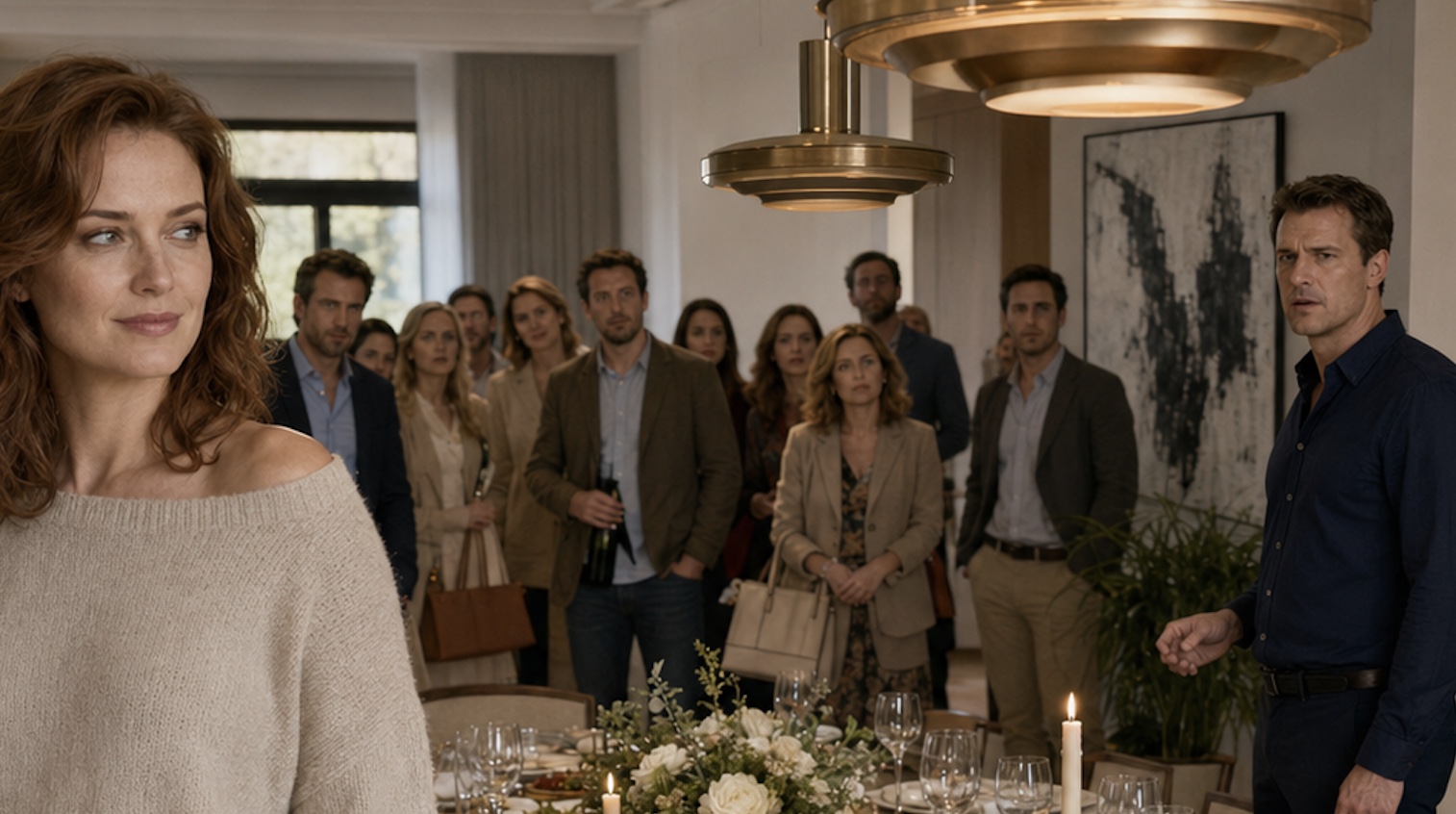
The apartment filled with people.
Oleg stood in the middle of the hallway, looking as though he still controlled the situation.
Kostya took off his jacket and looked around.
“Where is the table? You said there would be a proper dinner.”
“There will be,” Oleg said. “Dasha will cook.”
“Dasha will not cook,” Dasha said from the kitchen.
She stood in the doorway with one shoulder resting against the wall.
Calm.
“Dasha prepared breakfast for her parents. No one asked me to make dinner for twelve people. I was ordered to do it.”
Kostya looked at Oleg.
Then at Dasha.
Then back at Oleg.
“Oleg, what’s going on?”
“My wife decided to stage some kind of performance. Her father bought this apartment from Arkady and transferred it to her. Without my knowledge.”
Alina, who had been standing beside the hallway mirror pretending to check her hair, turned around immediately.
“Without your knowledge? She registered an apartment without her husband’s consent?”
“A deed of gift does not require a spouse’s consent,” Viktor said from the kitchen.
He stepped into the hallway and carefully closed the door behind him.
“I gave the apartment to my daughter. It was my gift, purchased with my money. I had every right to do it.”
Alina opened her mouth to object, but Viktor continued.
“Alina, I remember what you said at Sonya’s last birthday. You said Dasha had ‘done rather well for herself.’ Someone repeated it to me. Well, she has done well for herself now. Properly.”
Alina fell silent.
Kostya and Marina exchanged a glance.
Marina stood against the wall, clutching her handbag to her chest and staring at the floor.
She always stood like that, as though she were trying to take up as little space as possible.
“Oleg,” Dasha said, “I packed your things. Two bags. They’re in the hallway behind the wardrobe. There is everything you need for now. You can collect the rest when we agree on a day.”
“You’re throwing me out?”
“I am asking you to leave my apartment.”
“Our apartment!”
“No, Oleg. Mine. I can show you the documents. I can read them aloud. I can even dictate the cadastral registration number, in case that helps.”
Oleg turned toward his friends.
He was looking for support.
He was used to finding it among people who nodded whenever he spoke.
Kostya had been nodding for years.
“Kostya, are you hearing this? Say something to her.”
Kostya was silent for a moment.
Then he answered, and it was not the answer Oleg had expected.
“Oleg, I’ve known you for ten years. You’re my friend. But she’s right. If the apartment belongs to her, she has the right to decide who lives in it.”
“Are you serious?”
“I am. And honestly, in her place, I would probably do the same thing. Yesterday, when we were talking on the phone, you said, ‘Let Dasha work for once. It’ll do her good.’ I stayed quiet. I shouldn’t have.”
Lyosha, who was standing near the entrance, gave a quiet snort.
Zhenya nudged him with her elbow, but he was already smiling the awkward smile of someone who had unexpectedly witnessed justice being served.
Styopa said nothing, but he looked at Dasha with respect.
He was the only person in Oleg’s group of friends who had never made jokes at her expense.
Alina stepped closer to her brother.
“Oleg, call Dad. Let him talk to Arkady Semyonovich. This isn’t normal. You cannot let this go.”
“Boris Petrovich already knows,” Viktor said calmly. “I spoke to him the day before yesterday. He said, ‘You’re doing the right thing.’ Those were his exact words.”
Alina went pale.
So did Oleg.
“My father knew?”
“Your father is a reasonable man, Oleg. He sees what you refuse to see.”
Twenty minutes later, only Dasha, Sonya, Viktor, and Nina remained in the apartment.
The guests left quickly, awkwardly, and quietly, saying only brief goodbyes.
At the door, Kostya paused and turned to Dasha.
“You’re strong. Marina could never do something like this. But maybe one day she will.”
Marina stood beside him and said nothing.
But after they stepped into the stairwell, Dasha heard her say softly, “Kostya, I want you to talk to me too. Not give me orders.”
Kostya did not answer.
But he did not quicken his pace either.
Oleg took his bags.
He stood beside the elevator, staring at the closed apartment door.
He did not knock.
He did not shout.
He simply stood there.
Then the elevator arrived, and he left.
An hour later, Alina sent Dasha a message.
“You’ll come back anyway, and you’ll beg for forgiveness.”
Dasha read it, deleted it, and blocked the number.
That evening, Polina called.
“Zhenya told me everything. Everyone already knows. Dasha, how are you?”
“I’m all right. Tired, but all right. Sonya is laughing, my parents are here, and the apartment is mine.”
“The apartment is yours. That sounds like a song.”
“It sounds like a fact. I’ve had enough of songs.”
Polina was quiet for a moment.
Then she said softly, “Dima and I have been renting for six years. Every time we move, I wonder whether the next landlord will suddenly tell us to get out. Somehow, we always manage. But you know what it feels like when the floor beneath your feet does not really belong to you.”
“I do. And now I know what the difference feels like.”
“I’m happy for you. I really am.”
Dasha ended the call.
She walked over to the table where her parents had been sitting that morning.
The cups had already been washed, and the tablecloth had been folded.
Nina had tidied everything while Dasha was talking to Oleg.
Viktor was sitting in an armchair in the far room, reading a book to Sonya.
Sonya did not understand a word, but she listened with a serious expression, occasionally reaching out to grab her grandfather’s finger.
Dasha sat down beside them.
“Dad, the apartment needs repairs. The pipes are leaking, the wallpaper is peeling, and the wiring is old.”
“We’ll fix it. Not all at once, but we’ll do it. The important thing is that you have the walls. Everything else is plaster.”
“Do you regret it? Selling Grandma’s house?”
“Grandma Zoya called last night and said, ‘Vitya, tell Dasha that walls without people are dead, and people without walls are homeless. I choose the living.’ Your grandmother is quite the philosopher.”
Dasha smiled.
Her mother appeared in the doorway.
“Should I make some tea?”
“Yes,” Dasha said. “For four people. Exactly four.”
Nina nodded and returned to the kitchen.
A moment later, they heard the quiet click and hum of the kettle.
Sonya released her grandfather’s finger and reached for her mother.
Dasha picked her up and held her close.
She looked around at the high, cracked ceilings, the swollen wallpaper, and the old parquet floor that creaked under every step.
All of it belonged to her.
Truly belonged to her.
Not because someone allowed it.
Not because someone ordered it.
Not because someone gave her permission.
Her apartment.
Her decision.
Her life.
Sonya rested her cheek against her mother’s shoulder and began breathing softly.
In the kitchen, Grandma Nina poured the tea.
In the armchair, Grandpa Viktor closed the book and leaned back, shutting his eyes.
It was quiet.
It was peaceful.
It was home.