The elevator was out of order, naturally. A crooked sheet of paper had been taped to the doors with three thick layers of clear tape.
“Out of service. Sorry for the inconvenience.”
Olga climbed the six floors on foot, counting each flight as she went. By the time she reached the fourth floor, she could already hear it: heavy bass pounding through the building, women laughing over the music, and the sharp clinking of glass.
The noise drifted down the stairwell. The higher she climbed, the clearer it became.
It was coming from their apartment.
Again.
By the time Olga reached her front door, she already knew what she would find inside. She stood on the landing for a moment, trying to catch her breath after the stairs and gather what little strength she had left.
The apartment was shaking with noise.
She pulled out her key, but it missed the lock on the first attempt. Her hand was barely cooperating after a twelve-hour shift.
Olga worked as the head nurse at a private clinic. She spent the entire day on her feet, dealing with endless patients, demanding doctors, and piles of paperwork that never seemed to shrink. That particular day had been especially brutal. Two nurses had called in sick, and almost the entire workload of the floor had fallen on her shoulders.
All the way home, she had held on to one simple thought.
Silence.
A shower. Tea. The sofa. Perhaps some ridiculous television show playing in the background while she barely watched it.
Then sleep.
She wanted nothing else from the evening.
The moment the door opened, a wave of warm, stale air hit her face. The apartment smelled of fried food, garlic, alcohol, and something cloyingly sweet.
Music thundered from the living room. Voices rose over it, many people talking at once, interrupting one another.
Olga stepped inside, closed the door, and leaned back against it.
She did not switch on the hallway light.
In the dimness, a mountain of unfamiliar shoes glimmered near the entrance. She counted them automatically.
Four pairs.
No, five.
Some people had removed their shoes. Others had clearly walked through the hallway in dirty outdoor boots.
Pavel’s family.
Again.
No phone call. No warning. Just as always.
The hallway was buried under other people’s belongings. Coats hung in a thick pile from the rack, too many to fit properly. Two had fallen to the floor, and no one had bothered to pick them up. A scarf was draped over the mirror. A bag filled with empty bottles sat on the cabinet, beside a set of keys that belonged to no one Olga recognized.
She stared at the mess and felt the dull, crushing exhaustion inside her slowly change into something else.
Something hot.
Something tight.
Something that had been building for far too long.
From the living room came Vladislav’s booming laughter. Olga would have recognized her brother-in-law’s laugh anywhere. It was deep and hollow, like someone shouting into a barrel.
Then came the bright, breathless voice of his wife, Elena.
There were other voices too. Unfamiliar ones.
So it was not only family this time.
They had brought friends.
The apartment belonged to Olga and Pavel together. It was a two-room flat they had bought four years earlier, after getting married. They paid the mortgage equally, and Olga had always believed that arrangement was fair.
Their home.
A home they had chosen together, furnished together, and renovated together. They had even hung the hallway wallpaper themselves.
But during the past six months, their home had increasingly become a social club for Pavel’s relatives, while Olga had been reduced to something resembling household staff, arriving after everyone else to clean up the damage.
She did not go into the living room.
She had no strength to greet anyone, smile, make conversation, answer the same questions about work, or listen once again to people asking when she and Pavel were finally going to have children.
Instead, she slipped quietly down the hallway and into the bedroom.
She closed the door, changed into soft trousers and an old stretched T-shirt, then sat on the edge of the bed with her face in her hands.
The party continued on the other side of the wall.
A party she had not organized.
A party she had not even been invited to.
Inside her own bedroom, she hid like a frightened mouse.
Eventually, hunger forced her toward the kitchen.
Olga opened the bedroom door and listened. The guests were still laughing in the living room, and no one seemed to care whether she was home or not.
She slipped across the hallway unnoticed.
The kitchen looked as though it had been raided.
The sink was overflowing with dirty dishes: plates covered in dried food, wine-stained glasses, and a greasy frying pan that someone had abandoned after cooking.
The table was covered in crumbs, stains, open jars, and a half-eaten piece of bread lying directly on the tablecloth. Someone had spilled juice and left it there. The sticky puddle was already drying around the edges.
Grease covered the stove.
Empty bottles lined the windowsill.
Olga stood in the doorway and stared.
This was her refrigerator.
Her stove.
Her kitchen.
The place where, before these gatherings became routine, she had loved drinking coffee slowly in the morning while watching sunlight crawl across the wall.
Now it looked like a dump.
Someone else’s dump.
And once again, she would be expected to clean it.
She refused to do it immediately, almost out of spite.
Instead, she pushed part of the mess aside and cleared one corner of the table. She opened the refrigerator and found the few things the guests had not devoured: some cheese and, miraculously, a piece of sausage.
She made two sandwiches, poured herself tea, and sat alone in the corner of the ruined kitchen while laughter from the next room rang through the apartment.
She ate slowly, staring at the wall.
The sandwiches tasted like nothing, but that did not matter.
What mattered was that she was sitting in her own kitchen like an unwanted guest, eating in secret so she would not have to face anyone.
About twenty minutes later, Pavel appeared in the doorway.
His cheeks were flushed, and he held a glass in one hand. He looked cheerful and relaxed.
When he noticed Olga, his eyebrows rose in surprise.
“Oh, you’re home? When did you get here?”
“An hour ago,” Olga replied evenly, without looking away from her tea.
“An hour ago? Then why are you sitting here alone like some miserable owl?” Pavel frowned and placed his glass on the edge of the table, narrowly missing a pile of dirty dishes. “Everyone’s here. Vlad asked where you were. This is awkward. At least come and say hello.”
“I don’t want to, Pasha.”
“What do you mean, you don’t want to? That’s my family in there. What kind of performance is this?”
Olga put down the half-eaten sandwich and looked up at him.
Her expression was calm, but exhausted.
“Pasha, I’ve been on my feet since seven this morning. Twelve hours. Two nurses were absent, and I carried the entire floor by myself. The only thing I wanted on the way home was rest. Instead, I walked into another apartment full of people I didn’t invite and wasn’t even warned about. I’m sorry, but I don’t have the energy for polite conversation.”
“Well, why didn’t you just say you were tired?” Pavel waved his hand dismissively. “You could have gone to lie down. But surely you can spend five minutes saying hello.”
“I don’t want to say hello. I don’t want them here at all.”
Olga gestured toward the kitchen.
“Look around. Do you see this? Who is going to clean all of it? Me again? Tomorrow morning before work?”
Pavel glanced reluctantly at the mess and shrugged.
“We’ll clean it. What are you getting so worked up about?”
“Worked up about nothing?” Olga gave a bitter laugh. “Let’s count, Pasha. On Monday your parents came with your aunt. On Wednesday Vlad and Elena came with someone else. I don’t even remember who. Today is Friday, and the apartment is full again. Three gatherings in one week. Three. And the week isn’t even over.”
“So what?” Pavel asked, genuinely confused. “We’re a close family. We like spending time together. Is that suddenly a bad thing?”
“Spending time together is not bad. What’s bad is that you only ever do it here. Every single time. As though this apartment were a public clubhouse instead of a home where two working people occasionally want peace and quiet.”
Pavel rolled his eyes like someone forced to listen to the same ridiculous complaint for the hundredth time.
“People come over. So what? Does it really bother you that much?”
“It isn’t about being bothered by people. I need to rest in my own home. Sometimes. Is that too much to ask?”
But Pavel had already stopped listening.
He picked up his glass and said over his shoulder, “Honestly, calm down. You’re making a mountain out of a molehill.”
Then he returned to the living room, where the music and laughter swallowed him immediately.
Olga remained alone at the kitchen table.
She heard Pavel say something cheerfully, and everyone burst into laughter again.
Perhaps they were laughing at something else.
Perhaps not.
At that moment, it felt as though they were laughing at her.
She tried once more.
Olga followed him and stopped in the living-room doorway. She caught Pavel by the sleeve and pulled him a few steps aside.
“Pasha, I’m asking you politely for the last time. Why is it always here? Vlad and Elena have a three-room apartment. Your parents have a house. Why can’t people gather there occasionally?”
Pavel hesitated and turned the glass in his hand.
He had no convincing answer because the real answer was simple and ugly.
Their apartment was more convenient. It was in the city center. Olga always cleaned afterward. No one from Pavel’s family ever had to trouble themselves.
Naturally, he did not say any of that aloud.
Instead, he mumbled something vague about how things had “just worked out that way,” freed his sleeve from Olga’s hand, and disappeared back among the guests.
Olga remained in the doorway for another moment.
Vladislav was sprawled in her favorite armchair, telling a story and waving his hands dramatically.
Elena sat on the sofa with her legs tucked beneath her, scrolling through her phone.
Two unfamiliar men were playing cards on the coffee table, which was covered in dirty plates.
Crushed chips littered the floor.
Someone had placed a glass directly on the armrest of the pale sofa. There would almost certainly be a stain.
No one even turned to look at Olga.
She no longer had the strength to argue, shout, or demand that everyone leave.
She simply turned around, returned to the bedroom, and lay down.
She pulled the blanket over her head in a useless attempt to block out the noise.
For a long time, sleep would not come. There was music, laughter, footsteps in the hallway, and the bathroom door opening and closing again and again.
The guests finally left long after midnight.
Through her half-sleep, Olga heard their loud farewells in the hallway, Pavel seeing someone out, and at last the click of the lock.
Then Pavel stumbled into bed, smelling of alcohol, and began snoring almost immediately.
Olga remained awake, staring into the darkness.
How long would this continue?
Would it ever end?
Morning brought no relief.
Olga got up before Pavel. He did not need to be at work until ten, while her shift began at eight.
When she stepped into the living room, she froze.
In daylight, the destruction looked even worse.
The pile of dishes in the kitchen seemed to have doubled. Traces of the party were everywhere: a stain on the sofa, a sticky table, a sweater abandoned over the back of a chair, and a cigarette butt pressed into the soil of a flowerpot on the windowsill.
Smoking was not allowed in the apartment.
Someone had done it anyway.
There were bottles, food scraps, and one lonely sock under the table.
Naturally, no one had cleaned anything.
The guests had gone home, leaving the apartment exactly as it was, while Pavel slept peacefully as though he had done nothing wrong.
Once again, the responsibility fell on Olga.
She looked over the battlefield, checked the time, and began cleaning at least enough of the kitchen to make breakfast.
She washed other people’s plates, scrubbed other people’s grease from the stove, and carried out other people’s bottles.
Her hands moved automatically, while one thought repeated inside her head.
I am their servant.
The cleaner for their private banquet hall.
And none of them even notices.
She left for work without finishing and without waking Pavel.
Let him wake up surrounded by the mess.
Let him see, for once, what she faced every morning.
During her lunch break, Pavel called.
Olga stepped into the staff room and answered, foolishly hoping that perhaps he had finally understood.
Perhaps he would apologize.
Perhaps he would say he had cleaned everything himself.
“Listen,” Pavel said cheerfully instead of greeting her. “Vlad and Elena are coming over tonight. They want to finish that series with us, remember? We started watching it last time. So pick up something for tea on your way home, all right? And maybe some dumplings. Enough for everyone.”
Olga stood with the phone pressed to her ear, looking through the staff-room window at the gray hospital courtyard.
“Pasha, they were here yesterday.”
“So? They were here yesterday, and they’ll be here today. What’s the problem? Vlad’s great. You like him.”
“Did anyone ask whether I want guests again tonight?”
“Why would anyone need to ask?” Irritation appeared in Pavel’s voice. “They’re family. Anyway, don’t forget the dumplings. I have things to do. Got to go.”
He ended the call without waiting for her reply.
He had simply informed her of the plan and moved on.
As though Olga’s consent were an unnecessary formality.
She slowly lowered the phone and slipped it into the pocket of her uniform.
For a moment, she remained still.
Then she felt something inside her change.
Completely.
Irreversibly.
It was not an explosion of anger.
Quite the opposite.
A cold, solid clarity settled over her.
It was as though a swing had been rising for a very long time and had finally reached its highest point, pausing for a single second before plunging downward.
For the rest of her shift, Olga thought.
Not about dumplings.
She thought about how their marriage had reached this point.
Pavel no longer treated the apartment as something they shared. To him, it was his territory, a place where he could invite anyone he wanted, whenever he wanted.
Olga was merely an attachment to the property.
Someone expected to cook, serve, clean, and keep quiet.
When had it begun?
Perhaps it had always been there, only less frequent and less obvious.
Or perhaps Olga herself had helped create it by remaining silent for too long, compromising too often, and teaching Pavel that she would tolerate anything.
That she would always give in.
Olga did not buy dumplings on the way home.
She did not buy cake, biscuits, or anything else for tea.
Instead, her decision became harder and more certain with every step, until it felt like concrete.
That evening, the doorbell rang.
Olga had already changed out of her work clothes.
She walked to the door calm, composed, and ready.
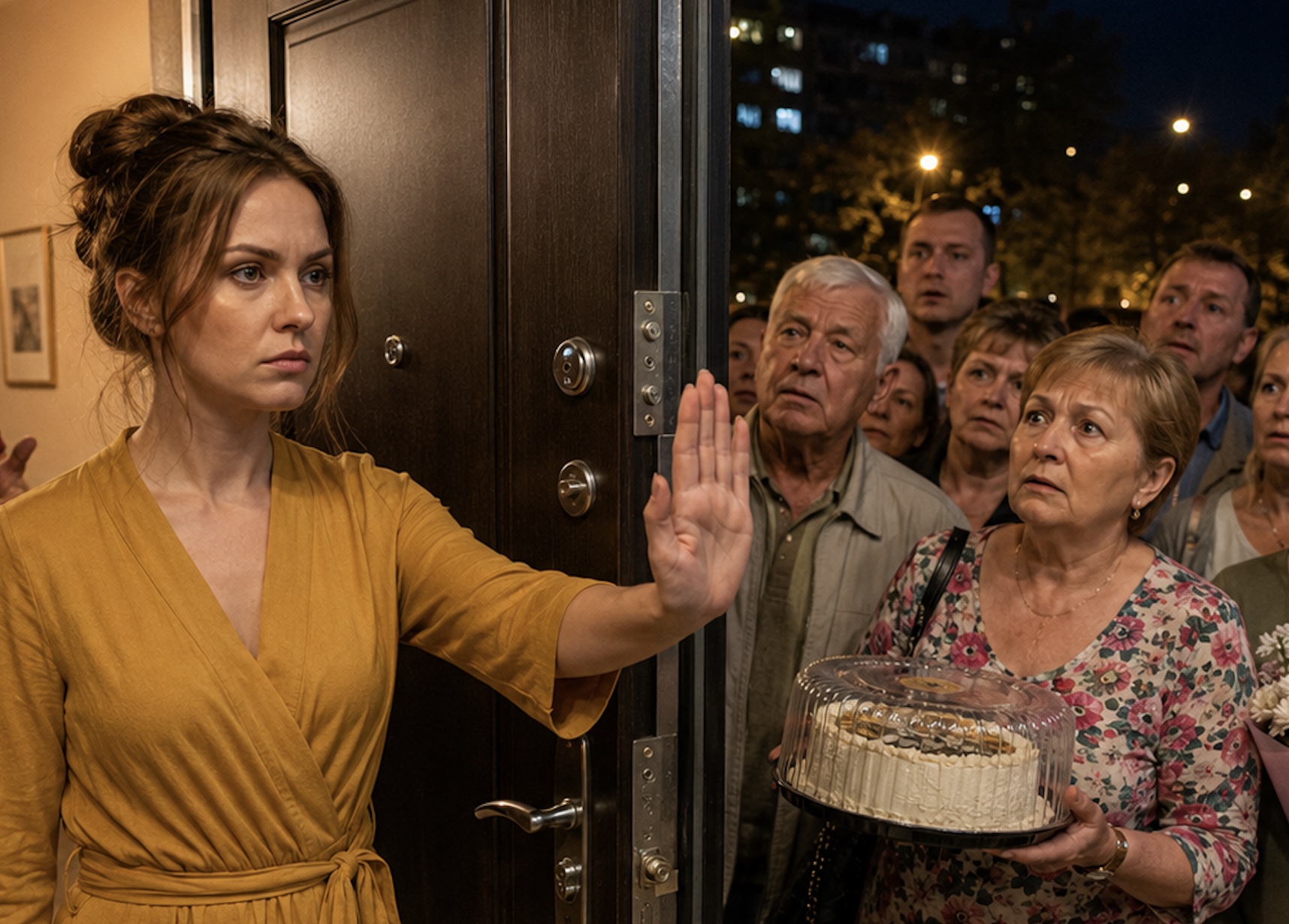
When she opened it, Vladislav and Elena stood on the landing.
But they were not alone.
Behind them were the two men who had played cards the night before, an unfamiliar couple, and another woman holding a cake box.
At least seven people.
Vladislav grinned broadly. He carried a shopping bag from which bottles clinked cheerfully.
“Hi, Olya! We’ve brought the whole crowd this time. Hope you don’t mind. We thought, why come in pairs when everyone can come at once?”
He stepped forward confidently, as he always did, expecting Olga to move aside and let him enter.
She did not.
Olga remained in the doorway, blocking the entrance.
There was no silence inside her now.
No exhausted obedience.
Something that had been stretched tight for six months finally snapped.
“Pasha!” she called without turning around or taking her eyes off the visitors. “Come here. Now.”
Something in her voice made Pavel appear much faster than usual.
He saw the group on the landing and smiled.
“Oh, there are so many of you! Come in, come in. Why are you standing outside?”
“No one is coming in,” Olga said sharply.
Pavel’s smile disappeared.
“Olya, what are you doing?”
She turned toward her husband.
Her face was pale but firm. Her voice was quiet, yet every word landed with the force of a hammer.
“What am I doing? I’ll tell you. For six months, I have kept quiet. For six months, I have come home after exhausting shifts and cleaned up after crowds of people I never invited. For six months, I haven’t been able to eat peacefully in my own kitchen because someone is always sitting there, eating, drinking, and making a mess. I’m tired, Pasha. Enough! This apartment is not a gathering place for your entire family!”
Her voice rang through the stairwell.
Suddenly, everyone on the landing fell silent.
Even the bottles in Vladislav’s bag stopped clinking.
Before anyone could recover, Olga stepped back and slammed the door in their stunned faces.
The lock clicked.
For one second, the hallway inside the apartment was completely silent.
Then someone outside said uncertainly, “Well… I suppose we should go.”
There was shuffling, whispering, and the sound of people heading toward the stairs.
Inside the apartment, a storm erupted.
“What have you done?” Pavel gasped in outrage. “Do you understand what you just did? That was Vlad! That was my family! You humiliated them in front of everyone. You slammed the door as though they were beggars!”
“They are beggars,” Olga snapped, no longer holding herself back. “They come here to eat, drink, and destroy the place, while I clean everything afterward. Have they ever washed a plate? Have they ever thanked me? Have they ever asked whether it was convenient for us or whether we were tired?”
“They were guests! Guests are not supposed to clean!”
“Then let them visit people who are willing to clean after them. Not me.”
“Not you?” Pavel almost choked. “This is my apartment too!”
“Of course it is yours,” Olga said, throwing up her hands. “It becomes yours whenever you want to invite your relatives. But when the place needs to be cleaned, scrubbed, and repaired after them, suddenly it becomes mine. Isn’t that how it works?”
They stood facing each other in the hallway, and six months of resentment burst open.
Pavel shouted that Olga had become cold and bitter. He said she had forgotten how to behave like a normal person. He said he was ashamed of her in front of his family.
Olga answered with everything she had swallowed for months: the endless invasions, the dirt, the noise, the complete absence of respect, and the feeling that she did not truly exist in their marriage except as a convenient household function.
“Am I asking for too much?” she demanded. Her voice trembled, but not from weakness. “I’m asking for respect. I want you to discuss things with me. I want you to ask one simple question: ‘Olya, do you mind if people come over?’ Just once. In six months, did you ask me even one time?”
“Why should I ask? They’re—”
“Your family. I know,” Olga finished tiredly. “I’ve memorized that line. Your family. But what am I, Pasha? Who am I to you? Am I family too, or am I just staff working for the family?”
Pavel stopped.
He opened his mouth, but no answer came.
His silence said more than words ever could.
Olga looked at the man she had lived with for four years. The man she had married believing they would build a warm, peaceful home together.
And suddenly, she understood that he had no intention of changing.
Not because he was cruel.
Because his life was comfortable this way.
He would continue inviting relatives. He would continue ignoring her exhaustion. He would continue expecting Olga to endure, clean, serve, and forgive.
Because that was what she had always done.
“You know what?” she said.
Her voice became calm and flat, like water after a storm.
“You should leave too. Go after your guests.”
“Go where?”
“To Vlad’s. To your parents. Anywhere you want. Stay there for a while. I need to be alone and think. You should think too. Decide whether you actually need me, or whether you only need a housekeeper whose name is on the mortgage.”
“You’re throwing me out of my own apartment?”
“I’m asking you to leave for now because I cannot look at you. If you refuse, I swear I’ll leave myself. Tonight. I’ll go to a friend. But something tells me I’m not the one who should have to leave.”
Pavel resisted.
He shouted that he was not going anywhere. He called the whole situation ridiculous. He said she had created a scandal out of nothing and would come to her senses by morning.
But Olga did not give in.
She no longer raised her voice. She simply stood her ground.
There was something new in her calm determination, something Pavel had never seen before, and it made him uneasy.
At last, he threw some clothes into a bag, slammed the door hard enough to shake the windows, and left.
Probably to Vlad’s.
Where else would he go?
Then the apartment became quiet.
Olga walked into the living room.
She looked at the stain on the sofa, the abandoned sweater, and the cigarette butt in the flowerpot.
For the first time in six months, the thought of cleaning did not fill her with despair.
She cleaned slowly and thoroughly because she knew it was the last time.
She was closing a chapter.
She washed the dishes, scrubbed the table, carried out the bottles, cleaned the sofa as well as she could, threw away the cigarette butt along with the damaged soil, and repotted the plant.
By night, the apartment was spotless.
And most importantly, silent.
The silence was clear and complete.
Pavel did not simply accept what had happened.
At first, he called angrily, demanding that Olga “stop the circus” and let him come home.
A few days later, his tone changed. He became wounded and resentful.
Then he began pleading.
He came over several times, supposedly to collect things or to “talk.”
He promised that he would invite guests less often. He said they could find a compromise.
But each time Olga listened to him, she understood more clearly that the problem had never truly been the guests.
They were only the visible part.
Underneath lay something deeper.
During four years of marriage, Pavel had never learned to take her feelings seriously. He did not see her as a complete person with an equal voice.
He saw her as part of the domestic arrangement.
Promising to invite guests “less often” could not repair that.
One day, Pavel’s mother came to visit.
Tamara Ivanovna arrived to make peace in her own way. From the moment she stepped inside, she began explaining that Olga had overreacted, that family was sacred, that no one should destroy a marriage over something so insignificant, and that Pavel was a good man who deserved forgiveness.
Olga listened calmly until she finished.
Then she said, “Tamara Ivanovna, I did not ask Pavel to leave because of the guests. I asked him to leave because in four years he never once asked what I wanted. The guests were simply the final straw. You say family is sacred. I agree. But family means listening to each other and treating each other with respect. When one person makes every decision and the other quietly cleans up afterward, that is not a family. It is something else.”
Tamara Ivanovna pressed her lips together, muttered something about ungrateful modern young women, and left.
She never returned.
The divorce was finalized three months later.
The apartment caused the greatest difficulty because it was still under a joint mortgage, and they had to negotiate.
In the end, Olga bought Pavel’s share.
She took out an additional loan and calculated that she could manage it. Her salary was sufficient, and years of carefully managing every coin had made her disciplined.
Pavel protested for appearances, then agreed.
It was easier for him to take the money and move back in with his parents, where someone would always feed him, clean for him, and never ask uncomfortable questions.
They separated without hatred.
They simply moved in opposite directions, like two people who had discovered they were never walking toward the same future.
The apartment became entirely Olga’s.
Every last square meter.
The first thing she did was rearrange the furniture.
She had wanted to do it for years, but Pavel had always waved her away, saying everything was fine as it was.
Olga moved the sofa toward the window, hung new curtains, and replaced the stained upholstery.
She threw out the clutter that had accumulated over the years.
Then she bought a large armchair, deep and soft, perfect for sitting with a book in the evenings.
Now, her evenings belonged only to her.
She could come home from work, kick off her shoes, and know with certainty that no music was blasting behind the living-room door.
There would be no mountain of dirty dishes in the kitchen.
No one would be sprawled in her chair.
Her home became a home again, not a banquet hall.
At first, Olga still tensed instinctively while climbing the stairs, listening for heavy bass drifting from above.
But the building was quiet.
Slowly, the anxiety disappeared and was replaced by something steady and peaceful.
Sometimes Olga invited people over.
Her own guests.
A friend from work, a cousin, or a couple of old university friends.
But those visits were completely different.
They were people Olga chose and looked forward to seeing. People who helped set the table and clear it afterward. People who asked whether she was tired or whether they had stayed too long.
When they left, they did not leave stains on the sofa or cigarette butts in flowerpots.
Only the warm aftertaste of a good evening remained.
One Saturday, while clearing out the storage cupboards above the hallway, Olga found an old wedding album.
She opened it and turned through the pages.
There she was with Pavel outside the registry office, young and happy. She wore white. He wore a suit. They were both laughing.
In another picture, they sat at a table surrounded by the same relatives who would later turn her home into a public passageway.
Olga studied the photographs without anger and without much sadness.
She felt only mild surprise, the way one might look at a picture of someone once familiar who had long since become a stranger.
So that life had existed.
Now it was over.
That was all.
She closed the album and returned it to the cupboard.
She did not throw it away. It was still part of her past.
Olga stepped down from the stool and brushed the dust from her hands.
Outside, evening was falling. One by one, windows lit up in the building across the street.
She made tea, curled up in her new armchair by the window, and watched the city slowly disappear into blue twilight.
It was quiet.
Truly quiet.
And the silence no longer felt heavy.
It felt like an embrace.
Her phone lit up on the table.
A message from a friend appeared.
“Olya, how are you? Aren’t you lonely by yourself?”
Olga smiled and typed back.
“You know, for the first time in a very long while, I’m not lonely at all. Quite the opposite.”
She paused, then added:
“Come over next weekend. We’ll have tea. Like normal people.”
She sent the message, put the phone aside, and turned back toward the window, warming her hands around the hot cup.
Tomorrow was Sunday.
Her Sunday.
Entirely hers, from beginning to end.
And so were the days after that.
From now on, she would decide how to live them.