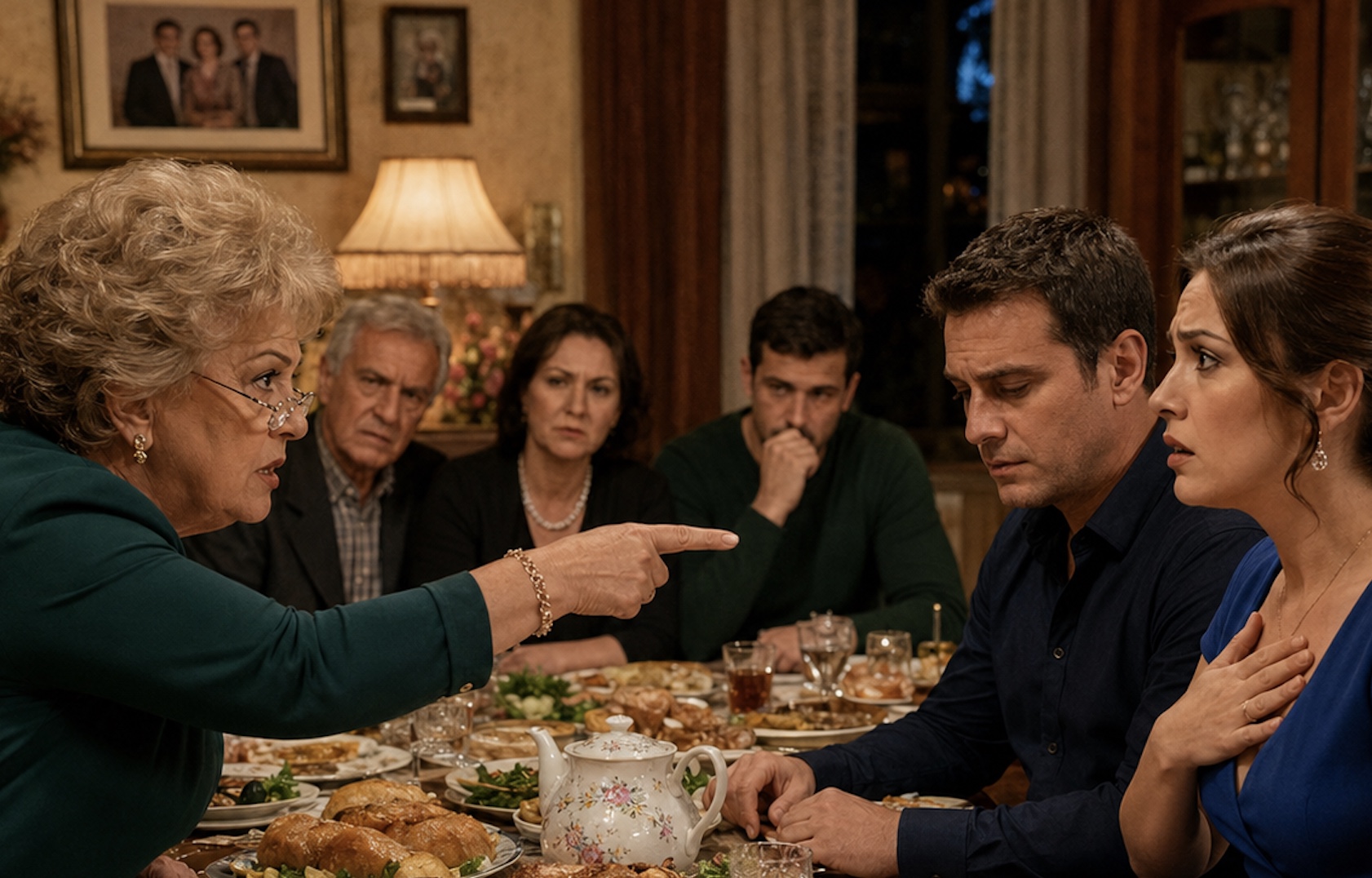
“So the buyers have already paid the deposit?” her mother-in-law asked, slowly stirring her tea with a small spoon.
“Yes. The sale will be finalized next week,” Artyom replied.
Lidia Vasilyevna let out a heavy sigh and shook her head.
“What a pity. Such a terrible pity.”
“What is?” he asked, confused.
“That the apartment is going to complete strangers. You could have given it to Nikita. You’re moving into another place anyway.”
Polina carefully lowered her cup onto the table and looked at her husband.
For several seconds, she was certain she had misheard. Perhaps the words had somehow formed a different sentence in her mind. Perhaps she had misunderstood what Lidia Vasilyevna meant.
But her mother-in-law was looking at them with genuine bewilderment, as though she had suggested something perfectly ordinary.
As though she had asked them to move a chair, not hand over an apartment they had spent five years paying for.
Whenever Artyom spoke about his past, he usually summed it up in a few words.
“I had to grow up early.”
A great deal was hidden behind that simple phrase.
His father died when Artyom was sixteen. Overnight, he stopped being an ordinary teenager and became the oldest man in a family where his younger brother was only eight.
The first summer after the funeral, Artyom unloaded trucks at a warehouse owned by a family acquaintance. He woke up at five every morning, came home with aching arms, and ate whatever food happened to be available.
Later, he enrolled at a technical university, but he never stopped working. He repaired computers for neighbors and acquaintances and accepted almost any job he could find.
He paid for his professional design courses himself.
He bought his first car with his own money too.
“Do you ever rest?” Polina used to ask when they had only just started dating.
“Of course I do,” he would answer with a smile that made it impossible to tell whether he was joking.
Nikita grew up differently.
By the time the younger brother was finishing school, the family was no longer struggling financially. After watching everything Artyom had endured, Lidia Vasilyevna decided that her youngest son should never have to suffer the same way.
When Nikita quit a job, she did not criticize him.
When he ran out of money, she helped without asking questions.
When his washing machine broke, she came over and dealt with the problem herself.
“He’s still young,” she always said. “Life will give him enough hardship later.”
Polina met Artyom at a corporate event she had attended reluctantly.
She worked as a procurement specialist for a large company, understood the value of money, and disliked unnecessary conversation.
Artyom was already working as a design engineer. He was calm, quiet, dependable, and not the sort of man who made promises lightly.
After they married, they bought a two-bedroom apartment in an aging building on the outskirts of the city.
They took out a mortgage and never complained.
For the first several months, they slept on a foldout sofa because buying a proper bed had to wait.
They assembled the kitchen cabinets together by following the instructions.
In the evenings after work, Artyom laid the laminate flooring himself, kneeling with a spirit level in his hands.
Polina painted the radiators and peeled away the old wallpaper one layer at a time.
“Beautiful,” she would say, studying yet another bare wall.
“It will be beautiful,” Artyom would correct her.
Every extra ruble went toward the mortgage.
Instead of taking vacations, they traveled by commuter train to visit friends in the countryside and jokingly called those trips their holidays in nature.
Five years later, the mortgage was finally paid off.
Now they were selling the apartment, the home they had repaired, furnished, and slowly made their own, so they could buy a larger place in a new neighborhood.
Polina had already found a nearby school, even though they did not have children yet.
“For the future,” she had explained, looking slightly embarrassed.
Artyom had not laughed.
He had simply hugged her and said it was wise to think ahead.
Nikita announced his engagement at the end of October during a family dinner at his mother’s home.
His fiancée was named Veronika. She was quiet, with neat hands and a cautious expression.
Everyone received the news warmly. They raised their cups of tea, congratulated the couple, and discussed possible wedding dates.
Then Lidia Vasilyevna gently asked where the newlyweds planned to live.
Nikita shrugged.
“For now, we’ll stay in the studio we’re renting. It’s fine.”
“Do you have any savings?” Artyom asked.
“Well, not much,” his brother admitted. “We only started saving recently.”
Polina said nothing and poured herself more tea.
About a week later, Lidia Vasilyevna called and casually asked about the sale of their apartment.
How much were they asking for it?
When would the transaction happen?
Who were the buyers?
“I’m only curious,” she said.
At the time, Polina did not think much of it.
A few days later, she visited her mother-in-law to help with the computer. Something would not open, and the system kept freezing.
Polina fixed the problem quickly.
She was already preparing to leave when she heard Lidia Vasilyevna speaking on the phone in the next room, unaware that her daughter-in-law was still standing in the hallway.
“Don’t worry, my dear Nikita. I’ll speak to your brother. We can settle everything within the family.”
Polina quietly closed the door behind her and stepped onto the landing.
For a full minute, she stood there staring at the wall.
A troubling feeling rose inside her and refused to disappear.
Several days later, while they were having tea, Lidia Vasilyevna began speaking aloud without addressing anyone directly.
“In the old days, brothers built houses for one another. Nobody kept track of who had contributed what.”
She paused before adding:
“People have become far too calculating. Family should always support family.”
Polina listened and understood that these were not random comments.
They were preparation.
Lidia Vasilyevna came over on Sunday, claiming that she wanted to discuss the wedding.
They talked about the date, the restaurant, and the guest list.
Polina made tea and brought out some cookies.
Everything remained peaceful.
Then, about half an hour later, her mother-in-law folded her hands on the table and began speaking in a different tone—calm, practical, and carefully measured, as though she had rehearsed the conversation many times.
“I’ve been thinking. Why sell the apartment to strangers? Put it in Nikita’s name instead. You’ve already found a new place, and you have money.”
Polina thought she had misunderstood.
“Wait. Are you serious?”
“Of course I’m serious. You’re both young. You can earn more. Nikita has a much harder start. He has nothing. An older brother helping the younger one is completely normal.”
Her mother-in-law spoke with such confidence that she had already begun discussing the paperwork.
Would it be better to transfer the apartment as a gift?
Or perhaps record it as a sale for a symbolic amount?
She spoke as though the decision had already been made.
Without them.
Polina felt her hands turn cold.
Artyom remained silent for a long time.
Then he spoke quietly, but every word was clear.
“Mom, I paid that mortgage for five years. I worked without weekends. We didn’t take vacations. Polina painted the walls herself because we couldn’t afford to hire anyone. I remember every payment.”
“So what?” Lidia Vasilyevna replied without looking away. “You managed, didn’t you?”
Three words.
She said them without cruelty, almost affectionately.
Artyom looked at his mother, and Polina saw something change in his face.
It was not anger.
It was something quieter and deeper.
As though those three words had erased everything he had done.
After that Sunday, Lidia Vasilyevna called every day.
Sometimes twice.
She did not always mention the apartment directly. Instead, she described how Nikita and Veronika were crowded into a rented studio, how noisy the neighbors were, and how inconvenient the commute was.
She sent article after article through their family messenger.
“Why Supporting Your Loved Ones Matters.”
“Family Members Are Not Strangers.”
Then came photographs of Nikita and his fiancée, always accompanied by the same message:
“They desperately need a place of their own.”
Polina read the messages and put her phone away.
At Aunt Galina’s birthday celebration, the entire family gathered around a crowded table.
There were speeches, salads, laughter, and raised glasses.
Then, in the middle of dinner, Lidia Vasilyevna suddenly spoke loudly, apparently addressing no one in particular.
“Some people would rather give an apartment to strangers than help their own brother.”
An awkward silence fell across the table.
Galina Vasilyevna began serving herself more salad.
Someone coughed.
Polina stared at her plate.
Artyom did not say a word.
Later, Galina Vasilyevna quietly told Polina something important.
Several years earlier, Lidia Vasilyevna had inherited a garage from a distant relative. She sold it and gave every last ruble to Nikita so he could buy a car.
Artyom had never known.
The following week, Artyom invited his brother to help repair something at a friend’s garage.
Surrounded by the smell of oil and the clicking of tools, they had their first honest conversation in years.
“Did you really expect me to give you the apartment?” Artyom asked.
Nikita was silent for a moment.
Then he nodded.
“Mom said you would help. She said that was how it was supposed to be.”
Artyom lowered the wrench onto the workbench.
At that moment, he finally understood.
His mother had not merely protected her youngest son.
For years, she had taught him that the world was supposed to rearrange itself for his convenience.
The sale was completed on Thursday.
There was a notary, a stack of documents, and dozens of signatures.
The buyers were a young couple, approximately the same age as Artyom and Polina.
The husband held his wife’s hand while the paperwork was being completed.
Outside, Artyom wrapped his arms around Polina.
She pressed her face against his shoulder and said nothing.
She simply stood there.
Lidia Vasilyevna arrived that same evening without calling first.
She rang the doorbell, stepped inside, and immediately began to cry.
Not quietly, but loudly enough to fill the apartment.
“You betrayed your family,” she said without even removing her coat. “You destroyed your relationship with your brother. Nikita will never forgive you.”
Artyom listened while standing in front of her.
Polina remained near the kitchen doorway.
“Mom,” he finally said, and there was neither anger nor pity in his voice, “I am Nikita’s brother. I am not his financial sponsor. If you believe helping him is an obligation, begin with your own property, not mine.”
Lidia Vasilyevna opened her mouth, then closed it again.
For once, she had no answer.
She stayed for another ten minutes before finally leaving.
About two months passed.
Then Nikita called Artyom himself.
He spoke briefly and without any introduction. He said that he and Veronika had been approved for a mortgage.
The apartment was small and located far from the city center, but it would be theirs.
“Congratulations,” Artyom said.
“Thank you,” Nikita replied.
They never discussed the old apartment again.
Artyom and Polina moved in March.
Their new three-bedroom apartment smelled of fresh plaster and wood.
In the courtyard, workers were finishing the children’s playground. The slide had already been installed, and the swings moved gently in the wind.
Boxes covered the balcony.
Hidden among them was a shopping bag containing a small teddy bear and a star-shaped rattle.
They had bought them a month earlier, after the pregnancy test showed two lines.
Polina moved the bag farther out of sight.
It was still too early to put those things on display.
They continued speaking to Lidia Vasilyevna, but their conversations became formal and distant.
The warmth was gone.
She stopped sending articles and no longer called every day.
The subject of the apartment disappeared as though someone had placed it inside a drawer and locked it away.
One evening, Artyom stood by the window, watching the lights in the neighboring buildings.
Polina entered the room carrying two mugs of tea.
“The strangest thing,” he said without turning around, “is that Mom never once asked anyone to help me. Not in all those years.”
“And now?” Polina asked softly.
“Now, for the first time in her life, she had to hear the word no.”
Polina placed the mugs on the windowsill and silently took his hand.
Outside, the swings in the courtyard were still moving.
Slowly.
All by themselves.