Sometimes life becomes nothing more than a collection of unfinished tasks.
A dripping kitchen faucet. A school form forgotten beneath a pile of mail. Bills still sealed in their envelopes. Leftovers sitting in the refrigerator because no one is particularly excited to eat them again.
Most days, I moved from one responsibility to the next without thinking too much about it.
But every once in a while, something small happened that reminded me why I kept trying.
My name is Rachel, and I work at a modest home-goods store wedged between a bakery and a nail salon. My job is hardly glamorous. Most of my day is spent answering calls, checking deliveries, calming irritated customers, and praying that our ancient inventory software does not crash.
Still, the paycheck covers the electricity, keeps groceries in the kitchen, and gives my daughter and me a safe place to call home.
For a long time, that was enough.
It had been just Lily and me since her father died.
She was only two then.
Now she was eleven, although sometimes she seemed much older. Life had given her the kind of quiet maturity children should never have to acquire so early. She could read my moods from across the room and knew when money was tight even when I never said a word about it.
Since losing my husband, I had learned to become everything our small family required.
I was the person who checked homework, fixed loose buttons, sang bedtime songs, found lost socks, unclogged sinks, remembered dentist appointments, and knew exactly where the emergency roll of toilet paper was hidden.
It was not the life I had imagined when I was younger.
But it was ours.
And despite everything, I considered us fortunate.
We had music playing while we made breakfast. We drank hot chocolate when the weather turned cold. We danced badly in the kitchen. We laughed at private jokes no one else would understand.
Our life was imperfect, but it belonged to us.
One cool autumn afternoon, after a particularly exhausting shift at work, I stopped by a local flea market.
I had no intention of buying anything.
Honestly, I only wanted thirty quiet minutes before going home, reheating leftovers, and helping Lily search for whichever school notebook had mysteriously disappeared that day.
The flea market had always felt like a place where time slowed down.
Tables were covered with chipped dishes, old lamps, tarnished jewelry, faded books, and objects whose histories no one knew anymore. I liked wondering who had owned them before and what kind of homes they had once occupied.
That afternoon, the air carried the first true signs of fall.
There was the smell of roasted nuts, cinnamon, wet leaves, caramel popcorn, and dusty paper.
I wandered between the stalls without hurry, running my fingers over an old casserole dish and examining a collection of mismatched teacups.
That was when I noticed them.
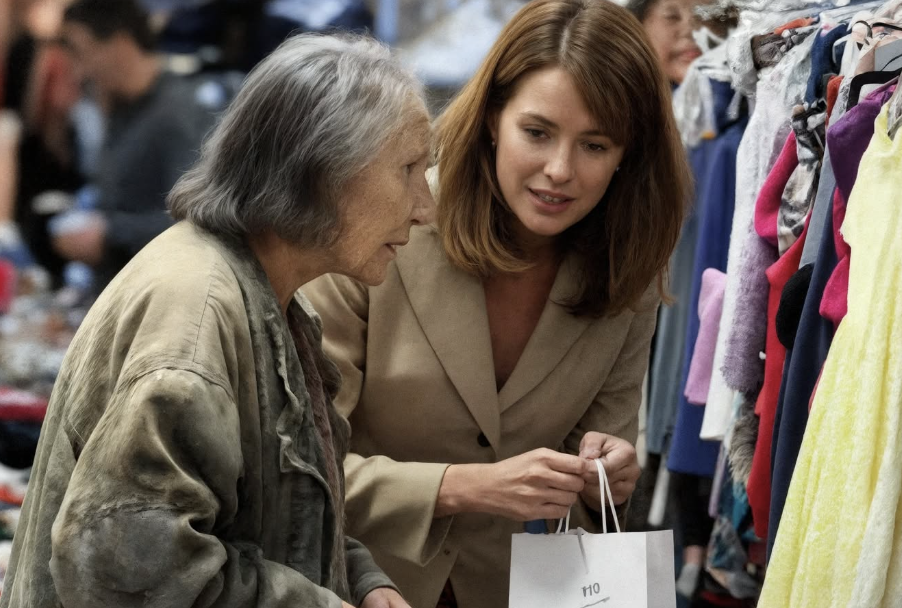
An elderly woman and a little girl.
The child looked about five years old. Her sneakers were badly worn at the toes, and her coat seemed far too thin for the sharp breeze moving through the market.
She held tightly to the older woman’s hand until they passed a rack of secondhand clothing.
Then she stopped so abruptly that her grandmother nearly stumbled backward.
“Grandma! Look!”
The excitement in her voice made several people nearby turn.
The little girl pointed toward a pale yellow dress hanging from the rack.
“If I wore that to the kindergarten fall party, I could be a princess!”
She bounced on her heels as she spoke.
The dress was simple. Soft yellow cotton, long sleeves, delicate lace at the cuffs. It was not expensive-looking or particularly elaborate.
But through a child’s eyes, it was magical.
I had learned long ago that children do not see price tags or designer labels the way adults do.
Sometimes a dress is not merely fabric.
Sometimes it is confidence.
Sometimes it is belonging.
Sometimes it is permission to feel beautiful for one special day.
The grandmother picked up the price tag.
I saw the change in her expression immediately.
It lasted only a second, but I recognized it.
That small pause.
That careful breath.
The calculation being made silently in her head.
She crouched in front of the girl.
“My darling,” she said gently, “that dress costs what we need for groceries this week.”
The child’s smile faded.
“I’m sorry, sweetheart. We can’t buy it today.”
For a moment, the little girl simply stared at the dress.
Then she swallowed hard.
“That’s okay, Grandma.”
She tried to sound brave.
But the last word trembled.
Something tightened painfully inside my chest.
Suddenly, I remembered Lily at five years old.
I remembered saving coins and cutting expenses so I could buy her a party dress she had fallen in love with. I remembered watching her spin around our living room, laughing while the skirt flared around her.
And I remembered hiding in the bathroom afterward and crying.
Not because I regretted spending the money.
Because I had been so relieved that, for once, I had been able to say yes.
I also remembered the day Lily received her first pair of good sneakers instead of the cheapest pair on the clearance shelf.
She had looked at me as though I had given her the world.
That look had stayed with me.
The wonder of being noticed.
The joy of being allowed to want something.
And as I watched the little girl walk away from the yellow dress, trying not to show her disappointment, I stopped thinking.
I took the dress from the rack.
The vendor folded it carefully and slipped it into a paper bag.
“Ten dollars,” he said.
I handed him the money.
“Need a receipt?”
“No.”
He looked at me curiously.
I smiled.
“This dress already has an owner.”
I hurried through the crowd, weaving between tables, food stands, and groups of shoppers until I finally spotted the grandmother and child near a caramel-popcorn stall.
“Excuse me!” I called.
The grandmother turned.
The girl peered cautiously from behind her side.
I approached them, slightly breathless, holding out the bag.
“This is for her.”
The grandmother looked confused.
“I’m sorry?”
“The yellow dress,” I said. “Please let her have it.”
For several seconds, she said nothing.
Then her face crumpled.
“Oh, my dear…”
She pressed one hand against her mouth.
“I can’t accept this.”
“Yes, you can.”
“You don’t understand. I’m raising her alone. Things have been difficult lately, and—”
“I do understand,” I said quietly.
Her eyes met mine.
“I’ve been the mother standing in front of something my child desperately wanted and knowing I couldn’t afford to say yes. I know exactly what that feels like.”
The little girl stared at the bag.
I lowered it toward her.
“This belongs to you.”
Her small hands slowly reached forward.
Then she looked inside.
Her eyes widened.
“Grandma! It’s the dress!”
She hugged the bag tightly against her chest.
“The princess dress!”
The joy on her face was so immediate and pure that I almost laughed and cried at the same time.
The grandmother was crying openly now.
She took my hand in both of hers.
“Thank you,” she whispered. “You have no idea what you’ve done for my Ava.”
I squeezed her hand.
“Let her enjoy her special day.”
Ava looked up at me.
“Thank you, lady.”
Then she smiled so brightly that the entire gloomy afternoon seemed different.
I watched them disappear into the crowd.
For a long moment, I remained where I was.
I did not feel proud, exactly.
It was something quieter than pride.
Something inside me, something I had not even realized was hurting, seemed to soften.
I went home that evening thinking the story was over.
I was wrong.
The next morning began like every school morning in our house.
The kettle hummed.
Toast crumbs covered the counter.
I was packing Lily’s lunch while mentally reviewing everything I had to accomplish before noon.
“Mom!” Lily called from the hallway.
“Yes?”
“I can only find one sock!”
“Check under your bed!”
“I did!”
“The laundry chair?”
Silence.
Then:
“Maybe.”
I smiled and pushed an apple into her lunchbox.
That was when someone knocked on the front door.
Three distinct, deliberate knocks.
I froze.
No one visited us that early without calling first.
I wiped my hands on a dish towel and crossed the room.
When I opened the door, I stared in disbelief.
The grandmother from the flea market stood on my porch.
And beside her was Ava.
She was wearing the yellow dress.
It fit as though it had been made especially for her.
A pale ribbon held her hair back, her cheeks were pink from the cold, and she looked exactly like the princess she had imagined herself becoming.
The grandmother looked different too.
Her gray hair was neatly arranged in a bun, and she wore a carefully pressed coat. She stood straight, with a quiet dignity I remembered from the previous day.
Ava held a small gold gift bag in both hands.
“Good morning,” the woman said. “I hope we aren’t disturbing you.”
“Not at all.”
“My name is Margaret. And, of course, this is Ava.”
Ava waved.
“Hi.”
I smiled at her.
“Hello, princess.”
She beamed.
Margaret hesitated.
“I realize this may sound strange, but we wanted very much to find you. I remembered your car at the market and wrote down the license plate. A neighbor of mine once worked in law enforcement, and he helped us locate you.”
My eyebrows lifted.
Margaret immediately looked worried.
“I hope you’re not angry. I know it was probably inappropriate, but Ava insisted that we needed to thank you properly.”
Before I could respond, Ava stepped forward and pushed the gold bag toward me.
“This is for you!”
I looked down.
“For me?”
“Grandma and I made it.”
Her fingers nervously twisted around the handles.
I knelt so we were at eye level.
“You made me a present?”
She nodded enthusiastically.
“It sparkles. And we picked our favorite colors.”
I accepted the bag and opened it carefully.
Inside, wrapped in white tissue paper, was a small wooden box tied with ribbon.
When I lifted the lid, I found a handmade bracelet.
The beads did not match perfectly.
Some were deep red, some burnt orange, others golden yellow.
They reminded me of fallen leaves, pumpkin pie, warm kitchens, and sunsets that came too early.
“It’s beautiful,” I whispered.
At that exact moment, Lily came running into the hallway in her socks, carrying both sneakers.
“Mom, I found—”
She stopped.
“Who’s here?”
“Lily, this is Margaret and Ava. Remember the little girl with the yellow dress I told you about?”
Her eyes lit up.
“Oh! The princess dress!”
Ava smiled and gave a small twirl.
The skirt lifted around her.
Lily laughed.
“You really do look like a princess.”
Margaret watched them with a warm expression.
“We stayed up late working on the bracelet,” she said. “It may not be valuable in the usual sense, but it was made with love.”
I looked again at the bracelet.
“That makes it valuable.”
Margaret’s expression softened.
“Rachel, yesterday you did much more than buy Ava a dress.”
I looked at her.
“You made that child feel special. And you reminded me of something I had almost forgotten.”
“What?”
“That good people still exist.”
My throat tightened.
“You really didn’t owe me anything.”
“Perhaps not,” Margaret replied. “But gratitude should be expressed while there is still time to express it.”
Ava spun once more.
“When I wear this to my school party, everybody is going to clap for me!”
Lily giggled.
“You’re going to be the queen of autumn.”
Ava gasped.
“Yes! The queen!”
We all started laughing.
And suddenly, my small kitchen—with its worn counters, chipped mugs, scattered breakfast crumbs, and lingering smell of toast—felt like the happiest place I had ever known.
A week later, I opened my mailbox and found a handwritten envelope.
Inside was a note written in elegant cursive.
Dear Rachel,
Ava’s kindergarten fall celebration is this Saturday, and she has insisted that we invite the woman who made her feel special.
We would be honored to have you there.
With affection,
Margaret
I read the note three times.
Part of me wondered whether attending would be intrusive.
I barely knew them.
Perhaps the dress had been enough.
Perhaps I should remain a pleasant memory from the flea market and leave it there.
Then Lily walked past, noticed the letter, and read it over my shoulder.
“Mom.”
“What?”
“She wants you there.”
“I don’t know. Maybe I’d be intruding.”
Lily gave me the kind of look only an eleven-year-old can give a parent who is obviously being unreasonable.
“Ava asked you to come.”
That settled it.
On Saturday, Lily and I entered a kindergarten gymnasium transformed by paper leaves, glitter-covered pumpkins, strings of warm lights, and handmade decorations.
Tiny chairs faced a makeshift stage.
Parents crowded together with phones ready.
I spotted Ava immediately.
She stood among the other children in her yellow dress.
Under the lights, she seemed to glow.
When the music began, Ava sang with all the confidence her small body could contain.
She was not simply participating.
She was radiant.
Lily squeezed my hand.
“She’s beautiful.”
“She is.”
“I’m really glad you bought her that dress.”
I looked at my daughter.
Then Lily added quietly:
“And I’m really glad you’re my mom.”
I nearly lost control of my emotions right there in the kindergarten gym.
When the performance ended, Margaret found us.
Her eyes shone with tears.
“She hasn’t stopped talking about you,” she said.
A moment later, Ava ran toward us.
“Rachel!”
She threw herself into my arms.
“Did you see me?”
“Every second.”
“Was I good?”
“You were wonderful.”
Ava turned and ran to Lily.
Margaret placed her hand lightly on my shoulder.
“Rachel, I don’t know everything you’ve lived through. But I know one thing.”
I waited.
“Kindness does not disappear after it is given. It settles somewhere. It grows roots. And someday, because of what you did, Ava may do something kind for another person.”
I thought about that for a long time.
Months have passed since then.
What began with a ten-dollar yellow dress became something none of us expected.
Margaret now visits regularly, usually without much warning and almost always carrying food.
And Margaret does not simply cook.
She creates the kind of meals that seem to contain history.
Rosemary rolls so soft they almost fall apart in your hands.
Chicken cooked slowly with carrots and thyme.
Apple turnovers wrapped in pastry so delicate it flakes at the slightest touch.
Sometimes she arrives with containers of lentil soup that Lily claims tastes like “a warm sweater when it’s snowing outside.”
Other evenings, we go to Margaret’s house and sit around her little round table, eating from mismatched plates beneath cloth napkins that somehow make everything feel special.
Lily, who had almost no memories of having a grandmother, now hugs Margaret around the waist whenever she arrives.
Ava has become equally comfortable in our home.
She curls against my side during movie nights and asks me to braid her hair the same way I braid Lily’s.
None of us is trying to replace anyone who is gone.
That is not how love works.
We are simply filling empty places in one another’s lives.
Sometimes love enters dramatically.
Other times, it slips quietly through an open door and makes itself comfortable before anyone realizes it has arrived.
One evening, Margaret was standing at our stove, stirring mashed potatoes with caramelized onions, while Lily sat at the counter.
Lily sighed dreamily.
Margaret immediately noticed.
“What is that sigh about?”
“Nothing.”
“That was not a nothing sigh.”
Lily blushed.
“There’s a boy in my class.”
Margaret stopped stirring.
I tried not to laugh.
“His name is Mason,” Lily continued.
Margaret narrowed her eyes.
“And?”
“He smells like pine trees and lemon gum.”
I covered my mouth.
Margaret slowly placed the spoon down.
“Lily.”
“Yes?”
“You are twelve.”
“Almost.”
“No boys until eighteen.”
Lily burst out laughing.
“What?”
Margaret picked up a dish towel and lightly tapped her shoulder with it.
“Perhaps twenty. I will consider eighteen if he has good manners.”
“What? Grandma!”
The word came out naturally.
Grandma.
For a fraction of a second, everyone became quiet.
Margaret’s face softened.
Lily seemed to realize what she had said.
Then Ava, who was sitting at the table swinging her legs, interrupted.
“What if Lily likes two boys?”
Margaret stared at her.
I waited for the answer.
“Then she must learn to bake apple turnovers immediately.”
Ava frowned.
“Why?”
“Because that is the kind of emergency only cooking can solve.”
We all exploded into laughter.
Real laughter.
The kind that fills an entire room and remains there after the sound is gone.
I looked around my kitchen.
At Lily.
At Ava.
At Margaret.
And I understood something.
Families are not always created according to plan.
Sometimes they begin with blood.
Sometimes with marriage.
And sometimes they begin with a little girl standing beside a rack of secondhand clothes, dreaming about a yellow dress she cannot afford.
I had thought I was giving Ava something that afternoon.
I had thought I was simply buying a child a dress.
But life has a strange way of returning kindness in forms we could never predict.
I gave Ava ten dollars’ worth of yellow fabric.
In return, she and Margaret became part of our lives.
We are not connected by blood.
We do not share a surname.
No legal document says we belong to one another.
But Margaret has become the grandmother Lily needed.
Ava has become another daughter of my heart.
And somewhere along the way, our two small, incomplete households became one large, unconventional home.
Maybe that is what family truly is.
Not simply the people we are given.
But the people who arrive unexpectedly, recognize the empty places inside us, and choose to stay.