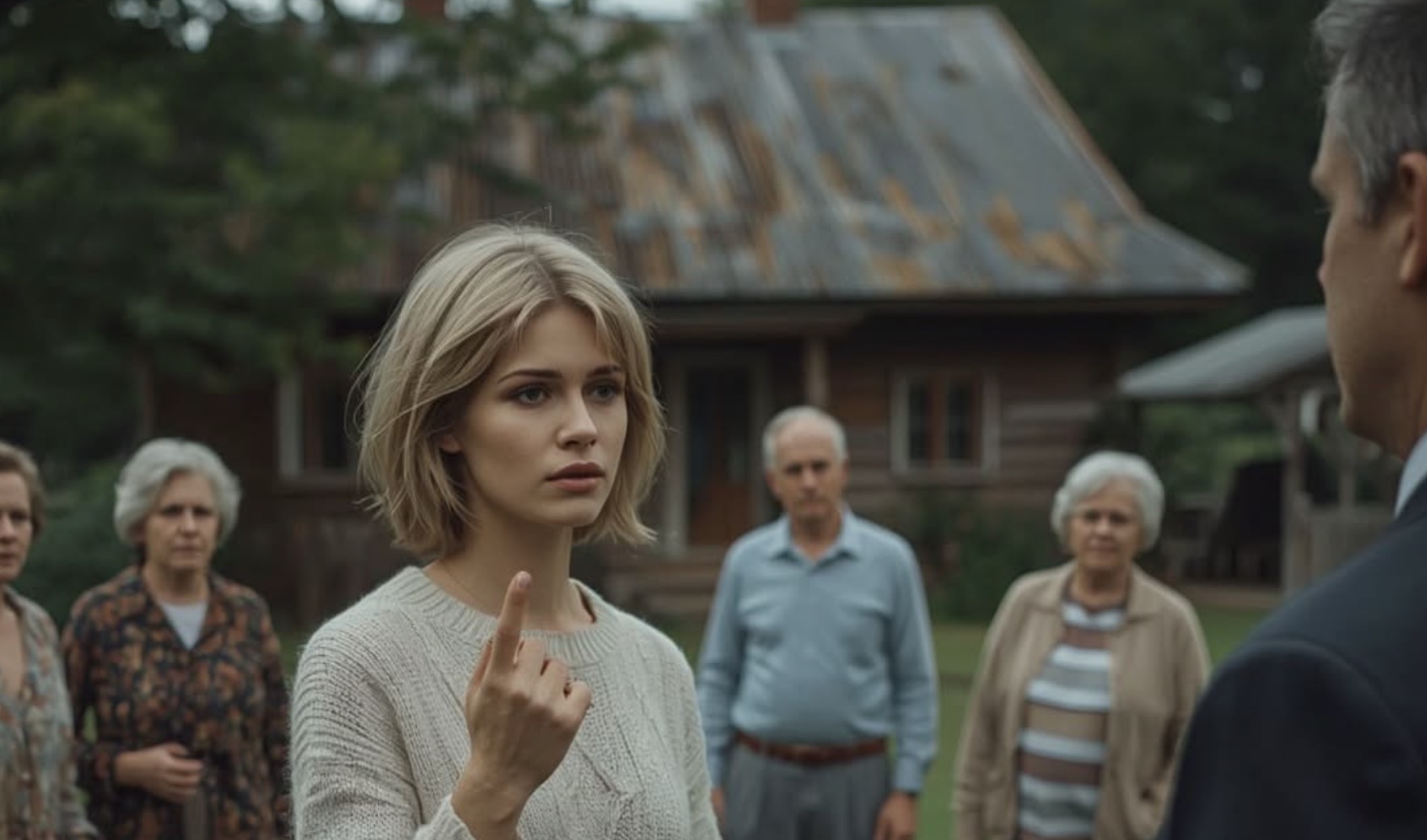
Anatoly stood in the kitchen doorway with his hands in his pockets. He looked down at his wife as she peeled potatoes. For almost two minutes he said nothing, as if enjoying the tension in her back.
“Give me the apartment keys,” he finally said. “You understand why.”
Zoya did not turn around. The knife kept moving steadily, shaving off thin strips of potato peel. She had known this conversation would happen. She had been preparing for it for weeks.
“I don’t understand,” she answered calmly.
“Yes, you do.” Anatoly stepped closer. “We’ll file for divorce next week. The apartment is mine, and you know it. Pack your things.”
Zoya slowly put the knife down on the cutting board. She wiped her hands on a towel, stood up, and turned to face him.
“Yours, you say?”
“Whose else would it be?” he smirked. “I privatized it. It’s registered in my name. You refused your share thirty years ago, remember? You signed the papers yourself.”
“I remember.”
“Well, good. Then you understand the situation.”
He stretched out his hand, palm up, waiting for the keys. Zoya looked at that hand — strong, wide-fingered, still wearing the wedding ring he had not bothered to remove. Thirty-two years of marriage. A daughter they had buried together three years earlier. A granddaughter sleeping now in the next room.
“Anatoly,” she paused. “Are you serious?”
“Absolutely. I have different plans for my life.”
“Different plans,” she repeated flatly. “And where am I supposed to go? Out onto the street?”
“That’s your problem. You should have thought about that when you gave up your share.”
Zoya felt the familiar wave of fear rising inside her. The same fear that had followed her for years — the fear of being left without a roof over her head, without protection, without support. But right after the fear came another thought. Bright, sudden, like a flash.
Nastya. Her granddaughter. Seven years old. Registered in this apartment too.
“Nastya is also registered here,” Zoya said evenly.
“So what?”
“So I am her legal guardian. By law, she has the right to live here. And I have the right to live with her.”
Anatoly frowned. Clearly, he had not expected that answer.
“We’ll see about that.”
“We already have.”
Zoya raised her hand and folded her fingers into a fig sign. Slowly, deliberately, she brought it right up to her husband’s nose. He recoiled in surprise.
“What the hell are you doing?”
“Here are your keys, Tolya. Take them.”
Anatoly burst out laughing. Loudly, broadly, the way he always laughed when he wanted to show he was superior. But confusion flashed in his eyes.
“Well, look at you, Zoyka. You think that changes anything?”
“I think it does. Respect the law.”
A week passed. Anatoly barely came home, spending nights at friends’ places or somewhere else — Zoya did not ask. But one evening he appeared with a bottle of wine and a peaceful smile.
“Let’s talk,” he said, sitting down at the kitchen table.
“Talk.”
“I’ve thought about it. You’re right about Nastya. I won’t be able to throw you out. I went too far.”
Zoya silently poured herself some tea and waited. She knew her husband too well to believe in such sudden changes.
“But the situation is still the same,” Anatoly continued. “We can’t live together. You understand that, don’t you?”
“My sympathies.”
“Exactly. So I found a solution.”
He took a sip of wine. Then he paused, like an actor on stage.
“My mother is alone in the village. Valentina Petrovna is eighty-three, you know that yourself. She has a good, solid house, a big plot of land. The village is developing now. There are shops, and they even opened a medical station.”
“What are you getting at?”
“I’m saying I’m ready to move there. I’ll live in the village and leave you alone. When we divorce, I’ll transfer the apartment to you, since things turned out this way with Nastya.”
Zoya put her cup down. It sounded too simple. Too perfect.
“And what’s the condition? Where’s the catch?”
Anatoly smiled. The same smile she had seen on his face when he closed profitable deals.
“You’ll take my mother in. She’s old. She needs care. It’s hard for her to live alone in the village, and I need freedom.”
“Freedom,” Zoya repeated slowly.
“Yes. I want to finally live for myself. Think about it — a house in the village, it’s nice there now. And my mother will be here, under your care. Everyone wins.”
Zoya looked at her husband and tried to understand his game. He was giving up the apartment — and in exchange, he was getting a house in the village. Not such a bad trade for him. But why was he so eager to get rid of his mother?
“Does Valentina Petrovna agree?”
“I’ll talk to her. She’ll agree. Where else would she go? She’s alone, old, sick.”
“You’ve already spoken to her?”
“Not yet. I wanted to settle it with you first.”
Zoya thought for a moment. Her mother-in-law had never been her enemy. She had never interfered with advice or caused scandals. She had helped with Nastya when she was born, and later, after Lena — their daughter — died. She had sent money from her pension, even though no one had asked her to.
“I need to think,” Zoya said.
“Think. Just don’t take too long. I have plans, you understand.”
“Plans?”
“My personal life, Zoya. I’m not an old man yet. I want to live normally.”
There it was. Zoya felt something inside her snap. Not from jealousy — what jealousy could there be after all this? It was from realizing how completely she had been just a tool to him. For thirty-two years.
“Is there someone specific?”
“That’s none of your business.”
“So there is.”
Anatoly finished his wine and stood up.
“So, do we have a deal?”
Zoya thought about Valentina Petrovna. About how she had cried at Lena’s funeral. About how she had held little Nastya in her arms and said, “I’ll help, my dear, just tell me what you need.” About how she sent jars of jam and pickles, even though she lived alone and life was not easy for her either.
“We have a deal,” Zoya said.
The move was hard on Valentina Petrovna. She cried as she said goodbye to the house where she had lived for more than fifty years. She stroked the walls, hugged the old apple tree in the yard.
“I’ll come back,” she whispered. “I’ll definitely come back.”
Anatoly hurried her, irritated as he loaded her things into the car.
“Mom, enough already. Let’s go.”
“Tolya, let me say goodbye.”
“Goodbye to what? These old pieces of wood? You’ll be better off in the city.”
Zoya watched the scene and felt disgust rising in her. A son was driving his own mother out of her home for the sake of some woman.
In the city, Valentina Petrovna spent the first weeks looking lost. She stared out the window at the gray buildings and sighed. Zoya tried to keep her busy — asked her to help with Nastya, cooked with her, talked to her in the evenings.
“Zoyenka,” her mother-in-law said one day. “Forgive me.”
“For what?”
“For my son. I didn’t raise him right.”
“That is not your fault.”
“It is. I spoiled him. Everything best went to him, everything was for him. And look what he became…”
Valentina Petrovna fell silent, gazing out the window.
“I know why he sent me here. Not for my sake. For his own.”
“You know?”
“Of course. I’m old, but I’m not stupid. There’s a woman in the village. Raisa, a widow. About fifteen years younger than you. He thinks I don’t see.”
Zoya said nothing. What could she say?
“He wants the house,” Valentina Petrovna continued. “The village is growing, and the land is becoming more valuable. Tolya has always been cunning. Even as a boy, he was always looking for a benefit.”
“Valentina Petrovna…”
“No, listen to me. I did something. That morning, before he came to take me away, I went to the notary.”
Zoya looked up at her mother-in-law. The old woman was looking straight at her, calmly.
“I wrote a will. The house goes to you. Not to him.”
“To me? But why?”
“Because you are a human being. And he… I don’t know what he is anymore.”
Valentina Petrovna lived in the city for a little over a year. She never managed to get used to it. She missed her land, her garden, her neighbors whom she had known for decades. She faded slowly, quietly, without complaint.
A week before her death, she called Zoya to her side.
“Promise me,” she said. “Don’t abandon Nastya. She is all that is left of our Lenochka.”
“I promise.”
“And don’t abandon yourself. You are strong, Zoya. Stronger than you think.”
Anatoly missed the funeral. He called and said he could not come because he had business to deal with. Zoya did not argue. She simply hung up.
Six months passed in silence. Zoya worked, raised Nastya, and sorted through her mother-in-law’s belongings. She found old photographs, letters, notebooks. She read them in the evenings and cried — not from grief, but from a strange feeling that resembled gratitude.
Then one day the doorbell rang.
Anatoly stood on the threshold. Red-faced, sweaty, with wild, furious eyes.
“Let me in.”
“Why did you come?”
“I said, let me in!”
He pushed past her and entered the apartment. Zoya calmly closed the door.
“Is Nastya at school?”
“She’s at school.”
“Good. We need to talk.”
He sat down on the sofa without taking off his jacket. His hands were shaking.
“You knew,” he said through clenched teeth. “You knew from the very beginning.”
“What are you talking about?”
“The will! The house! Mother left everything to you!”
Zoya sat across from him and folded her hands in her lap.
“So you found out.”
“Found out? Six months have passed. I went to claim the inheritance, and they tell me, ‘Nothing is left to you, sir. Everything goes to your daughter-in-law!’”
“And?”
“What do you mean, ‘and’?” he shouted, jumping to his feet and pacing the room. “That is my house! Mine! I was born there! Mother had no right!”
“She did,” Zoya said calmly. “It was her house. Her property. She had the right to leave it to whoever she wanted.”
“You turned her against me! You did it on purpose!”
“I found out about the will after she came here, when she told me herself.”
“You’re lying!”
“I never lie, Anatoly. You know that.”
He stopped and stared at her with hatred.
“Give the house back. I’m asking nicely.”
“No.”
“Zoya, I’m warning you…”
“What are you going to do to me?”
She stood and came closer to him. She was not afraid.
“Do you remember Lena? Our daughter?”
“What does that have to do with—”
“Do you remember how she died? How we buried her? How I was left with seven-year-old Nastya because her father had already been stripped of parental rights?”
“That has nothing to do with this.”
“It has everything to do with this.”
Zoya stepped back.
“Do you know where you were when I was filing for guardianship? When I was gathering documents, running from one office to another, proving that I could raise a child?”
“I was working!”
“You were fishing with your friends, Tolya. For two weeks. Because you were ‘tired of all the fuss.’”
He looked away.
Zoya walked to the window. Beyond the glass, the city hummed — cars, voices, ordinary life.
“And do you know where your mother was?” she asked without turning around. “Here. With me. Helping with Nastya, cooking, cleaning. She came from the village for three months and lived in this very room.”
“Mom, she…”
“She was there. And you weren’t.”
Zoya turned around.
“Then you decided to throw me out. Remember? ‘Give me the keys.’ And when that didn’t work, you came up with a scheme involving your mother. You got rid of her so you could live with Raisa.”
“How do you…”
“Valentina Petrovna told me. Half the village knew.”
Anatoly went pale.
“For one year, I took care of your mother. One year. I fed her, dressed her, took her to doctors. I listened to her stories and held her hand when she felt unwell. And you did not come once. You did not even call.”
“I had business…”
“You had a woman in your bed. And plans for the house. You thought your mother would die, you would inherit everything, and life would be beautiful. Isn’t that right?”
He said nothing.
“But your mother was smarter than you. She saw right through you, Tolya. She had seen you clearly all her life. She simply loved you too much to admit it.”
“She couldn’t…” he faltered. “This isn’t fair. It’s my house.”
“It was yours. Now it’s mine.”
“Zoya, listen. Let’s make a deal. We’ll sell the house and split the money.”
“No.”
“Don’t you understand? I have nothing! I gave you the apartment in the divorce! The house is gone! What am I supposed to do now?”
“That is not my question.”
He lifted his head. Angry tears stood in his eyes.
“You did this to me on purpose!”
“No, Tolya. I didn’t do anything on purpose. I simply lived. I cared for your mother. I raised our granddaughter. I worked. And you… you made choices. Every day, you made choices — and every time, you chose yourself.”
She opened the front door.
“Leave.”
“Zoya…”
“Leave. Nastya will be home from school in an hour. I don’t want her to see you like this. Angry.”
Anatoly stepped toward the exit, then stopped.
“All I have left is my car. An old one. Nothing else.”
“That is more than I had when you were planning to throw me out.”
He left. Zoya closed the door. Her hands were trembling — lightly, unpleasantly. But there was a smile on her face. Small, barely noticeable.
She had held her ground.
An hour later, Nastya came home — noisy, cheerful, full of stories about school. Zoya listened, nodded, and helped her take off her jacket.
“Grandma, why do you look so strange?”
“Strange?”
“Yes. Like… I don’t know. Like you’re happy or something.”
Zoya hugged her granddaughter tightly.
“That’s exactly it, Nastya. That’s exactly it.”
That evening, she took an old photograph from a small box. Valentina Petrovna stood beside her house — young, beautiful, holding a rake in her hands. On the back, in faded handwriting, was written:
“To Zoyenka, as a memory. Take care of yourself and Nastya. Your mother-in-law.”
Zoya looked at the photo for a long time. Then she put it back.
Tomorrow she would call about the house in the village. Maybe in the summer, she and Nastya would go there. They would see the apple tree Valentina Petrovna had hugged before leaving.
After all, someone had to water it.