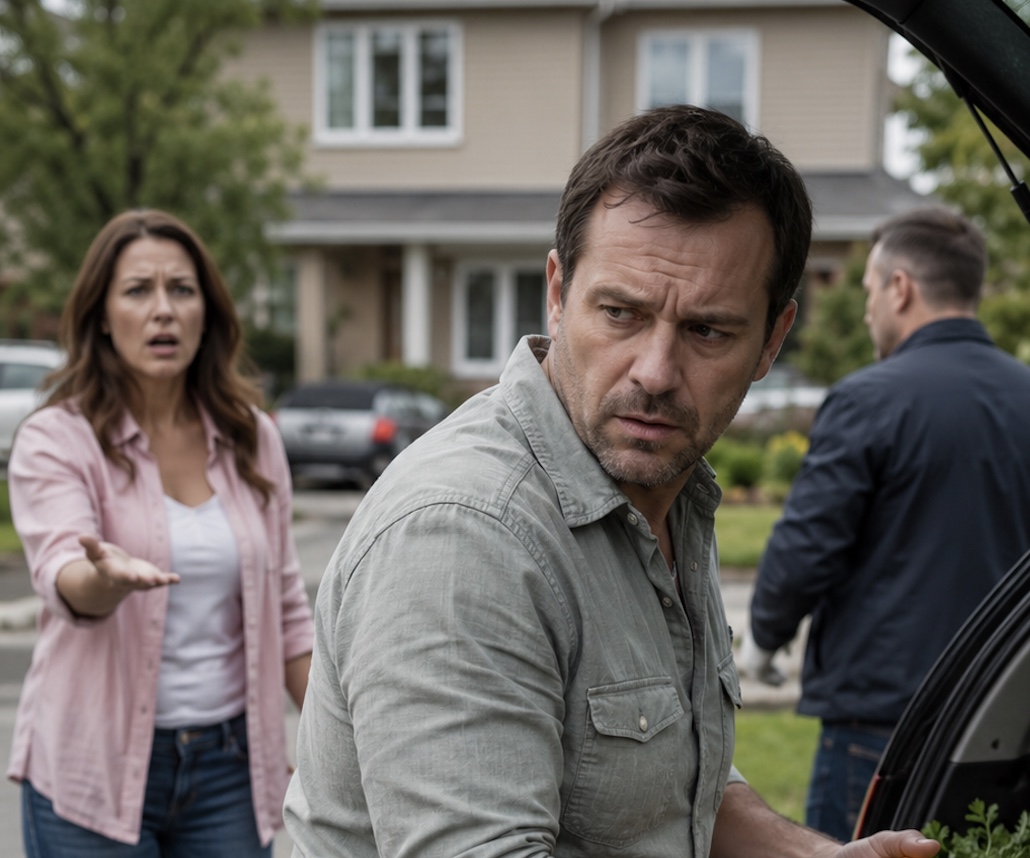
Three sacks of potatoes had been standing by the gate since early morning, and Svetlana nearly tripped over them when she stepped outside to get the mail. Next to them were two buckets of carrots covered with an old checked cloth, and a net bag of onions still smelling of fresh earth. She stopped, set her bag down on the porch, and looked at her husband, who at that very moment was steering neighbor Tolik’s Gazelle truck toward the gate.
“Sergey, where is all this going?”
“To my mother,” he said shortly, without looking at her, and began dragging the sacks into the back of the truck.
“To your mother,” she repeated. “The whole harvest?”
“Not the whole thing. We’ll keep some for ourselves too. Don’t worry.”
Svetlana looked toward the garden beds behind the house. They were empty, freshly dug up, with dark holes where only yesterday the tops had been sticking out. All the onions had been pulled. The carrots too, the entire row, down to the very last root. The potato patch, which she and their daughter Alina had spent a month and a half hilling and watering from a can, now looked like a graveyard — bare soil, a few forgotten stems, and mud pressed down by the wheels of the Gazelle.
“Sergey,” she said, coming closer. “We spent two weeks gathering all this. Every day after work I was on my knees digging potatoes. Alina helped me. Her hands are covered in blisters.”
“So what?” he finally turned to her. He had a heavy sack in his hands and held it as if that somehow gave him a special right not to answer questions. “My mother needs it more. She doesn’t have an extra three thousand lying around from her pension to buy potatoes in winter.”
“We don’t have an extra three thousand lying around either, Sergey. Our daughter is applying to art school, remember? She needs a uniform, brushes, special paper. I was saving money for that, and these potatoes were so we wouldn’t have to buy them in winter.”
“Then you’ll buy them.”
He said it so casually, as if they were talking about a pack of cigarettes that could be picked up at any kiosk, not sacks of potatoes. Svetlana stood there and watched him throw the last sack into the truck, wipe his hands on his pants, take out his phone, and type something — probably telling his mother he was on his way.
“You didn’t think to ask me?”
“What was there to ask? It’s my harvest too. I planted it.”
“We planted it together. And we dug it together. And I watered it alone, because you went fishing every weekend while I ran around the beds with a watering can.”
Sergey grimaced as if she had hit a sore tooth.
“Svet, don’t start. My mother is alone, she’s sixty-eight years old, and her garden only survives because other people help her. She can’t manage it herself anymore. She needs potatoes for winter. What don’t you understand?”
“I don’t understand why you couldn’t tell me yesterday. Or a week ago. Why am I only finding out now, when the sacks are already standing by the gate?”
“Because I knew you’d start all of this.” He waved his hand in her direction as if swatting away a fly. “I decided it would be easier to just do it and not listen to the whining.”
Alina came out onto the porch, wearing a T-shirt slipping off one shoulder and holding a book in her hand. She stopped and looked from her mother to her father, then to the empty garden beds behind the house.
“Dad, where are our potatoes?”
“We’re taking them to Grandma,” Sergey answered quickly, as if he were relieved to have found someone he could speak to in a cheerful voice. “Grandma doesn’t have any supplies.”
“And what are we going to eat in winter?”
“We’ll buy some,” he said, already climbing into the truck. “No big deal.”
Alina looked at her mother. Svetlana said nothing. She watched as the Gazelle pulled out through the gate and raised dust along the dry track toward the village where her mother-in-law, Valentina Petrovna, lived — a woman who, in twenty years, had never learned to call Svetlana by her name, preferring “that one” or, on better days, “the daughter-in-law.”
“Mom?”
“Go inside, Alina. Do your homework. I’ll come in a minute.”
Her daughter went back in, looking over her shoulder. Svetlana remained standing alone beside the empty beds, and for the first time in a long while there were no tears in her mind. There was only a strange, very calm silence, and somewhere at the bottom of it, a thought began to form. It had no shape yet, but one thing was already clear: she was going to do something. What exactly, she did not yet know.
That evening, Sergey returned pleased with himself, flushed from the cold air, smelling of gasoline and someone else’s kitchen — clearly his mother had fed him borscht, as usual. He came into the house, took off his boots, sat down at the table, and without looking at his wife said:
“Mother sends her thanks. She says God bless your Svetka.”
Svetlana stood by the stove, stirring buckwheat she was cooking for their daughter’s dinner — without meat, because there was only enough meat left for one meal, and payday was still ten days away.
“Tell her I’m very touched.”
There was no sarcasm in her voice. She said it completely evenly, and that very evenness made Sergey tense for a second, the way a person tenses when they hear an unfamiliar sound in the dark.
“Why are you so… calm? I thought you’d be sulking all evening.”
“What’s the point of sulking?” she turned to him, still speaking in the same steady tone. “What’s done is done. The potatoes are already at your mother’s. It’s too late to sulk.”
Sergey had clearly been expecting a fight. Perhaps he even wanted one, so he could release his irritation and close the subject in the usual way: he would shout, she would cry, and two days later he would apologize by buying her a chocolate bar, and life would go on. But Svetlana did not give him that script. She placed a plate of buckwheat in front of their daughter, ate her own portion standing by the window, washed the dishes, and went to the bedroom to read, as she did every evening.
Sergey remained sitting alone in the kitchen, more confused by her behavior than he would have been by any shouting.
The next day, Saturday, Svetlana got up early — before her husband had even woken. She put on her old jacket, took her phone, and quietly left the house.
Neighbor Tamara Ivanovna, from whom Svetlana sometimes bought eggs from her chickens, was sitting on the porch with a cup of tea.
“Svetochka, why are you out so early? Did something happen?”
“No, Tamara Ivanovna, everything is fine. I just wanted to ask — how was your harvest this year? Do you have any extra?”
“Oh, plenty of extra, dear. My daughter moved to the city, she doesn’t need even half of it. Why do you ask?”
“I was thinking maybe we neighbors could help each other out. My beds are empty now, and I need some vegetables for winter, while someone else might have too much. We could trade, help one another.”
Tamara Ivanovna immediately brightened. She liked such conversations. In the village, people called it “neighborly,” and Svetlana knew that this phrase would open far more doors than any direct request for help.
Within two hours, Svetlana had visited six houses. One person had extra zucchini, another had jars of pickled cucumbers left from the previous year, and old Zina had an entire pantry full of apples no one could eat because her grandchildren lived in the city. By lunchtime, two buckets of apples were standing on Svetlana’s porch, along with a jar of honey from beekeeper Mikhalych, which she had exchanged for tutoring — she promised to help his grandson with math later — and three cabbages from Tamara Ivanovna given simply “for friendship.”
When Sergey came outside around noon, he found his wife sitting on the porch among all that abundance, sorting apples by size.
“What is all this?”
“The neighbors helped. I found out who had extra and made arrangements.”
He stood there, not knowing whether he should be pleased about it or not.
“Why didn’t you tell me you wanted to go around?”
“I don’t report to you, Sergey,” she said in the same level tone, without lifting her eyes from the apples. “You didn’t report to me when you took the potatoes away either.”
It was the first sentence in two days that contained anything resembling reproach, but it was said so matter-of-factly that Sergey could not find an answer. He simply went to the garage to tinker with the engine, as he always did when he did not understand what was happening in the house.
On Monday, Svetlana went to Valentina Petrovna herself — without warning, something she had not done in years. She preferred to see her mother-in-law only on holidays and keep her distance.
Her mother-in-law’s house greeted her with its familiar smell: mothballs, boiled cabbage, old carpets. Valentina Petrovna was so surprised to see her daughter-in-law on the doorstep that she forgot to say hello first.
“Why have you come? Is Sergey sick?”
“Sergey is fine, Valentina Petrovna. I came on my own business.”
She stepped inside without waiting for an invitation and immediately saw the sacks of potatoes in the corner of the entryway — the very same ones from her garden, neatly stacked against the wall, not yet sorted.
“I wanted to ask,” Svetlana said calmly, looking her mother-in-law straight in the eyes, “do you really need this many potatoes? Three sacks is a lot for one person for winter.”
Valentina Petrovna stiffened, preparing herself for the usual war she had been waging against her daughter-in-law all her life, over anything and nothing.
“Sergey said I was in need. And I am.”
“I’m not arguing that you need help. I’m asking exactly how much you need, so I know what to plan for at home. Alina and I also need something to eat in winter, and we have to buy her school uniform too. She is applying to art school.”
It sounded so direct and so free of the usual hysteria of such conversations that Valentina Petrovna became confused. She was used to her daughter-in-law either remaining silent with offended lips pressed together, or crying, or calling her son with complaints. A calm, businesslike tone threw her off more than any shouting could have done.
“Well… one sack would probably be enough. Two is too much for me. I won’t eat that much alone.”
“All right.” Svetlana nodded, as if they were discussing an ordinary business arrangement. “Then I’ll take two sacks back. I’ll leave one for you — that’s enough for one person, and besides, you can always ask if you need anything. But from now on, if Sergey decides to give something away without discussing it with me, I will come and count it myself. So everything is fair.”
Valentina Petrovna said nothing. She could not find the words. All the familiar accusations she had collected over the years — “that city woman,” “she doesn’t respect her husband,” “she turns him against his mother” — suddenly hung in the air with no support, because Svetlana gave her no reason to attack. She did not shout, did not accuse, did not cry. She simply counted the sacks, took two of them, and asked her mother-in-law’s neighbor, Uncle Kolya, to help carry them to the car. She had called a taxi, without waiting for her husband.
“You should thank your husband for caring,” Valentina Petrovna finally squeezed out as Svetlana was already leaving the yard.
“Taking someone else’s property without the owner’s consent is not care. It is self-will.”
Svetlana turned around at the gate.
“I’ll tell him, Valentina Petrovna. Have a good day.”
That evening, when Sergey came home from work, he saw two sacks of potatoes on the porch — the very same ones, with the familiar chalk mark on the side, the one he himself had made a week earlier.
“What is this?”
“Potatoes. Your mother said one sack would be more than enough for her, and she had nowhere to put the rest. I brought them back.”
Sergey froze with his keys in his hand.
“You went to my mother?”
“I did. We had a normal conversation.”
“Svetka, what are you doing? I brought all that for her, and now you went there and took it back like… like some kind of thief!”
For the first time in all those days, something sharp appeared in her voice — not shouting, but a firmness he had not heard from her in a long time.
“A thief, Sergey, is someone who takes what doesn’t belong to them without asking. I took back what was mine — what Alina and I grew for two months while you kept going fishing. Your mother herself said one sack was enough for her. So she wasn’t the one who needed three sacks. You were the one who needed to look like a good son at my expense.”
He opened his mouth to argue, but no words came. There was nothing to say. Her argument had been built too precisely, with no gap left for objection.
“You humiliated me in front of my mother.”
“I didn’t humiliate you. I counted vegetables. If that feels like humiliation to you, think about why.”
Alina, who was doing her homework at the table in the next room, listened to the conversation and, for the first time in a long while, saw her mother not crying and not silently swallowing hurt, but different — collected, calm, and refusing to retreat even one step.
A week passed. Sergey did not rage aloud at home. He fell silent instead, walking around with pressed lips, pointedly eating dinner in front of the television instead of at the family table. Svetlana either did not notice or pretended not to. She went on with ordinary things — packing apples into jars, making compote, helping Alina prepare for her art school exam, advising her which folder to choose for her works.
One evening, when Sergey was being especially demonstrative in his silence, she approached him herself.
“Sergey, I want to tell you one thing, and then we won’t discuss it again.” She sat opposite him at the table, her hands folded calmly. “I’m not angry that you help your mother. Help her as much as you want. I’m not against it. I’m angry because you decide it for me, as if I and my work don’t exist. If you ever again take something from our land without talking to me first — even a sack of onion skins — I won’t argue and I won’t cry. I’ll simply do what I did this time: I’ll sort it out myself and act the way I think is right. Without your permission, exactly the way you acted without mine.”
Sergey looked at her for a long time, and there was something new in his gaze now — not anger anymore, but something like confused respect mixed with resentment that he had been put in his place so calmly, without a scandal he could later turn against her.
“You’ve changed,” he said at last.
“No,” Svetlana replied, getting up to clear the plates. “I just stopped waiting for you to understand on your own.”
She went to wash the dishes, while he remained sitting at the table, staring at his hands and thinking about something he could not yet put into words — maybe about his mother, maybe about his wife, maybe about himself, a man who had grown used to the fact that in this house decisions were made by two people: his mother and himself. And suddenly it turned out there was a third voice too, one that had once been quiet, but was now perfectly clear.
On Friday, Alina came home from art school with news: her works had impressed the teacher, and there was a chance she could get a state-funded place. She rushed into the kitchen, flushed and breathless, and hugged her mother.
“Mom, she said I have a good sense of composition!”
“Of course you do,” Svetlana smiled, truly and lightly for the first time that week. “You spent two months digging potatoes. Your hands are used to precise movements now.”
Alina laughed, and even Sergey, who was sitting in the corner with a newspaper, could not help smiling — for the first time since that Saturday morning when three sacks of potatoes stood by the gate and seemed like the most important thing in the world.
Svetlana poured tea into three cups, as usual, and thought that the sacks of potatoes had long since cooled in the cellar, the forgotten stems in the garden had rotted under the rain, but this calmness she now lived with — not answering someone else’s self-will with shouting, but calculating, deciding, and acting in her own way — was exactly what she had wanted all these years, without knowing how to name it.
Outside the window, October was beginning, and somewhere at the edge of the garden, in the freshly turned soil, a forgotten parsley bush was unexpectedly turning green — the only thing left of their harvest on that particular patch of land. Svetlana thought that in spring she would plant everything again, but this time she would know exactly where the boundary lay between what belonged to her and what could not be disposed of without asking.
The End.