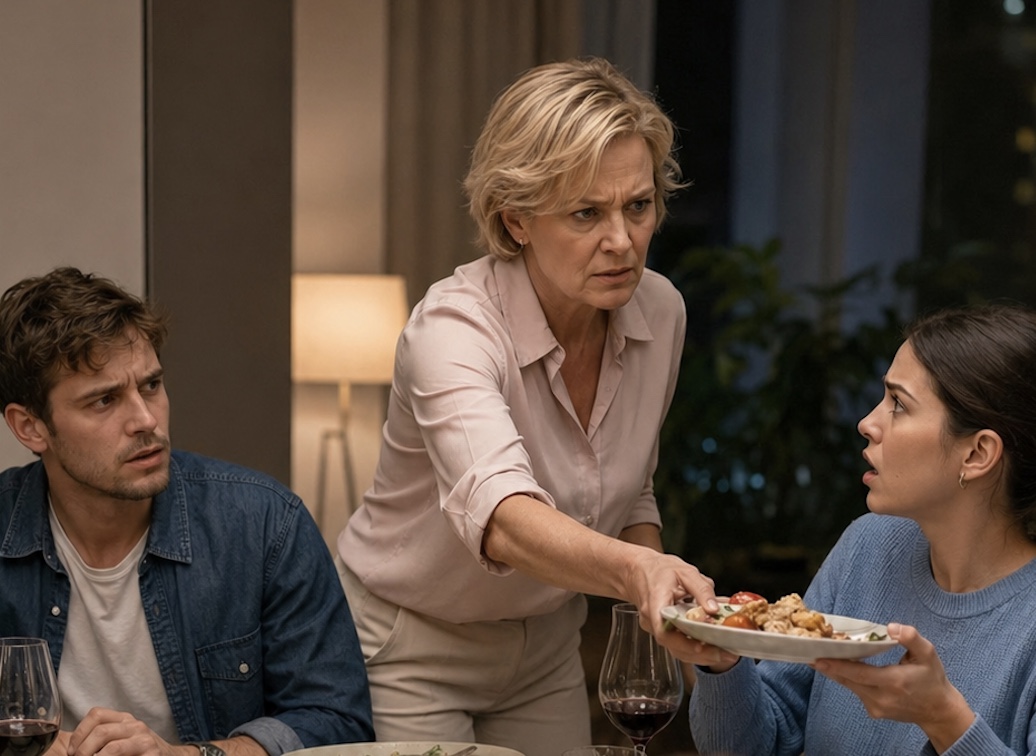
— Artyom, why aren’t you eating?
Karina stopped in the kitchen doorway so abruptly that the strap of her bag slipped off her shoulder. The apartment was noisy, stuffy from food and other people’s voices, and her five-year-old son was sitting on a stool by the wall, as if he had not been placed at the table, but pushed into some corner where useless things were kept.
At the table, her husband’s relatives were eating, laughing, discussing someone’s new plot of land, and arguing about which cake tasted better. Large plates were covered with salads, meat, cold cuts, and fruit. Every guest had food.
Everyone except Artyom.
In front of the boy stood an empty children’s plate with a little bear drawn on it. Beside it lay a small fork. Clean. Untouched.
“Mom…” Artyom raised his eyes to her, then immediately lowered his gaze to the sleeve of his sweater, which he had been twisting for so long that the fabric had stretched.
Karina slowly walked into the kitchen. At first, she even thought she must be mistaken. Maybe his plate had just been cleared away. Maybe he had eaten earlier. Maybe she was simply tense after the exhausting trip, the hospital smell in the clinic corridors, and the client calls that had not let her breathe calmly since morning.
But Artyom did not simply look tired. His face was pale, his lips were dry, and his eyes shone the way they did after long crying. He sat slightly hunched over and did not reach for the salad, or the cutlet, or even a piece of casserole, although normally at the table he would ask for at least some bread.
“Did you eat today?” Karina asked quietly, crouching beside him.
Her son shook his head.
Karina looked at her husband.
Pavel sat at the head of the table like the host of a large celebration. His mother, Zinaida Grigoryevna, sat beside him, flushed and pleased with herself. His sister Svetlana, her husband, and their two children occupied almost the entire right side of the table. There was also Pavel’s cousin-aunt with her husband and his mother’s neighbor, whom Karina had seen only once before in her life.
“Pasha,” Karina said, her voice low and dry. “Why hasn’t Artyom eaten?”
Pavel frowned, as if his wife had asked something completely inappropriate.
“He probably did eat.”
“Probably?”
Zinaida Grigoryevna was the first to put down her fork.
“Karina, don’t start the moment you walk in. We’ve been on our feet all day. We cooked so much, received so many people. The child isn’t a baby anymore. He could have said something himself if he wanted to eat.”
Karina shifted her gaze to her son. Artyom pressed his chin into the collar of his sweater.
“He is five years old. He is not supposed to beg adults for food.”
“Oh, what a tragedy,” Svetlana said, reaching for the salad. “Mine take food themselves when they want it.”
Her younger son was at that very moment eating his second piece of dessert, smearing cream across his fingers. Her older daughter held half a cutlet in one hand and stared absentmindedly at her phone.
Karina slowly straightened. She had not shouted yet. She had not even raised her voice. But inside her, something became hard and tight, like a knot pulled to its limit.
“Artyom, what did you eat today?”
The boy was silent for a long time. Then he answered so quietly she could barely hear him.
“Cookies in the morning.”
“What cookies?”
“The ones that were in the box. The little ones.”
Karina remembered that box. The remains of dry plain biscuits had been sitting in the cupboard since yesterday evening. She had left them in case her son wanted a snack after kindergarten. That meant he had taken them himself in the morning. Or someone had given them to him so he would not get in the way.
“And soup? Porridge? An omelet? Anything normal?”
Artyom shook his head again.
The table grew slightly quieter. Not because the guests had suddenly understood what had happened. Rather, everyone began to realize that an ordinary family gathering might now turn into something unpleasant.
“Karina, you came home earlier than you said you would, so now you’re nitpicking,” Pavel said, leaning back in his chair. “We didn’t know you’d be back so soon.”
“And if I had come home late?”
He did not answer immediately.
“Well, we would have fed him.”
“When? After everyone finished the cake?”
Zinaida Grigoryevna exhaled loudly.
“Don’t make a spectacle. The child was with us. Nobody abandoned him. He played in the room all day.”
“Alone?” Karina turned sharply toward her.
“Why alone? Sveta’s children were running back and forth too.”
Svetlana snorted.
“My children ate because they came and asked. Yours stayed silent. Were we supposed to guess?”
Karina clenched the strap of her bag so tightly that a red mark appeared on her palm.
This apartment was hers. Not Pavel’s. Not her mother-in-law’s. Not “a shared place for relatives.” It was her two-room apartment, bought by her parents before her marriage and registered in Karina’s name back when she was still at university. Pavel knew that perfectly well. But in recent months, he had begun acting more and more often as if the apartment had become a convenient family hall for his relatives.
Today, Karina was supposed to leave for only a few hours. That morning, she had received a call from the private clinic where she was being examined after an old complication. An appointment had opened up with a doctor she had been unable to see for almost a month. Pavel was home that day. He himself had said:
“Go calmly. I’ll handle Artyom.”
Karina had checked three times: feed him, take him outside, give him medicine after food, do not invite many people over because the child still got tired quickly after his recent cold.
Pavel had nodded, even joked:
“I’m not a father for the first day. When you come back, he’ll be full, happy, and holding a toy car.”
And now her son was sitting against the wall with an empty plate while her husband’s relatives ate in her kitchen as freely as if the whole home existed only for their comfort.
“Who even came here?” Karina asked, looking around the table.
“We had wanted to get together for a long time,” her mother-in-law replied. “Sveta had a day off, Aunt Lyuba was free too. Pavlik said you had gone out anyway and the apartment was free.”
Karina slowly turned to her husband.
“The apartment was free?”
Pavel grimaced.
“You’re twisting words now.”
“No. I am trying to understand how guests appeared in my apartment while I was away, and why my child has been hungry all day.”
“Enough already with this hungry business!” Pavel slapped his palm against the table, not too hard, more for show. “He’s alive and healthy. We’ll put food for him now.”
“Now?” Karina gave a short laugh. “After an entire day?”
She reached toward a plate to serve food for her son herself, but stopped. A thought flashed through her mind: who knew what he could even eat now after a whole day on cookies? Besides, after his illness he was supposed to be on a gentle diet. That morning she had specifically left a container in the refrigerator with stewed turkey and buckwheat, separately a children’s cottage cheese, sliced apples, and a bottle of water.
Karina opened the refrigerator.
The container was gone.
She turned around.
“Where is Artyom’s food?”
Svetlana was the first to look away. It was a brief movement, but Karina noticed it.
“I am asking: where is the container with the child’s food?”
Pavel scratched the bridge of his nose.
“We… well… we took it out during the day.”
“And?”
“There wasn’t much in it. Sveta’s children tried some. Then Aunt Lyuba said the buckwheat was good. So, basically, it was eaten.”
Karina froze with the refrigerator door open.
For several seconds she simply stared at her husband. She did not blink. She did not move. Her hand on the door had gone white from tension.
“You ate the food I left for the child?”
“It didn’t have a sign on it saying it was only for him,” Svetlana muttered.
Karina closed the refrigerator slowly, without slamming it. That movement was more frightening than if she had screamed.
“Sveta, are you serious right now?”
“What’s the big deal? You have plenty of food. Someone could have given him something else.”
“Who was supposed to give it to him?”
Svetlana finally looked up.
“Well, you’re his mother. You should have thought ahead.”
Karina nodded slowly. Once. Then again. Her face became calm, but too even, as if she was no longer arguing, but memorizing every word.
“I did think ahead. I left food. I left medicine. I left instructions. I left the child with his father.”
Pavel abruptly stood up.
“Don’t make me look like a monster! My mother came, my sister came with the children, relatives came. Was I supposed to throw everyone out?”
“No. You were supposed to feed your son.”
“We’ll feed him now!”
“Not we. I will.”
Karina took her son by the hand.
“Artyom, come with me.”
The boy stood up from the stool too quickly, then immediately swayed. Karina managed to catch him by the shoulders.
The silence in the kitchen was no longer ordinary silence. Someone placed a fork on the edge of a plate. Aunt Lyuba carefully pushed her dish away. Her mother-in-law squeezed a napkin in her hand but still tried to look like an offended hostess.
Karina led her son to the bathroom, washed his face, and gave him water in small sips. Artyom drank greedily but obediently stopped whenever she asked him to.
“Does your stomach hurt?” she asked.
“A little.”
“Your head?”
“I want to sleep.”
Karina crouched in front of him. She wanted to hug him so tightly that she could shield him from the kitchen, from the voices, from the adults who had seated everyone at a full table except the smallest person there. But she knew she could not fall apart into pity right now. She had to act.
“You’ll eat a little now. Not all at once. All right?”
Artyom nodded.
She took him to the nursery, sat him on the bed, and pulled a home blanket from the drawer. The room was quiet. Toy cars lay on the floor, but they stood too neatly, as if the child had hardly played and had simply moved them from place to place to keep his hands busy.
On the windowsill, Karina noticed a cookie wrapper. One. Beside it was an empty plastic water bottle. So he had found water by himself too.
Karina felt her face grow hot. Not with some beautiful literary anger, but with ordinary maternal fury, the kind that makes you want to speak briefly and without unnecessary words.
At that moment, a key turned in the hallway door.
Karina straightened.
“That’s Nina Pavlovna,” she told her son quietly. “She came to help.”
Nina Pavlovna was the mother of Karina’s close friend Lera. Lera lived in another city, but her mother had long ago become almost family to Karina. After Artyom was born, Nina Pavlovna had helped many times: she picked the boy up from kindergarten, stayed with him when he was sick, came over when Karina had to go to a doctor. She never interfered in family matters with advice, but if she saw injustice, she could not stay silent.
That morning, Karina had written to her that she was going to the doctor and might need help with the child in the evening. Nina Pavlovna had replied shortly: “I’ll stop by after work and check on the boy.”
And now she entered the apartment.
“Karina?” her voice sounded from the hallway. “Are you already home?”
“Here,” Karina answered.
Nina Pavlovna appeared in the nursery doorway with a bag in her hand. She was short, sturdy, wearing a dark coat, her hair tied back, and she had the look of a person who had seen enough in life not to believe cheerful excuses from adults.
She looked first not at Karina, but at Artyom.
“Why are you so pale, little sparrow?”
Artyom tried to smile, but it came out weak.
Nina Pavlovna put the bag on the floor, came to the child, placed her palm against his forehead, then took his hand.
“Have you eaten?”
Karina remained silent.
That silence was enough.
Nina Pavlovna turned toward the kitchen. From there came Svetlana’s muffled voice:
“Well, now this one has come too…”
Nina Pavlovna slowly removed her coat and hung it on a hook in the hallway. Then she rolled the sleeves of her thin sweater up to her elbows.
“Karina, where is the proper food for the child?”
“They ate it.”
“Who?”
“The guests.”
Nina Pavlovna blinked once. Then a second time. Her face did not twist, did not become theatrically menacing. Only her eyes hardened, and her mouth became a straight line.
“And the child?”
“He’s been on cookies since morning.”
Nina Pavlovna said nothing. From her bag, she took bananas, children’s kefir, a pack of plain cottage cheese, and a small container with homemade meatballs, which she had apparently brought just in case.
“First kefir in small sips. Then banana. Then we’ll see how his stomach is,” she ordered calmly.
Karina nodded and opened the package.
But in the kitchen, Pavel said loudly:
“Maybe you’ll stop making criminals out of us already? The child wasn’t sitting in a basement.”
Nina Pavlovna turned her head.
“What did he say?”
Karina tiredly closed her eyes for a second.
“Don’t, Nina Pavlovna.”
“Yes, I will.”
She walked out of the nursery.
Karina followed her but stopped in the doorway. She wanted to see the faces of all these people. Not hear Pavel’s version later, not receive a new version from her mother-in-law where “everything was different,” but see it herself.
Nina Pavlovna entered the kitchen quietly. No shouting. No door slamming. But the conversations at the table stopped by themselves.
She looked over the table. Full plates. Cold cuts. Hot dishes. Desserts. Salads. The sticky sweet-covered hands of Svetlana’s children. Artyom’s empty plate by the wall.
Then she looked at Pavel.
“Is this your son?”
“He is,” Pavel replied, tensing.
“Then why has he been sitting hungry all day?”
“Who are you to interrogate me?” he snapped.
Nina Pavlovna did not even blink.
“A person who is now looking at a hungry child beside a full table. That is enough.”
Her mother-in-law rose from her chair.
“Woman, do not interfere in another family. We’ll sort this out ourselves.”
“You already have,” Nina Pavlovna nodded at the table. “You served yourselves. You served one daughter’s children. And the little boy whose home you are sitting in was left with an empty plate.”
Aunt Lyuba tried to smile.
“Why are you being so harsh? We’ll feed him now. He didn’t die.”
Nina Pavlovna slowly turned to her.
“Repeat that.”
“I’m saying there’s no need to dramatize…”
“No, you said something else. Repeat it fully.”
Aunt Lyuba lowered her eyes to her plate.
Svetlana angrily pushed back her chair.
“How much longer will this go on? Nobody starved him. He didn’t ask!”
Nina Pavlovna stepped closer to the table. Svetlana was holding a plate of hot food in her hand, about to pass it to her husband.
With a sharp movement, Nina Pavlovna took the plate from her hands and set it on the table in front of herself.
“Are you serious? You didn’t feed the child all day?!”
Her voice rang in such a way that the corridor seemed to go empty. It was not louder than a scream, but heavier. There was no hysteria in it. Only a direct accusation from which no one could hide behind a joke.
Svetlana jumped up.
“What do you think you’re doing?”
“What any adult woman at this table should have done hours ago. Look at the child.”
Pavel stepped out from behind the table.
“Don’t you dare speak to my sister in that tone.”
Nina Pavlovna looked at him in such a way that he stopped halfway.
“And you don’t you dare call yourself a father only when it is convenient. A father is not the one who sits at the head of the table. A father is the one who asks first whether the child has eaten.”
Karina stood in the doorway and looked at her husband. Irritation flickered across Pavel’s face, then confusion, then his usual offense. He always did that: when he was caught in something obvious, he quickly stopped being guilty and became humiliated.
“Karina, tell her not to interfere,” he demanded.
Karina stepped into the kitchen.
“No.”
Pavel turned sharply.
“What do you mean, no?”
“I mean I will no longer cover up your irresponsibility.”
Zinaida Grigoryevna threw up her hands.
“Well, here we are! Shaming her husband in front of everyone over a plate of food!”
Karina looked at her.
“Not over a plate. Over a child.”
“He’s a boy! Boys are tough. Nothing happened to him.”
“Are you really trying to explain to me that it is good for a five-year-old child to sit on cookies all day?”
Her mother-in-law opened her mouth but found no answer.
And then a quiet voice came from the nursery:
“Mom…”
Karina instantly turned and went to her son. Artyom stood in the doorway, holding the doorframe with one hand. In the other, he held the kefir.
“I don’t want them to argue,” he said quietly.
That sentence hit harder than anything else.
Karina came to him, knelt in front of him, and adjusted the sweater on his shoulder.
“This is not your fault. Do you hear me? Not yours.”
“I didn’t ask.”
“You are a child. You were not supposed to ask. The adults were supposed to think.”
Nina Pavlovna came up to Artyom and crouched beside him.
“And now you will go to your room, eat a banana, then a little piece of meatball. And the adults will finally remember where the exit from the apartment is.”
Someone at the table drew in a noisy breath.
Pavel stepped toward his wife.
“Karina, you are not going to throw out my relatives.”
“Yes, I am.”
“This is my apartment too!”
The kitchen froze again.
Karina slowly straightened. This time she looked only at her husband.
“Repeat that.”
Pavel already realized he had said too much, but he did not want to retreat.
“I live here. I am your husband. I have the right to invite my relatives.”
“You may invite them only after agreeing it with me. Especially when I am not home. And the stamp in your passport did not give you the right to control my apartment.”
“Here we go,” Svetlana muttered. “How convenient to suddenly remember documents.”
Karina turned to her.
“Svetlana, gather your children.”
“You’re throwing us out?”
“Yes.”
“Pavel, do you hear that?” Svetlana looked at her brother. “Your wife is kicking me out of the house!”
“Out of my house,” Karina corrected. “And yes, I am.”
Zinaida Grigoryevna grew even redder.
“Ungrateful. We came to you with good intentions.”
Nina Pavlovna gave a short laugh.
“People with good intentions usually don’t eat a child’s food and leave him sitting by the wall.”
Svetlana began gathering her children in jerky movements: a jacket for one, a hat for the other, a bag with dessert for herself. At the same time, she kept muttering:
“Disgraceful. Turning a snack into a trial.”
Karina heard and turned sharply.
“Leave the bag.”
“What?”
“Leave the dessert. Did you take it from my refrigerator?”
“Pavel allowed it.”
“I did not.”
Svetlana looked at her brother, but Pavel remained silent.
“Choke on that dessert then,” she hissed and threw the bag onto the table.
“Choose your words in front of the child,” Karina said.
Svetlana’s husband, who until then had tried very hard to act like a piece of furniture, quickly stood up and began looking for the children’s shoes. Aunt Lyuba also started preparing to leave, but tried to preserve her dignity.
“We should probably go. The atmosphere here has become unhealthy.”
Nina Pavlovna cut her off at once.
“The atmosphere has become honest. It was unhealthy when you were silently eating beside a hungry child.”
Aunt Lyuba grabbed her bag and went into the hallway.
Zinaida Grigoryevna was the last to get ready. She came up to Pavel and said loudly, so Karina could hear:
“Son, think carefully about who you live with. Today she threw out guests; tomorrow she’ll throw you out.”
Karina answered before Pavel could.
“If tomorrow he again puts the convenience of adults above the child, I will throw him out not tomorrow, but today.”
Her mother-in-law turned sharply.
“Are you threatening me?”
“No. I’m warning you.”
“How dare you…”
“Zinaida Grigoryevna, the keys.”
Her mother-in-law fell silent.
“What keys?”
“The keys to my apartment. Pavel gave you a set in the spring when you watered the plants while we were away. Return them.”
Pavel jerked.
“Karina, why now?”
“Because today I found out how people appear in my home when I am not here.”
Her mother-in-law pressed her bag to her side.
“I didn’t take any keys.”
Karina looked at her husband.
“Pasha.”
He looked away.
“Mom, give them back.”
Zinaida Grigoryevna stood motionless for several seconds, then reached into the side pocket of her bag and took out a set of keys. A small house-shaped keychain hung from the ring. Karina recognized it immediately: it was hers. She had once given Pavel the spare set herself.
Her mother-in-law held the keys out not to Karina, but to her son.
Karina intercepted them herself.
“Thank you.”
“Don’t choke on your precious property,” her mother-in-law said quietly.
Nina Pavlovna stepped closer.
“Woman, you are leaving now. And it would be better if you did it silently.”
Zinaida Grigoryevna looked at her with hatred, but did not argue. A minute later, the hallway filled with the rustling of coats, children’s voices, and nervous goodbyes that were not really goodbyes. Finally, the door closed.
The apartment became so quiet that Karina could hear Artyom in the nursery eating a banana in small bites.
Pavel remained in the kitchen. The table looked absurd: a ruined celebration, half-eaten dishes, an empty chair by the wall, the plate Nina Pavlovna had taken from Svetlana.
Karina went to the sink but did not start cleaning. She simply poured water for her son into a clean mug.
“Karina,” Pavel began, softer now. “You understand they didn’t mean harm.”
She turned toward him.
“Don’t start.”
“I am guilty, yes. I should have kept track. But why did it have to be in front of everyone?”
“Because my child sat hungry in front of everyone.”
“I didn’t notice.”
“That is the worst part.”
Pavel ran a hand over his face.
“Everything got chaotic from the morning. Mom called and said they were nearby. Then Sveta came with the children. Then Aunt Lyuba. I thought you would be delayed, that we’d sit for a bit quickly…”
“Quickly? There are hot dishes, desserts, and guests from different parts of the city on the table.”
“Well, yes, I ordered some of the food.”
Karina looked at him carefully.
“You ordered it?”
“Yes.”
“So you had time to order food for adults, welcome relatives, set the table, but you did not have time to feed your son with the food I left?”
Pavel opened his mouth and closed it.
He had no answer.
Nina Pavlovna entered the kitchen, took a clean plate, and put meatballs and a little side dish from her container onto it.
“Karina, I’ll give him a little at a time. Call the doctor if he complains about his stomach.”
“I will.”
Pavel frowned.
“There’s no need for a doctor. Don’t exaggerate.”
Nina Pavlovna did not even look at him.
“Your opinion has already shown its quality today.”
Pavel straightened sharply.
“You are a stranger here.”
Karina answered calmly:
“Today a stranger behaved more like family than the relatives at this table.”
That phrase hung between them heavily and finally.
Pavel sat down. No