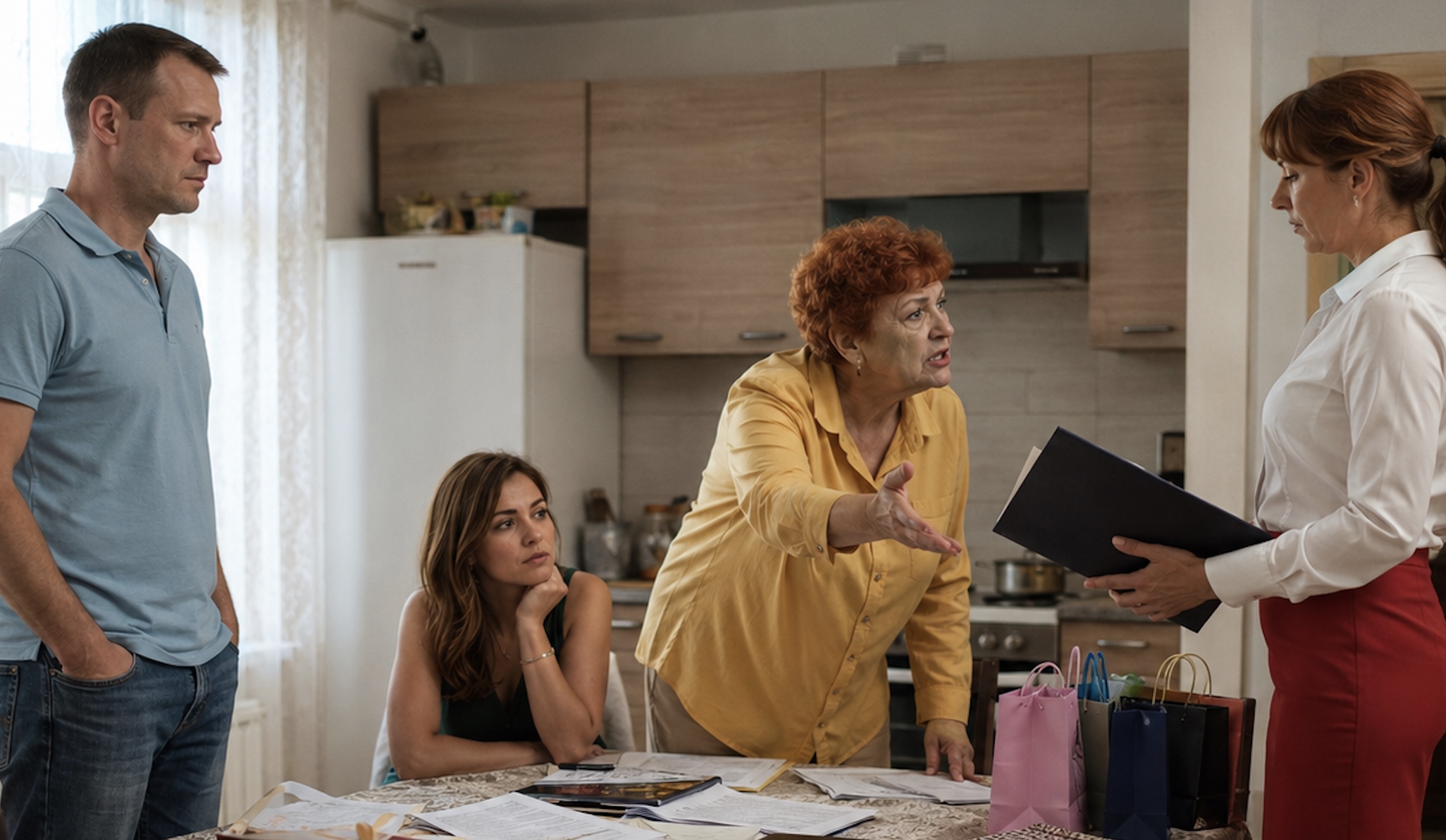
When Nadezhda opened the gate on Friday evening, people were already arguing inside the house. Not shouting at the top of their lungs, the way they sometimes did on Sundays over money or Zhanna’s shopping, but speaking in low, careful voices — with that busy, businesslike urgency people get before doing something unpleasant and profitable.
She stopped on the porch, slipped off her shoes, shook the fine sand from the bus stop out of them, and heard Raisa Nikolaevna’s voice.
“Lida, don’t explain it to me like I was born yesterday. I saw the passport. You can draw up the certificate — you’ve got your own people there. She’s clean: no loans, no missed payments, official salary. Banks like women like that.”
Nadezhda put her bag down on the bench by the door and did not go in. In four years of living in her mother-in-law’s house, she had learned to move quietly. Not because she was hiding, but because in that house, her very appearance could become a reason for criticism: she looked the wrong way, said the wrong thing, came home too late, worked too much, smiled too little.
“What power of attorney?” Raisa Nikolaevna continued. “We’ll make the signature look similar. She works with papers all day long, she won’t notice a thing. Tell her, ‘Sign here,’ and she’ll only ask what pen to use.”
Someone in the living room snickered. Most likely Zhanna. Her sister-in-law laughed exactly like that — short and nasal, as if she already knew everyone around her was stupider than she was.
Nadezhda did not go into the kitchen right away. First, she went upstairs, opened the dresser, and took out the blue folder where she kept her documents. Her passport was there. So was the copy of her employment record, her pension insurance certificate, tax number, and marriage certificate. But the folder had been fastened on the wrong side of the snap. Someone else would not have noticed such a tiny detail. Nadezhda noticed.
She worked at the public services center as a senior real estate registration specialist, and she was used to other people’s folders, other people’s trembling hands, people who lost one certificate and, along with it, half their strength. In the family, they called her “the paperwork woman.” Raisa Nikolaevna liked to say:
“Our Nadya wouldn’t even get married without a stamp.”
Sergey, her husband, laughed along with everyone else. Then later, in their room, he would stroke her shoulder and say:
“Mom’s joking. Don’t take it to heart.”
Nadezhda did take it to heart. Only she did not store it as resentment. She put it somewhere deeper, where everything waited for its moment.
In the kitchen, Raisa Nikolaevna, Zhanna, and Anatoly Palych, Sergey’s stepfather, were sitting at the table. Printed vacation offers lay in front of them. The colorful pages showed swimming pools, white towels, lounge chairs, women in hats. Zhanna tapped one page with her fingernail.
“This hotel is better. They have ultra all-inclusive wristbands, and the bar is open around the clock. Mom, we’re not flying to some dump.”
“Not a dump,” her mother-in-law said with satisfaction. “I’ve worked my whole life. I have the right to rest properly.”
Nadezhda poured herself a glass of water.
“Planning a trip to Turkey?”
Raisa Nikolaevna turned around with the expression of someone caught not discussing a loan, but trying on someone else’s fur coat.
“And what, are we not allowed? We’re family. We have the right to make plans.”
“Of course.”
“Good. Glad you understand.”
Sergey came home late. He worked as a logistics manager at a warehouse for household appliances, and in recent months his shifts had either been moved around, or his boss had demanded he come in on Saturdays. Nadezhda used to believe he was tired. Now she watched him take off his shoes in the hallway and avoid her eyes, and thought that exhaustion did not stop a person from telling the truth.
“Did you know your mother took my documents?” she asked when they were alone.
Sergey froze by the wardrobe.
“What do you mean, took them?”
“I mean someone opened my folder. Someone touched my passport.”
“Nadya, maybe Mom needed something for utilities. You know how she is — she likes to handle everything herself.”
“Then why didn’t she ask?”
“Because you immediately put on that investigator face.”
He tried to smile, but it came out weak. Nadezhda did not argue. In that house, every argument worked in Raisa Nikolaevna’s favor: she raised her voice, Zhanna backed her up, Anatoly Palych shook his head, and later Sergey would say, “You started it yourself.”
The next morning, a bank called her. It was a bank whose name she had only ever seen on a sign near the market. A polite young woman asked whether Nadezhda Vladimirovna Safonova confirmed an application for a cash loan.
“What amount?” Nadezhda asked.
“Three million two hundred eighty thousand rubles. The application is still preliminary, submitted through a partner channel.”
Nadezhda wrote down the name of the bank and the application number, then asked them to mark the application as refused. During her lunch break, she filed a self-ban on new loans through the credit bureau. An hour later, she called Oksana, a former client whom she had once helped restore apartment documents after a registry mistake. Oksana worked in the security department of a large bank and rarely wasted words.
“If the application already came through partners, then they have copies of your documents,” Oksana said. “You did the right thing with the self-ban. But if they have a person inside the bank, they may try to bypass it through a power of attorney or supposedly in-person confirmation. Don’t start a scandal at home. Let them think you haven’t understood anything.”
“And if they manage to do it?”
“Then we catch them in the act. But you need to record everything: calls, papers, who asked for what documents and when. And get your passport out of that house.”
That same evening, Nadezhda put her passport in a storage box at work, in the safe used for employees’ temporary document storage. At home, she left an old cover with copies inside, deliberately in plain sight. She felt disgusted by this little game, but even more disgusted when she remembered her mother-in-law’s voice: “Tell her, ‘Sign here’…”
Two days later, Raisa Nikolaevna organized a family dinner. She bought smoked chicken, sliced cheese, and brought out the crystal glasses she usually saved for outsiders. Sergey came home earlier than usual and sat beside his mother. Nadezhda noted it automatically.
“We have news,” Raisa Nikolaevna said, pouring compote. “We’re flying to Belek. A good hotel, not some cheap place. I decided: how long can a person deny herself everything?”
“Mom, am I going with you?” Zhanna asked, though her face made it clear she already knew the answer.
“Of course, sweetheart. You need a change of scenery. You’ve been sitting here turning gray.”
Zhanna beamed.
“Sergey is going too,” her mother-in-law continued. “He got vacation time. Anatoly, me, Zhanna, and Sergey. Seven days. Sea, sun, decent food, not our pots and pans.”
Nadezhda placed her fork on the edge of her plate.
“And me?”
Raisa Nikolaevna lifted her eyebrows in theatrical regret. She had clearly been waiting for this question.
“Nadya, you’re a grown woman. The tickets are expensive. And we can’t leave the house empty: the cat, the garden, a package is supposed to be delivered. The family is going to the sea. You stay here and watch the house.”
Zhanna lowered her face into her phone, but her shoulders trembled. Sergey stared at his plate. Not at Nadezhda. Not at his mother. At the plate where his potatoes were getting cold.
“I see,” Nadezhda said.
“Don’t be offended,” Raisa Nikolaevna added more cheerfully. “We’ll bring you a robe. Or a towel. The textiles there are good.”
“No need. Buy something for yourselves.”
She stood up from the table and took away her plate. Raisa Nikolaevna did not get tears, pleading, or a scene. That seemed to irritate her most of all.
The night before their departure, Sergey tossed and turned for a long time. Then he sat up in bed and said:
“Nadya, don’t turn this into a tragedy. Mom really paid for it. I couldn’t refuse.”
“You could have.”
“You don’t understand. She would be offended.”
“And me?”
He said nothing. Then he lay back down, turning his face to the wall. And that silence was more precise than any confession.
When the taxi took them away with their suitcases in the morning, Nadezhda closed the gate and returned to the house. In the hallway stood a bag of trash that Zhanna had been too lazy to take out. Nadezhda untied it not out of curiosity, but because a sheet with her surname was sticking out on top.
On the papers were lines written in someone else’s hand: “Safonova N. V.,” “Nadezhda Safonova,” “I agree to the terms of the contract.” Beneath that were calculations: 3,280,000, commission, insurance, transfer to Lida, remaining amount to Raisa. On a separate sheet was the phrase: “Income 178,000, monthly bonus.” Nadezhda even gave a short laugh. She could only dream of that kind of salary at the public services center.
She spread the sheets out on the table, photographed them, put them in a file, and called Oksana.
“They’ve flown out. I have the papers.”
“Good,” Oksana said. “Come to the bank this afternoon. You’ll speak with our lawyer. And one more thing: do you have a neighbor named Antonina Matveevna?”
“Yes.”
“A year ago, someone tried to take out a loan in her name through the same channel. If she agrees to give a statement, this stops being a family quarrel and becomes a pattern.”
Antonina Matveevna lived across the way, in half of an old house with a peeling veranda. She did not open the door to Nadezhda right away; first she fussed with the chain for a long time.
“Is Raisa gone?” she asked, peering through the crack.
“Yes. She flew off on vacation.”
The old woman let her into the kitchen, where an unfinished cup of tea and blood pressure pills sat on the oilcloth-covered table.
“She came to me,” Antonina Matveevna said after Nadezhda explained why she was there. “Asked for my insurance number. Said she’d arrange a pensioner discount for garbage collection. Then I got a notice saying I owed one hundred twenty thousand. My son ran around and argued with people, and it seems they canceled it. But I trusted her. We’ve lived over the fence from each other for twenty years.”
“Can you write a statement?”
Antonina Matveevna tugged at the edge of her headscarf for a long time.
“I’m afraid of her, Nadya. She won’t let me live in peace afterward.”
“She already won’t. And not only you.”
The old woman looked at her carefully, the way people look when they are tired of being afraid but have not yet grown used to any other way of living.
“Write it. I’ll sign.”
After that, everything moved forward — not quickly, and not beautifully. Nadezhda went to the bank, wrote a statement, handed over copies, checked dates. Oksana found the employee in the partner channel: Lidia, the very friend Raisa Nikolaevna had mentioned. At first, Lidia insisted she knew nothing. Then she asked them not to make a fuss. Then she admitted Raisa had brought copies of the documents and promised to pay off her microloan debt.
But the hardest blow came on the fifth day. Sergey called from the resort and asked for her passport.
“Nadya, there’s some confusion with the hotel booking,” he said too quickly. “Send me a photo of the first page and the registration page. Mom says they need it for a family discount, to confirm the household.”
“A hotel in Turkey needs my registration address in Yaroslavl?”
“Don’t start. Just send it.”
“Did your mother ask you?”
He exhaled into the phone.
“Nadya, can you help just once without an interrogation?”
She did not send him her passport. She sent him a photo of the old copy with a barely visible mark she had placed in advance: a tiny dot next to the issuing authority number. Two hours later, Oksana sent a message: “The copy appeared in a new application. Now we have a link to Sergey.”
Nadezhda sat in her mother-in-law’s empty kitchen and stared at the screen. Until then, she had still held on to a thin hope that Sergey was simply weak — a convenient son who did not ask his mother questions. Now it was clear: he had not only kept silent. He had helped, even if he called it a request “for the hotel.”
The bank did not issue the loan. Oksana and the lawyer made sure the application was not merely rejected, but handed over to the police with materials concerning forged documents and an attempt to bypass the self-ban. Lidia agreed to cooperate. Antonina Matveevna signed her statement. Another woman from a nearby street came forward on her own after hearing from Antonina’s son that “they had started dealing with Raisa.”
By the time the vacationers returned, Nadezhda had prepared not a performance, but order. Three folders lay on the table: her statement, the bank materials, and the neighbors’ explanations. Her phone contained Sergey’s messages asking for the passport. In the hallway stood a bag with her belongings. She had already rented a room from a colleague on the other side of town and arranged to move her boxes in the morning.
They returned on Sunday evening, tanned and loud. Zhanna came in first, wearing new sunglasses and carrying a bag of sweets.
“Our house guard is home!” she said cheerfully. “Did you miss us?”
“No.”
Raisa Nikolaevna followed her in, tired but pleased. A new bracelet glittered on her wrist, clearly not a cheap one.
“Nadenka, we brought you a towel. A small one, true, but it’s from the hotel. The quality there is nothing like ours.”
“Put it on the chair.”
Sergey came in last. He immediately noticed the folders on the table and the bag in the hallway.
“Are you going somewhere?”
“Yes.”
Raisa Nikolaevna took off her hat, placed it on the cabinet, and gave her own bag a brisk slap with her palm.
“First, we talk. Since everyone is home.”
They sat down in the kitchen. Zhanna managed to open a box of baklava. Anatoly Palych poured himself water. Sergey stayed standing by the window. Raisa Nikolaevna took a printed contract from her bag and placed it in front of Nadezhda.
“Here. No need to make big eyes. We took out a family loan for repairs and debts. We’ll pay it together, but it’s in your name because you have a reliable job. You’re not a stranger, after all.”
“The family went to the sea,” Nadezhda said. “But the loan is suddenly for everyone?”
Zhanna froze with a piece of pastry in her hand.
Raisa Nikolaevna pursed her lips.
“Don’t cling to words. You live in my house. You eat at my table. You use everything here. It’s time you became useful.”
“I already have.”
Nadezhda opened the first folder and placed the photographs of the drafts in front of her.
“These are your practice attempts at my signature. This is the calculation showing how much Lidia gets. This is the certificate with the invented salary. This is the new application where Sergey sent a copy of my passport. And this is Antonina Matveevna’s statement — the woman you already tried to put a loan on under the excuse of a garbage discount.”
Raisa Nikolaevna turned pale, but quickly pulled herself together. She was the kind of person who, even when caught red-handed, first tried to shout.
“You were digging through my things?”
“The trash. The sheets were on top. The rest came from the bank.”
“What bank? Are you insane? This is a family matter!”
“No. This is document forgery and attempted fraud.”
Sergey pushed himself away from the windowsill.
“Nadya, I didn’t know Mom was going to submit an application. She told me the copy was needed for the hotel.”
Nadezhda took out her phone and read his message aloud:
“‘Just send it. Mom says the amount won’t go through without you.’ Was that for the hotel too?”
He opened his mouth, but said nothing. Zhanna slowly placed the baklava back into the box.
Raisa Nikolaevna slammed her palm on the table.
“Who do you think you are? You think you can scare us with papers? I let you into this house. I fed you and Sergey. If you don’t like it, pack your things and leave. But you’ll sign the loan, because now everything is stuck because of you, and I have to pay people back!”
“What people?”
Her mother-in-law stopped short. Anatoly Palych looked away.
“The supplier from the market?” Nadezhda asked. “Or the people who gave you money at interest? The bank already knows where part of the loan was supposed to go.”
This time Raisa Nikolaevna had no answer. In the kitchen, the old refrigerator clicked behind the wall.
There was a knock at the door. Not the bell — a knock. Even, official. Nadezhda stood up.
“I asked the district officer to come at nine. A policewoman will be here too. No one is arresting you tonight, Raisa Nikolaevna. Today they will take your statements and seize the documents. What happens next will be up to the investigator.”
“You’re disgracing me in front of the neighbors,” her mother-in-law hissed.
“No. You went to the neighbors yourself when you took their documents.”
At the doorway stood the district officer and a woman in uniform. Behind them, near the gate, Antonina Matveevna hovered in a gray cardigan. She did not enter the yard; she only watched from behind the fence. Raisa Nikolaevna saw her and, for the first time that evening, lost her commanding look.
“Tonya, what are you doing here?” she shouted. “I helped you!”
Antonina Matveevna adjusted her cardigan and answered quietly, but loudly enough for everyone to hear:
“I’ve had enough of your help, Raisa. I spent three months taking pills after it.”
That sentence did more than the folders and statements. Zhanna began to cry. Anatoly Palych started fussing near the cupboard. Sergey sat down on a stool as if all his strength had suddenly left him. Raisa Nikolaevna tried to speak, interrupted the district officer, demanded a lawyer, called Nadezhda ungrateful — but with every minute her voice grew quieter. In her house, in her kitchen, in front of her neighbor, people no longer obeyed her.
An hour later, the police left with the documents, Zhanna’s laptop, and Raisa Nikolaevna’s phone. They did not take the mother-in-law away immediately, and that made the punishment feel even heavier: she had to remain in the house where everyone already knew what had happened. The next day Antonina Matveevna told her son; her son told the neighbors; the neighbors told theirs. By evening, no one stopped at Raisa Nikolaevna’s gate to chat anymore, though before that she had loved ruling the street from her bench.
Nadezhda did not spend that night in the house. Sergey helped carry out the boxes, but she did not thank him. On the porch, he said:
“I thought you’d forgive me. You always smoothed things over.”
“I wasn’t smoothing things over, Seryozha. I was hoping.”
“And that’s it? A divorce over one loan?”
She looked at him calmly.
“Not because of the loan. Because you knew they were crossing me out of the family, and you stayed silent. And then you asked for my passport yourself.”
He wanted to object, but this time Nadezhda did not wait. She got into the taxi and left.
The following months were unpleasant, with no beautiful victory scenes. Raisa Nikolaevna was dragged in for questioning, and later charges were brought against her in several episodes. Lidia lost her job and gave testimony. Zhanna sold her watch, bags, and phone because some of the purchases were recognized as having been made with money obtained through deception. Anatoly Palych got a job as a security guard at a parking lot — for the first time in many years, not for show, but because they needed money for a lawyer.
For Raisa Nikolaevna, the most painful part was not the trial. First, the bank blocked the disputed operations. Then the bailiffs placed temporary restrictions on the car. Then the market supplier — the very man for whom the whole loan scheme had been started — came to the house and demanded his money back in front of the neighbors. Raisa Nikolaevna stood by the gate in a housecoat, without her bracelet and without her usual threatening smile, while people from neighboring yards looked not at Nadezhda, not at Antonina Matveevna, but at her.
“You said you had everything under control,” the supplier said. “Where’s the money, Raisa?”
She tried to close the gate, but the lock jammed. She struggled with it for a long time, red-faced and bewildered, under the eyes of the very people she used to teach how to live.
The sentence came six months later. Raisa Nikolaevna received three years in a general-regime penal colony, with the execution delayed pending appeal due to her health condition. But the house was already under arrest, the car had gone to auction, and her name in the neighborhood had stopped being a source of authority and become a warning. Lidia received a suspended sentence and a ban from working in banking. Zhanna got off with a fine and community service, because they proved only her involvement in passing along copies and making purchases. Sergey formally remained a witness, but Nadezhda filed for divorce, and his silence cost him more than any criminal charge: his mother could no longer support him, his wife had left, and the house he had clung to had stopped being a fortress.
Nadezhda rented a small apartment near work. It had a narrow kitchen, an old table, and a window facing a courtyard where someone loudly started a car every morning. She did not feel like a winner. Victory in stories like this rarely looks like celebration. It feels more like slowly straightening your back after carrying something heavy for too long.
One day, Antonina Matveevna came to visit her. She brought a jar of gooseberry jam and a letter from the bank: her debt had been officially recognized as a mistake, and her credit history had been corrected.
“I sleep now,” the old woman said, smoothing the letter with her palm. “Can you imagine? I simply sleep.”
Nadezhda put the kettle on and smiled.
“I can imagine.”
She no longer wore her wedding ring and did not answer Raisa Nikolaevna’s messages — the ones where she first threatened, then complained, then asked Nadezhda to “have mercy as a woman.” Nadezhda reserved mercy for those who made mistakes and admitted their guilt. Those who called a person an outsider and then tried to hang a debt around her neck deserved something else: to meet the consequences.
That evening, she placed Antonina Matveevna’s letter into a folder. Not as evidence. Simply as a memory — a reminder that silence does not always mean weakness. Sometimes a person stays silent because they are still gathering themselves together. And once they have, it is too late to explain to them who truly belongs in the house.