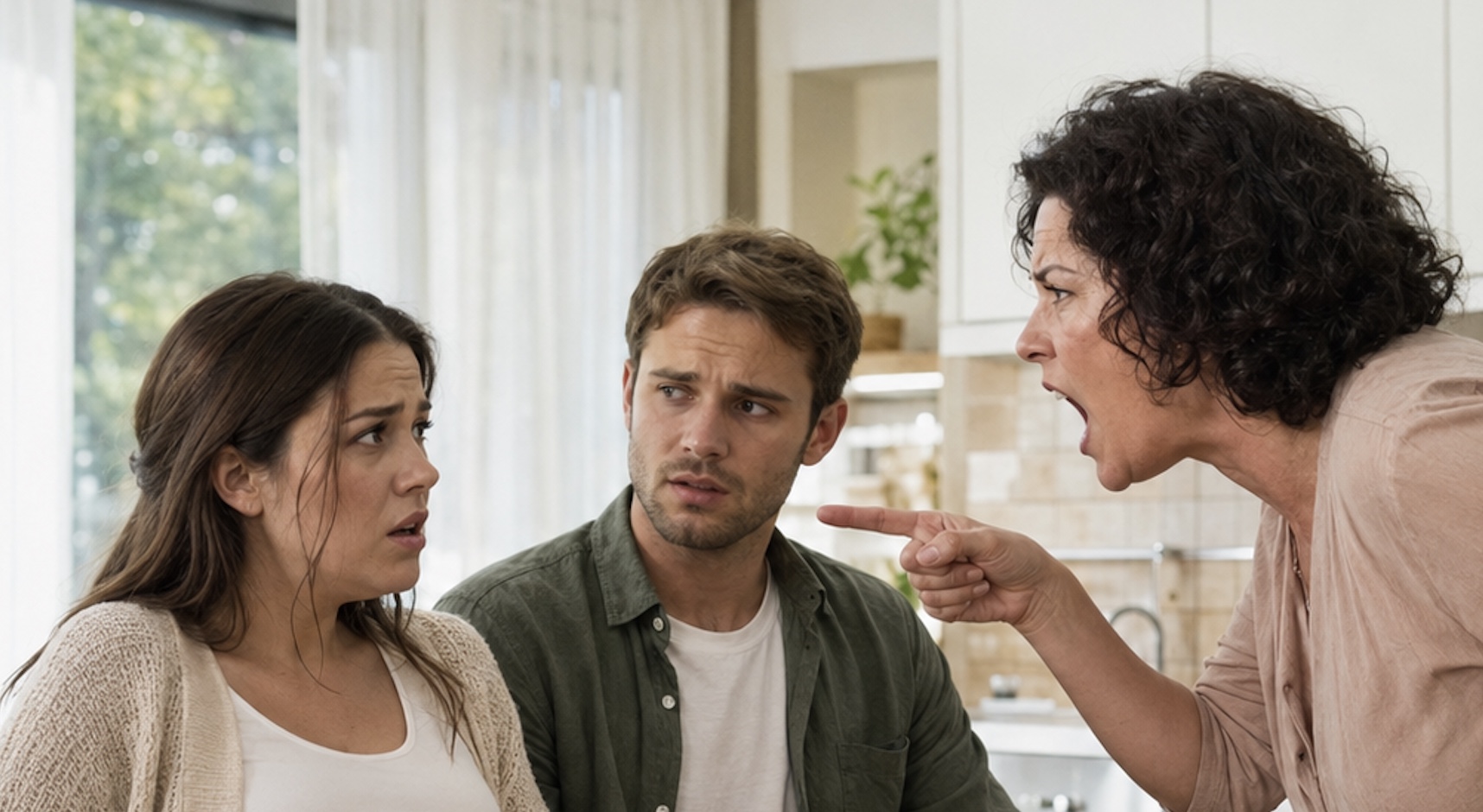
“Women like you shouldn’t have children at all,” my sister-in-law said after finding out I was pregnant.
I slowly placed my hand on the countertop and looked at Svetlana so steadily that, for a second, even her smile disappeared.
“Say that again,” I said quietly.
My husband, Pavel, froze by the refrigerator with a bottle of mineral water in his hand. His mother, Valentina Pavlovna, sat at the kitchen table, pretending to study the rim of her cup. No one rushed to stop Svetlana. No one told her she had crossed a line. No one even tried to pretend that the words had slipped out by accident.
And I stood in the middle of my own kitchen, three months pregnant, and for the first time in a long while I understood everything clearly.
This was it.
Not a hint. Not an unpleasant remark. Not some awkward family moment.
This was the final line.
“What’s there to repeat?” Svetlana smirked. “You heard me perfectly. A child is a responsibility. And you’re always going on about your rules, your boundaries, your order. What kind of mother would you even be?”
Pavel set the bottle down on the table. Not carefully — with irritation, as if the sound of plastic hitting the surface was supposed to end the conversation.
“Svet, enough,” he said weakly. “Don’t start.”
“I’m not starting anything,” his sister raised her eyebrows. “I’m telling the truth. First you closed the apartment off from everyone, and now you’re using pregnancy like a trump card. As if now no one is allowed to touch you.”
I looked at my husband.
“Pavel, did you hear what your sister just said?”
He rubbed his hand over his face.
“Lida, she’s just emotional. You know Svetka.”
“I didn’t ask what state she was in. I asked if you heard her.”
Pavel looked away.
And that was enough.
I found out I was pregnant a week earlier. I took the test in the morning while Pavel was still asleep. Two lines appeared so quickly, as if they had been waiting for that exact moment for a long time. I sat on the edge of the bathtub, holding the test in my hand, staring at it for several minutes.
I didn’t cry. I didn’t laugh.
I just blinked rapidly because my eyes burned from a sudden warmth rising somewhere beneath my ribs.
Pavel and I had been married for five years. We had planned children, but without rushing. Doctors, tests, vitamins, conversations, hopes — we had gone through all of it. And when the pregnancy finally happened, I wanted to tell him beautifully. Not with theatrics, but in a real way.
I bought tiny white baby socks, placed them in a small box, and put it next to his mug.
Pavel opened the box, stared at the socks for a long time, then looked up at me.
“Is this true?”
I nodded.
He hugged me tightly — too tightly, even. He pressed his forehead to my temple and exhaled as if he had been carrying a heavy stone inside him all this time.
“Lidka… wow.”
I laughed then. I thought a different life was beginning for us. A difficult one, of course. But ours.
The mistake was that by evening Pavel had already told his mother.
And Valentina Pavlovna told Svetlana.
I had nothing against my husband’s family. At least, not before. Valentina Pavlovna lived in a neighboring district and rarely visited, but every visit felt less like a visit and more like an inspection. She could open the hallway closet, look through the kitchen shelves, and ask why the towels were placed there and not somewhere else.
Pavel always laughed it off.
“That’s just Mom. She needs to know everything.”
Svetlana was three years younger than Pavel, divorced, with a nine-year-old son named Artyom. She worked as an administrator in a phone shop and constantly complained — about being tired, about her ex-husband, about housing, about people, about life.
When she needed someone to watch Artyom, she called Pavel. When she needed help moving things, Pavel again. When her phone broke, when she needed a ride to the store, when her ex delayed seeing the child — once again, Pavel.
At first, I took it calmly. Everyone has family. Helping from time to time is normal.
But gradually, the words “from time to time” disappeared.
Svetlana could call on a Saturday morning and announce:
“Pash, pick up Artyom for a couple of hours. I need to run errands.”
A couple of hours turned into the whole day. Artyom ran around the apartment, played videos at full volume, opened drawers, and took my things without asking. I told Pavel that at the very least the child needed to be stopped.
“He’s a child,” my husband would say. “Don’t be so strict.”
When Svetlana left her son with us overnight without even warning us that she herself would be gone until morning, I spoke sharply for the first time.
“Pavel, this is my apartment. I want to know in advance who is going to spend the night here and when.”
He looked surprised.
“Your apartment?”
“Yes. Mine. You’ve known that from day one.”
The apartment really was mine. Not “almost ours.” Not “shared in spirit.” Not “family property.”
It was left to me by my grandmother. I inherited it a year before I married Pavel. The documents had been finalized long ago, and I was the only owner. Pavel moved in with me after we registered our marriage because the room he had been renting was far from work and inconvenient in every way.
I didn’t object.
He was my husband. That meant we lived together.
But over time he began speaking about the apartment as if it had simply appeared out of nowhere and now belonged to everyone who carried his last name.
“We have a large kitchen.”
“We live in a convenient area.”
“We can let Mom stay for a couple of weeks if she needs medical tests.”
I corrected him.
“I have an apartment. We have a marriage.”
Pavel would get offended.
“You divide everything.”
But I wasn’t dividing anything.
I simply remembered what belonged to whom.
Valentina Pavlovna especially disliked that I remembered it. Once, while examining the hallway, she said:
“Of course, it’s nice when a woman gets housing handed to her. But a man should still have some place of his own. Otherwise, it turns out my son is like a tenant here.”
I answered calmly:
“Pavel lives here as my husband. But ownership doesn’t change because of that.”
My mother-in-law frowned, but said nothing.
Svetlana, however, would never have stayed silent. She believed silence was weakness, and rudeness was character.
Two days after the pregnancy news, Pavel came home deep in thought. He took off his jacket and spent a long time fiddling with his shoe zipper, though there was nothing to fiddle with.
“Lida, Svetka and Artyom will probably move in with us for a while.”
I was standing at the sink washing apples. When I heard that, I turned off the water.
“What do you mean, ‘probably’?”
“Well, she’s having problems with her landlord. He wants to sell the apartment. She needs to find something else.”
“Then let her find something else.”
Pavel turned to me.
“She’s my sister.”
“I remember.”
“She has a child.”
“I remember that too.”
“They have nowhere to go.”
I dried my hands on a towel.
“Pavel, Svetlana has a mother. Valentina Pavlovna has a two-room apartment.”
“Mom’s apartment is small.”
“And mine is made of rubber?”
His jaw tightened.
“We have three rooms.”
“One bedroom, one living room, and one room I’ve already started preparing for the baby.”
“It’s too early to prepare anything.”
I looked at him carefully.
“Too early for whom?”
Pavel didn’t answer.
That evening we argued. Not loudly, but heavily. He said I was cold-hearted. I said that temporary residence of other people in my apartment without my consent was impossible. He insisted Svetlana would stay for one month. I reminded him that the last “couple of hours” had ended with her child spending the night without warning.
The next day Valentina Pavlovna arrived. Without calling.
She had keys — keys Pavel had once given her “just in case.” I found out only when I heard the lock turning.
My mother-in-law entered with a grocery bag as if she were coming into her own home.
“Lida, are you home? I won’t be long.”
I came into the hallway and first looked at her, then at the keys in her hand.
“Where did you get the key?”
Valentina Pavlovna hesitated for a fraction of a second.
“Pavlik gave it to me. Just in case.”
“Give it back.”
“What?”
“The keys. Now.”
She straightened.
“You became pregnant and your personality completely changed?”
“The keys, Valentina Pavlovna.”
My mother-in-law tried to smile.
“Lidochka, why are you being like this? I’m not a stranger. I’m your husband’s mother.”
“That is exactly why I’m asking calmly. The keys.”
She placed the keyring on the dresser as if she were doing me a huge favor.
“This isn’t right. Shutting yourself off from family.”
“What isn’t right is entering someone’s apartment without the owner’s permission.”
Valentina Pavlovna pressed her shoulders together, went into the kitchen, and began unpacking groceries. I didn’t argue about the groceries, though I already understood: this wasn’t care. It was an attempt to mark territory.
An hour later Svetlana arrived.
With Artyom and two bags.
I opened the door and understood immediately: this was not a visit.
This was a move-in.
“We won’t be here long,” she said, pushing past me. “Mom, where are you?”
I stepped in front of her.
“Svetlana, stop. Where are you going?”
“To the room. Which one is free?”
“We don’t have a free room.”
She smirked.
“Lida, don’t start. Pasha said it was fine.”
I turned to my husband. He had arrived with them, only coming up later because he had been carrying the bags. In his hands were Artyom’s scooter and a bag of shoes.
“Pavel, did you decide this without me?”
He uncertainly set the scooter against the wall.
“I thought you’d calm down.”
“So you waited until they came with their things so you could present me with a fact?”
Svetlana rolled her eyes.
“Oh, here comes the performance. Artyom, take off your shoes.”
The boy was already reaching for the shelf where my gloves were lying.
“Artyom, don’t touch that,” I said.
He pulled his hand back and looked at his mother.
“Mom, she’s ordering me around again.”
“It’s all right, son,” Svetlana answered loudly. “We’ll endure it. Not everyone has a kind heart.”
Valentina Pavlovna came out of the kitchen and threw up her hands.
“Lida, you can’t be like this. A pregnant woman should be softer, and you’re keeping everyone on the doorstep.”
I looked at all of them at once: my husband with other people’s bags, my sister-in-law with her brazen smile, my mother-in-law with the expression of a judge, and the child who already considered my apartment a place for his games.
And suddenly I became very calm inside.
Not soft. Not warm.
Calm.
The kind of calm that comes before a decision that has been ripening for a long time.
“No one is going to live here,” I said.
Pavel stepped toward me.
“Lida, don’t embarrass me.”
“You’re doing that perfectly well on your own.”
Svetlana threw her bag onto the floor.
“Are you serious? My child is supposed to wander around strange corners while you keep a room empty for a baby?”
“That is not your concern.”
“It absolutely is! My brother lives here. That means we have a right too.”
“No, Svetlana. You do not.”
She came closer. She smelled of sharp perfume and cold winter air.
“Who do you think you are? The owner?”
“I don’t think it. I am the owner.”
Her face changed. The smile vanished. Her eyes narrowed.
“Women like you shouldn’t have children at all,” my sister-in-law said after finding out I was pregnant.
That was the moment everything snapped.
I didn’t scream. I didn’t rush into an argument. I didn’t begin proving that I would be a good mother.
I simply walked to the dresser, took my phone, and dialed the number of the local police station, which I had saved after a previous issue with noisy neighbors. No one answered. So I dialed emergency services.
Pavel turned pale.
“What are you doing?”
“Calling the police.”
Svetlana laughed, but the laugh came out uneven.
“Did the pregnant lady get offended? Go ahead, call them. Tell them your husband’s sister came over.”
“I’ll tell them that people are trying to move into my apartment against my will. And that one of the people living here let them in without the owner’s consent.”
Valentina Pavlovna gasped.
“Lida, you’re disgracing the family!”
I raised my hand to stop her.
“One more word about disgrace, and I’ll ask the officers to record that I am being pressured in my own apartment.”
The operator answered. I calmly gave the address and explained the situation: I was the owner of the apartment, my husband’s relatives had brought belongings, they refused to leave, there was a minor child present, there had been no physical violence yet, but the atmosphere was escalating.
Pavel looked at me as if he were seeing me for the first time.
“Are you out of your mind?”
“No, Pavel. I’ve finally come back to myself.”
Svetlana grabbed her bag by the handle.
“Artyom, get ready. The child doesn’t need to see the police because of this crazy woman.”
“Watch your words,” I said. “The child isn’t hearing the police. He is hearing his mother insult a pregnant woman in someone else’s apartment.”
Artyom stood by the door, scowling. I even felt sorry looking at him. He had not chosen his mother. He had not chosen those bags. He had not chosen the role of a living argument in someone else’s audacity.
But pity for a child did not mean I had to give him my future baby’s room and my own peace.
The police arrived quickly. Two officers came upstairs and listened to everyone. Svetlana immediately changed her tone.
“We simply came to visit, and she threw a tantrum.”
Without saying anything, I brought my passport and the property ownership extract I kept in my document folder, and showed them to the officers.
One of them nodded.
“You are the owner?”
“Yes.”
“Are these citizens registered here?”
“No.”
“Do they live here permanently?”
“No. They arrived today with belongings without my consent.”
The officer turned to Svetlana.
“You need to leave the apartment if the owner objects to your presence.”
Svetlana lifted her chin.
“And my brother? He’s her husband! He lives here!”
“A husband cannot move third parties in without the owner’s consent,” the officer answered calmly. “Especially when the owner objects.”
Pavel stood against the wall as if it wasn’t words pressing him down, but facts. He didn’t interfere. He didn’t defend me or his sister.
He just stood there silently.
And that silence finally showed me that next to me was not support, but a person used to hiding behind other people’s backs.
Svetlana left first, loudly dragging her bag across the floor. Valentina Pavlovna followed her, throwing Pavel a look full of resentment. Artyom took his scooter.
At the door, Svetlana turned back.
“You’ll regret this. Pavel won’t live with you after this.”
I looked at my husband.
“That is now his decision. But the keys to my apartment are staying with me.”
Pavel snapped his head up.
“What do you mean?”
“Exactly what I said. You gave keys to your mother without my consent. Today you tried to move your sister and her child in. I no longer trust your decisions regarding my apartment.”
“I live here!”
“For now, yes. But the keys you hand out — I need them back.”
The officers exchanged glances but did not intervene. This was already our family conversation.
Pavel took the keyring from his pocket and threw it onto the dresser. The keys hit the surface, clinked, and fell onto the rug.
“Happy?”
I bent down, picked them up, and put them in a drawer.
“No. But now it’s at least safer.”
After the police left, the apartment became quiet. Not cozy, not peaceful — quiet, like after a storm when the air is still heavy, but the thunder has passed.
Pavel sat in the kitchen with his hands clasped. I made myself tea but didn’t drink it. I only kept the mug nearby because I needed to keep my hands busy. Forbidden words kept pushing into my head, but I forced myself to speak precisely.
“Pavel, why did you do this?”
He looked up.
“Svetka really has nowhere to go.”
“She has a mother.”
“Mom doesn’t want to share a room with Artyom.”
I gave a short laugh.
“And I’m supposed to want that?”
“You could have understood her situation.”
“I did. I stepped into it and saw myself, pregnant, in my own apartment, while other people’s bags were being brought in without permission. I didn’t like it.”
He stood up sharply.
“You reduce everything to legal language.”
“Because you don’t hear normal human language.”
“She is my sister.”
“And I am your wife. Pregnancy does not turn me into furniture that can be moved around.”
Pavel turned toward the window. Outside, it was getting dark. In the reflection of the glass, his face looked tired and unfamiliar.
“Svetka lost control. She shouldn’t have said that.”
“She shouldn’t have,” I agreed. “But the worst part wasn’t her. The worst part was that you stood right there.”
His fists clenched.
“I didn’t want to make it bigger.”
“You didn’t want to choose. Those are different things.”
That night Pavel slept in the living room. I didn’t stop him.
In the morning, I called a locksmith and changed the lock cylinder. No statements. No dramatic gestures. No unnecessary conversations. I simply called, arranged it, and paid for the work.
The old keys stopped working.
When Pavel came home from work, he stood at the door for a long time ringing the bell. I didn’t open immediately. Not out of spite. I needed a few seconds to prepare.
“You changed the locks?” he asked the moment he stepped inside.
“Yes.”
“And you didn’t make me a key?”
“Not yet.”
He gave a short, bitter laugh.
“So I’m a guest now?”
“You come into an apartment where you live only because I allowed it. After yesterday, I want to know that you won’t bring anyone else here.”
“You’re humiliating me.”
I nodded.
“Unpleasant, isn’t it? When your boundaries are treated as unimportant.”
Pavel threw his jacket onto the hallway bench.
“Lidia, don’t go too far. I’m the father of your child.”
“That is exactly why I’m still talking to you.”
On the third day after the scandal, Valentina Pavlovna called. I put her on speaker because Pavel was nearby.
“Lida, I want to settle this peacefully. You must apologize to Sveta.”
Pavel flinched, but said nothing.
“For what?” I asked.
“For the police. For humiliating her. She didn’t sleep all night. Artyom was frightened.”
“Let Svetlana apologize for what she said about my child.”
There was silence on the line for a second.
“She spoke rudely, but you’re not easy either. Pregnancy is no reason to become a queen.”
“Valentina Pavlovna, I am not a queen. I am the owner of this apartment and a future mother. And I will no longer allow your daughter to decide who lives in my home.”
“Pavel, do you hear this?” my mother-in-law raised her voice. “Your wife is throwing your mother and sister out onto the street!”
Pavel moved closer to the phone.
“Mom, enough.”
For the first time in days, I looked at him with interest.
“Enough what?” Valentina Pavlovna snapped.
“Enough pressure. Sveta really crossed the line.”
“Oh, so that’s how it is! Your wife is more important to you than your mother?”
Pavel closed his eyes.
“Mom, don’t.”
But Valentina Pavlovna was no longer listening. She spoke for a long time, loudly, with years’ worth of grievances, accusations, and hints that I was “holding her son hostage with square meters.”
I placed the phone screen-down and left the kitchen.
Pavel ended the call himself.
That evening he came to the bedroom.
“Lida, I’ll talk to Svetka.”
“Too late.”
“What do you mean?”
“You should have talked there, when she said what she said about children.”
He sat on the edge of the bed.
“I froze.”
“No. You chose the familiar path. Pretend nothing serious happened.”
Pavel lowered his head. His shoulders somehow seemed narrower.
“I didn’t want to hurt you.”
“Pavel, hurt is when someone forgets to congratulate you. But when a pregnant wife is told she shouldn’t have children and her husband stays silent, that isn’t hurt. That’s a diagnosis of the relationship.”
He was silent for a long time.
“Do you want a divorce?”
I looked at him. A month earlier that word would have terrified me. Now it was just a word. Heavy, but honest.
“I want safety. For myself and for the child. If you can be a husband and a father, not an eternal son and emergency brother, prove it. If not, we’ll divorce through court, because we’ll have a child. And the issues concerning the child will also need to be settled legally.”
Pavel looked up.
“So you’ve already decided everything?”
“I’ve decided that I will no longer live waiting for someone else to invade my home.”
The next week became a test.
Pavel seemed to try. He wrote to Svetlana himself that she had no right to come to our place without an invitation. He returned his mother’s bag of forgotten things on neutral territory — outside Valentina Pavlovna’s building. He even apologized to me. Not with beautiful words, but normal ones.
“I was afraid of conflict and hid. That was cowardly.”
I listened and did not rush to forgive. Forgiveness cannot be issued like a receipt. It either comes after actions, or it does not come at all.
Svetlana, however, had no intention of going quiet. At first she sent me messages. I didn’t answer. Then she started calling from unknown numbers. I blocked them. Then in the family chat, where Pavel’s cousins were also present, she wrote a long message about how I had “thrown a child onto the stairwell.”
I answered briefly:
“Svetlana came to my home with belongings without my consent. In my apartment, she told a pregnant woman that people like her should not have children. I called the police after she refused to leave. Ownership documents were shown. I will not discuss this further.”
After that, some relatives went silent. Some wrote to me privately. A few cautiously supported me. Others advised me “not to escalate.” I didn’t explain myself twice to anyone. Adults hear the first time if they want to.
Ten days later, Svetlana came again.
I saw her through the peephole. Alone. Without Artyom. She had nothing in her hands except her phone. Her face was tense, her hair pulled back carelessly. She pressed the doorbell in short, sharp bursts.
Pavel wasn’t home.
I didn’t open the door.
“Lida, I know you’re in there!” she shouted. “Open up, let’s talk!”
I came closer but did not remove the chain.
“Svetlana, leave.”
“I need to get my things!”
“Your things aren’t here.”
“They are! I left a bag in the hallway that day.”
That was a lie. She had taken all the bags when the police were there. After they left, I had specifically checked the hallway and living room.
“There is nothing of yours here.”
“Did you steal it?”
I took out my phone and turned on video recording, pointing the camera toward the door from inside.
“Repeat that louder. Are you accusing me of theft?”
It went quiet behind the door.
Then she hit the door with her palm.
“Because of you, Pasha turned away from us!”
“Pavel is an adult. His decisions are his responsibility.”
“You trapped him with a baby!”
I laughed involuntarily. Not because it was funny, but because it was absurd.
“Svetlana, first you decided I shouldn’t have children. Now you’ve decided the child is a way to trap him. Pick one version.”
“Open the door!”
“No.”
She stood outside for several more minutes, saying nasty things, then left. I saved the video and sent it to Pavel.
He arrived an hour later. He burst into the apartment pale, with red marks along his cheekbones.
“She came?”
“Yes.”
“Why didn’t you call me right away?”
“Because I handled it.”
He watched the recording. Several times he rewound the moment where Svetlana screamed about the baby.
“I’m going to her now.”
“Why?”
“To talk.”
“Pavel, conversations in your family are strange. After them, people show up at my door with bags.”
He stopped by the door.
“What do you suggest?”
“I’m not suggesting. I’m telling you to act. Write to her that if she comes here again without an invitation, I will call the police again. And that you do not support any insults toward me or the child.”
He wrote it. In front of me. Without prompts.
Svetlana’s reply came almost instantly:
“So she won.”
Pavel looked at the screen for a long time, then typed:
“This is not a competition. You insulted my wife and my child. I will not allow that again.”
I read the message and, for the first time in days, felt not relief, but a cautious pause. As if somewhere a small window had opened. Not wide, but enough to breathe.
But the story did not end there.
A month later, when I was already registered with the doctor and beginning to get used to the new morning weakness, Pavel came home too quietly. He took off his shoes, washed his hands, and sat across from me.
“Svetka submitted an application to transfer Artyom to a school in our district.”
I slowly put down my phone.
“Why?”
“She says she found a room nearby.”
“A room?”
“Yes.”
“Where?”
He gave me the address. The building was across the courtyard from ours.
I gave a short laugh.
“What an amazing coincidence.”
Pavel rubbed the bridge of his nose.
“I didn’t know.”
“I believe you.”
And I really did. Pavel didn’t look guilty. He looked exhausted. Svetlana had decided to come from another angle: settle nearby, constantly ask for help, bring Artyom over, and turn our life into a branch office of her problems.
“What are you going to do?” I asked.
He looked up.
“I already told her I won’t pick Artyom up from school, I won’t watch him without prior agreement, and she won’t have keys.”
“Good.”
“But if it’s urgent…”
I narrowed my eyes.
“Pavel.”
He fell silent and nodded.
“I understand. Urgent means hospital, fire, threat to life. Not ‘I need to run errands.’”
Svetlana really did rent a room in the neighboring building. A week later I met her at the store. She was standing with Artyom at the checkout, moving items along the belt and pretending not to see me. Artyom noticed first.
“Mom, Aunt Lida.”
Svetlana turned sharply. Her eyes immediately dropped to my stomach, though it was still barely visible under my loose coat.
“Look how important she thinks she is,” she said to her son.
I took my basket and moved to the neighboring checkout.
“Svetlana, it’s better to speak calmly about adults in front of a child.”
She snorted.
“Don’t teach me how to raise my son.”
“I wasn’t planning to. I have my own experience ahead of me.”
Her face twitched. She wanted to answer, but there were people around. With witnesses present, Svetlana became more careful. Her strength was in kitchens, hallways, and family chats where she could use kinship as pressure. In an ordinary store, she looked like nothing more than a rude woman picking on a pregnant one.
At home, I told Pavel. He listened silently, then said:
“I’ll talk to Artyom if she starts dragging him into this.”
“Don’t make the child a negotiator. Just keep boundaries with Svetlana.”
He nodded.
Weeks passed. My relationship with Pavel did not become what it had been. And perhaps it never could. But something appeared in it that had not been there before: direct words.
He no longer made promises behind my back. He no longer gave away keys. He no longer said, “Just be patient.” If his mother called with a request, he first discussed with me whether it had anything to do with our life. Most often, it didn’t.
Valentina Pavlovna was offended and stopped visiting. I did not suffer. Pavel went to see her himself and helped if she really needed it. Her requests no longer reached me.
In the fifth month of pregnancy, I began preparing the baby’s room. Slowly. I bought a dresser, a crib, several soft blankets. Pavel assembled the furniture himself. Not perfectly — he mixed up the fasteners a couple of times — but he didn’t call his mother or sister. He sat on the floor with the instructions, frowned, checked the parts, and finally managed it.
When the crib was ready, he stood beside it for a long time.
“It turned out beautiful.”
I looked at him.
“Yes.”
He ran his finger along the side rail.
“I really was scared back then.”
“Of what?”
“That the baby would change everything. That Svetka would be offended, Mom would pressure me, you would start demanding things… And like an idiot, I tried to please everyone.”
“Pavel, a baby is supposed to change everything. Just not in a way where your sister decides who gets to be born.”
He lowered his head.
“I know.”
At the end of the sixth month, something happened that finally put everyone in their place.
It was Friday evening. Pavel was delayed at the doctor’s with Valentina Pavlovna — her knee hurt, and he had taken her for an examination. I was home alone, cutting fruit, when the doorbell rang.
Through the peephole I saw Svetlana, Artyom, and two unfamiliar men with boxes.
At first I didn’t even understand what was happening. Then Svetlana lifted her face toward the door and smiled.
“Lida, open up. We need to talk.”
I didn’t open.
“Talk through the door.”
“That’s inconvenient. There are people here.”
“All the more reason.”
One of the men shifted awkwardly near the elevator.
“Lady, where should we put the boxes? You said the apartment was yours.”
Svetlana sharply hissed at him.
I turned on the recording.
“Svetlana, what is this?”
She realized I was filming, and her face twisted.
“Don’t act innocent. I’m leaving the room. The landlady turned out to be crazy. We’ll stay with you for a couple of days until I find another place.”
I wasn’t even surprised.
So this was where everything had been heading.
“No.”
“Lida, don’t embarrass yourself. I’m with a child.”
“You’re with a child and movers. Those are different things.”
“Pasha knows.”
“Let’s check.”
I called my husband. He answered almost immediately.
“Lid, did something happen?”
“Your sister is standing at the door with Artyom, two men, and boxes. She says you know.”
There was a pause on the other end. Then Pavel spoke so sharply that I even moved the phone away from my ear.
“Do not open the door. I’m coming.”
Svetlana heard him.
“Of course, don’t open! Afraid pregnancy won’t help this time?”
I called the police for the second time.
This time Svetlana did not laugh. She paced around the landing, called someone, argued with the movers, who clearly did not want to take part in someone else’s scandal. Artyom sat on a box and looked at his phone.
It hurt to see him like that, but I did not open the door.
Pavel arrived before the police. He came up the stairs because the elevator was blocked by boxes. I watched through the peephole as he stopped in front of his sister.
“What have you done?”
Svetlana immediately started speaking loudly.
“What am I supposed to do? Sleep on the street? Are you my brother or what?”
“I told you a month ago: you are not moving in with us.”
“So it’s not with you, it’s with her? You’re completely under her thumb?”
Pavel turned to the movers.
“Guys, I’m sorry. No one is accepting anything here.”
One of them raised his hands in relief.
“We just need payment and we’ll leave.”
Svetlana flared up.
“Pasha!”
“Pay them yourself,” he said. “You called them.”
She stepped toward him and jabbed a finger into his chest.
“You’re a traitor.”
Pavel removed her hand.
“No, Svet. I’m a husband. And a future father. Late, but I finally understood that.”
I stood behind the door and felt my fingers tremble. Not from fear. From the fact that, for the first time, Pavel had said this not to me in the kitchen, but to her face.
The police arrived a few minutes later. The situation repeated itself, only now Pavel confirmed that he had not invited his sister and had no intention of moving her in. The officers asked Svetlana to remove her belongings from the landing and not block the residents’ passage. One neighbor had already looked out and asked irritably why the elevator was blocked.
Svetlana shouted. Valentina Pavlovna, whom she had managed to call, rushed over by taxi and also tried to interfere. But when the officer firmly explained that the apartment owner objected and Pavel himself did not confirm any invitation, both of them quieted down.
“Lida, open,” Pavel said after the boxes had been taken back downstairs. “It’s me.”
I opened the door.
He came in, closed it, and leaned his back against it. His face was gray with exhaustion.
“I’m sorry.”
I looked at him and said nothing.
“Not just for today. For everything. For the keys, for the bags, for the silence, for letting it get to the police. I thought if I gave in to them on small things, they’d calm down. But they just decided they could take more.”
“Pavel, they didn’t decide that on their own.”
He nodded.
“I know. I allowed it.”
We didn’t hug. There was no beautiful reconciliation scene like in a movie. I simply went to the kitchen, poured myself water, placed apple slices on a plate, and sat down. Pavel sat across from me.
“I want to make you a key,” I said.
He looked up.
“Really?”
“Yes. But on one condition. Not one duplicate without my consent. Not one promise to relatives about this apartment. Not one ‘she’ll stay for a couple of days.’ If you break that, you move out.”
He answered immediately.
“I agree.”
“And one more thing. After the baby is born, no visits without agreement. Even your mother.”
“I agree.”
“Svetlana does not enter my apartment. Not until I decide otherwise.”
He held his breath for a moment, then nodded.
“I agree.”
A few days after that conversation, the baby kicked for the first time. I was lying in bed reading when inside me it felt as if a tiny fish touched my palm. I froze, then called Pavel. He came carefully, as if afraid to scare something away.
“What?”
I took his hand and placed it on my stomach.
At first, nothing.
Then a light kick.
Pavel blinked. Once, then again. His face changed so quickly that I couldn’t find words for it: confusion, joy, fear, tenderness — all of it passed across him at once.
“Is that him?”
“Or her.”
He laughed softly.
“Wow.”
I looked at him and understood: trust had not fully returned. But we had a chance. Not because I gave in.
Because, for the first time, I did not.
After that incident, Svetlana disappeared from our lives for almost two months. Then she sent Pavel a message:
“Tell Lida I was wrong.”
He showed me the screen silently.
“What should I answer?” he asked.
“Nothing from me.”
“And from myself?”
“As you think best.”
He wrote:
“Apologies need to be said to the person directly. But only when she is ready to listen.”
I was not ready.
Valentina Pavlovna came after our daughter was born. We named her Kira. She was tiny, serious, with dark hair and surprisingly strong little fingers. My mother-in-law called Pavel in advance, and he asked me. I allowed one short visit.
Valentina Pavlovna entered without keys. That alone was progress. She held a bag of baby clothes in her hands. At the threshold, she stopped and looked at me.
“Lida… I’ve thought a lot.”
I held Kira in my arms and waited.
“Sveta said something terrible back then. I should have stopped her.”
“Yes,” I answered.
My mother-in-law nodded. Without arguing.
“I didn’t stop her because I was used to thinking my daughter is sharp-tongued but quick to cool down. But that is not an excuse.”
Pavel stood nearby and remained silent. This time his silence was different. Not cowardly, but attentive.
“I’m not asking you to forget,” Valentina Pavlovna continued. “I just wanted to see my granddaughter. If you allow it.”
I looked at Kira. She was sleeping, wrinkling her nose. So small. So real. And so many adults had already managed to start a battle around her for the right to command.
“I won’t let you hold her yet,” I said. “You may look.”
My mother-in-law did not protest. She came closer, bent down, and her face softened.
“What a beauty.”
I didn’t answer. But I didn’t send her away either.
Svetlana appeared later. Not in the apartment. Outside the building. I was returning from a walk, and Kira was sleeping in the stroller. Svetlana stood near a bench, without her usual defiant confidence. She twisted the strap of her bag in her hands.
“Lida, may I have a minute?”
I stopped in a way that kept distance between us.
“Speak.”
She looked at the stroller but did not come closer.
“I wanted to apologize.”
I said nothing.
“Back then… I said something vile. I knew exactly where I was hitting. I was just angry that you had everything. An apartment, a husband, a child. And everything in my life was falling apart, so I decided I had the right to take a piece of your peace.”
The words were unexpectedly honest. Not polished, not pretty — uneven, forced through pride with difficulty.
“That did not give you the right,” I said.
“I know.”
“And you shouldn’t have dragged Artyom into those scandals either.”
She lowered her eyes.
“I know.”
I adjusted the edge of the blanket in the stroller.
“Svetlana, I don’t want to be enemies with you. But you will not enter my apartment. You will not hold my child. And we will communicate only calmly. Raise your voice once, and the conversation is over.”
She nodded.
“I understand.”
“Good.”
I pushed the stroller toward the entrance. Svetlana remained by the bench. She didn’t run after me, didn’t grab my elbow, didn’t start shouting.
Perhaps for the first time in her life, she had to accept someone else’s “no” not as a challenge, but as a boundary.
A year passed.
Kira grew calm, but stubborn. If she didn’t like a toy, she pushed it away with such a serious face that Pavel laughed every time.
“Just like her mother.”
“I hope so,” I answered.
Svetlana rented a separate apartment in another district. She enrolled Artyom in a school near their home. Pavel helped his nephew sometimes — drove him to the doctor, picked him up from practice, if it had been agreed in advance. But no one brought children to our home without warning anymore. No one dumped bags in the hallway. No one discussed my right to motherhood.
Valentina Pavlovna came by invitation. At first she sat tensely, afraid to say too much. Then she got used to it. She was affectionate with Kira, but I still kept my distance. Not out of revenge. Simply because some doors, once broken open, can only be opened from the inside afterward — and not for everyone.
Pavel and I did not become a perfect couple. But we became more honest. He learned to say no to his mother and sister, and I learned not to expect betrayal in every phone call of his. Sometimes we argued. Sometimes I reminded him that helping relatives should not be paid for with my peace. He no longer got offended. He listened.
One evening, after Kira had fallen asleep, Pavel came into the kitchen and placed a small box in front of me.
“What is this?”
“A new set of keys. One is mine. One is spare. The spare will stay in your document folder. I won’t give it to anyone. Not even if there’s a fire, a flood, or the end of the world.”
I opened the box, looked at the keys, and smiled faintly.
“We’ll survive the end of the world. The main thing is no unauthorized move-ins.”
He sat across from me.
“Lid, sometimes I think: if you hadn’t called the police back then, Svetka really would have lived with us.”
“Of course.”
“And Mom would still have come in with her own key.”
“Of course.”
“And I would have kept saying you were making everything complicated.”
“You definitely would have.”
Pavel ran his palm over the table.
“Thank you for stopping it.”
I looked at him carefully.
“I wasn’t saving you, Pavel. I was saving myself and the child.”
He nodded.
“I know. But you saved me along the way too.”
I said nothing. I only took the box and put the spare key into the drawer.
Later, I often remembered Svetlana’s words. Not because they still hurt. No. Over time, they became not a wound, but a mark on the map.
The place where I stopped trying to persuade grown adults to be decent and started protecting what was mine.
Women like me should have children.
Exactly women like me.
Because a child does not need a mother who is convenient for everyone. Not a woman who keeps silent for someone else’s comfort. Not a homeowner who gives keys to anyone who demands loudly enough.
A child needs a mother who knows how to open the door to a guest.
And how to close it in front of someone who has come to take away her home.
Dear readers, an animal shelter really needs help — these are not scammers! Irina is truly a person with a huge heart and an open soul.
I copied this post from her:
Good morning, dear friends!
So today is “Hundred-Ruble Day”!
We’re forced to do this, though I don’t know if it will help… In recent days, as I understand it, something is wrong with the internet again, and posts are spreading very poorly. And when people don’t see the posts, they often don’t remember us either — everyone has their own affairs and worries. I understand and don’t take offense. At times like this, the best thing that works is direct outreach — simple private messages. And here I ask you not to be offended. We need to survive…
Yesterday evening we finally reached the goal — 10,900 — and reduced the debt to 58,000. The next delivery comes tomorrow evening. We have two days to reduce the debt as much as possible. So once again — Hundred-Ruble Day!
Reposts, likes, kind comments, private shares.
Whatever anyone can give.
The most common thought under posts like this is:
“They’ll manage without me.”
They won’t.
The shelter has a debt of 58,000 and 145 animals that need to be fed every single day.
If everyone thinks, “Someone else will help,” then no one will.