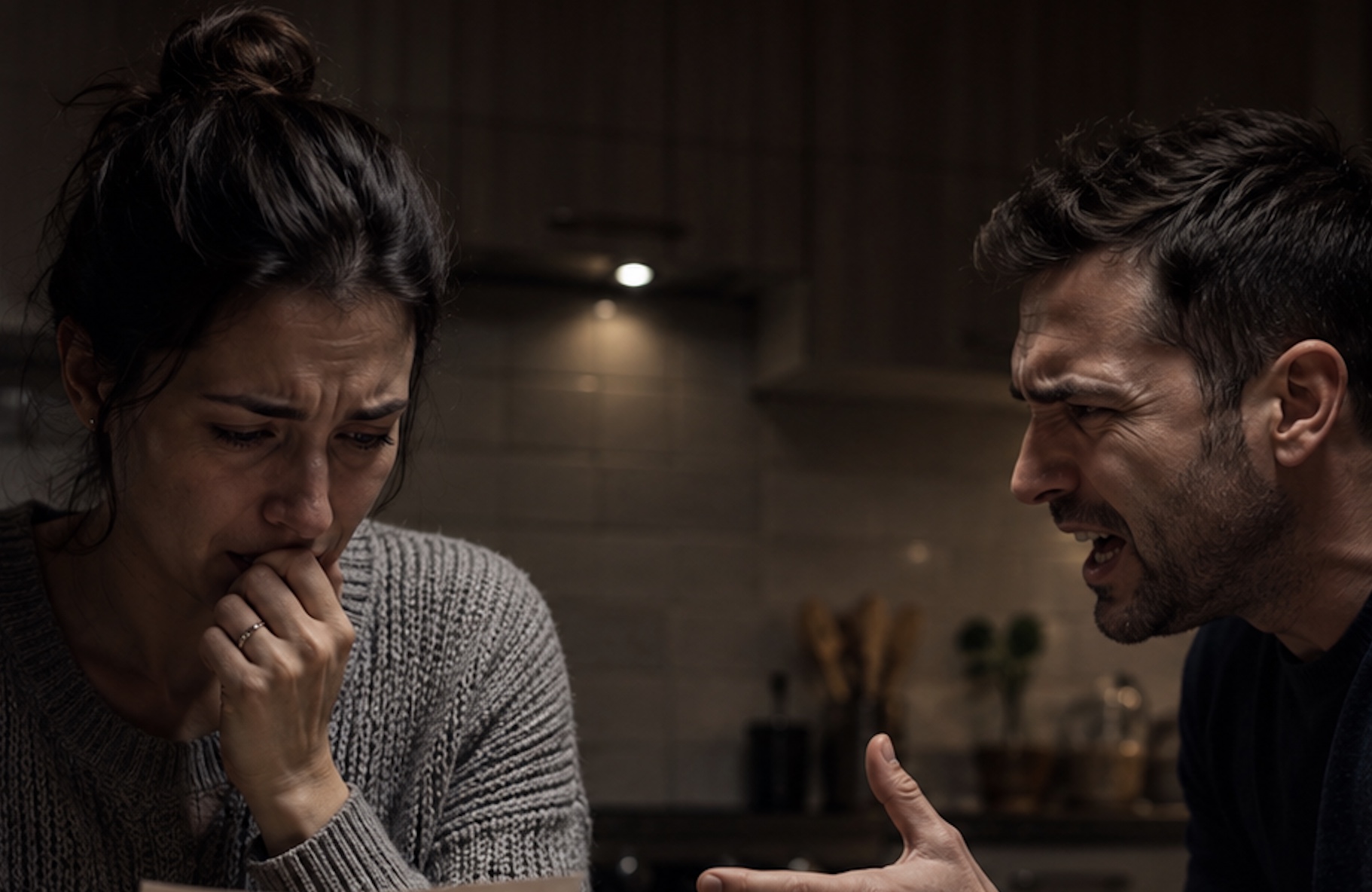
“Money disappeared from the card? The report has already been filed. Deal with it,” Darya said calmly.
Only after those words did Artyom finally stop smiling.
Until then, he had been acting confident. Too confident for someone who had just been shown a list of transfers from someone else’s bank card. He was sitting on the edge of the sofa with his jacket unzipped, as if he had only dropped by home for five minutes, tossed his keys onto the entryway cabinet, and was now waiting for the usual dinner, the usual questions, the usual female irritation that could be waited out, turned into a joke, answered with offense — and then everything would settle back into place again.
But Darya did not shout.
She did not ask how he could have done it.
She did not snatch the phone off the table.
She did not pace around the room, waving her hands.
She simply placed the phone in front of him, its screen showing the banking app, where transfer after transfer was listed. Different amounts, different times, no payment description. The recipient was an account Artyom used.
And that silence turned out to be more unpleasant for him than any scandal.
“Dasha, you’ve got this completely wrong,” he finally said, glancing quickly at the phone before looking away at once. “It’s not what you think.”
Darya sat across from him at the table. In front of her lay a folder with printouts, a pen, her passport, and a second phone — an old one with a cracked corner on the screen, which she had taken out of a drawer that morning only to restore access and calmly complete all the checks.
“And what do I think?” she asked.
Her voice was even. Not icy, not theatrical, just ordinary. That made Artyom visibly tense. He was used to Darya becoming alive in difficult moments — loud, emotional, argumentative. She could be interrupted, thrown off track, offended, made to justify herself. But now she was looking straight at him, taking her time, and giving him no convenient opening.
“You think I stole it,” he said, twisting his mouth into a crooked smile. “Seriously? From my own wife?”
Darya gave a small nod, as if noting his first line of defense.
“I’m not thinking anything yet. I’m looking at the transactions.”
“So they’re transactions. What of it? I was going to tell you.”
“When?”
Artyom rubbed the bridge of his nose with his thumb.
“Today.”
“After I noticed it myself?”
“Dasha, don’t start.”
She tilted her head slightly and looked at him carefully. Not with anger. More like she was looking at a complicated household appliance that had been crackling and sparking for a long time, but had only now finally begun to smoke.
“I haven’t started yet, Artyom.”
Darya’s morning had not begun with suspicion. It began with the dull sound of her phone on the kitchen shelf. She woke up before the alarm because someone in the neighboring apartment was dragging a heavy box across the floor. At first, Darya lay there, listening to the uneven sounds. Then she got up, threw on her robe, went to the kitchen, and switched on the kettle.
It was supposed to be an ordinary day. On Monday, she had planned to take the old vacuum cleaner to the repair shop, pick up an order for her mother from the delivery point, and sort through the apartment documents in the evening. Nothing special. No major decisions. No family scenes.
And then she opened the banking app.
At first, Darya thought she had selected the wrong card. She had several accounts: one for everyday expenses, one savings account, and a separate card for online payments. The card from which the money had disappeared was lying at home in her wallet. She rarely used it and kept money there for appliance repairs, insurance payments, and unexpected expenses. Artyom knew about that card. Of course he knew. He liked knowing where everything was, how things were paid for, and what plans Darya had.
The balance on the screen was unusually low.
Darya blinked, ran her finger through the transaction history, and saw the first withdrawal. Then the second. The third. The fourth. The transfers had gone through in a series, several hours apart. Some at night, some in the morning. As if the person had not dared take everything in one move and had been testing whether it would work.
The recipient was familiar to her.
Not the name, not the surname, but the account itself — one she had seen before, when Artyom had asked her to help pay for some purchase. Back then, he had said his card was temporarily not working, and Darya had transferred him a small amount. The banking app had saved the recipient.
Darya stood barefoot in the middle of the kitchen. The kettle clicked off, releasing a thin stream of steam. She did not move. Her face felt hot, especially her cheeks and ears. She put the phone down on the table, screen facing up, walked over to the sink, turned on the cold water, and simply watched the stream strike the metal basin.
Her first impulse was to call Artyom.
To ask him sharply, without preparation.
To demand an explanation.
But her fingers, which had already dialed his number, stopped. Darya looked at the screen and slowly ended the call before it connected. She knew her husband too well. Artyom knew how to talk. He was not necessarily smarter, but he was quicker in an argument. In one minute, he could turn the obvious into “you’re overdramatizing again,” “I wanted to do the right thing,” “it’s your own fault for not explaining anything,” or “I was going to pay it back.” If she called him now, he would have time to prepare. Delete something, invent a story, call someone, start putting pressure on her.
Darya dried her hands on a towel, sat down at the table, and began checking everything step by step.
First, she opened the card settings. Virtual links. Devices. Approved payment methods.
And there she saw the detail that immediately put half the picture into place: the card was linked to Artyom’s phone.
She remembered that evening almost at once.
It had been about three months earlier. They were coming back from a hardware store. Darya had been buying new bathroom shelves and a few small things for the kitchen. At the checkout, her phone froze and the payment would not go through. Artyom let out an irritated sigh, took her card and phone from her.
“Give it here, I’ll set it up properly. Everything on your phone works backward.”
She had been tired then and did not argue. He tapped quickly through the screens, grumbling that she could not be trusted with technology, then said:
“There. Now you can pay normally.”
Darya remembered that he had asked for the confirmation code that came by message. She had dictated it. At the time, it had looked like help. Her husband beside her, a shared life, an ordinary household inconvenience. She had even thanked him afterward because the payment had indeed gone through.
Now that “help” stared back at her from the app in one line: device connected.
Darya moved to the confirmation section. Some of the transactions had gone through using push notifications on a device Artyom had access to. Her own phone had not shown any confirmations at the time. That meant he had not simply paid for something with her card by accident. He had deliberately left himself a technical way to transfer money.
Darya sat there for a long time.
The water in the kettle had already gone cold, the janitor outside was clearing wet snow from the entrance, and a neighbor’s child ran down and up the stairwell twice. But she kept looking at the screen, piecing together not one transfer, not one missing sum, but an entire chain of events from the past few weeks.
Artyom had become especially irritable at the beginning of the month. Sometimes he said they urgently needed to help his younger sister Lilya, sometimes he complained that his mother’s washing machine had broken, and then suddenly he began scolding Darya for being “secretive.”
“You always keep everything separate,” he said over dinner. “Separate cards, separate plans, separate money. That’s not how people live.”
“People live in different ways,” Darya replied. “We have a joint account for groceries and utilities. Everything else, each of us manages separately.”
“Convenient position. Especially when you decide that yours is only yours, while mine can be discussed.”
Darya had not argued then. She worked as a technologist at a small packaging factory and was tired from shifts, from the smell of plastic, from constantly monitoring defects. At home, she wanted silence, not debates about who owed whom emotionally or financially.
She and Artyom had been together for six years. They had no children. The apartment belonged to Darya: she had inherited it from her grandmother, registered ownership after the required six months, and made small renovations before the marriage. Artyom moved in after the wedding. At first, everything was calm. He worked as a mechanic at an auto repair shop, got along easily with people, and knew how to fix almost anything that broke in the apartment. Darya valued that. It seemed to her that life beside him would become easier: the lamp would not hang for months without a shade, the faucet would not drip until it drove her mad, and a proper shelving unit would finally appear on the balcony.
And truly, in the first years, he did a lot with his hands. He replaced the faucet, assembled a wardrobe in the hallway, insulated the balcony, repaired an outlet. But gradually, behind every favor, an invisible bill began to appear.
“I’ve done so much in this apartment, it’s already half mine,” he once threw out when Darya refused to register his sister at their address.
“An apartment doesn’t become half yours because you assembled a wardrobe,” Darya answered calmly.
Artyom laughed then, but the laugh came out unpleasant.
“That’s how you are. Always counting.”
Darya did count. Not because she was greedy. She simply knew the price of carelessness too well. Her mother had once spent several years living with a man who took money “until Friday,” “just for one week,” “I’ll get out of this and pay it back,” and then disappeared, leaving behind debts, broken things, and other people’s claims. As a teenager, Darya had understood one thing: if an adult does not know how to respect boundaries, you cannot rescue him with your wallet.
With Artyom, she had hoped for a long time that it would never come to that.
But the small warning signs accumulated.
He could take her headphones without asking and leave them in the car. He could open her package because he “thought it was ours.” He could ask for her phone “to check the route” and at the same time scroll through her notifications. Each time, Darya told him it made her uncomfortable. Each time, he acted as if she were nitpicking.
“Got secrets now?”
“Personal boundaries, Artyom.”
“That sounds funny when people sleep in the same bed.”
After conversations like that, Darya did not make scenes. She simply changed passwords, put away documents, and stopped leaving bank cards in plain sight. But that incident at the hardware store had been a hole she herself had forgotten to close.
That morning, after discovering the transfers, Darya began to act the way she knew how: point by point.
She blocked the card in the app. Not temporarily, not “until things are clarified,” but completely. Then she unlinked every device except her own. She saved screenshots of the transactions. She downloaded the account statement. She opened a chat with the bank and wrote that she had not made the transactions, had not given consent for the transfers, and that access to the card had been used without her permission. At first, the operator replied with standard phrases, asking her to clarify the dates, amounts, and recipient. Darya provided everything. Then she was offered the option to file a claim for unauthorized transactions.
She filed it.
After that, Darya called the bank using the number from the official website, waited for a specialist, repeated everything aloud, and asked them to register the complaint. She wrote down the complaint number in large numbers on a sheet of paper, not trusting her memory.
Then she went to the branch.
Not because she did not trust the app, but because she wanted paper confirmations in her hands. The branch was stuffy and smelled of coffee from the vending machine and wet clothing. Ahead of her in line, a man was arguing about a fee, a woman was asking for a printed statement, and a young couple was applying for a card. Darya sat with her ticket in her hand and watched the electronic display. Her knees ached from tension, but her face remained calm.
When she was called, she explained the situation in detail to the employee.
At first, the woman listened with routine professional politeness. Then her expression became more serious.
“Was the physical card in your possession?”
“Yes.”
“You did not confirm the transfers?”
“No.”
“Was your husband’s device linked with your consent?”
Darya held her gaze on the woman’s name badge for a moment.
“He linked the card when he was setting up payment for me. I gave him the code, thinking he was connecting payment on my phone. I did not give him permission to transfer money to his own accounts.”
The employee nodded.
“I understand. We’ll register the complaint. But if this involves someone you know, the bank may request additional documents. It would be better to contact the police as well and officially record the fact.”
That was exactly what Darya had expected.
She left the bank with the printouts. Outside, the wind was sharp. Hair slipped out from under her hood and stuck to her lips. Darya stopped by the entrance, opened the folder, checked the papers, and only then put them into her bag.
She did not go to the police immediately. First, she returned home, took her passport, marriage certificate, apartment documents, and the printouts confirming that the card was hers, the account was hers, and the transactions were disputed. Not because all of it was necessarily required for the report, but because Darya no longer wanted to find herself in the position of someone who had arrived “on emotions” and forgotten something.
The local police office was in the neighboring district, but they accepted the statement at the police department. At first, the duty officer looked at her with tired condescension.
“Family matter?”
“Money matter,” Darya replied.
He raised his eyes.
“Your husband?”
“The recipient of the transfers is my husband. I did not give permission for the transfers.”
“Maybe you should sort it out at home?”
Darya opened the folder and placed the printouts in front of him.
“We have already sorted it out at home enough for me to come here.”
The duty officer scratched his chin and called another employee. They gave Darya a form, then asked her to describe everything in detail. She wrote carefully: when she discovered the withdrawals, what amounts had been transferred, how her husband could have gained access, when the card had been linked to his device, and that confirmations had gone through the phone in his possession. At the end, she stated that she requested an investigation.
The words came strangely. Not painfully, but dryly. As if she were describing a malfunction at work: date, time, violation, possible cause. Only instead of a machine, there was a person to whom she had once entrusted the keys to her apartment.
When the report was registered, Darya asked for the notification slip. The employee looked at her more attentively.
“You’re prepared.”
“I learn from mistakes.”
He said nothing, only handed her the document.
Darya returned home closer to evening. By the entrance stood her neighbor, Valentina Sergeyevna, with a bag of cat food. She wanted to ask something about the residents’ meeting, but Darya apologized and walked past. Conversations with people felt unnecessary now. She needed to make it in time before Artyom came back.
In the apartment, she took off her coat, washed her hands, and walked through the rooms.
It was a two-room apartment: bedroom, living room, kitchen, and a small hallway. No extra people, no children, no relatives who might suddenly find themselves “caught in the middle.” Just her and Artyom. And now she had to decide how to arrange the evening so it would not turn into a loud, meaningless mess.
First, Darya removed the spare keys from the hallway. The same ones that lay in a small ceramic bowl “just in case.” Then she took the apartment documents from the drawer and moved them into the folder she planned to take to her mother for safekeeping. The inheritance certificate, the ownership extract, the utility contracts — everything went into a thick file.
Then she opened the wardrobe in the bedroom and looked at Artyom’s things.
Shirts, work clothes, a sports bag, a box of tools. Everything ordinary. Everything domestic. And that made it especially unpleasant. A person could choose socks from a shared dresser in the morning, ask where the charger was, kiss her on the temple at the door, and then at night transfer money from her card to his own account.
Darya did not touch anything. She did not want him to come home and immediately understand that the conversation would not only be about money. Let him answer for the transfers first.
She sat down in the living room and once again reviewed the chat with the bank. Then Artyom’s messages from the past few days.
“I’ll be late today.”
“Lilya has problems again, I’ll explain later.”
“Don’t buy anything big for now.”
“Will you be home tonight?”
The last message was from yesterday. Back then, Darya had answered, “Yes.” He had sent a smiley face.
Now that smiley looked like mockery.
Lilya, Darya’s sister-in-law, lived on the other side of the city. She and Artyom had been close since childhood. In principle, Darya had nothing against Lilya. She was loud, sharp, fond of complaining, but for a long time she did not interfere directly in their life. Everything changed after Lilya broke up with her common-law husband and was left alone with a pile of everyday problems. Artyom began constantly driving over to her: a faucet, a wardrobe, the car, some documents. Darya did not object as long as help did not turn into an obligation for the whole family.
“Lilya needs help with rent.”
“Lilya needs new appliances.”
“Lilya has nothing to get the child ready for school.”
Lilya had a son from her first marriage, ten-year-old Pasha. Darya treated the boy kindly, sometimes buying him books or board games. But when Artyom began speaking as if Lilya’s expenses automatically became their shared expenses, Darya stopped it.
“You can help your sister yourself,” she said. “But don’t include my money in it.”
“You’ve become harsh.”
“No. I just don’t want to pay for other people’s decisions.”
“She’s my sister.”
“Yours. Not mine.”
After that, Artyom was cold for several days. Then he became normal again, even overly caring. He brought mandarins, fixed the balcony door handle, suggested they watch a movie together. Darya decided the conversation had reached him.
Now she understood: he had not agreed. He had simply changed his method.
At seven in the evening, Artyom called.
Darya looked at the screen and did not answer.
A minute later, a message arrived: “I’ll stop by the store. What should I get?”
She typed: “Nothing.”
He replied: “Why are you being so dry?”
Darya did not answer.
When the key turned in the lock, she was sitting in the living room. Not in the dark, not like the heroine of some cheap exposure scene. The light was on, the documents, phone, and folder were on the table. The refrigerator hummed in the kitchen. Outside the window, a car passed, its headlights sliding across the ceiling and disappearing.
Artyom came in cheerfully.
“I’m home!” he called from the hallway. “Dasha, where are you?”
“In the living room.”
He walked in, taking off his jacket as he went.
“I got bread and cheese anyway. You said nothing, but there’s almost nothing at home.”
Darya looked at the bag in his hand.
“Put it in the kitchen.”
He froze for a second.
“What happened?”
“Put the bag away and come here.”
Artyom smirked.
“That sounds official.”
“It is.”
He went into the kitchen. Darya heard him open the refrigerator, rustling the bag longer than necessary. Stalling. Then he returned, wiping his hands on his jeans.
“Well?”
Darya placed the phone in front of him.
The transaction history was open on the screen.
Artyom leaned over, looked, and his face did not change immediately. At first, he seemed not to understand what he was seeing. Then one corner of his mouth twitched upward.
“And?”
“Explain.”
He sat on the edge of the sofa.
“Dasha, they’re transfers.”
“I can see that.”
“Then what’s the question?”
She did not look away.
“Why did money leave my card and go to your account?”
Artyom exhaled loudly.
“I was going to tell you. I just didn’t want to wake you up in the morning over this nonsense.”
“The transfers were made at night.”
“What difference does it make? Night, morning… I needed it urgently.”
“For what?”
He shrugged.
“For something.”
“What exactly?”
“Dasha, don’t interrogate me.”
She raised her eyebrows slightly.
“You transferred money from my card to your account. This is exactly the time for questions.”
“I’m not a stranger.”
Darya silently looked at him, and Artyom, not getting the usual response, continued faster:
“Lilya needed to close one issue. It was an unpleasant situation. I thought I’d transfer it and then pay it back. You would have started arguing, saying it wasn’t your problem, and she really needed it fast. I didn’t want a scandal.”
“So you took it without asking.”
“I didn’t take it. I used it temporarily.”
Darya picked up the pen and quietly laid it across the folder. She did not slam it down, did not throw it. She simply placed it there. For some reason, that careful gesture made Artyom clench his jaw.
“Artyom, do you understand the difference between ‘asking’ and ‘transferring through a linked card’?”
“You’re choosing words on purpose to make me look like a criminal.”
“I’m choosing accurate words.”
“Accurate? Then let me say it accurately: I am your husband.”
Darya nodded.
“That does not give you the right to manage my card.”
He stood up, walked to the window and back. Uncertainty flickered in his stride, but he quickly pulled himself together.
“Fine. Yes, I did the wrong thing. But don’t turn it into a tragedy. I’ll pay it back.”
“When?”
“Soon.”
“Specifically?”
“Why are you picking at me? I said I’ll pay it back.”
“From where?”
He turned sharply.
“What do you mean, from where?”
“From which account? Have you already transferred it to Lilya?”
Artyom fell silent.
And that silence answered better than any words.
Darya opened the folder and took out a printout.
“The money went to your account. Then what?”
“That’s none of your business.”
She gave a faint smile. Not a happy one, just a short breath of disbelief.
“I see.”
“Yes, you do. Because if I’m helping my sister, I don’t have to report every transaction to you.”
“For your transactions, no. For mine, yes.”
“Don’t start again with this ‘mine-yours’ nonsense. We live together.”
“In my apartment.”
Artyom narrowed his eyes.
“Ah. There it is. Finally.”
“What exactly?”
“You’ve been wanting to say that for a long time. That I’m nobody here. A freeloader. A guest.”
Darya placed her palm on the folder. Her fingers were dry and cold, but she did not hide her hands.
“This conversation is not about the apartment. It is about the money that left my card without my consent.”
“I’ll pay it back!”
“That is no longer enough.”
He let out a sharp laugh.
“What else do you want? Should I get on my knees? Apologize ten times? Dasha, honestly, sometimes you’re so… It’s impossible to deal with you like a normal person. You turn everything into a trial.”
“It’s funny that you brought up a trial yourself.”
Artyom did not understand at once.
“What do you mean?”
Darya turned the second sheet toward him. On it were the bank complaint number and the details of the police report.
He leaned over and read it. The color left his face gradually, not all at once. First his lips grew pale, then the skin around his cheekbones turned gray. He ran his hand through his hair, opened his mouth, but said nothing.
Darya gave him time.
He swallowed.
“What did you do?”
“I blocked the card. Filed a complaint with the bank. Made a police report. All transfers are documented.”
Artyom slowly sat back down.
“Are you insane?”
“Choose your words carefully.”
“You filed a report against your husband?”
“I filed a report regarding unauthorized transfers from my card.”
“Do you understand what you’re doing?”
“Yes.”
He leaned toward her sharply.
“Dasha, withdraw the report.”
“No.”
“You don’t understand. There’ll be an investigation. They’ll call me in. They might drag Lilya into it. My mother will find out. Do you want to disgrace me?”
“You chose a method that does not look good under investigation.”
“I said I’ll pay it back!”
“You said that after I noticed.”
Artyom stood up. Now he was no longer trying to look relaxed. His movements became sharp, almost jagged. He approached the table and grabbed the printout, but Darya immediately covered the folder with her hand.
“Don’t touch it.”
“These are my details too!”
“These are my documents.”
“Dasha, you’re acting like an enemy.”
She stood up. She did not step back. She did not raise her voice.
“No. I’m acting like a person whose money was taken without permission.”
“I didn’t take it! I moved it! Within the family!”
“Don’t call it family only when it suits you.”
He stared at her. At last, something appeared in his eyes — not even anger, but confusion. He had not expected her to stop saving him from the consequences. Artyom was used to Darya being stern in words, but then looking for a compromise herself, just so they would not air their dirty laundry in public. That was what he had counted on.
“Lilya was crying,” he said more quietly. “She really is in trouble.”
“What kind of trouble?”
“It doesn’t matter.”
“It does. Because of that ‘trouble,’ money disappeared from my card.”
He turned away.
“Her ex isn’t helping her. She urgently needed to cover the rent debts.”
“Lilya rents an apartment?”
“Yes.”
“And you decided I should pay for it?”
“I decided I’d sort it out later.”
“No. You decided I wouldn’t notice right away. And if I did, you’d explain it, pressure me with pity, involve your sister and your mother, tell me I was heartless. And I’d swallow it just so I wouldn’t have to listen to the whole chorus.”
Artyom said nothing.
Darya walked over to the dresser against the wall, took out a small notebook, and opened it to the page where she had written down the amounts that morning.
“The first transfer was at night. The second, three hours later. The third in the morning. The fourth after six. You didn’t make one mistake, Artyom. You confirmed the action several times.”
His fingers tightened until his knuckles turned white.
“Because she needed the amount in parts.”
“So you understood exactly what you were doing.”
“What do you want to hear from me?” he snapped. “That I’m bad? That I’m a thief? Fine! Think that if you want! Just don’t act like you’re some saint. You always kept me at a distance. Always. Your apartment, your money, your decisions. But when my family needs help, suddenly you start counting every ruble.”
Darya slowly inhaled.
“Your family?”
“Yes.”
“Then what am I?”
He stopped short.
The question hung between them, not loudly, but heavily. Artyom looked at her, and for the first time something like shame appeared on his face. But it didn’t last long. He grabbed hold of anger again, as if it were a handrail.
“Don’t twist my words.”
“I’m not twisting anything. I’m asking. If I’m your family, why didn’t you come to me and tell me honestly? If Lilya is your family, why are her problems being solved with my card? If we’re adults, why did you act like someone sneaking at night into a place where he wasn’t invited?”
“Because you would have refused!”
“Yes.”
He blinked.
Darya repeated:
“Yes, I would have refused. Because I already told you: I’m not paying your sister’s debts. I can buy Pasha a winter coat if the child needs one. I can help with groceries. I can take him to the doctor if Lilya doesn’t have time. But I will not cover her adult decisions with my money.”
“That’s exactly why I didn’t tell you!”
“And that’s exactly why this isn’t help. It’s bypassing my refusal.”
Artyom walked toward the hallway, then came back. He was clearly looking for a way out: call someone, leave, slam the door. But he understood that any movement now would only make things worse.
“You’ll withdraw the statement,” he finally said.
Darya looked at him so intently that he heard his own tone.
“That wasn’t a request?”
“A request,” he corrected himself quickly. “Dasha, please. Let’s do this without the police. I’ll talk to Lilya. We’ll return the money.”
“The money must return to the card officially. Through a transfer from you or from her, I don’t care. But I’m not withdrawing the statement just because you suddenly feel uncomfortable.”
“You’ll destroy me.”
“No. For the first time, you’ll face consequences.”
“I’m your husband.”
“For now.”
Artyom lifted his head.
“What does ‘for now’ mean?”
Darya closed the folder.
“It means exactly what it sounds like. I won’t live with a person who treats my refusal like a temporary obstacle.”
He stared at her for a long time. Then, suddenly, his voice changed. It became almost pleading.
“You want to destroy our marriage because of money?”
Darya walked to the table, picked up her phone, and locked the screen.
“Not because of money. Because of trust. The money simply left a trace.”
He sat down as if his legs had become heavier.
“I didn’t think you were like this.”
“And I thought you weren’t like this. We were both wrong.”
At that moment, the doorbell rang.
Artyom flinched.
Darya didn’t go to open it immediately. First, she looked at the intercom screen. Lilya was standing on the landing. No hat, a bright bag on her shoulder, already irritated before the conversation had even started. Apparently, Artyom had managed to text her while he was in the kitchen, or she had figured out on her own that everything had been exposed.
“Open it,” Artyom said. “Let her explain.”
“No.”
“Dasha…”
“I didn’t invite Lilya.”
The bell rang again. Then came a knock.
“I know you’re home!” Lilya shouted from the landing. “Darya, open the door properly. Stop putting on a show!”
Darya turned to Artyom.
“Did you call her?”
He looked away.
“I wrote that you found out.”
“Quick.”
“She’s worried.”
“She can worry at home.”
Lilya knocked again, harder this time.
“Artyom! Open the door!”
Darya approached the door but did not remove the chain. She opened it only as far as the safety latch allowed.
“What do you want?”
Lilya stood almost right against the door. Her face was red from the stuffy stairwell and anger.
“I want you to stop pretending to be a victim. Artyom said you filed a police report. Do you even understand what you’re doing?”
“I do.”
“That wasn’t your last money!”
Darya slowly looked at her.
“Are you seriously starting with that sentence?”
Lilya faltered for a second, but quickly went on.
“I have a child. I’m in a difficult situation. You live in your own apartment. It’s easy for you to judge.”
“My apartment doesn’t make my card communal property.”
“Who said anything about communal property? Artyom would have paid it back!”
“He couldn’t even help you with his own money, so he took mine. What makes you think he would have easily paid it back?”
Behind Darya, Artyom said sharply:
“Dasha, enough.”
She didn’t turn around.
Lilya tried to peer into the apartment.
“Open the door. I’m not going to talk through a crack.”
“And I’m not going to let you into my apartment.”
“My apartment, my apartment… Do you remind everyone of that? Afraid someone might forget?”
Darya looked at her sister-in-law calmly. Lilya clearly had not come to return the money. She had come to apply pressure. To use volume, neighbors, family ties, a child. Everything except the actual point.
“Lilya, the money must be returned.”
“I’ll return your money! Why are you clinging to it like that?”
“When?”
“When I can.”
“Then the matter is closed. You can explain the deadlines and circumstances to the people conducting the investigation.”
Lilya suddenly grabbed the door, trying to pull it open wider, but the chain held.
“Have you completely lost your mind?”
Darya lowered her eyes to Lilya’s fingers.
“Remove your hand.”
“Or what?”
Darya took out her phone.
“I’ll call the police and report that you’re trying to enter my apartment against my will. The report about the transfers has already been filed. We can add another incident.”
Lilya yanked her hand back so quickly it was as if she had touched a hot pan.
“Artyom! Do you hear what she’s saying?”
Artyom came to the door.
“Lil, go home.”
“What?”
“Go home. I’ll handle it myself.”
Lilya stared at her brother.
“Are you serious? I came here because of you!”
Darya slightly turned her head.
“That’s interesting. Because of him or because of the money?”
Lilya leaned forward, but Artyom finally stepped between the door and Darya.
“Lilya, enough. Don’t make it worse.”
“So now I’m the one to blame?”
“Nobody is making you the only one to blame.”
“You’re both something else! One promised to help, and the other is now acting like she owns the whole world!”
Darya closed the door. Calmly, without slamming it. Then she turned the key.
For several more seconds, angry words could be heard from the landing. Then footsteps moved away toward the elevator.
Artyom stood in the hallway, staring at the door.
“Why did you do that?”
“Do what?”
“In front of her.”
“She came to my home demanding that I feel sorry for both of you.”
“She’s desperate.”
“That doesn’t give her the right to pressure me.”
He ran a hand over his face. He looked tired, as if he had aged in one evening.
“You really won’t withdraw the statement?”
“I really won’t.”
“What happens now?”
Darya went into the bedroom and took Artyom’s large sports bag out of the wardrobe. She placed it on the bed.
He followed her in and froze.
“What are you doing?”
“Pack some things for now.”
“Dasha.”
“You’re not sleeping here tonight.”
“You’re kicking me out?”
“Yes.”
He let out a short, unpleasant laugh.
“This is my home too.”
Darya turned to him.
“No. This is my apartment. You lived here as my husband. After today, you are not staying here.”
“I’m registered here.”
“You’re not. You said yourself back then that you were ‘fine without it.’ You don’t have temporary registration either. So now you pack your things, give me the keys, and leave.”
He opened his mouth as if to argue, but no argument came. At one time, it had been convenient for him not to formalize anything. He didn’t like “paperwork.” Now that convenient carelessness had turned against him.
“And if I don’t leave?”
Darya picked up her phone.
“Then I call the police and say that the person I filed a report against for transfers from my card refuses to leave my apartment and is behaving aggressively.”
“I’m not aggressive.”
“Not yet.”
He looked at the bag. Then at Darya.
“You decided all this in advance.”
“No. You did everything in advance. I just stopped running after you with explanations.”
Artyom stood still for a few more seconds, then jerked open the wardrobe and began pulling out clothes. Shirts fell in a heap, socks were thrown on top, and when he couldn’t find his phone charger at first, he slammed the bedside cabinet door in irritation.
“Don’t break the furniture,” Darya said.
He turned around.
“Is furniture more important to you than your husband?”
“Right now, order is more important to me.”
He wanted to answer, but kept silent. He packed the bag, then went to the bathroom for his razor and shampoo. Darya didn’t follow him around, but she stood in the hallway where she could see what he was doing. Not out of pettiness. Trust had ended. Completely.
When Artyom returned to the hallway, she held out her hand.
“The keys.”
He took out the keychain, removed the two keys to her apartment, and placed them in her palm.
“All of them.”
“That’s all.”
Darya looked at the keychain.
“The mailbox key.”
He grimaced.
“Seriously?”
“Yes.”
He removed the small key and handed it over too.
“Happy now?”
“No.”
Artyom put on his jacket. At the door, he paused.
“You’ll regret this.”
Darya did not answer. She was tired of threats disguised as warnings.
“Dasha,” he said more quietly. “You can’t just do this. We’ve been together for so many years.”
She looked at him. In front of her stood the man she had eaten breakfast with, gone out of town with, chosen a refrigerator with, laughed at silly videos with, nursed through illnesses with, and made plans with. And that same man had transferred money from her card at night because he had decided her refusal could be bypassed.
“You can, Artyom. Sometimes this is exactly how it has to be done.”
He left.
Darya locked the door with both locks.
Then she stood in the hallway for several minutes, holding the keys in her fist. The metal pressed into her skin. She opened her fingers, looked at the red marks, and put the keys into the dresser drawer — not into the shared bowl anymore, but into a small envelope.
That evening, she called her mother. She didn’t tell her everything right away. First, she asked how she was feeling, how things were, whether she had picked up her medicine from the pharmacy. Her mother listened, then quietly said:
“Darya, say it already. Your voice sounds like you’re standing in a draft.”
Darya closed her eyes for a couple of seconds.
“Artyom transferred money from my card. Without asking. I filed a report. He left.”
Her mother was silent, but not for long.
“Are you home?”
“Yes.”
“Did you lock the door?”
“Yes.”
“Did you take the keys?”
“Yes.”
“Where are the apartment documents?”
“With me. I’ll bring them to you tomorrow for safekeeping.”
“Good.”
Darya suddenly sat down on the edge of the armchair. She didn’t cry. Her shoulders simply dropped, as if after a long road with a heavy bag.
“Mom, I don’t know what happens next.”
“Next will be unpleasant,” her mother said honestly. “They’ll start calling. Shaming you. Frightening you. Begging. Then shaming you again. You don’t have to listen to it.”
“He said I’m destroying the marriage because of money.”
“A marriage doesn’t collapse because of a police report. It collapses when one person secretly reaches into the other person’s pocket.”
That sentence was more precise than any long explanation. Darya even repeated it in her mind, so she wouldn’t forget it when the calls began.
And the calls started within an hour.
First Artyom. Darya didn’t answer.
Then Lilya. Darya didn’t answer.
Then an unknown number. She didn’t pick up that one either.
After that came a message from her mother-in-law, Nina Pavlovna:
“Darya, what is going on? Artyom is at my place, completely beside himself. Couldn’t this have been handled like normal people?”
Darya read it and put the phone aside. She answered only in the morning:
“Nina Pavlovna, money was transferred from my card without my consent. I have contacted the bank and filed a report. Artyom knows everything. I will not discuss this over the phone.”
The reply came almost immediately:
“But he isn’t a stranger!”
Darya deleted the message without answering.
The next day, she took the documents to her mother, then called a locksmith and changed the locks. No statements, no drama, just a regular service. The man in a work jacket quickly removed the old mechanisms, installed new ones, checked the keys, and left. Darya closed the door, turned the new key, and for the first time in a day, exhaled properly.
The investigation into her report did not move quickly. She was called in to clarify details, asked to show messages, transactions, and confirmation of her contact with the bank. Artyom was called in too. After that, he sent her a long message containing everything: resentment, remorse, accusations, a promise to return the money, and a request not to “finish him off.”
Darya read it to the end and saved it.
She did not answer.
Three days later, part of the money came back. The transfer was from Lilya. No comment. Two days after that, Artyom transferred the rest. The payment note was empty. Darya took a screenshot and added it to the folder.
Then Artyom came.
He didn’t come upstairs right away. He called from below.
“I’m outside the building. We need to talk.”
“Talk on the phone.”
“Dasha, I’m not your enemy.”
“After the report, that’s not something our conversations will decide.”
“I returned the money.”
“You did.”
“Then why continue?”
Darya looked out the window. He was standing near the entrance without a hat, his face lifted toward her windows. In another situation, perhaps she would have felt sorry for him. But now pity looked like a dangerous crack through which everything could begin again.
“Because returning the money doesn’t cancel how it disappeared.”
“I understand my mistake.”
“Good.”
“And that’s it?”
“Yes.”
He was silent for a moment.
“I want to come home.”
Darya closed her eyes, then opened them.
“This is no longer your home.”
“I lived there for six years.”
“And left with keys that no longer work.”
He lifted his head sharply.
“You changed the locks?”
“Yes.”
“That was fast.”
“I’m learning from my mistakes, Artyom.”
He stood there a little longer, then said:
“You’ve become cruel.”
Darya looked at his figure below, small against the gray courtyard.
“No. I just used to explain the obvious for too long.”
She ended the call.
Divorce became the next logical step. They had no children, but at first Artyom refused to go to the registry office with her. Sometimes he said he wasn’t ready. Sometimes he said they needed to think. Sometimes he said Darya was acting “under the influence of resentment.” So she filed through the court, because he would not agree to a calm dissolution. There could be no division of her inherited apartment, and Darya prepared the documents proving her ownership in advance. They discussed major joint purchases separately: the appliances Darya had bought stayed with her; Artyom took his tools; small things she offered to return at a prearranged time through the building entrance, without him entering the apartment.
He still tried to argue about his “contribution to the home.”
“I did so much there!”
“You used the apartment for six years and lived without paying rent,” Darya replied in writing. “I will return your personal tools. The apartment was mine and remains mine.”
After that, he sent a few angry messages, then fell silent.
The hardest part was not the paperwork or the conversations with the bank. The hardest part was getting used to the fact that the silence in the apartment was not temporary, but final. Darya caught herself listening in the evenings for footsteps in the stairwell. Automatically buying groceries for two. Wanting to tell Artyom some funny story from work, and then remembering: there was no one to tell anymore, and no need to.
But alongside that emptiness came another feeling. Not joy. More like steady ground under her feet. Darya no longer checked whether her card had been left in plain sight. She no longer wondered who had taken her phone. She no longer listened to speeches about how her money was “too separate.” She no longer justified her refusal to help adults at the cost of her own peace.
One evening, her mother came over. She brought a container of cutlets and a bag of apples. She walked into the kitchen and looked around.
“It’s quiet here.”
“Yes.”
“Bad?”
Darya thought for a moment.
“Unfamiliar.”
Her mother nodded and began putting the food into the refrigerator.
“Unfamiliar will pass. Bad would have been pretending nothing happened.”
Darya picked up an apple and turned it in her hands.
“Sometimes I think maybe I really should have talked to him first.”
Her mother closed the refrigerator.
“You talked to him for six years. He simply didn’t listen where it wasn’t convenient for him.”
Darya smiled faintly. Not cheerfully, but without the old heaviness.
“You’re very precise today.”
“With age, unnecessary words fall away.”
A few weeks later, the bank sent an official response to her complaint. Some of the transactions were recognized as disputed based on the information she had provided, but since the money had been returned voluntarily by the recipient after the report, what happened next depended on the investigation. Darya did not expect miracles and did not plan revenge. The main thing had already happened: the fact had been recorded, the money had been returned, access had been closed, and Artyom could no longer pretend it was just a “small family matter.”
He did not come alone to the final divorce hearing. Nina Pavlovna came with him. She sat in the courthouse corridor with her bag on her knees and looked at Darya as if she were not a former daughter-in-law, but a person who had deliberately ruined someone’s fate.
“Dasha,” she said when Artyom stepped away toward the window. “I always respected you. But you can’t treat a husband like this.”
“Like what exactly?”
“With police reports. With court. With shame.”
“And taking money without permission is acceptable?”
Nina Pavlovna looked away.
“He got confused.”
“He confirmed the transfers several times.”
“Lilya asked for help.”
“Lilya received money that didn’t belong to her.”
Her mother-in-law adjusted the handle of her bag.
“You could have felt sorry for the child.”
Darya looked at her tiredly.
“I do feel sorry for Pasha. Adults are showing him that other people’s boundaries can be crossed if the need feels urgent enough.”
Nina Pavlovna hugged the bag closer to herself, but said nothing.
After court, Artyom caught up with Darya near the exit.
“That’s it?” he asked.
“That’s it.”
“Are you satisfied?”
She looked at him. He had lost weight, his face was drawn, but in his eyes there was still the same hope: that she would soften now, give him a chance, admit she had gone too far.
Darya did not.
“I’m calm.”
“I’m not.”
“That is no longer my responsibility.”
He smirked.
“You learned some phrases.”
“I learned boundaries.”
Darya stepped outside. The air was cold and clean. She buttoned her coat, walked to the bus stop, and only there noticed that her hands were no longer trembling.
Later, Artyom wrote several more times. First, he asked to meet. Then he sent a long message saying Lilya had returned part of the money to him, that he had argued with his sister, that his mother was worried, that he had realized how wrong he had been. Darya did not answer. Not because she wanted to punish him with silence. There was simply nothing left to say.
One day, he wrote briefly:
“I really thought I’d explain it later.”
Darya stared at that sentence for a long time.
Then she typed:
“That was exactly the whole problem.”
And blocked his number.
In spring, she finally took the vacuum cleaner to the repair shop — the one she had planned to fix on the very day she discovered the missing money. The technician said the repair would cost almost as much as buying a new one, and for the first time in a long while, Darya laughed easily, without strain.
“Then don’t torture it or me,” she said. “I’ll buy a new one.”
At the store, she chose a model without Artyom’s advice, without his usual, “Why do you need that one?” or “You can find something cheaper,” or “I’ll look later.” She simply chose it, paid with her new card — the one no longer connected to anyone else’s device — and brought it home.
That evening, Darya walked through the clean living room, put the box on the balcony, and sat by the window. On the table lay a thin folder with copies of documents: bank papers, the report, the returned transfers, the court decision. She no longer opened it every day, but she wasn’t going to throw it away either. Not out of resentment. As a reminder that peace does not appear by itself. Sometimes it has to be formalized with documents, confirmed through action, protected with keys, statements, and the refusal to listen to beautiful explanations.
Darya opened her banking app. New account, new card, new settings. All devices checked. All notifications came only to her.
She closed the app and placed the phone face down.
The story did not become beautiful. There was no loud final triumph, no applause, no instant happiness. There was something else: an apartment where no one reached into her things anymore; a door whose keys belonged only to her; money she no longer had to justify; and a silence in which she no longer had to wait for someone else’s “I’ll explain later.”
Because now Darya knew with certainty: when a person takes without asking, he is not relying on trust. He is relying on impunity.
And that impunity ended that evening when Artyom came home calmly, as if nothing had happened, saw the phone with the transactions in front of him, and tried to start explaining.
Darya did not interrupt him then. She let him finish. A pause settled in the room.
Only after that did she calmly say:
“Money disappeared from my card? The report has already been filed. Deal with it.”
He fell silent, and his confidence vanished.
And in that very moment, it became clear: “I’ll explain later” no longer works when everything has already been officially recorded.