The morning began as it always did — with a silence Natalia had long ago learned to value more than any words. She stood at the stove, stirring porridge for the children, listening as the house slowly woke up behind the wall. Misha was dropping his schoolbooks. Katya was humming something in her little bed. Those were the only sounds worth waking up for.
Sergey came into the kitchen, silently poured himself coffee, and buried himself in his phone. Natalia placed a plate in front of him. He did not even lift his eyes.
“Sergey, we need to talk,” she said quietly, sitting down across from him.
“About what now?” he asked, without looking away from the screen.
“About us. About what’s happening in this house. I feel like we stopped hearing each other a long time ago.”
“Natalia, don’t start first thing in the morning. My head is already killing me.”
She tightened her fingers around her cup. The hot porcelain burned her skin, but she did not let go. It was an old habit — holding on to something when everything inside her was falling apart.
“I’m not starting anything. I’m asking. I’ve been asking for ten years. Could you at least listen to me once?”
“I do listen. But you say the same thing every time. Mother, mother, mother. She’s an elderly woman, Natalia. A widow. Can’t you be a little more forgiving toward her for once?”
Natalia leaned back in her chair. Outside the window, a gray, endless drizzle fell, just like all her attempts to get through to him. She knew these words by heart. She knew what would come next — about his mother’s kind heart, her bluntness, the fact that she had raised him alone.
“Yesterday, in front of Misha, she called me a freeloader. In front of our son, Sergey. He’s eleven. He understands everything.”
“Mother didn’t mean anything bad. That’s just how she jokes.”
“Jokes? The same joke for ten years?”
Sergey finally raised his eyes. There was no guilt in them, no sympathy — only the irritation of a man pulled away from his comfortable routine.
“Listen, I’m not going to choose between you and my mother. She’s the only close family I have.”
“And me? And the children?”
“You’re different. You understand that.”
Natalia did understand. She understood everything with frightening clarity. “Different” meant second place. An attachment to a life that revolved around Galina Petrovna like the earth around the sun.
Misha peeked into the kitchen, and the conversation broke off. Natalia smiled at her son and straightened the collar of his shirt. Misha looked at his mother carefully, with a grown-up seriousness, as if he could read everything she was hiding behind that smile.
“Mom, are you sad?”
“No, sweetheart. Everything’s fine. Eat your porridge before it gets cold.”
She turned toward the window. The rain did not stop. And neither did her hope of being understood. Not yet.
The call from her mother-in-law came exactly at noon — as always, without a hello, straight into an order. Natalia answered and prepared herself to listen.
“Natalia, did you order the cake?”
“Yes, Galina Petrovna. Three tiers, just as you wanted. With white roses.”
“What do you mean white? I said cream-colored! Are you deaf? Call them back and change it. And the tablecloths — I saw the photos. They’re pale blue, and they need to be ivory. There’s a huge difference, though of course you wouldn’t understand that.”
“Galina Petrovna, Sergey chose the blue tablecloths. That was his decision.”
“Sergey doesn’t understand these things. He’s a man. You’re the woman, so organize it properly. Or are you incapable of arranging even one celebration?”
Natalia closed her eyes. Her fingers turned white around the phone. Behind her, Katya was building a tower out of blocks, and every block that fell landed like a blow inside Natalia’s temples.
“I’ll fix it.”
“I should hope so. And choose something decent to wear. Last time you looked like a pale moth next to normal women.”
Natalia ended the call and stood motionless for a full minute. Then she opened the task list on her phone: cake, tablecloths, flowers, seating plan, family gift, hall decorations, extra appetizers. Twenty-three items — all on her shoulders.
That evening, Sergey came home. She tried again.
“Sergey, your mother called. She wants to change the tablecloths. And the cake. Could you talk to her yourself?”
“Natalia, just do what she asks. She’s turning sixty. This celebration matters to her. Be patient a little longer.”
“A little longer — how long is that? Another ten years?”
“Don’t be dramatic.”
“I’m not being dramatic. I’m asking. Will my feelings ever matter to you at all?”
Sergey rubbed his chin. She hated that gesture more than anything. It meant the conversation was over. It meant she had once again turned into background noise.
“Natalia, let’s talk after the anniversary. Now isn’t the time.”
“After the anniversary there’ll be something else. Then New Year’s. Then Sergey’s birthday. Then another visit from your mother. The right time will never come, and you know it.”
“You’re being unfair.”
“I am?” She laughed so bitterly that, for the first time that evening, Sergey truly looked at her. “I’m unfair. Fine. Let it be that way.”
She went into the bedroom and closed the door. An open book lay on the nightstand — the only place where nobody judged her. But even the letters blurred before her eyes.
The next day, Galina Petrovna came in person “to supervise.” She walked through the apartment, touching things, opening cupboards, clicking her tongue.
“Dust on the shelves. Natalia, do you even clean? My Sergey lives in these conditions?”
“I cleaned yesterday, Galina Petrovna.”
“Then you cleaned badly. As usual. Fine, show me the restaurant list.”
Natalia handed her the printed sheet. Her mother-in-law put on her glasses, skimmed the page, and threw it onto the table.
“What is this penny-pinching? At my anniversary? Sergey, do you see what your wife is doing? She’s saving money on me!”
Sergey looked out from the room.
“Mom, calm down. Natalia, just add whatever Mom wants.”
“Sergey, it’s already twice the original budget. We can’t…”
“Then find a way. You’re smart, aren’t you? Figure it out.”
Galina Petrovna folded her arms across her chest in triumph. Her smile — wide, victorious — was the smile of a person used to winning with other people’s hands.
Natalia silently took the list and left the room. Something inside her shifted — quietly, almost soundlessly, like a needle crossing into the red zone.
The night before the anniversary was unbearably warm. Natalia lay awake, staring at the ceiling, where shadows from passing cars trembled. Sergey slept beside her with his back turned, the way he had slept for all ten years — turned away from her.
She got up, went to the kitchen, and poured herself some water. In the silence of the apartment, only the ticking of the old wall clock could be heard. It had belonged to her grandmother. It was counting the time Natalia had spent living someone else’s life.
She took out her phone. Opened the government services portal. For a long time, she simply stared at the screen without touching anything. Then she called her father.
“Dad, did I wake you?”
“No, sweetheart. I’m reading. What happened?”
“Dad, I need your help. Tomorrow. I need the locks changed in the apartment.”
The silence on the line lasted three heartbeats. Then her father answered calmly, without unnecessary questions.
“What time?”
“By two in the afternoon. When everyone is at the restaurant.”
“I’ll do it. Natalia… are you sure?”
“For the first time, yes.”
“Then I’ll come. And your mother is waiting for you and the children at the country house. The rooms are ready.”
Natalia ended the call and sat in the dark for a long time. There were no tears, no trembling. Inside, it was empty and ringing, like a vacant room from which everything unnecessary had finally been removed.
In the morning, she acted clearly, as if following a protocol. She took Misha and Katya to her mother. Then she returned. Got dressed. A beige dress — modest, almost invisible. Exactly the kind of woman they had wanted her to be all these years.
The restaurant was dazzling. Garlands, roses, crystal, starched ivory tablecloths — the very ones she had reordered at her mother-in-law’s demand. Galina Petrovna arrived in a bright raspberry-colored dress, loud, triumphant, glowing.
“Natalia, move the vase to the left! No, not like that! Good heavens, you can’t even place a vase properly!”
“All right, Galina Petrovna.”
“And smile, for God’s sake. You look as if you’re at a funeral. This is my anniversary, not a memorial service.”
Natalia smiled. Gently, softly, almost tenderly. That smile was the last gift she would ever give her mother-in-law — Galina Petrovna simply did not know it yet.
The guests arrived. Natalia greeted them, seated them, watched over the serving of dishes. She was perfect — invisible, silent, functional. As always.
Sergey gave a toast.
“To my mother! To the woman who sacrificed everything for me! Who raised me alone! Mom, you are my everything!”
The guests applauded. Galina Petrovna shed a beautiful, dignified tear, dabbing her eyes with a handkerchief. Natalia stood by the window and looked down at the city. Rows of apartment blocks stretched toward the horizon, identical and faceless, and in each of them, perhaps, someone else was standing by a window just as unseen, just as unheard.
She looked at her watch. Half past two. Her father should already be in the apartment. The locks should already be changed. Life should already have begun to change.
Natalia picked up her handbag from the windowsill. She walked past Sergey — he was laughing with his cousin. She walked past her mother-in-law — who was telling her friends how hard it had been to raise a son alone. She walked past the guests, the waiters, the crystal, and the roses. Quietly, like a shadow. As always.
No one turned around.
She stepped outside and breathed in. The air was different — fresh, sharp, real. Not restaurant air, not air soaked with Galina Petrovna’s perfume and compliments in which there had never been a place for Natalia.
She took out her phone, opened the government services portal, and filed for divorce. Her fingers did not tremble. She filled in every field calmly, methodically, the same way she had filled out the twenty-three items on her mother-in-law’s list — only now, this was her own list and her own life.
Two hours passed. She was already on the train when her phone rang. The screen showed Sergey’s name.
“Natalia, where are you? They brought the extra bill. We went over budget. Where are you?”
“I left, Sergey.”
“What do you mean you left? Where? We need to pay! Mom is getting nervous!”
“Sergey, listen to me carefully. I won’t repeat myself. Two hours ago, I filed for divorce through the government services portal. If you disagree, we’ll meet where we’re supposed to. But my decision is final.”
Silence. Natalia could hear him breathing — heavily, unevenly, like a man who had been punched in the stomach.
“You… what? What divorce? Natalia, have you lost your mind? We have children!”
“Exactly. For the children. So Misha won’t grow up thinking a woman can be humiliated. So Katya won’t grow up thinking it’s normal to endure it.”
“Wait, we’ll talk. Come back! We’ll discuss everything!”
“We talked for ten years. You didn’t hear me. Now there’s nothing left to discuss.”
“Natalia!”
“And one more thing, Sergey. Don’t come home. The apartment belongs to my father, you know that. The locks have already been changed. I’ll pack your things and leave them by the entrance.”
“You have no right!”
“It’s my father’s apartment. He has every right. And he used it.”
“And the children?! Where are Misha and Katya?!”
“With my mother, at the country house. They’re fine. For now, you won’t see them. I need time to explain everything calmly, without shouting and without your mother standing behind you.”
“Natalia, stop! We can fix this!”
“We already fixed it. I fixed it. And please give Galina Petrovna my congratulations on her anniversary. Sincerely. I will remember this day for a long time.”
She ended the call and switched off her phone. Outside the train window, trees, country houses, fences, and someone’s wet sheets on a clothesline flashed past. The world was enormous and open, and she felt like part of it.
Meanwhile, back at the restaurant, Sergey stood in the middle of the hall with the phone hanging from his lowered hand. His face was gray. The guests began exchanging glances. Music was still playing, but something heavy had settled in the air.
Galina Petrovna was the first to approach him.
“Sergey, what happened? Where is Natalia? Tell her to bring out the gift already!”
“Mom, Natalia left. She filed for divorce.”
“What?! What divorce?! On the day of my anniversary?!”
“Mom…”
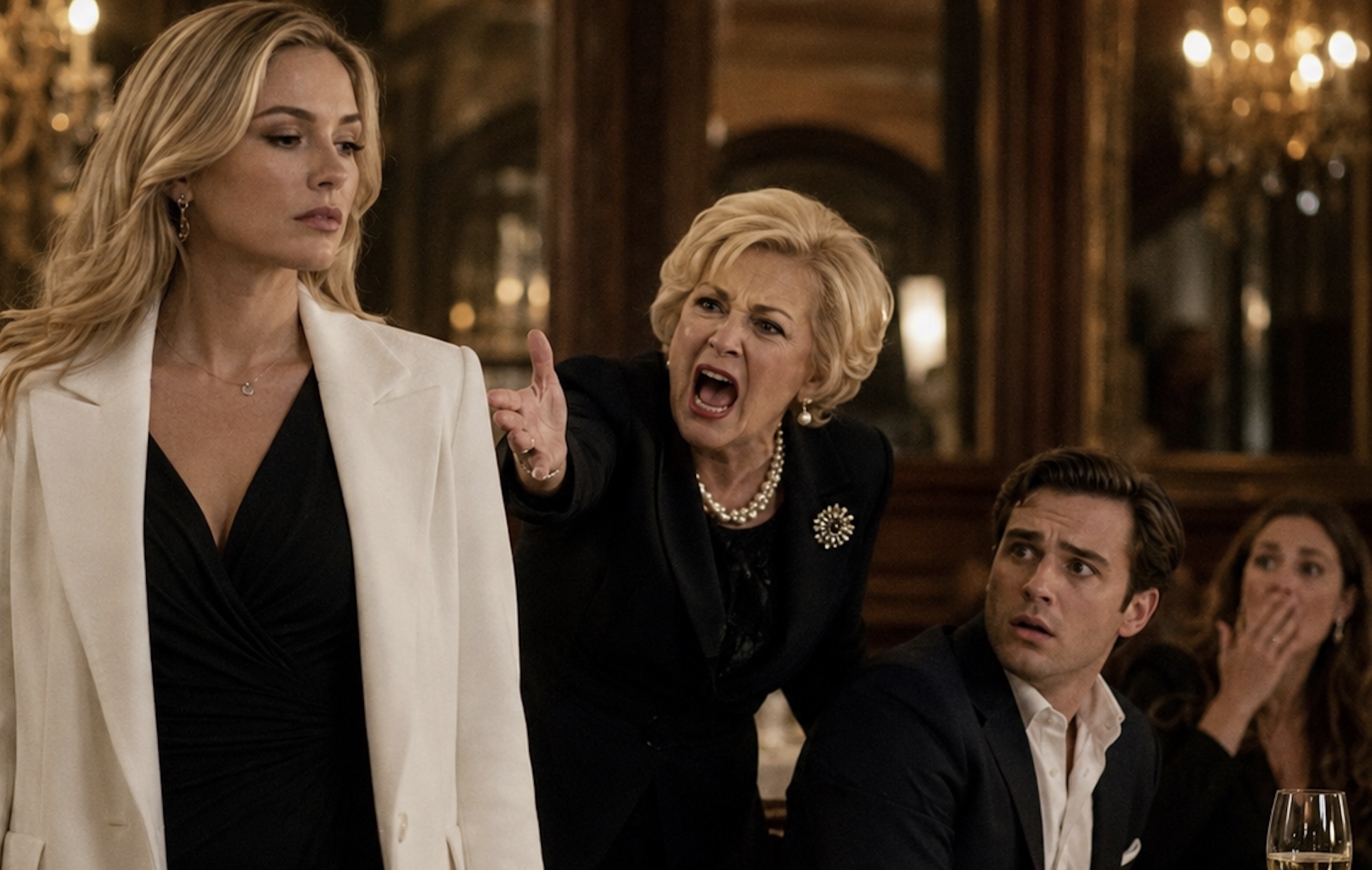
“She did it on purpose! She ruined everything on purpose! I knew it. I always knew she was a vile, quiet snake! And you! You’re a rag! For ten years I told you to divorce her, to find someone normal! And now what? She ran first! She did!”
Galina Petrovna’s voice rose like a siren. The guests froze. The waiters retreated toward the walls. Sergey’s cousin quietly finished his glass and turned toward the window.
“Mom, lower your voice…”
“I will not lower my voice! I gave my whole life to you! And you couldn’t even keep your wife! A rag! A rag abandoned by that gray mouse!”
She shouted in the corridor of the restaurant, and her voice bounced between the walls like a trapped bird. Her bright raspberry dress turned from a birthday outfit into a flag of surrender.
Sergey silently handed his card to the waiter, paid the bill, and left. Galina Petrovna remained standing alone among garlands, roses, and awkwardly silent guests who were already reaching for their coats.
For three weeks, Sergey called every day. Natalia answered — briefly, practically, without emotion.
“Natalia, let’s meet. Let’s talk properly.”
“About what?”
“About us. About the children. I understand everything now. I’ll change.”
“Sergey, you say that every time you lose control. But you don’t know how to change. You just want everything to go back to the way it was. And the way it was no longer works for me.”
“I’ll talk to Mom. She won’t…”
“This hasn’t been about your mother for a long time. It’s about you. About the fact that for ten years, you stood beside me and watched as I was ground into dust. And you were fine with it. Because dust doesn’t complain, doesn’t demand anything, doesn’t get in the way. You can simply wipe it away.”
“That’s not true.”
“It is the pure truth. And you know it.”
The divorce went through. Natalia did not step back an inch. Sergey tried to negotiate, begged her to wait, promised and swore — but every word he said shattered against the silence he himself had spent ten years teaching her to keep.
Natalia returned to the apartment with the children. Misha was quiet for the first few days, then one evening he came up to her.
“Mom, will Dad come to see us?”
“Of course, sweetheart. He is your father. You’ll see each other.”
“And Grandma?”
“Grandma can decide that for herself.”
Galina Petrovna made her decision a week later. She arrived without calling, as she always had — certain of her right to enter any door. She rang the bell. Natalia looked through the peephole.
Her mother-in-law stood on the landing with her lips pressed tightly together, holding a bag of sweets for the grandchildren. But her face was the same as ever: stone-like, commanding, intolerant of objection.
Natalia opened the door. Galina Petrovna drew in a breath and began before even crossing the threshold.
“Well? Are you satisfied? You broke the family? Disgraced my son? Do you think you’ve achieved something? You’ve achieved nothing! You are nobody! You were nobody, and you remain nobody!”
Natalia looked at her silently. One second. Two. Three. Then she placed her hand on the door handle.
“You will never enter this home again.”
And she slammed the door. Sharply, with a force she herself had not known she possessed. The heavy wooden door flew shut only inches from Galina Petrovna’s face, and the wind from the impact stirred her hair.
Her mother-in-law staggered back. The bag of sweets fell from her hands and scattered across the landing. She stood there with one hand pressed to her chest, wearing an expression Natalia had never once seen on that face in ten years. Not anger — fear. True fear. The fear of a person who had, for the first time, met a closed door.
Half an hour later, Sergey called.
“Natalia, you almost broke my mother’s nose! What is wrong with you?”
“I’m perfectly fine. And tell Galina Petrovna this: if she comes again, I’ll throw her down the stairs. And if you come with her — you too.”
“You’ve changed.”
“No, Sergey. I just stopped pretending I don’t exist.”
She hung up. Misha was standing in the hallway, looking at his mother — serious, unsmiling, but with something new in his eyes. Something like respect.
“Mom,” he said quietly.
“What is it, sweetheart?”
“I’m proud of you.”
Natalia crouched in front of her son and hugged him. Katya ran out of the room and pressed herself against them too.
A month later came news no one had expected. Sergey, left without an apartment, without his family, without his familiar life, moved in with his mother. He did not last two weeks. Galina Petrovna, having lost her daughter-in-law, turned all her energy onto the only remaining target — her own son.
She criticized him with the same fury she had once directed at Natalia. His clothes, his food, the way he spoke. She did not know how to live any other way. She needed someone nearby whom she could shrink in order to feel large.
Sergey called Natalia one last time.
“Natalia… I only understand now. Everything you said — it was all true. Every word.”
“I know, Sergey. I’m sorry it took you so many years and your own skin to see it.”
“She treats me… exactly the same way.”
“Yes. Exactly the same way. But you had a choice. You could have noticed it earlier. You chose not to.”
He was silent. And in that silence, Natalia finally heard everything she had waited years to hear. But it was too late.
Galina Petrovna remained alone — in her apartment, with her photographs and her righteousness. Sergey moved out and rented a room. The guests from the anniversary stopped calling; it was too awkward to remember that evening. The friends to whom she had spent years boasting about her obedient daughter-in-law and perfect son began looking away when they met her.
One day, her mother-in-law called Natalia herself. For the first time in all those years, her voice was quiet.
“Natalia… May I see the grandchildren?”
“Galina Petrovna, when you’re ready to speak like a human being instead of a commander, call me. I’ll answer. But not now. Not tomorrow, and not the day after tomorrow. Maybe in a year or two. Maybe.”
She hung up and looked at Misha, who was doing his homework at the kitchen table. Then at Katya, who was drawing a sun — huge, yellow, covering the whole page. The sun was smiling.
Natalia smiled too. Not for anyone else. Not because she had been asked to.
Simply because she wanted to.
And ahead of her was a morning — ordinary, quiet, real.
And no one would ever again tell her how to live it.