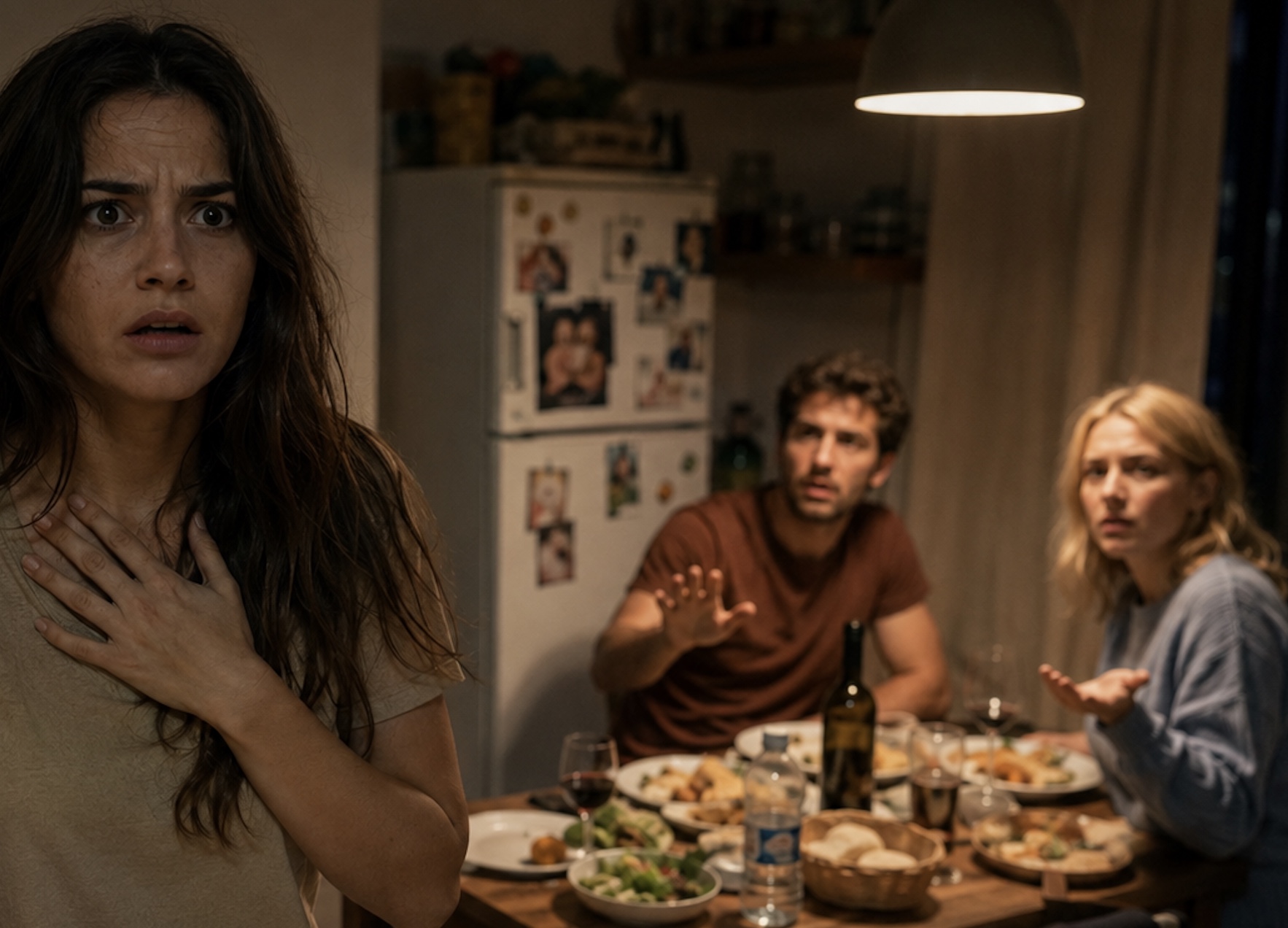
“What on earth is going on here?..”
Alina froze on the threshold of her own apartment, still gripping the handle of her suitcase. The clock showed half past two in the morning. After a long flight and a taxi ride through the sleeping city, she had dreamed of only one thing: taking off her clothes, falling into bed, and closing her eyes.
Instead, music crashed over her.
Loud music, with a heavy, pulsing bass that made the chandelier in the hallway tremble. From the kitchen came laughter, the clinking of glasses, and someone’s drunken argument about football.
She took one step inside. On her favorite light-colored sofa, a man she had never seen before was asleep without even taking off his shoes. On the table, her festive dinnerware set — the one she had inherited from her grandmother — was buried under cigarette butts, bottles, and dried-out plates of salad.
Denis came out of the kitchen. He was wearing sweatpants and holding a glass. He did not even look surprised.
“Don’t start,” he said indifferently. “The guys are staying with us for a while. They’re renovating their place.”
Alina lowered her suitcase and looked around. Someone from the kitchen waved at her, as if she were the guest here.
“Denis, what guys? What renovation?” she asked quietly.
“Artyom and Lena. And Kirill, their son. I told you they bought a new apartment.”
“You told me they bought one. You didn’t tell me they were living with us.”
“Well, that’s not exactly the kind of thing you discuss over the phone,” he shrugged. “You were resting. I didn’t want to bother you.”
Alina had bought this apartment long before Denis had ever appeared in her life. Seven years of mortgage payments, side jobs, refusing herself vacations, paint on her hands after doing the renovations herself — she knew every square meter of it by touch.
When Denis moved in after the wedding with one suitcase and a gaming console, she had never once reminded him whose name was on the documents. She thought they were a family. She thought it was their home now.
Gradually, everything became “theirs.”
His friends, who dropped by “for half an hour” and stayed until morning. His colleagues, who “had nowhere to sleep after the office party.” His cousins from out of town. Alina endured it all. In the mornings, she made coffee for eight people, washed the dishes, and laundered the blankets.
“You’re too uptight,” Denis would say every time. “A home should be open. Why are you acting like a security guard?”
Before her vacation, she had gone away alone for the first time in three years — to the sea with her friend Masha. Denis “couldn’t get time off,” but he saw her off with a smile.
“Relax,” he said. “I’ll just work quietly. No parties, I promise.”
And now, standing in the hallway of her own apartment, she heard an unfamiliar woman’s voice from the kitchen:
“Denis, bring another corkscrew! It’s in your top drawer!”
Your drawer.
As if he were the owner here.
As if Alina were some passerby who had wandered into the wrong apartment.
“How long have they been living here?” she asked.
“About three weeks. Maybe a little more.”
Alina slowly walked through the rooms. The lights were dim everywhere, and because of that, the apartment felt foreign, like a room in some questionable hotel.
On the light-colored sofa she had spent six months choosing, dark burgundy stains had spread across the fabric. Someone had tried to wash them out, but that had only made it worse. A stranger’s men’s shirt lay on the armrest.
In the kitchen, unfamiliar jars, cereal boxes, and someone’s vitamins stood on her shelves. The refrigerator was so packed that she would have needed a flashlight to find her own yogurt. In the sink stood a mountain of dirty dishes.
In the bathroom, someone else’s women’s underwear was hanging on her drying rack. On the shelf by the mirror sat an unfamiliar makeup bag and a hairbrush full of long blond strands.
She opened the bedroom door.
On her bed, under her favorite wool blanket — the one her mother had given her — a teenage boy of about fifteen was asleep. He had headphones in and a phone in his hand.
Alina quietly closed the door and returned to the living room. Inside, she felt empty and terribly cold, as if someone had opened a window in her chest.
“Denis,” she called evenly. “Can I speak to you for a moment?”
He came out already irritated. Artyom and his wife followed behind him with obvious curiosity.
“Alina, what is it now?” Denis began loudly, clearly performing for the audience. “You’ve only just walked in and you’re already making that face.”
“There is someone else’s child sleeping in my bedroom.”
“He is not ‘someone else’s child.’ That’s Kirill.”
“There are stains on my sofa. There is someone’s underwear in my bathroom.”
Denis rolled his eyes and spread his arms, glancing at his friends as if he were an actor turning to his audience.
“You’re acting like a hotel manager counting towels!” he scoffed. “People are in a difficult situation, and all you care about is your apartment!”
Artyom and his wife gave a small snort. Someone in the kitchen laughed.
And in that exact second, Alina understood something very simple: her home had stopped being her home a long time ago.
And her husband had stopped being on her side.
“I want everyone to leave. Tonight. Right now,” Alina said.
At last, the music was turned off. The kitchen became unnaturally quiet. Lena pressed a hand to her mouth. Artyom tensed. Denis looked at Alina as if she had stripped naked in front of the guests.
“Are you serious?” he stepped closer. “It’s the middle of the night. Where are they supposed to go? Their apartment is being renovated. They have a child!”
“That is not my problem.”
“You are my wife!” his voice cracked. “Family is supposed to help! Friends are supposed to help! What happened to you after that trip to the sea? Did your friend mess with your head?”
“Denis,” Alina said quietly, “this is my apartment.”
And then he said the words after which there was no going back.
He said them loudly, so everyone could hear, with a bitter, triumphant little smile:
“Actually, we’re husband and wife. That means the apartment is shared too. You don’t get to decide everything alone.”
The silence that followed was so complete that the dripping faucet in the kitchen could be heard.
Alina turned without a word and went into the bedroom. The teenager was already sitting up, staring at her in fear. Without looking at him, she opened the wardrobe, took a blue folder from the top shelf, and returned to the living room.
She placed it in front of Denis.
Opened it.
The purchase agreement. The ownership certificate. The date — two years before their wedding.
“This apartment was bought by me. Before marriage. With my money. And the person who decides what happens here,” she said, looking around at the suddenly silent guests, “is me.”
Then she picked up her phone and calmly dialed a taxi service.
“Hello. I need a car to this address…”
Lena was the first to lower her eyes. Then she quietly touched her husband’s sleeve and hurried into the kitchen to gather bags, pack her makeup, and wake her son. Artyom muttered something under his breath and grabbed his shirt from the back of a chair.
“Alina, please forgive us,” Lena stopped beside her, nervously twisting the strap of her bag. “Denis told us you knew. That you had offered. We would never have…”
“I understand,” Alina answered calmly. “I have no questions for you.”
“We really thought everything had been agreed. He said you were kind, that you didn’t mind…”
“Lena, it’s all right. Pack your things.”
Denis was pacing around the room like an animal in a cage. He grabbed his phone, then his glass, then his phone again.
“Are you seriously leaving now?!” he shouted. “Because of her little tantrum? Alina, do you even understand what you’re doing? It’s night! You’re throwing a child out into the street!”
“I called a taxi. No one will be left outside.”
“Greed! Plain female greed! You care more about your square meters than about people!”
Alina did not answer.
Before, she would have started explaining herself — for a long time, clumsily, with her voice trembling. Before, she would have made tea for everyone and apologized for something she had not done.
Now, inside her, everything was calm and empty, like after a long illness when the fever has finally broken.
She went into the bedroom. Opened her husband’s wardrobe. Calmly, without rushing, she began putting his things into his old gym bag.
Jeans. T-shirts. Razor. Charger. Laptop in its case.
On top of everything, she placed his toothbrush from the cup in the bathroom.
Then she carried the bag into the hallway and set it beside his sneakers.
Denis froze mid-sentence.
“What is that supposed to mean?”
“Those are your things,” Alina said. “If living with your friends matters so much to you, then go live with them.”
“You’re kicking me out? Me? Your husband?”
“I’m not keeping you here.”
The entrance door downstairs slammed — Lena and her son had already gone down. Artyom, avoiding everyone’s eyes, squeezed past with two bags.
Denis stood in the middle of the hallway, and for the first time that night, something like confusion crossed his face.
But Alina was already walking to the kitchen to open the window and air out the чужой smell that had settled in her home.
The next day, Denis packed the rest of his things and left.
“Temporarily,” he muttered from the doorway. “Think carefully while I cool off.”
Alina nodded and closed the door behind him.
The “temporary” separation stretched on.
First for a week. Then two.
His calls became less frequent, and his tone more sulky.
But his mother became very active. She called almost every evening, her voice shaking with righteous anger.
“Alina, do you even understand what you’ve done? A man wanted to help his friends, to show generosity, and you turned it into a tragedy over some plates!”
“Tamara Petrovna, it was my apartment. My sofa. My bedroom.”
“Oh, there you go again — mine, mine, mine! That’s not how things work in a family!”
“In a family,” Alina answered calmly, “people don’t move strangers in without asking their wife.”
Her mother-in-law hung up. Then called again a day later.
Alina no longer justified herself.
And the apartment slowly came back to life.
She washed all the blankets, ordered professional cleaning for the sofa, and threw the strangers’ jars out of the refrigerator. At night, it was quiet — so quiet that she could hear the kitchen clock ticking.
A month later, Denis called her himself. His voice was soft and guilty.
“Alina, let’s forget all this. I overreacted. You overreacted. I’ll come by tonight, okay?”
“No, you won’t,” she replied. “I changed the locks.”
Several months passed.
The divorce turned out to be surprisingly peaceful. There was nothing to divide.
One evening, Alina sat by the window with a cup of coffee. The apartment smelled of cinnamon and clean laundry. Masha, who had dropped in “just for half an hour,” studied her closely.
“You look younger somehow. Don’t you miss him?”
“Not him,” Alina smiled. “You know, for a long time I thought it was all about those guests. The renovation. The stains on the sofa.”
“And was it?”
“No. It was about the fact that a person who loves you would never turn your home into a place where you feel like a stranger.”
Masha nodded silently.
After her friend left, Alina sat down by the window again. Beyond the glass, the windows of neighboring buildings glowed — other people’s lives, other people’s conversations.
And inside her, there was silence.
Not the empty kind that makes you want to cry.
A different kind.
Full.
For the first time in many years, it was not loneliness.
It was freedom.