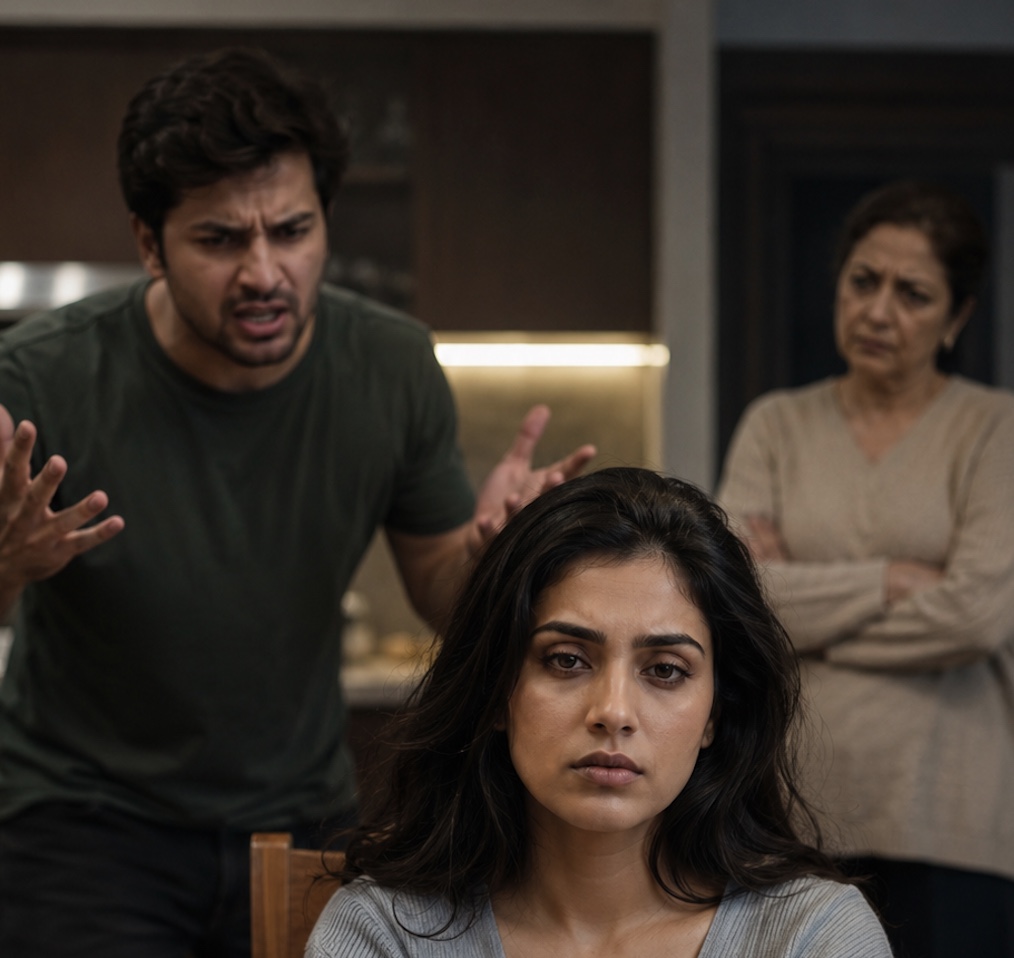
Lena arranged the utility bills on the kitchen table in a neat stack — electricity, water, gas, intercom. Every month, on the fifth, she transferred the money, and in a year and a half, there had not been a single late payment.
Her grandfather’s apartment was well cared for: warm, clean, with a working air conditioner and spotless windows, as if some invisible person looked after every corner of it every day.
That invisible person was Lena.
Anton came home late. He dropped his keys on the shelf by the door, walked into the kitchen, opened the refrigerator, looked inside, then shut it again. Then he sat down at the table across from Lena.
“We need to talk,” he said.
“Go ahead,” Lena replied, putting her pen down and sliding the bills aside.
“I’ve decided to give my entire salary to my mother. Things are hard for her right now. You know how many people are crammed into their apartment. Father can’t manage alone. Tamara has no money at all after the fire. Olesya is stuck with little Kirill. They need it more.”
Lena said nothing. She looked at her husband and waited for him to continue. Maybe he would say, “But we’ll figure something out.” Or, “It’s only temporary, just for a couple of months.”
“And me?” she asked calmly.
“What about you? We don’t pay rent. Utilities are pennies. The car belonged to your grandfather, the furniture belonged to your grandfather. You just graduated from university, your salary is still small. You’ll manage.”
“Manage what?”
“Everything. The house, the expenses. You’re smart. And my mother is really struggling.”
Lena nodded. Not because she agreed, but because she understood. There was no point arguing now. He had already made his decision. He had not come to discuss it with her. He had come to announce it.
“All right,” she said. “I’ll think about it.”
“There’s nothing to think about, Lena. This is my family.”
She lifted her eyes to him. Quietly, without accusation, without a tremor in her voice, she asked:
“And what am I?”
Anton shrugged and went into the bedroom.
Lena remained sitting at the table. In front of her lay the bills — all paid from her own pocket.
Every single one of them.
The next day, Lena called Anton during lunch. He did not answer immediately. Only on the fourth ring. His voice sounded like he had been expecting the call and had prepared his replies in advance.
“Anton, I want us to talk normally. Not emotionally. Let’s sit down tonight and calculate everything.”
“Calculate what?”
“Our expenses. Yours, mine. How much goes to food, fuel, household items. I want to understand how we’re supposed to live if your entire salary goes elsewhere.”
“Lena, I explained everything yesterday. You live in someone else’s apartment for free. You don’t need to pay rent. That saves you about thirty thousand a month, by the way. What else is there to calculate?”
“Someone else’s?” She paused for a second. “This is my grandfather’s apartment. Nikolai Petrovich’s. He is sick now and living with my mother because he needs care. He allowed us to live here. Both of us.”
“Exactly. For free. So you’ll have enough.”
“And if I don’t?”
“Then find a side job. You’ve just graduated. It’ll be good for you. And I have a duty to help my mother.”
Lena was silent for a moment. Then she said in an even, almost gentle tone:
“Fine. Then I’ll call Galina. I’ll talk to her.”
“Why?”
“Because I want to hear how she sees this situation. Maybe we can find a compromise.”
“She’ll tell you the same thing I did.”
“Maybe. But I want to hear it myself.”
Anton threw out a short “do what you want” and hung up.
Lena dialed her mother-in-law’s number.
Galina answered instantly, as if the phone had already been in her hand.
“Galina Vladimirovna, hello. It’s Lena.”
“I know. Anton warned me you would call.”
“Then you know what I want to discuss.”
“I do. And I’ll tell you plainly — Anton is doing the right thing. He has finally grown up. Family is sacred. You are young and healthy. Your whole life is still ahead of you. You don’t even pay for the apartment.”
“Galina Vladimirovna, Anton and I are also a family.”
“You’ve been together for a year and a half. I raised him for twenty-five years. Alone, by the way, until Boris came along. Do you feel the difference?”
“I do. But that doesn’t mean a husband can stop contributing to his own household completely.”
“He contributes. He lives with you, doesn’t he? A man’s presence is also a contribution. As for money… money is needed here right now. Tamara’s house burned down. She has nowhere to go. Olesya has a child, and that Dmitry of hers left. Too proud to squeeze in with the rest of us. But Anton isn’t like that. Anton understands.”
“Understands what?”
“That blood is not a stamp in a passport. Blood is forever. And wives, forgive me, can be replaced.”
In those words, Lena heard more than rudeness. More than an insult.
She heard a program.
A clear, polished belief that Galina had been planting in her son’s head for twenty-five years. Everyone else was temporary. Everyone else wanted to deceive him. But she did not. She was forever.
“Thank you, Galina Vladimirovna. I understand you.”
“Good. Don’t be offended, Lenochka. Just accept it.”
Lena ended the call.
She was not offended.
She simply stopped hoping.
That evening, Lena wrote to her friend: “Nastya, can you talk? Not by text — voice.”
Nastya called back three minutes later.
“Tell me,” she said without preamble.
“Anton decided to give his whole salary to his mother. Every last ruble. I spoke to him, then to her. They both think I already have it easy because the apartment is my grandfather’s and we live here for free.”
“Wait. He’s serious? All of it?”
“All of it. He said she matters more.”
Nastya fell silent. Then her voice changed — firm, sharp, precise.
“Lena. Kostya and I have been paying a mortgage for three years on a studio apartment. Twenty-two square meters. I know what it means to count every ruble. And I know what it means when both people contribute. Because when only one person contributes, that isn’t a family. That’s support.”
“He says his presence is also a contribution.”
“Presence? A cat lying on the sofa is also present. A husband means responsibility. What are you going to do?”
“I don’t know yet.”
“No, Lena. You do know. I can hear it in your voice. You’ve already decided. You just want someone to confirm that you’re not losing your mind.”
“Maybe.”
“You’re not. You are completely within your rights.”
The next day, Dmitry called.
On his own.
Apparently, Olesya had told him about Lena’s conversation with Galina, and within twenty-four hours the news had spread through the family.
“Hi, Lena. I don’t know if you want to hear this, but I want to say it anyway.”
“Go ahead, Dima.”
“I didn’t leave because I was proud. I left because it is impossible to live in that apartment. Two rooms, one of them a walk-through, six people. Tamara sleeps on a folding bed in the hallway. Olesya and Kirill are in the small room. Galina and Boris are in the big one. I suggested to Olesya that we rent at least a room, just for the beginning. She refused. She said she wouldn’t abandon her relatives.”
“And Galina?”
“Galina told me I was selfish. That a real man should endure. That I was obligated to support not only my wife, but everyone around her too. I tried for a month, Lena. One month. I gave money, bought groceries, paid bills. And do you know what I got in return?”
“What?”
“Galina told Olesya that I wasn’t giving enough. That I could do more. That her Anton — now he was a good man, carrying everything without complaint.”
“At that point Anton wasn’t carrying anything yet.”
“Exactly. But Galina was already preparing the ground. She’s a master at it, Lena. She tells each person exactly what they need to hear to feel guilty. And then that person gives everything. Not because they truly want to help, but because they’re afraid not to.”
“Anton is afraid?”
“Anton has lived inside this since childhood. Galina taught him from the cradle that everyone would deceive him, everyone would betray him, and only she never would. And he believes it. Because he has no other experience. He really thinks he won’t survive without her.”
“And you?”
“I understood one thing. You cannot save someone who doesn’t want to be saved. Olesya chose a side. I’m not her enemy, but I will not feed a system that chews people up and spits them out.”
Lena exhaled and said quietly:
“Thank you, Dima. You helped me a lot.”
“Don’t drag out your decision. The longer you wait, the harder it is to leave.”
She had no intention of waiting.
On Saturday morning, Lena got up at six. Anton was still asleep. She dressed, took the apartment documents and the car keys, got behind the wheel of her grandfather’s Toyota, and drove to her mother’s house.
Nikolai Petrovich was sitting in an armchair by the balcony door. He had lost weight over the past few months, but his eyes were the same — lively, attentive, with a sly little squint.
“Grandpa, I need your help.”
“Sit down. Tell me.”
She told him everything. About Anton, about his salary, about her mother-in-law, about the conversation with Nastya, about Dmitry’s call.
Nikolai Petrovich listened without interrupting. When she finished, he asked only one question:
“Do you love him?”
“I loved a man who apparently doesn’t exist. The Anton who brought me coffee in the mornings and said we were a team. This Anton thinks I’m a free attachment to your apartment.”
“Then you’ve decided.”
“I have. I want you to give me power of attorney. For the apartment and the car. So I can act on my own.”
“No power of attorney needed,” her grandfather said, then looked at Lena’s mother. “Irina, bring me the folder from the wardrobe. The blue one.”
Irina brought it.
Nikolai Petrovich took out two documents and placed them on the table in front of Lena.
“I want to transfer the apartment to you. And the car too. These are gift deeds. They haven’t been notarized yet, but they’re ready. You will be the sole owner.”
Lena froze.
“Why didn’t you tell me?”
“Because I wanted to see how you would handle things. You did well. Now act. I’m getting dressed, and we’re going to the notary.”
She returned home at eleven.
Anton was already awake, sitting in the kitchen, eating a cheese sandwich.
With her cheese.
With her bread, bought with her money.
“Where were you?” he asked lazily.
“At Grandpa’s. Anton, we need to talk.”
“Again?”
“For the last time. I won’t repeat myself.”
He looked at her and sensed something. Maybe it was her tone. Maybe the way she stood — straight, calm, with documents in her hands.
“Well, say it.”
“I’m giving you three days to pack your things and move out. The apartment is mine. The car is mine. Here are the gift deeds. You can look at them. They’re notarized. You won’t be able to contest them.”
Anton stopped chewing.
“What?”
“You heard me. Three days. Until Tuesday.”
“Are you joking?”
“Do I look like someone who’s joking?”
“Lena, wait. We can talk about this. Maybe I overreacted. Not my whole salary. Part of it. Let’s say part.”
“A week ago, I asked you to talk. You said there was nothing to discuss. The day before yesterday, I called your mother. She said wives can be replaced. So let the next one come along. But not here. Not in my apartment. And not in my car.”
“You can’t do this! We’ve been together for a year and a half.”
“For a year and a half, I paid the utilities, bought the groceries, filled the car with fuel, and kept this home running. You lived here. Simply lived here. And now you decided that even the little you contributed could be taken away and carried to your mother. Fine. Carry it. But live with her too.”
“There’s no space there! Six people already live there!”
“Then there will be seven. That’s the problem of your family. The family that matters more to you.”
Anton jumped up. He paced around the kitchen, breathing heavily, turning red.
“I’ll call my mother.”
“Of course. Call her and get your instructions. She raised you for twenty-five years. Let her raise you for another twenty-five.”
He grabbed his phone and went into the hallway.
Lena could hear scraps of the conversation — quick, broken, with notes of panic.
He returned ten minutes later. His face was gray.
“She said they don’t have room. Tamara already sleeps in the hallway.”
“How surprising. There’s enough money for everyone, but no room.”
“Lena, please…”
“Three days, Anton. Tuesday. Start packing.”
He stood in the middle of the kitchen — lost, stunned, facing for the first time in a year and a half a person who was not begging, not waiting, not enduring.
A person who simply decided.
Anton moved out on Monday. A day early.
He took two suitcases and a backpack — everything that belonged to him. The furniture, appliances, dishes — all of it stayed. It belonged to the apartment, and the apartment belonged to Lena.
He left by taxi.
Lena had blocked the car in the parking lot and reissued the insurance in her own name. Anton did not even ask for a ride. Apparently, he had understood there was no one left to ask.
Three days later, Olesya called.
“Hi, Lena. I’m not calling because of Anton. I’m calling for myself.”
“I’m listening.”
“He’s been here for three days. He sleeps on the floor in our room. Kirill cries at night, Tamara walks through the hallway, Boris works shifts every other day, and when he’s home, he keeps the television blasting. I’m about to tell you something I haven’t said to anyone.”
“Go ahead.”
“Dima was right to leave. I only understand that now. I didn’t want to admit it, but he was right. It is impossible to live here. And Mother… Do you know what Galina did with Anton’s money?”
“What?”
“She bought herself a fur coat. In May. A fur coat for eighty thousand. She said it was discounted, a good deal. Not a ruble for Tamara’s medicine. Not a ruble for my son Kirill’s winter snowsuit. Everything went to her. Anton found out yesterday. He found the receipt in the wardrobe.”
Lena was not surprised. She felt a strange, dull confirmation of what she had already known instinctively.
“And what did he say?”
“Nothing. He just sat in the kitchen and stayed silent. For an hour. Then he asked, ‘Mom, what about the utility money I gave you?’ And she said, ‘Boris pays the utilities. I told you it would go toward the family.’ And he understood that ‘the family’ meant Mother.”
“Olesya, why are you telling me this?”
“Because I want to call Dima. I want to ask him to forgive me. But I’m afraid he won’t answer.”
“He will answer. I know that for sure.”
“How?”
“Because he called me himself. A week ago. He was worried about you. A man who calls a former relative to warn her is not indifferent.”
Olesya began to cry. Quietly, briefly, like someone who had been holding everything in for too long and finally allowed herself to break.
Two days later, Nastya came to Lena’s place with a cake and a bottle of lemonade.
“Well,” she said, setting the cake on the table. “Tell me. How does it feel?”
“Quiet. Clean. Free.”
“Any regrets?”
“Not for a second.”
“And him?”
“He lives with his mother. Sleeps on the floor. Found out all his money went to a fur coat. Olesya called Dima, and they talked for three hours.”
“And Galina?”
“Galina,” Lena smiled faintly, “told Anton he was ungrateful. That she had devoted her whole life to him, and now he was making a scandal over some fur coat. And that Lena had turned him against her, ruined him, taken everything from him.”
“Classic.”
“Completely. But do you know what the most interesting part is? Tamara called me yesterday. Boris’s sister. She said, ‘Lenochka, you’re the only normal person in this whole story.’ And she asked me to help her find a room to rent. She wants to move out of Galina’s apartment.”
“And you helped?”
“Of course. There’s a one-room apartment for rent on the first floor of our building. I connected her with the owner.”
Nastya shook her head.
“You are impossible, Lena. They throw you away, and you still help someone standing next to the people who threw you away.”
“Tamara did nothing wrong. Her house burned down. She became a hostage of someone else’s apartment and someone else’s rules.”
They drank tea and ate cake.
Behind the walls, everything was quiet. The two rooms — the walk-through room and the far one — seemed to breathe with a peace that had not been there in a long time.
A week later, Lena received a message from Anton.
It was long, chaotic, full of words like “forgive me,” “I understand now,” and “give me another chance.”
She read it.
Then she wrote only one sentence:
“You had your chance, Anton. You gave it to your mother along with your salary.”
Then she blocked his number.
That same evening, her grandfather called.
“How are you, granddaughter?”
“I’m good, Grandpa. Truly good.”
“Do you know why I transferred everything to you?”
“Why?”
“Because Anton came to me. In February. Alone, without you. He asked whether I could put the apartment in his name. Said it would be more convenient if the documents belonged to the ‘man of the house.’”
Lena slowly lowered her cup onto the table.
“He… what?”
“He came and asked. Calmly, politely. Even complimented me. Said the renovation was excellent, Nikolai Petrovich, you did a wonderful job. And then he said, ‘Maybe you could transfer it to me? I live there, it would be easier.’ I said nothing to him then. Just nodded and saw him out.”
“Grandpa, why didn’t you tell me back then?”
“Because you wouldn’t have believed me. You would have said maybe he didn’t mean it that way, maybe he phrased it badly. But now you see him for yourself. Not because I told you — because he showed you.”
Lena was silent.
In her hands was a cup of cold tea. On the table lay the documents for the apartment and the car — her name, her right, her home.
“Thank you, Grandpa.”
“No need, Lenka. You handled it.”
She ended the call and smiled.
Not broadly. Not triumphantly.
Just quietly, with the corners of her lips.
Like someone who knows that the worst thing is not being betrayed.
The worst thing is failing to notice it in time.
She noticed.