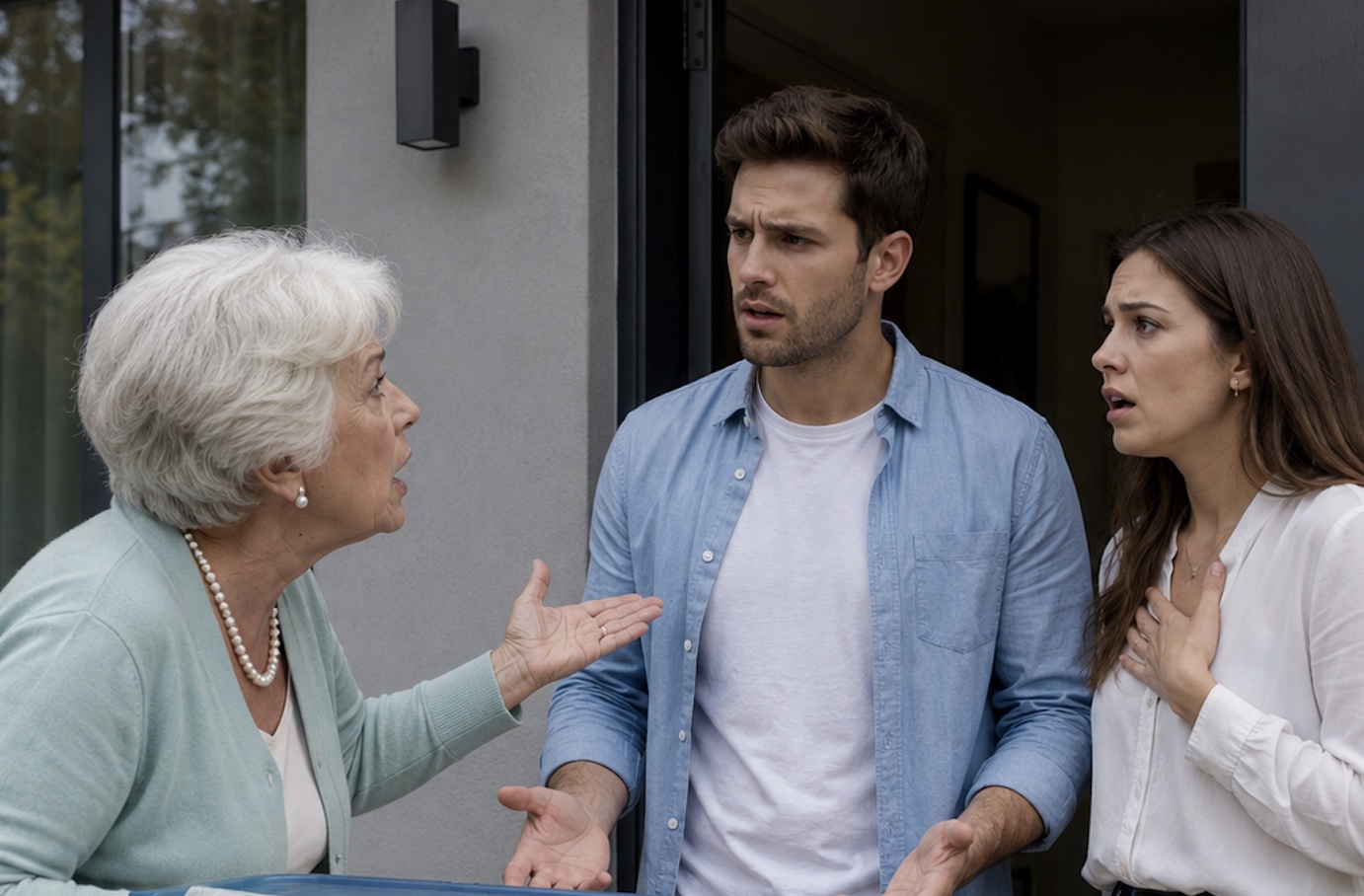
The containers were lined up right on the festive table.
Not beside it, not underneath it, not tucked away in a bag by the door — right on the snow-white tablecloth Lena had ironed that very morning, imagining how beautiful everything would be. Five plastic containers, each one larger than the last, like nesting dolls, only without the cheerful faces. Valentina Stepanovna was already opening the lids with businesslike focus, clearly deciding what would go where: the smaller one was obviously meant for the aspic, and the large one for the roasted chicken with potatoes.
“What is this?” Lena asked.
Her voice was quiet, almost a whisper, because she couldn’t speak any louder. Her throat had tightened.
“Containers,” her mother-in-law replied calmly, without even looking up. “We won’t eat all of this. It would be a shame if it went to waste.”
Around the table sat Kostya, Lena’s brother-in-law, with his wife Irina; Nadya, her sister-in-law; two nephews who had already managed to smear themselves with cake; and Vasya — Lena’s husband — who was staring down at his plate as if studying the map of an unknown continent.
Lena slowly exhaled.
Outside the window, the first October dusk was settling in. In the fireplace — the one she and Vasya had built together the previous autumn, when their hands had grown stiff from the cold — logs crackled softly. And the evening she had imagined for so long was melting before her eyes like a candle placed in a draft.
They had spent almost three years building this house.
No, not building it — carving it out of nothing.
Out of exhausted evenings after work. Out of weekends that never really existed. Out of arguments and reconciliations. Out of loans that Lena recalculated at night while Vasya slept, because if she didn’t sleep, she felt she might lose her mind.
The plot of land had come from Valentina Stepanovna. It was her land, inherited from her parents — an old plot outside the city, overgrown with nettles and wild raspberry bushes, with a crooked shed where only mice and someone’s forgotten past seemed to live. For many years it simply stood there. It simply existed. Like a debt to herself that Valentina Stepanovna had never quite decided whether to settle.
The idea had been Vasya’s. He brought it up carefully one evening over dinner in their tiny rented apartment, where the bed and sofa stood so close together that at night it felt as if you were sleeping in two rooms at once.
“Mom, what if we built a house on your land?” he asked.
Lena saw his shoulders tense slightly. He always did that when he was waiting for a blow.
But no blow came.
Valentina Stepanovna pressed her lips together, stayed silent for a moment, looked out the window, and said:
“Well, if you really need it. It’s no use to me anyway. Just remember — I’m making a sacrifice. I could sell it and live comfortably. You do understand what I’m doing for you, don’t you?”
They understood.
They were reminded of it regularly.
During the first year of construction — at least ten times. During the second — Lena lost count. Every time something went wrong — a tool broke, a contractor disappeared with money, the foundation had to be redone — Valentina Stepanovna called and said the same thing, only changing the words slightly, never the tone.
“I could have sold it, you know. People offered good money. I could be living peacefully now, denying myself nothing. But I gave it to you. And this is how things turn out.”
Lena learned to answer briefly.
“Yes, we remember. Thank you.”
Then she would hang up and cry in the bathroom so Vasya wouldn’t see, because he was already torn enough. It was worse for him, because this was his mother. He couldn’t explain anything to her — or maybe he simply didn’t want to try.
The house turned out small: one floor, three rooms, a kitchen-living room, and a spacious veranda. But it was solid. Every board had been chosen personally. Every nail driven in with purpose. Lena had painted the walls herself, spending ages choosing shades, carrying samples around, holding them up to the light. She wanted the house to feel alive, not cold and official. She wanted someone to walk inside and immediately feel: it’s good here.
And it did feel that way.
Warm.
Their own.
Valentina Stepanovna arrived first for the housewarming — before all the guests, without warning, carrying two heavy bags, with Nadya following behind to help.
“Open up, open up,” she said to Lena, barely giving her time to unlock the door.
Then she walked in without taking off her shoes and looked around with the air of someone inspecting completed work.
“The ceilings are a bit low,” she noted, although the ceilings were perfectly normal.
“The windows are too small,” she added, even though Lena had chosen those windows especially for the view of the garden.
“The kitchen is cramped.”
“The hallway is inconvenient.”
“Well, never mind. It’s livable,” she concluded, and headed toward the bedroom.
Lena stood in the hallway and smiled.
She had long ago learned to smile that way — not with her mouth, but with some separate, tired muscle of endurance.
Then Kostya arrived with Irina. Nadya came back in from outside. Friends started arriving, and suddenly the house became noisy, cheerful, truly festive. Lena set the table, lit candles, and took out the glasses she had been saving for this day. Vasya made a toast — quietly, but beautifully — about how long they had worked toward this moment and how they finally had a place that belonged only to them.
Lena’s eyes stung.
And then Valentina Stepanovna got up from the table, pulled the containers from her bag, and placed them on the tablecloth.
“It would be a shame if it went to waste,” she repeated, already spooning aspic into one of them.
“Mom,” Vasya said at last, lifting his eyes from his plate. “Wait a little. We haven’t even finished eating yet.”
“I’m waiting,” Valentina Stepanovna agreed, shifting the containers slightly to the side. “I’m in no hurry. Besides, I want to see where my room is.”
Silence fell over the table like a tablecloth dropped onto a stack of dishes — all at once, with a crash.
“What?” Lena said.
“My room,” Valentina Stepanovna repeated patiently, as if explaining something obvious. “I’m not going to live alone in the city forever. You’re young, you need help. And the land is mine — which means the house here is also, in a way, partly because of me. So I wanted to see which room you’ve set aside for me.”
Nadya stared at the ceiling.
Kostya studied the label on the bottle.
Irina quietly put down her fork.
Lena felt something shift inside her chest — in the place where three years of silence, patience, humiliation, and swallowed words had been packed down tight. Something trembled. Like a wall beginning to crack. Not from the outside, but from within.
“Valentina Stepanovna,” she said, and her voice was perfectly even, “let me explain something to you.”
“Lena,” Vasya said quietly.
“No, Vasya. It’s all right.”
She looked at him — not with anger, not with reproach, just firmly.
“I’ll explain.”
She stood up, placed her napkin beside her plate — carefully, almost ceremonially — and looked at her mother-in-law.
“You came to our housewarming with containers and asked where your room would be. That means you believe you are entitled to a room here. Because the land used to belong to you.”
“Exactly,” Valentina Stepanovna nodded.
“Fine. Then let’s be honest. You gave us the land. You didn’t sell it to us — you gifted it to us, because you said yourself that you had no use for it. We value that. We are grateful for it. Truly. But we built this house ourselves. Every penny, every brick, every board. You never once came to help. You never once offered money. You never once asked whether we needed anything. But you reminded us again and again of the sacrifice you made.”
“It was a sacrifice!” Valentina Stepanovna raised her voice. “I could have sold it and lived normally!”
“You could have,” Lena agreed. “But you didn’t. That was your choice. And we are grateful for it. But that choice does not give you the right to a room in our house — a house we built ourselves. Without your help. With our own hands. Our own money. Our own nerves and our own sleepless nights.”
The table was completely quiet.
Even the nephews had stopped fidgeting.
Nadya lowered her eyes.
“You have no right,” Valentina Stepanovna said, and her voice changed — hard, wounded, scratched raw. “You married into this family. This is our land. Vasya’s land.”
“Lena is right, Mom,” Vasya said.
Only three quiet words.
But Lena felt them physically, like warmth from the fireplace behind her.
“Vasya,” his mother began.
“No.”
He stood up, walked over to Lena, and stood beside her.
“We are both grateful to you for the land. But Lena is telling the truth. We did not set aside a room for you. That conversation never happened. And we should have said this earlier — it’s my fault that I kept silent. But we’re saying it now.”
Valentina Stepanovna slowly rose from her chair.
She picked up her bag.
Then she looked at the containers still sitting on the table — and suddenly something in her face broke.
Not anger.
Something else.
Something like confusion.
As if all this time she had been following a map, and only now realized the map was wrong.
“I thought,” she said quietly, “that you would want it.”
“Want what?” Lena asked carefully.
“For me to be nearby.”
She didn’t look at them.
“I live alone. I’ve lived alone for so many years. That land truly was of no use to me. I gave it away because I thought… well. That you would build here. And I would be close. At least sometimes.”
The silence changed.
Lena looked at this woman — no longer young, dressed in a nice cardigan she had probably chosen specially for the housewarming, with containers she may not have brought out of greed, but because she didn’t know any other way to feel useful — and felt the anger inside her slowly change shape.
It did not disappear.
But it became something else.
A tired understanding.
“Valentina Stepanovna,” Lena said more gently, “we are happy to see you. Always. Come visit. Come for barbecues in the summer, for holidays, for weekends. There is a sofa here — a good, wide one. Stay overnight whenever you want. I mean that. But living here permanently — no. We need our home. Just ours.”
“Because I’m a burden to you?”
“Because this is our home,” Lena repeated. “Not because you are bad. But because we need a space that belongs only to us. That is normal.”
Valentina Stepanovna was silent for a long time.
Then, without looking at anyone, she took the containers and put them back into her bag — one by one, carefully, as if putting away arguments that had turned out to be useless.
“All right,” she said.
She added nothing else.
Just: “All right.”
Then the evening continued.
Kostya poured wine for everyone and made a toast — awkward, but sincere — about how the most important thing in a family is to talk, because people can keep silent perfectly well on their own. Nadya laughed. The nephews found the neighbor’s cat under the veranda and went off to feed it. Irina helped Lena clear the table.
Valentina Stepanovna sat in the armchair by the fireplace, drinking tea.
Lena sat down beside her — not immediately, giving the awkwardness between them time to settle.
“Will you come for New Year’s?” she asked.
Her mother-in-law looked at her for a long moment, as if checking whether there was a trap hidden in the question.
“If you invite me,” she finally answered.
“We will,” Lena said.
Outside the window, it had long since grown dark.
The fire in the fireplace burned steadily and warmly.
The house stood there — warm, solid, theirs.
And there was not a single crack in it.
Not outside.
And not inside anymore.