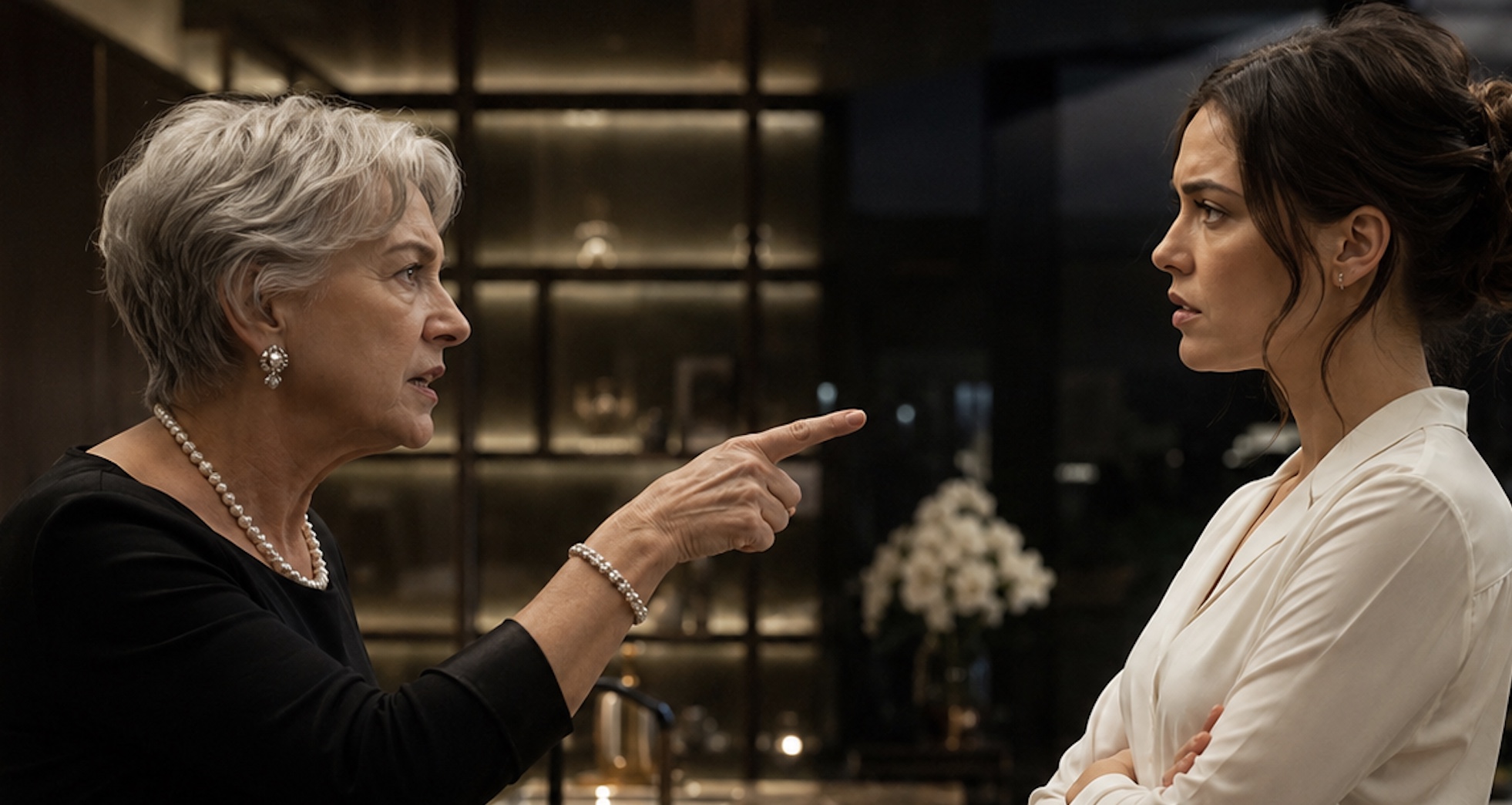
“Why did you leave your passport on the table? So I would accidentally see it, or so I would have to ask you myself?”
Varya was standing by the sink with a wet sponge in her hand, and at first she did not even understand what Nina Petrovna was talking about. The kitchen smelled of bleach, fried onions, and new furniture that still had not fully aired out. Nina Petrovna, Artyom’s mother, was holding Varya’s passport between two fingers, as if it were not a document but a bag of rotten herring.
“I didn’t leave it there, Nina Petrovna. It was on the cabinet. We came back from the government office yesterday.”
“From the government office,” her mother-in-law repeated slowly. “Fast. Only a week has passed since the wedding, and you’re already registered here.”
“Artyom said it was the right thing to do. We live together.”
“You live together,” Nina Petrovna said, tapping the passport cover with her fingernail. “But this apartment was not bought by you. Not even by Artyom. It was bought by me. With my money. I broke my back for twenty years in a clinic so my son wouldn’t have to wander around rented corners.”
“I remember that. And I’m grateful.”
“She’s grateful,” Nina Petrovna sneered. “These days, gratitude is quickly sealed with a stamp in the passport. Just in case.”
“What exactly are you accusing me of?”
“So far, nothing. I’m just watching. I’m an observant woman, you know. I worked as a doctor all my life. I can see right through people.”
“Then please see that I’m not your son’s enemy.”
“Time will show that, Varenka. Time and actions.”
That evening, Artyom only waved it off when Varya told him about the conversation. He sat on a stool, eating pasta with a cutlet and scrolling through his phone.
“Mom didn’t mean anything bad. She’s just worried about the apartment.”
“About the apartment, or about the fact that I’m breathing inside it?”
“Come on, don’t start. She really did buy it. It matters to her to feel that all her hard work wasn’t wasted.”
“Artyom, she was turning my passport over in her hands like it was evidence.”
“Varya, try to understand her too. She raised me alone. She invested everything in me.”
“Is anyone planning to understand me?”
“I understand you. But let’s not start a war. We just got married.”
“I don’t want a war. I want us to have a door. A normal door, where people ring first and only then come in.”
“I’ll talk to her.”
“When?”
“Well… when the right moment comes.”
As usual, the right moment never came. But Nina Petrovna came regularly — on Tuesdays, Thursdays, and on any other day when she suddenly happened to be “nearby.” Her route was strange: from home to the store, from the store to the pharmacy, and from the pharmacy, somehow, always to their entrance.
“I brought chicken. Artyom loves homemade broth. Do you make broth for him?”
“I make it when he asks.”
“A man shouldn’t have to ask. A woman should notice.”
“I’m not a mind reader. I have a different profession.”
“What profession? Moving papers around in an office?”
“I’m an accountant.”
“Right, you know how to count money. That much is obvious.”
“Nina Petrovna, would you like some tea?”
“Tea later. Your towels are hanging wet in the bathroom. You’ll get mold. And there’s opened sausage in the fridge without a container. Artyom has a weak stomach.”
“Artyom opened it himself yesterday and didn’t put it away.”
“Are you the woman of the house or not? A man comes home from work tired.”
“I come home from work too.”
“You sit at work. Don’t compare.”
Sometimes Varya answered. Sometimes she stayed silent. Silence was more useful: at least it did not grow into a scandal. But inside, everything still kept building up. Like water under linoleum: the surface looks dry, but step on it and it squelches.
Seven months after the wedding, Varya showed Artyom the test. The two lines appeared so clearly it was as if someone had drawn them with a marker.
“Artyom, just don’t faint.”
“What?”
“Look.”
“Is this… serious?”
“No, I decided to conduct a chemistry experiment this morning.”
“Varya,” he grabbed her, spun her around the kitchen, and immediately got scared. “Oh, wait, I’m not supposed to do that, right?”
“I don’t know. But if you drop me, then definitely not.”
“We’re going to have a baby.”
“Looks like it.”
“Should we tell Mom?”
“Let’s tell the doctor first.”
“Mom will be offended.”
“Your mom gets offended even by the weather forecast if it rains without her permission.”
He laughed, and for the first time in a long while, Varya felt that maybe everything really could be all right.
Nina Petrovna found out a week later and rushed over with a bag of vitamins, printed-out medical information, and the air of a chief specialist in other people’s pregnancies.
“Here’s how it’s going to be, Varvara. No coffee. No heels. None of your office stress.”
“My office is fine. The only one stressing there is the printer.”
“Don’t joke. Pregnancy is serious. You need to register with a good doctor. I’ll arrange it.”
“I’ve already made an appointment at the women’s clinic.”
“At our district clinic? There are queues, old women coughing everywhere, and doctors fresh out of university.”
“There’s a good doctor there. A friend recommended her.”
“Friends recommend manicurists, not doctors. I’ll find you a specialist at a private clinic.”
“Nina Petrovna, thank you, but we’ll decide ourselves.”
“Ourselves,” she said, looking at Artyom. “Do you hear that? Already ‘ourselves.’ And then, when something goes wrong, you’ll come running to me.”
“Mom, don’t make things worse.”
“I’m not making things worse. I’m warning you. Because apparently, I’m the only one here who uses her head.”
The pregnancy turned out to be ordinary, not like in the movies. Varya felt sick from toothpaste, craved pickles, and for some reason, mandarins in July. In the evenings, she sat on the balcony, listening to teenagers arguing near the scooters downstairs, and thought that motherhood did not begin with tenderness. It began with an endless prayer: as long as everything is all right.
Artyom tried. He bought cottage cheese, carried bags, stroked her belly, and talked to it.
“Little one, don’t kick your mother too hard in there. She’s nervous enough as it is.”
“You’re the nervous one.”
“I’m responsible.”
“A responsible person doesn’t forget to submit the meter readings.”
“When the baby is born, I’ll change.”
“God help this child if they have to hear those fairy tales from birth.”
Nina Petrovna kept coming with advice, as if she carried it in her bag together with shoe covers.
“You shouldn’t buy one of those fashionable strollers. You need a proper one, with big wheels.”
“Our elevator is small.”
“You’ll fold it.”
“Will I fold myself too after a C-section?”
“Who told you anything about a C-section? A woman must give birth naturally.”
“A woman owes nothing to anyone except the tax office.”
“That tongue of yours, Varya. Artyom, do you hear how your wife talks?”
“I hear it. I like it.”
“He likes it. You’ll cry later.”
Their daughter was born at the end of November, when the city was already dusted with dirty snow. The baby cried angrily, as if she had not been born, but illegally evicted from a warm apartment. Varya lay exhausted, her lips cracked, her hair stuck to her forehead, but when they placed the baby on her chest, everything inside her became quiet.
“Sofia Artyomovna,” the midwife whispered. “Three kilos two hundred. A good girl.”
Artyom arrived an hour later, crumpling a bag with water and cookies in his hands, looking at Varya through the glass like a schoolboy at a shop window.
“Is she beautiful?”
“Artyom, she’s an hour old.”
“So what? You can already tell.”
“You can tell she’s very displeased.”
“She takes after you.”
“Thank you, father.”
“And her hair is dark.”
“My father had black hair. Did you forget?”
“No, I didn’t mean it like that. She’s just amazing. Ours.”
Nina Petrovna appeared the next day. She brought a huge bouquet that was not allowed in the ward and a bag of pink baby clothes, as if the child urgently needed to be disguised as a marshmallow.
“Well then, mother, congratulations.”
“Thank you.”
“Is the girl healthy?”
“Yes.”
“Normal weight?”
“Normal.”
“Do you have milk?”
“It’s coming in.”
“Don’t neglect it. Formula is chemicals.”
“Nina Petrovna, I’ve just given birth. Could we please skip the lecture at least today?”
“I’m only speaking to the point. May I see her?”
Varya showed her a photo. Her mother-in-law zoomed in with her fingers, stared at it for a long time, and then said:
“She’s dark-haired.”
“Yes.”
“Everyone in our family is fair.”
“Not in mine.”
“Her eyes are dark too.”
“Newborns’ eyes often change.”
“They do change, of course. Everything changes.”
She said it in such a way that Varya immediately heard the second meaning. It landed somewhere beneath her feet with a dull thud.
At home, ordinary newborn chaos began. Diapers, swaddles, damp onesies drying on the radiator, tea forgotten until it turned into cold swamp water, crumbs on the floor, sleepless nights. Varya fed Sonya, rocked her, fed her again, rocked her again. At first, Artyom tried to stay brave.
“I’ll get up at night.”
“You will?”
“Of course.”
After three nights, he was sitting on the edge of the bed with the face of a man dragged in for questioning at four in the morning.
“She’s crying again.”
“I noticed.”
“Maybe it’s her stomach?”
“Maybe.”
“What do we do?”
“Carry her.”
“I am carrying her.”
“Not like a sack of potatoes, Artyom. She has a head.”
“I’m afraid I’ll break her.”
“Then hold her carefully, not like a grenade with the pin pulled out.”
At first, Nina Petrovna helped. She brought soups in jars, ironed baby cloths, washed dishes. Varya even thought that maybe she had been wrong to be angry with her. But the help quickly grew into inspections.
“Why is the baby not wearing socks?”
“Because it’s twenty-five degrees in here.”
“Her heels are cold.”
“That happens with babies.”
“Did you read that online?”
“I asked the pediatrician.”
“Pediatricians these days are children themselves. How did Sonya eat today?”
“Normally.”
“How many grams?”
“I don’t measure breast milk in grams.”
“You need to do a control weighing.”
“Nina Petrovna, no, we don’t.”
“You know everything, don’t you? And yet the child looks somehow… thin.”
“She gained four hundred grams in two weeks.”
“And still, she doesn’t look like Artyom.”
“What does that have to do with anything?”
“Nothing. I just said it.”
Within a month, “I just said it” became a daily refrain.
“Here is Artyom at one month old. Look at his forehead. Sofia’s is different.”
“Nina Petrovna, all people have different foreheads.”
“Children who are truly family usually have family features.”
“She has my chin.”
“How convenient, when everything that doesn’t match comes from your side.”
“What are you trying to say?”
“Me? Nothing. You’re the one getting nervous.”
“I’m nervous because you walk around comparing my child to a photo album like she’s a product sample.”
“What else am I supposed to do? I’m her grandmother. I’m interested.”
“Grandmothers ask how the baby sleeps. They don’t look for evidence in the shape of her nose.”
“Varya, don’t raise your voice. This is a panel building. The neighbors can hear everything.”
“Let them hear. Maybe someone will explain to you that what you’re doing is disgusting.”
“Disgusting is making a man look like a fool.”
Varya froze. Sonya lay in her arms, sleepily smacking her lips. Outside, in the courtyard, the janitor scraped icy slush with a shovel, and for some reason, that sound seemed louder than the words.
“Repeat that.”
“Don’t pretend you didn’t understand.”
“Say it properly. Not in hints.”
“Fine. I don’t see anything of Artyom in Sofia. Nothing at all. And that worries me.”
“It’s not the child that worries you. What worries you is that you can’t control my womb retroactively.”
“What a horrible way to speak. Artyom should hear this.”
“Call him. I’ll tell him myself.”
“You won’t. Because you’re afraid.”
“The only thing I’m afraid of is that one day I won’t hold back and I’ll throw you out together with your photo albums.”
“Out of my apartment?”
“Out of the apartment where my family lives.”
“Your family,” Nina Petrovna sneered. “You’ve arranged things well for yourself. First the registration, then the child, then alimony and half the property?”
“Are you sick?”
“I’m experienced.”
“No. Experienced people know when to shut their mouths.”
That evening, Varya told Artyom everything. Not right away. First he came home, threw his jacket on a chair, washed his hands, and asked why dinner wasn’t ready. Varya looked at him in such a way that he took yesterday’s rice out of the fridge by himself.
“Mom came again?”
“She came.”
“You two clashed again?”
“Artyom, your mother thinks Sonya is not your daughter.”
He stopped chewing.
“What?”
“She said there is nothing of you in the child. That a man is being made a fool of.”
“Did she say that directly?”
“Almost. Direct enough for someone who spent her whole life perfecting poisonous hints.”
“Varya, maybe you’re emotional…”
“Don’t start. Don’t you dare start with that ‘Mom didn’t mean anything bad.’”
“I’m not starting. It’s just that Mom sometimes goes too far.”
“Goes too far? She’s accusing me of cheating a month after I gave birth, while I sleep two hours a night and going to the bathroom feels like a heroic mission. That’s not going too far. That’s cruelty.”
“I’ll talk to her.”
“When?”
“Tomorrow.”
“No. Today. In front of me. Call her.”
“Varya, it’s already late.”
“For suspicions about my loyalty, her working hours are around the clock. Call her.”
He called. Nina Petrovna did not answer right away.
“Artyom? What happened?”
“Mom, did you tell Varya that Sonya doesn’t look like me?”
“I said the child doesn’t have your features yet. That’s a fact.”
“And what about saying that I’m being made a fool of?”
“Son, I didn’t want to upset you.”
“So you did say it?”
“I wanted you to open your eyes.”
“To what?”
“To the fact that you can’t be so trusting! You are good and honest, and women can be different.”
“Mom, Varya is my wife.”
“All the more reason! Wives can sometimes deceive worse than strangers.”
“Do you have proof?”
“I have eyes.”
“Eyes are not an expert examination.”
“Then do an examination.”
Varya sat beside him as if a sheet of ice had been placed inside her chest. Artyom turned pale.
“What examination?”
“DNA. Then everything will become clear. If Varya is innocent, what does she have to fear?”
“Mom, do you understand what you’re suggesting right now?”
“I’m suggesting that you protect yourself. And the apartment. And your future.”
“My future is Varya and Sonya.”
“Until you know for sure.”
“I know.”
“Because you want to know. But you need to check.”
“Mom, enough.”
“Not enough. I stayed silent, I watched, I tolerated it. But the girl looks like a stranger. It’s obvious. Have you seen yourself at one month old? Fair-haired, little upturned nose, gray eyes. And this one…”
“Don’t you dare say ‘this one’ about my daughter.”
“If she is yours.”
He hung up. Varya stood and went to the bathroom. She wanted to wash her hands, her face, the walls, the whole apartment, the very air in which something had just been spoken aloud — something that had already been crawling through the corners for a month.
Artyom knocked.
“Varya, open the door.”
“Why?”
“To talk.”
“You already talked.”
“I’m on your side.”
“So far, that sounds like a line from an instruction manual. Be more specific.”
“I’ll go to Mom tomorrow. I’ll tell her not to come without an invitation anymore and not to touch you.”
“And if she asks for a test?”
“I’ll refuse.”
“And if she starts pressing you with the apartment?”
“Let her press. I’m not a wardrobe; I won’t fall over.”
“Artyom, she has been commanding you your whole life. Today was the first time you hung up on her. I don’t know if you have enough strength for a real war.”
“I do.”
“I don’t need pretty words. I need my child to be a child in this apartment, not an object for examination.”
“I understand.”
“No, you don’t. In the morning, you’ll go to work, and I’ll stay here. With her keys, her calls, her messages, the looks from neighbors she has probably already told that her daughter-in-law is ‘somehow shady.’ I don’t need ‘I’ll talk to her.’ I need the lock changed.”
He was silent for a long time. Then he said:
“We’ll change it.”
“Really?”
“I’ll call a locksmith tomorrow.”
“And we won’t give her the keys?”
“We won’t.”
They changed the lock on Saturday. The locksmith, in dirty boots, worked at the door. Sonya screamed. Varya rocked her in the kitchen. Artyom stood ready with the vacuum cleaner as if taking part in a special operation.
Nina Petrovna came two days later. First she rang the doorbell. Then she tried her key. The key did not fit.
“Artyom! Open the door!”
Varya stood in the hallway with Sonya in her arms.
“Should we open?”
“I’ll open it,” Artyom said.
Nina Petrovna did not burst in right away, because Artyom did not let her. He stood in the doorway.
“Why did you change the lock?”
“Because this is our door.”
“This is my apartment!”
“No, Mom. It’s registered in my name. You did that yourself.”
“I gave a gift to my son, not to this person!”
“This person is my wife.”
“A wife who is afraid of DNA!”
Varya came out of the kitchen.
“I’m not afraid of DNA, Nina Petrovna. I’m only afraid that your foolishness has no bottom. But every time, you bring a shovel and dig even deeper.”
“There! Do you hear how she talks to me?”
“I hear it,” Artyom said. “And I understand why.”
“You’re against your mother?”
“I’m for my family.”
“I am your family! I gave birth to you!”
“And thank you for that. But giving birth to a child does not give you the lifelong right to break his life.”
“She turned you against me.”
“No, Mom. You managed that all by yourself.”
“Fine. Then let’s say it in front of her. Artyom, do the test. Just once. You can do it secretly. I’ll pay. Take a cotton swab from the girl, one from yourself, and that’s it. No one will know.”
“I will know,” Varya said. “And that will be enough.”
“What do you have to hide?”
“Nothing. That’s exactly why I won’t prove my honesty to a person who came into my home with filth in her hands.”
“Your home? Again, your home? If it weren’t for me, you’d be renting a one-room apartment near the train station right now and counting coins until payday.”
“Maybe. But at least there, no one would crawl into my life like a district officer responding to a complaint.”
“You ungrateful little thing!”
“Yes, I’m ungrateful. Because a gift used to hit someone over the head is not a gift. It’s a club.”
“Artyom, do you hear this?”
“I hear it. And I agree.”
Nina Petrovna looked at her son as if, before her very eyes, he had changed his surname, his blood, and his planet.
“So you choose her?”
“I choose not to humiliate my wife.”
“You’ll come running back later.”
“I won’t.”
“When it turns out the girl is someone else’s?”
“Mom, leave.”
“What?”
“Leave the apartment.”
“You’re kicking me out?”
“Yes.”
“Your own mother?”
“A woman who calls my daughter someone else’s child.”
“You’ll regret this.”
“Maybe. But right now, I regret not doing it earlier.”
She left without a word. Only in the elevator, behind the closed doors, they heard:
“Fool.”
After that, everything became quiet. Not peaceful — exactly quiet. Like after an old refrigerator is switched off: the noise disappears, and only then do you realize you had been living inside it for years.
Nina Petrovna wrote to Artyom. Long messages without commas and with capital letters in all the right places.
“YOU DON’T UNDERSTAND HOW SHE HAS FOOLED YOU.”
“I WILL GO TO A LAWYER.”
“THE APARTMENT WAS BOUGHT WITH MY MONEY.”
“DO A DNA TEST AND I’LL LEAVE YOU ALONE.”
Artyom answered briefly:
“Don’t write about Varya and Sonya in that tone.”
“Without an apology, we are not communicating.”
“You can go to a lawyer.”
Varya did not believe he would hold out. Honestly, she did not. She waited for the crack: “But she’s my mother,” “Let’s do it for peace,” “The test won’t change anything.” But Artyom held firm. He rocked Sonya, went out for formula at night when Varya developed a fever, washed bottles, argued with the building management company about the cold radiators. For the first time, the apartment began to feel like their home, not a branch of Nina’s will.
Three weeks later, Artyom’s aunt Valentina called.
“Artyom, have you decided to finish your mother off completely?”
“Hello, Aunt Valya.”
“Don’t you ‘hello’ me. She’s lying there with blood pressure.”
“In the hospital?”
“At home. But she has pressure.”
“All living people have pressure.”
“Don’t be clever. Your mother is crying. She says you kicked her out of the apartment.”
“That’s what happened.”
“Have you completely lost your mind?”
“She accused Varya of cheating and called Sonya someone else’s child.”
“Oh, she’s doing that again.”
“What do you mean, again?”
There was a pause on the other end.
“Nothing. It just slipped out.”
“Aunt Valya, what does ‘again’ mean?”
“Artyom, that’s not why I called.”
“Now it is. Tell me.”
“Listen, just don’t tell your mother I told you. She’ll lose her mind completely.”
“Just tell me.”
“When you were born, she fought with your father too. He shouted that you weren’t his. Because you were a little reddish-haired and thin, and everyone in their family was dark-haired. Nina nearly went mad back then. He demanded a test, left for his mother’s place, then came back. They never did the test, but he drained the life out of her.”
“Why don’t I know this?”
“Who would tell you? In our family, unpleasant things are wrapped in newspaper and put on the top shelf. The main thing is to keep the appearance of order.”
“And now Mom is doing the same thing to Varya?”
“Looks like it. Only she remembers herself as the victim, and she has forgotten how much it hurts others.”
That evening, Artyom told Varya. She was holding Sonya upright after feeding, listening and slowly shaking her head.
“So she was once crushed the same way herself?”
“Aunt Valya says yes.”
“And she decided to pass on the baton?”
“Maybe she thought she was protecting me.”
“Convenient word — ‘protecting.’ You can cover any ugliness with it. Like putting oilcloth over a table at a memorial meal.”
“I’m not justifying her.”
“I know.”
“Now it’s just clear where it came from.”
“Clear doesn’t mean forgivable.”
“No, it doesn’t.”
“Artyom, I don’t want to see her. Not yet. Even if she has childhood trauma, an adult woman is still responsible for her mouth.”
“I agree.”
“And another thing. If she ever comes back, the conversation will happen with me present. No secret meetings on a bench and no ‘Mom is upset.’”
“All right.”
Nina Petrovna appeared on her own. Not at the door — at the entrance to the building. Varya was coming back from the clinic. Sonya was sleeping in the stroller. Gray slush made of snow and sand clung to the wheels. Her mother-in-law stood by the entrance in an old puffer jacket, holding a bag from a children’s store.
“Varya.”
“Nina Petrovna.”
“May I have five minutes?”
“If this is about DNA, then no right away.”
“It’s not about DNA.”
“Then speak here. The baby is sleeping.”
“I know about Artyom’s conversation with Valya.”
“She told you?”
“Valya doesn’t know how to keep quiet. And thank God, probably.”
“So?”
“I didn’t sleep all night. At first, I was angry. At Valya, at you, at Artyom, at my late husband, at this damned life. Then I understood one unpleasant thing.”
“What?”
“That I had become the very person I hated.”
Varya stayed silent. Nina Petrovna looked not at her, but at the stroller.
“When Artyom was born, his father said, ‘Not mine.’ Just like that, without even shouting. He looked and said it. I was lying there after giving birth, my stitches hurt, my milk had come in hard as stone, and he stood there examining the baby like a defective part. I remembered that my whole life. I thought there were no worse words.”
“And still, you said them to me.”
“Yes. Because I got scared.”
“Of what?”
“That Artyom would be hurt the same way I was. Stupid, isn’t it? To keep him from being wounded, I picked up the knife myself and started swinging it around.”
“Not stupid. Cruel.”
“Cruel,” Nina Petrovna nodded. “I didn’t come to justify myself. I came to say that I’m ashamed. Not beautifully ashamed, like in TV dramas, but truly ashamed. The kind where you don’t even want to go back inside yourself.”
“You understand that I don’t believe you?”
“I understand.”
“And I’m not obliged to believe you?”
“You’re only obliged to feed the baby and sleep whenever you can. You’re not obliged to believe me.”
“It’s good you understand that at least now.”
“I want to apologize to you. And to Sonya, when she grows up, if you allow it. I said something vile. Many vile things. About the apartment, about the registration, about the child. All of it was low.”
“It was.”
“I won’t ask to be let upstairs. I won’t ask for keys. I won’t bring bags to buy myself the right to enter. Here are some things. If you need them, take them. If not, I’ll donate them.”
“What’s in there?”
“A winter snowsuit. One size bigger. And the receipt is inside. You can return it.”
“You even put the receipt in?”
“I’m learning not to pressure people with care.”
Varya suddenly felt tired. She did not soften, did not forgive, did not rush to hug her. She was simply tired of holding her armor so tightly that her shoulders hurt.
“Nina Petrovna, I don’t know what to do with you.”
“Nothing. Deal with yourself. With Sonya. With Artyom. And I’ll sit with my shame by myself.”
“You won’t talk about the test anymore?”
“No.”
“About the apartment?”
“No.”
“Come without calling?”
“No. Even if I’m dying from the desire to check how your towels are lying.”
“The towels are lying terribly.”
“I suspected as much.”
Varya suddenly smirked. Very briefly, almost bitterly. Nina Petrovna smiled a little too, but immediately removed the smile, as if afraid it would be taken as insolence.
“I’ll talk to Artyom,” Varya said. “I’m not promising anything.”
“That is enough.”
“No. Enough will be if you truly change. Not for a week, not until the next offense. Truly.”
“I’ll try.”
“Try silently. Words are still a bad tool for you.”
“I agree.”
The first visit happened a month later. Nina Petrovna came by invitation, exactly at five. She called from downstairs on the intercom and did not come up until Artyom said, “Come in.” She sat on the edge of a chair, did not inspect the refrigerator, did not ask how many grams Sonya had eaten, and did not even go look at the wet towels in the bathroom, although Varya could see that she wanted to.
“May I hold her?” she asked.
Varya looked at Artyom, then at her mother-in-law.
“You may. But if you start looking for resemblance, I’ll take her back.”
“I won’t.”
“And don’t advise me on how to hold her either.”
“I remember.”
Nina Petrovna took Sonya so carefully, as if the child were not her granddaughter but the last unbroken glass in the house after a family celebration.
“Hello, Sofia Artyomovna,” she said quietly. “I’m your grandmother. Foolish, but trainable.”
“We’ll see about that,” Varya muttered.
“We’ll see,” Nina Petrovna agreed. “Your kettle is whistling.”
“We have an electric kettle. It doesn’t whistle.”
“Then it’s in my head.”
“That happens.”
Artyom laughed first. Then Varya. Then Sonya hiccuped so seriously that all three fell silent, and then they laughed again.
Peace did not arrive. Not the kind with fanfare and family photos in matching sweaters. What arrived was a truce — uneven, with conditions, with cautious steps across thin ice. Nina Petrovna was learning to ask instead of command. Varya was learning not to expect a blow in every word. Artyom was learning to be a husband not only at the registry office and in photographs, but also in the moments when he had to stand between two people dear to him and not allow one to destroy the other.
One day, already in spring, Nina Petrovna came with a bag of apples and spent a long time hesitating in the hallway.
“Varya, may I say one thing? Not advice. Just a thought.”
“Try.”
“Sonya smiled at me today the way Artyom smiled when he was little. With one corner of her mouth. I didn’t see it before.”
“Because before, you weren’t looking at her. You were looking at your fears.”
“Yes.”
“Fears are terrible glasses. Through them, everyone looks like an enemy.”
“You’re sharp-tongued.”
“I haven’t changed. You’re just hearing the meaning now, not the threat.”
“Probably.”
At that moment, Sonya was lying on the play mat, kicking her legs and trying to grab a plastic giraffe. The giraffe was bright yellow, ridiculous, with one ear worn down after the sterilizer. Varya looked at her daughter and thought that family is not a place where everyone suddenly becomes good. It is a place where bad things are either called by their names, or they grow, sit down at the table, and demand their own keys.
“Nina Petrovna,” she said, “I haven’t fully forgiven you.”
“I know.”
“Maybe I never will completely.”
“You have that right.”
“But if you stop confusing care with control, I won’t confuse you with an enemy.”
Her mother-in-law nodded.
“Agreed.”
“And one more thing.”
“What?”
“The apartment is just walls. Family is not in the walls. You nearly lost your son not because of me and not because of Sonya. You nearly lost him because you decided that since you bought the walls, you had bought the people inside them too.”
Nina Petrovna was silent for a long time. Then she put the bag of apples on the floor and said:
“The most offensive thing, Varya, is that you’re right.”
“It’s all right. You’ll get used to it. Artyom already has.”
“Hey,” Artyom called from the room. “I can hear everything.”
“That’s good,” Varya said. “In this family, everyone hears everything now. It’s safer that way.”