Part 1. The Expropriation of Space
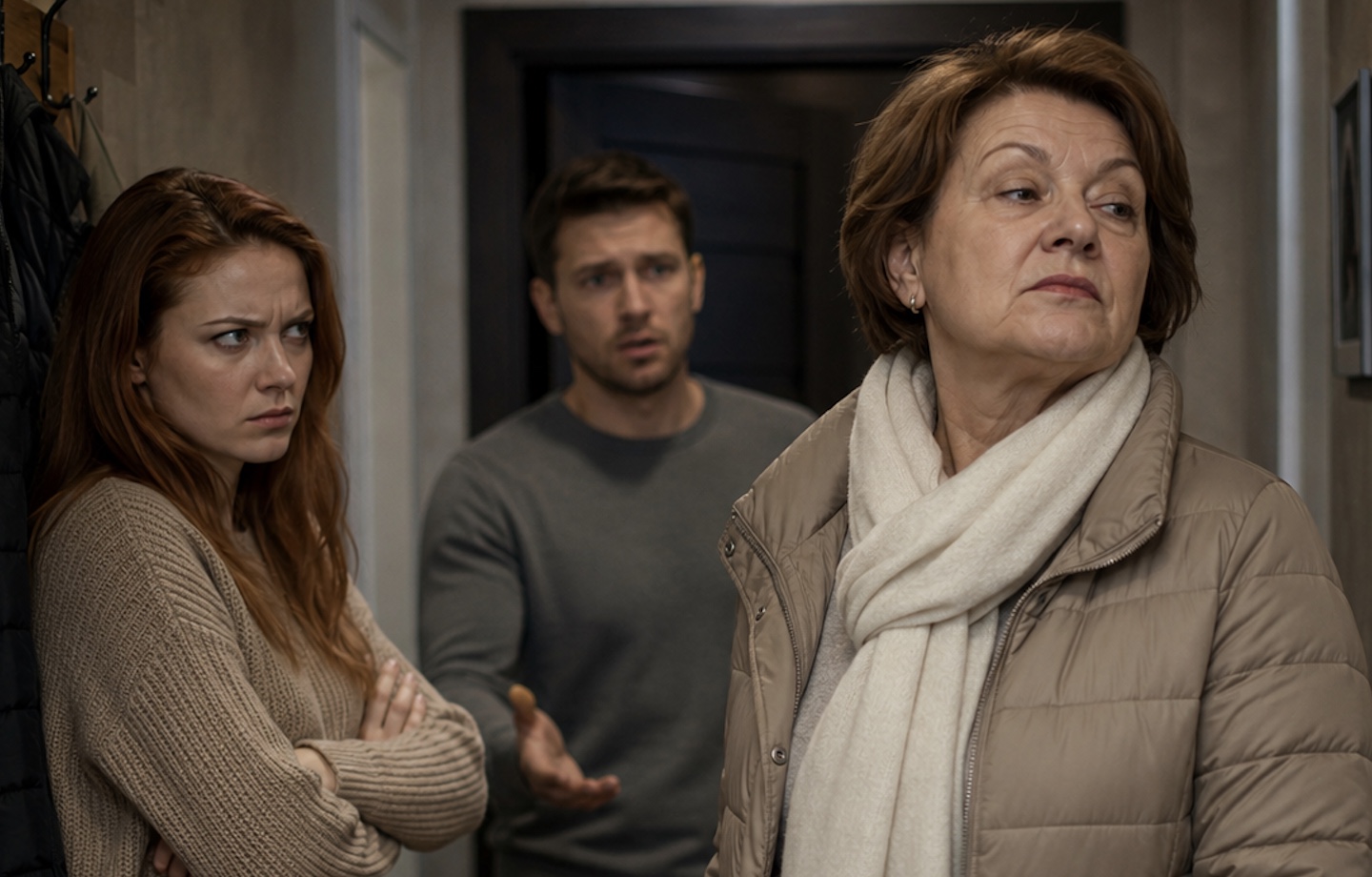
“I didn’t come here to live with you. I came to live with my son, so keep quiet,” the mother-in-law announced to her daughter-in-law, dragging her suitcase into the hallway.
The wheels of the old, overstuffed bag left a dirty streak across the pale porcelain tiles. Galina Ivanovna, a heavyset woman with lips permanently pressed into a line of disapproval, planted her luggage right in the middle of the entrance hall, blocking the way to the wardrobe. She did not even look at the woman who owned the home, as if Dana were just another piece of furniture — and not a particularly useful one.
Dana froze with her keys still in her hand. It had been an exhausting day: handing over a project in a new residential complex, dealing with two stalled elevators in a business center, and surviving difficult negotiations with winch suppliers. All she wanted was silence, a hot shower, and perhaps a glass of wine — not an invasion by barbarians.
“Does Roman know?” she asked, trying to keep her voice even, though a hot, heavy knot was already forming in her chest.
“Roma is the head of the family. He made the decision,” her mother-in-law snapped, unzipping her puffer coat. “And you, dear, would do better to put the kettle on. His mother has come from the road.”
Roman himself appeared from the kitchen. In a stretched-out house T-shirt, a sandwich in his hand, he looked strangely pleased with himself. Lately, her husband had spent most of his time in gloomy silence, complaining about the injustice of the world, his bosses, and clients who failed to appreciate his plumbing talents. But now he was glowing as if he had won the lottery.
“Oh, Dasha, Mom will stay with us for a while. She’ll rent out her apartment, the money won’t hurt us, and it’ll be more fun this way,” he mumbled with his mouth full. “We can’t carry the mortgage alone forever.”
Dana slowly placed her keys on the console table. They were not carrying the mortgage together. She was carrying it. Lift-Montazh, the company Dana had built from nothing, learning the trade the hard way and hauling heavy equipment alongside men at the beginning of her career, brought in the main income. Roman’s salary from the construction firm went toward his own whims, the upkeep of his old SUV, and endless “projects” that never took off.
“More fun?” she repeated, looking straight into his eyes. “You didn’t discuss this with me. This is my home too.”
“Oh, here we go!” Galina Ivanovna threw up her hands. “I told you, son. She doesn’t respect you at all. Are you the man of the house or not? If you said your mother is staying, then she is staying. And this one can get used to it. A woman’s duty is to accept.”
Roman straightened, his nostrils flaring. He liked this support. For the first time in a long while, he felt power behind him.
“Mom is right, Dana. You’re always unhappy with everything. I’m tired of your pressure. Mom is staying here, and that’s final. Besides, we need to move the furniture in your office. That will be her bedroom.”
Her office. Her workspace. The place where her drawings, control station diagrams, and contracts were kept. Dana felt reality tilt slightly. This was not merely rudeness. It was a revolt. A planned, shameless rebellion by a failure who had decided to assert himself through the number of allies per square meter.
“No one will be sleeping in my office,” Dana said. She did not raise her voice, but there was something in her tone that usually made employees reach for a hard hat and hide in an elevator shaft. “Galina Ivanovna, you have your own apartment. We’ll have dinner, call a taxi, and you’ll go home.”
“Did you hear that?” her mother-in-law shrieked, turning to her son. “She’s throwing me out of my own son’s home!”
Roman stepped forward, trying to loom over his wife.
“No. She stays. And if you don’t like it, you can sleep on the sofa in the living room. The office is Mom’s room now. I decided.”
Dana looked at her husband. There was no love in his eyes. No partnership. Only the vindictive triumph of a weak man who had finally found a way to bite someone stronger than himself.
Part 2. The Coalition of the Offended
The next three days became hell. Galina Ivanovna did not simply occupy the office — she began methodically reshaping the household according to her own standards, which smelled of mothballs and cheap fried onions. Dana’s drawings were shoved into a pile as “waste paper,” and the expensive groceries disappeared from the fridge, replaced by pots of greasy soup.
But the worst part was not happening at home. Roman, having tasted power, began gathering a support group around himself.
On Saturday, Dana returned from an emergency call and found a full headquarters assembled in her living room. Roman sat at the table with his mother, his older brother Viktor, and Viktor’s wife, Lena. The table was loaded with food and alcohol — bought, no doubt, with the credit card linked to Dana’s account.
Viktor was a copy of Roman, only a more worn-out version. A lifelong schemer who had gone bankrupt selling Chinese watches and now worked as a taxi driver, he always looked at Dana with a sticky mixture of envy and contempt.
“Oh, the breadwinner has arrived!” Viktor laughed, raising his shot glass. “We were just discussing how you’ve completely crushed Romka under your heel. Good thing his mother came. She’ll restore order.”
“Sit down, Dana,” Roman said lazily. “We need to talk. Vitya has a point. I’ve been thinking… Your company. You spend too much time there. I believe it’s time for me to join as a co-founder. I’ll help out, oversee the finances. Then you can focus more on the home, and we can finally have a child.”
Lena, a thin woman with sharp, grasping eyes, nodded along while spreading caviar — the caviar Dana had bought as a New Year’s gift for business partners — onto a thick slice of bread.
“That’s right, Romochka. A man should run business matters. A woman with money is like a monkey with a grenade. With Vitya and me, everything is harmonious because he is in charge.”
Dana looked around at this grotesque gathering. They were sitting in her home, drinking her wine, eating her food, and dividing up her business. Roman lounged in his chair, drunk on the support of his clan. He believed what he was saying. He genuinely thought his failures were the result of Dana “pressuring” him with her success, not his own laziness and lack of initiative.
“You want to become a co-founder?” Dana asked, still wearing her coat. “You? The man who can’t tell debit from credit and forgets to pay traffic fines?”
“Don’t act clever!” Galina Ivanovna barked. “Roma has golden hands and a bright mind! You simply never let him develop! You’ve worn the man down!”
“We’re family, Dana,” Viktor added with a predatory smile. “And family should share. You have plenty. Romka has little. That isn’t fair. So we’ve decided to help my brother restore justice.”
“Yes,” Roman nodded. “And I’ll be taking your car more often too. My jeep is in the shop, and I need to match the status of a future co-owner.”
A ring of greed was tightening around Dana. They did not merely want money. They wanted to destroy her self-worth so they would no longer feel small in comparison. It was a revolt of mediocrity.
Part 3. The Mechanics of Pressure
On Monday, Dana found out that Roman had tried to enter her office. The security guard had refused him because Dana had wisely canceled his pass a month earlier after one of his drunken outbursts. But the fact itself was enough. He had called the accountant, introduced himself as the director, and demanded that funds be transferred to some “reserve account.”
At home, the situation grew worse. Uncle Kolya, Galina Ivanovna’s brother, joined the coalition — a marginal type with philosophical views on other people’s property. Now there were always between three and five people in the apartment. They watched television, loudly discussed politics and Dana, smoked on the balcony, and flicked ash downward.
Dana tried to speak with Roman alone.
“Roma, wake up. They’re dragging you down. Can’t you see they’re just using us?”
“You’re the one using me!” he screamed back, spraying spit. “You humiliated me for years with your handouts! From now on, things will be my way! My family respects me! They see me as a leader!”
He truly believed it. The court played at serving the king, as long as the king paid for the feast with the queen’s card.
The final straw was a call from the bank. Dana learned that Roman had tried to take out a loan using her country house as collateral by forging a power of attorney. Fortunately, the notary had doubts and called the owner.
“This is already criminal, Roma,” she told him that evening.
“You wouldn’t dare report your own husband!” Viktor laughed from the sofa. “Family is untouchable! Besides, the country house is shared.”
“The country house was bought before the marriage,” Dana reminded him.
“We’ll sue!” Lena declared. “We know a lawyer. He said if we can prove Roma invested his soul into it…”
They had surrounded her from every side. There were five battlefields in their war: the apartment, the country house, the office, the garage — where they had stored Dana’s “unnecessary” belongings after removing them from the house — and even her phone, which kept buzzing with threats and demands to “respect her husband.”
They expected her to break. They expected her, as a well-bred victim, to cry, beg, negotiate. They expected her to buy peace with concessions.
Part 4. Critical Overload
Dana came home earlier than usual. The hallway was thick with the smell of alcohol fumes and cheap perfume. The entire company was there: Galina Ivanovna, Viktor, Lena, Uncle Kolya, and, of course, Roman. They were celebrating something. Shards of her favorite vase lay scattered on the floor.
Roman stood up, swaying slightly.
“Ah, there she is. We’ve decided… We need a second car. It’s inconvenient for Lena to ride the bus. You’ll buy one. Register it in Mom’s name.”
Something clicked inside Dana. Not broke — no. A fuse switched, changing the mode from “diplomacy” to “annihilation.” All her life she had been taught to be restrained. Be smarter. Stay silent. But now a pack of jackals sat before her, convinced that the lion was dead.
She began to laugh. Loudly. Terribly. Hysterically. The laughter turned into a shriek that made the dishes in the cabinet tremble.
“A CAR?” she screamed so loudly that Uncle Kolya dropped his fork. “FOR YOU, YOU PARASITE?”
Dana grabbed a dish of salad from the table and smashed it against the floor. Mayonnaise splattered across Viktor’s trousers.
“DID YOU THINK I WOULD KEEP ENDURING THIS?” she roared. She was not speaking anymore. She was expelling fury. This was not quiet resentment. This was a hurricane. “I WORKED MYSELF TO THE BONE FOR TEN YEARS, NOT TO FEED A HERD OF FAILURES!”
Roman turned pale. He had expected tears. He had expected, “Roma, let’s talk.” He had not expected her to grab his expensive fishing rod from the corner and snap it over her knee with a crack.
“MY HOUSE! MY MONEY! MY RULES!” Dana hurled the broken pieces at her husband’s face. “YOU THOUGHT YOU WERE A MAN? YOU ARE NOTHING BUT A WRETCH HIDING BEHIND YOUR MOTHER’S SKIRT!”
“Dana, calm down…” Viktor muttered, backing away.
“SHUT UP!” Dana lunged toward him, staring into his eyes with the fury of a chained dog gone wild. “YOU ENVIOUS MOTH! GET OUT! ALL OF YOU, GET OUT! RIGHT NOW!”
“You’re having a breakdown. You need treatment,” Galina Ivanovna tried to say, but her voice trembled.
“I’M HAVING A PURGE!” Dana rushed to the coat rack, grabbed the guests’ jackets, and began throwing them out onto the stairwell. “I’M GIVING YOU ONE MINUTE, OR I’LL LOCK THE DOOR AND CALL AN AMBULANCE TEAM. I’LL SCRATCH UP MY OWN FACE AND SAY YOU ATTACKED ME! YOU KNOW ME — I’M CRAZY!”
She grabbed a heavy bronze figurine. There was such a cold, calculating fire of madness in her eyes that the entire entourage became genuinely frightened. They understood: she was not joking. She had crossed the line.
Roman stood helplessly. His “coalition” was falling apart before his eyes. Viktor and Lena, clutching their jackets, were already scurrying toward the exit. Uncle Kolya was edging sideways toward the door.
“Roma, do something!” his mother shrieked.
“I WILL DO SOMETHING!” Dana spun toward her husband. “TODAY I’M BLOCKING EVERY CARD. I’M CANCELING EVERY POWER OF ATTORNEY. I’M CHANGING THE LOCKS IN AN HOUR. GET OUT WITH THEM!”
“Where?” Roman asked, confused. “This is my home too…”
“THIS IS MY APARTMENT, BOUGHT BEFORE THE MARRIAGE. YOU ARE NOTHING HERE. YOU’RE NOT EVEN REGISTERED!” she shouted the truth he preferred to forget. “GO TO YOUR MOTHER! YOU LOVE YOUR MOTHER SO MUCH, DON’T YOU? THEN LIVE WITH HER IN HER ONE-ROOM FLAT! ALL FIVE OF YOU!”
She advanced on him like a paving machine. Dana’s rage was terrifying because it was practical. These were not just emotions. This was the force of destruction aimed directly at dead weight.
Roman’s family, realizing that the feeding trough was not merely closing but might slam shut on their fingers, retreated. Roman, looking back over his shoulder, trudged after them.
“The suitcase!” Dana shouted after them.
Then she kicked her mother-in-law’s bag with all her strength. It flew out onto the landing and knocked Lena off her feet as she hesitated in the doorway.
The door slammed shut. The lock clicked.
Part 5. The Balance of Power
Two weeks passed.
Roman sat in his mother’s kitchen. The cramped Khrushchev-era apartment smelled of old medicine and hopelessness. The atmosphere of victorious heroism had evaporated on the very first evening.
The coalition collapsed instantly once it became clear there would be no more of Dana’s money. Viktor suddenly remembered that Roman owed him three thousand and stopped talking to him. Lena declared that “you can’t build a life with an idiot like that” and forbade him from coming to their place. Uncle Kolya simply vanished.
Only Galina Ivanovna remained, and now she nagged her son around the clock.
“You fool! You lost a woman like that!” she wailed, stirring watery porridge. “I told you we had to be smarter! But no, you had to charge ahead like an idiot! Now sit here on my neck! And utility bills keep going up!”
Roman shrank into himself. He had tried to return. He called Dana. He came to the building and stood outside her door. But the entrance codes had been changed. The concierge, whom Dana had paid well and briefly explained the situation to — without unnecessary details, simply saying “my ex-husband is aggressive” — would not let him in. The cards were blocked. Dana retrieved the car with the spare keys from the parking lot where Roman had abandoned it.
He was ruined. But the worst part was realizing that he had not been fighting Dana. He had been fighting his own comfort, his own stability, his own good life. And he had lost everything because he believed flatterers who only needed him as a key to someone else’s safe.
Dana stood by the panoramic window in her office. Her phone chimed. A message from “Roman” appeared:
“Dashul, maybe we can talk? Mom is eating me alive. I can’t live like this. I understand everything now. I was wrong. I love you.”
Dana smirked. There was no pain. Only a vast, ringing sense of relief. As if a ton of garbage had been pulled out of an elevator shaft, and now the cabin could rise freely again.
She typed a short reply:
“NO.”
Then she blocked the number.
After that, she turned to her new chief engineer, a young, capable man who was waiting for instructions.
“We continue,” she said calmly. “We have a new project. The old trash has been taken to the dump.”
She felt magnificent. The anger she had unleashed that night had burned every bridge by which parasites could ever crawl back into her life. And on the ashes, the first shoots of a new life — entirely her own — were already beginning to grow.