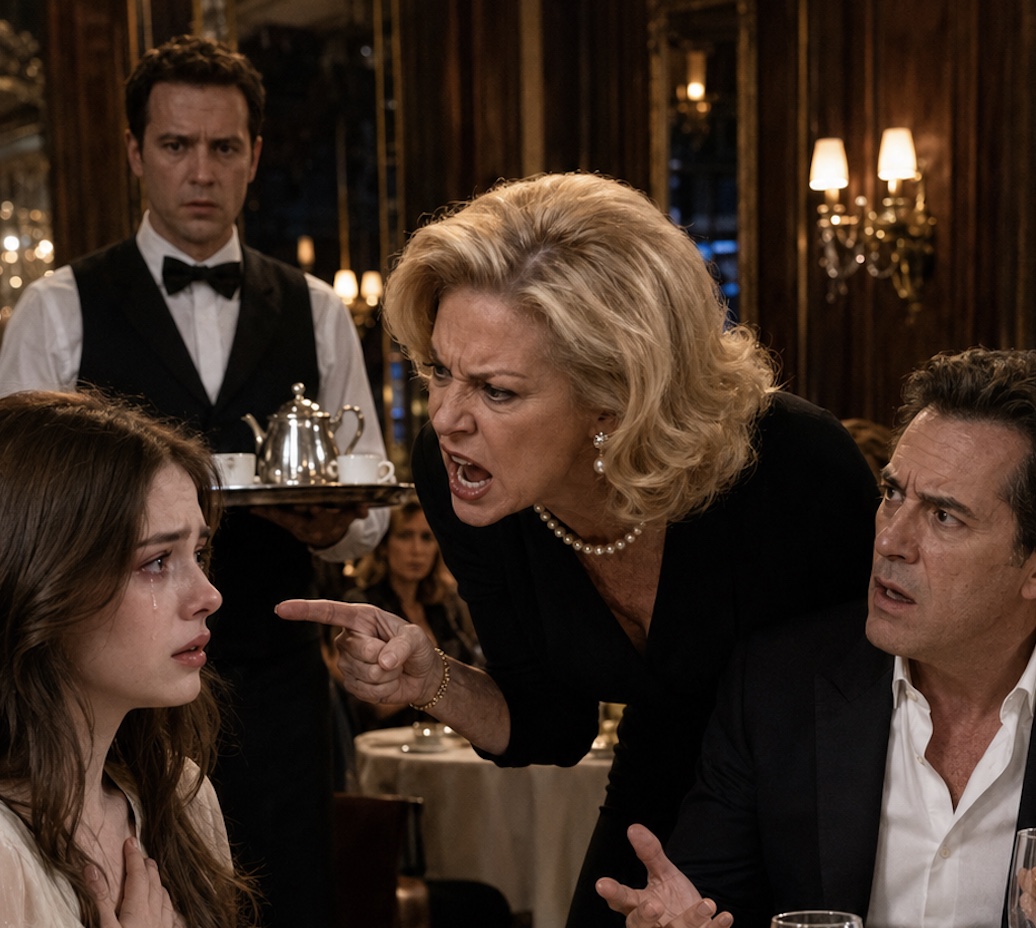
“You’re a broke nobody from the provinces! You arrived here with one suitcase, and you’ll leave with that same suitcase!” Inga Petrovna’s face, usually so polished and arrogant, was now twisted with open rage.
Her fingers, tipped with an expensive salon manicure, dug into my wrist so hard that white marks instantly appeared on my skin. The cup of cold cappuccino on the edge of the table trembled dangerously.
“You live in my son’s apartment! You eat at our expense! You will sell that shabby little place in Saint Petersburg and buy me a house by the sea. That is a family duty to the older generation! Otherwise, I’ll make sure Artem throws you out onto the street, right back to the gutter you crawled out of!”
People at the nearby tables in the cozy café began turning around. A waitress froze with a tray in her hands. And I looked at the woman I had spent ten years trying to call “Mother,” feeling the last thread of my patience snap inside me. Ten years of humiliation, swallowed insults, and desperate attempts to prove I was worthy of their family burned away in a single second.
But to understand how we reached that point of no return, we need to go back a little.
I am thirty-eight years old. I am an ordinary treatment-room nurse from Tula. Ten years ago, I married Artem, a promising civil engineer. I loved him madly. I believed we could move mountains together, build a strong family, and raise children. But along with the man I loved came her — Inga Petrovna.
My mother-in-law had always considered herself a woman of high society, even though she had spent her entire life working as an accountant at an average company. She wore silk scarves, drank coffee only from porcelain cups, and spoke to me in the tone of a noblewoman scolding a careless servant.
My greatest sin in Inga Petrovna’s eyes was that I had nothing to my name except a nursing school diploma and an elderly mother living in a tiny settlement near Tula. Artem, on the other hand, had brought me into his spacious two-room apartment — or more precisely, the apartment Inga Petrovna had once bought for him after selling her dacha and adding her savings.
“Rita dear, you should be more careful with the stove. That appliance costs more than you earn in six months at your clinic,” my mother-in-law would say with a sweet smile, running one finger across the countertop in search of dust.
“Margaret, I hope you understand that you have no right to register anyone in this apartment. Even if you have children, we will still have to see how the documents are arranged. Property is a serious matter, and there are plenty of outsiders these days eager to get their hands on someone else’s assets,” she announced once during a family dinner.
And what about Artem? My husband was not a bad man. But he was the typical son of a domineering mother. He preferred not to notice her little stabs.
“Rita, why do you let yourself get so upset? Mom is from the old school. She has her odd ways. Don’t pay attention. She doesn’t mean any harm,” he would sigh, staring into his phone while I washed the dishes after yet another visit from his mother, choking back tears.
I endured it. I worked one and a half shifts, took night duty, and made sure I never had to ask my husband for a single kopeck for my own needs. I paid my own expenses, bought groceries for the household, and tried to create warmth in an apartment where I was constantly reminded that I was no one. A guest without rights. A tenant tolerated out of mercy.
The thought of having my own home was my secret, painful dream. I tried to save tiny amounts from my nurse’s salary, but inflation devoured those tears faster than I could collect them. Any thought of a mortgage was cut down immediately by my mother-in-law.
“Why should Artem get himself into debt? He already has a home! And if you need something, go and work harder.”
That was how my life might have passed — in an endless feeling of inferiority — if not for the phone call that changed everything.
Lidia Andreevna was my second aunt. She was an extraordinary woman, a translator who had lived in Europe for many years before returning to Russia in her old age and settling in Saint Petersburg. The rest of the family did not like her much. They thought she was arrogant. But I liked her.
I often called her for no special reason. I asked about her health, told her about my hospital shifts, and listened to stories from her youth. I expected nothing from her. I simply felt sorry for a lonely elderly woman whom no one visited. When she fell ill, I took unpaid leave and went to Saint Petersburg to care for her. For three weeks, I gave her IV drips, cooked broth, and read books aloud to her.
Six months later, Lidia Andreevna passed away.
When the notary called and told me that my aunt had left me all her property, including a luxurious two-room apartment in the historic center of Saint Petersburg and a substantial bank account, I could not believe it at first. I cried from the pain of losing her and from the shock. Overnight, I — the “poor little nobody” from Tula — became the owner of real estate worth tens of millions of rubles.
And that was when things became truly interesting.
As soon as the news of my inheritance reached Inga Petrovna, it was as if someone had replaced her. The woman who had spent ten years almost disgusted to drink tea from a mug I had washed suddenly turned into the most loving mother in the world.
“Rita darling, my dear girl! You’ve lost so much weight with all those shifts of yours!” she cooed, appearing at our doorstep with homemade pies. “I baked these for you. Cabbage filling, just the way you like. You need to rest, sweetheart!”
She began calling me every day. She asked how I had slept and whether my head hurt. She insisted on going shopping together. At first it frightened me. Then it made me suspicious. But somewhere deep inside me, in that part starved for motherly warmth, a foolish hope began to flicker. Maybe she had finally accepted me. Maybe she had realized I was not hunting for her son’s square meters after all.
How wrong I was.
The truth came out two months after I officially received the inheritance. Inga Petrovna insisted on inviting me for coffee at an expensive restaurant in the city center.
“Rita dear, we need to have a little woman-to-woman chat,” she chirped over the phone.
I agreed. Artem was supposed to pick me up after work that day, and we arranged for him to come get me directly from the café.
My mother-in-law greeted me in full parade. She ordered expensive desserts, sighed for a long time about her health, and complained about her blood pressure and aching joints.
“You see, Rita dear, the climate here is hard on me. The doctors all say the same thing: I need sea air. Otherwise, I won’t last long,” she said, dabbing at dry eyes with a napkin. “I gave my whole life to this family. I raised Tyomushka all alone. And now, in my old age, I dream of a small house in Gelendzhik. A little garden. A place where you and Tyoma could come in the summer, bring the children…”
“That’s a beautiful dream, Inga Petrovna,” I said carefully, feeling an unpleasant chill forming inside me. “Maybe you could sell your dacha? Artem could take out a small loan and add to it…”
“Why loans?” my mother-in-law threw up her hands, and her face suddenly became hard and businesslike. “We now have an apartment in Saint Petersburg! What do we need it for? Renting it out is nothing but trouble. Tenants will destroy everything. It should be sold now, while the prices are good! There will be enough money for an excellent house by the sea for me, and there will still be something left for you and Tyoma to buy a new car.”
I went still. The air suddenly disappeared from my lungs.
“You are suggesting that I sell the apartment my aunt left me so I can buy you a house?” I asked quietly.
“Of course! We’re family!” Inga Petrovna smiled as if we were discussing the purchase of a kilo of potatoes. “We’ll register the house in my name to pay less tax. I’m a pensioner, after all. And by inheritance, it will all go to Tyoma anyway. You’re a smart girl. You should understand that money must work for the family!”
“No,” I said firmly and clearly. “That apartment is a memory of Lidia Andreevna. I am not going to sell it. Especially not to buy property in your name.”
The smile slid off my mother-in-law’s face so quickly it was as if acid had washed it away. Her eyes narrowed into two sharp slits.
“What did you say?” she hissed.
“I said no. I’ll rent it out. It will be my financial safety cushion. Just in case I’m ever reminded again that I live here on sufferance.”
That was when the dam burst. Ten years of carefully hidden hatred came pouring out. Inga Petrovna lunged forward, knocking over the cup. Coffee spread across the snow-white tablecloth, but she did not even notice.
“You ungrateful little trash!” she hissed loudly enough for the whole room to hear. “A safety cushion, is that what you need? You’ve been eating from my pot for ten years! You sleep on sheets I bought! You haven’t put a single kopeck into this home, you beggar!”
She grabbed my arm, her nails digging painfully into my skin.
“You live in my son’s apartment out of mercy! Sign over the inheritance, or tomorrow you’ll be out on the street! I’ll do everything to make Artem throw you out like a mangy cat! You are nobody, do you hear me? Nobody! Your place is in the gutter!”
I sat there, frozen by the stream of filth pouring over me. I tried to pull my hand free, but the old woman had locked onto me with a dead grip. People around us began whispering. Someone took out a phone.
“Let go of me! Are you out of your mind?” I cried, feeling tears of humiliation and fury roll down my cheeks.
“Mother. Let go of her hand. Right now.”
The voice cracked through the air like a whip. We both flinched and turned our heads. Artem was standing beside our table, pale as a sheet. He had arrived earlier than promised, and judging by his eyes, he had heard enough.
“Tyomushka!” Inga Petrovna instantly released my hand and theatrically pressed her palms to her chest. “Son, you misunderstood everything! This rude woman was insulting me! She shouted at me and nearly gave me tachycardia! I only wanted to talk about our future, and she…”
“Stop lying, Mother,” Artem said. His voice trembled, but there was steel in it — a kind I had never heard before. He stepped toward me, gently placed a hand on my shoulder, and stood between me and his mother, shielding me with his body. “I heard everything. Every word.”
“Son…” my mother-in-law blinked in confusion.
“Do you think I’m an idiot?” Artem leaned closer to her. “Do you think I don’t know you’ve been calling me every day for the past two weeks, demanding that I force Rita to sell the apartment? That you’ve been filling my head with stories about her ‘greed’ and ‘scheming plans’? I told you to drop the subject. I begged you not to get involved. It is her inheritance. Her money. But you would not calm down. You decided to pressure her in person.”
“I’m doing this for you! For the family!” Inga Petrovna shrieked, her face turning blotchy red. “She’ll leave you as soon as she feels the money in her hands! You warmed a snake at your chest! I am your mother! I gave my whole life for you!”
“You gave your life to controlling everything,” my husband cut her off sharply. “For ten years, you humiliated my wife behind my back, and I, like a coward, looked away, hoping the two of you would somehow get along. I will not allow it anymore.”
Artem took several bills from his wallet and threw them onto the coffee-stained table.
“Rita is not going anywhere. This is my home, and she is my wife. But you are no longer welcome in our home. Do not call us. Until you learn to respect my family, I don’t want to know you. Come on, Rita.”
He took my hand — the same hand still marked red from his mother’s nails — and led me toward the exit. Out of the corner of my eye, I saw Inga Petrovna sink heavily into her chair, gasping for air. For the first time in her life, her manipulations, threats, and hysterics had not worked. For the first time, her son had chosen someone other than her.
We stepped outside. A light rain was falling, but it felt to me as if I were breathing the cleanest air on earth. Artem wrapped his arms around me and held me so tightly it was as though he was afraid I might disappear.
“Forgive me,” he whispered into my hair. “Forgive me for being a blind idiot. No one will ever dare call you nobody in our home again. I promise.”
Six months have passed since then. Our life has changed completely.
We did what I had always dreamed of doing — we rented out the Saint Petersburg apartment on a long-term lease. The income turned out to be substantial. I was finally able to leave my exhausting night shifts and move to a comfortable schedule at a private clinic. I had time for myself, for my husband, and for simple human happiness. I even took my first trip abroad. Artem and I spent two weeks in Turkey, and it was the best vacation of my life.
As for Inga Petrovna, she tried to break through our defenses. She called from other numbers, faked heart attacks — the ambulance Artem called found nothing wrong — and complained to every relative about the “snake” her son had taken in. But Artem kept his word. He blocked her everywhere. He said he needed time before he could forgive her for the way she had treated me all those years.
Recently, we began renovating our apartment. Completely, from scratch. And when the workers stripped away the old wallpaper that my mother-in-law had once chosen, I stood in the middle of the living room and smiled.
I am no longer a “tenant.” I am no longer a “poor nobody.”
I am the owner of my own life.
And sometimes, to understand that, all it takes is one scandal, one overturned cup of coffee, and the courage to finally say, “No.”