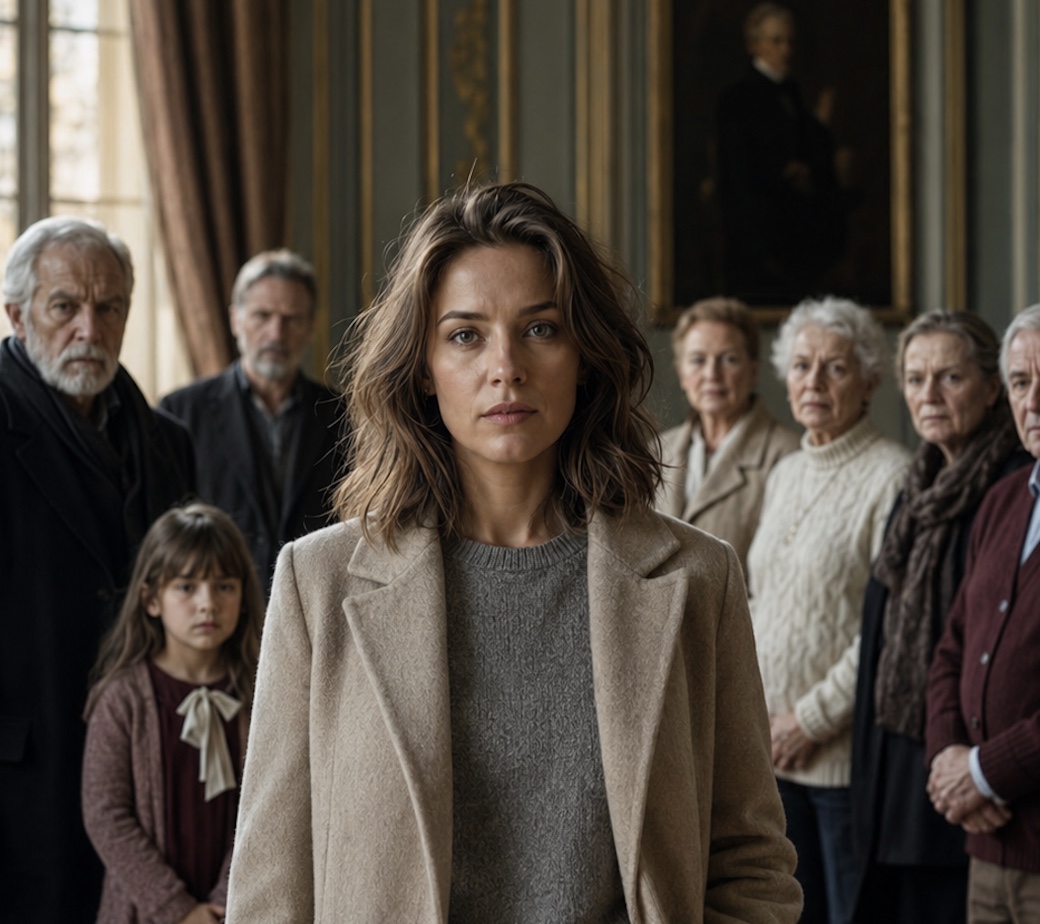
Marina was setting the plates on the table, counting them out loud.
Eight.
Exactly eight — not one extra, not one accidental place setting. Each plate belonged to someone she was truly happy to see, someone she wanted beside her that evening.
“Dasha, sweetheart, take the napkins to the table, please,” she asked her daughter, who was spinning around nearby. “The ones with the golden stars. You chose them yourself, remember?”
“Mom, will Aunt Tanya bring me modeling clay? She promised.”
“She will. Aunt Tanya keeps her promises.”
Artyom came in carrying grocery bags. He held the cake box carefully against his chest, as if it were a fragile vase. He placed the mandarins and grapes into a large dish, and Marina set it in the center of the table.
“Everything the way you wanted,” he said, taking off his jacket. “Raspberry cheesecake. Candles included.”
“Thank you, Artyom.”
“Don’t thank me. It’s your day.”
Marina looked at him with warm gratitude. He had understood everything without long explanations, without persuasion. When she told him she wanted a quiet celebration with only her own people, he simply nodded and asked no unnecessary questions.
“You’re sure you told Natasha about the countryside trip?” she asked quietly, once Dasha had run off to her room.
“I did. I wrote to Mom that on the thirteenth we were leaving to visit friends outside the city and coming back on the fifteenth. She replied, ‘All right.’ Everything was calm.”
“Don’t you feel guilty?”
“I’d feel guilty if I let them ruin your birthday,” Artyom replied, straightening the tablecloth that had slipped slightly. “Over the past year, they’ve shown up at our place without an invitation about twelve times. Twelve times, Marina. I counted.”
“I counted too.”
She went back into the kitchen, where the shangi were cooling. For her father, she had made them with potatoes, exactly the way he liked. She had found her grandmother’s recipe especially for the occasion and read it three times. The dough had turned out soft. Proper.
The roast breathed heat from the oven. Olivier salad was already in the refrigerator, beside the layered herring salad and thin slices of salmon. Marina wanted the table to be generous, but not excessive. Every dish had to belong there.
“Artyom, help me move the armchair. We need one more seat for Irina.”
“Already on it.”
They moved the furniture together, easily and without fuss. Dasha was taping a garland of paper flags to the wall. She had cut them out herself a week earlier and colored them with markers. The letters were crooked, but readable: “Happy Birthday, Mommy!”
“See that?” Artyom nodded toward the garland. “She wrote ‘mommy’ with two m’s.”
“I see,” Marina smiled. “It’s the best gift.”
The phone rang. It was Tatyana.
“Marinka, we’re on our way! Mom and Dad are with me. Can you imagine? Dad put on his new jacket. He’s been saving it for two years.”
“For my birthday, that’s perfect.”
“Will Irina be there?”
“She will. She already called. She’s coming from the metro.”
“Listen, Roman sends you a huge hello. He sent you flowers by delivery. He said to expect the courier around seven.”
“Tell him I adore him.”
Marina hung up and looked at the table. Everything was even, symmetrical, thought through. Wine glasses, shot glasses for her father, juice for Dasha. Candles too — not church candles and not leftover New Year’s candles, but low ones in glass holders. Irina had brought them from a fair back in November.
January thirteenth.
Old New Year and her birthday at the same time. All her life, she had shared this day with the holiday, and all her life, her congratulations had drowned in the general noise.
Today she had decided: enough.
Her parents arrived first. Her father, Boris Mikhailovich, really was wearing his new jacket, standing straight-backed with a faint smile. Beside him walked Valentina Petrovna — small, neat, in a cornflower-blue wool dress.
“My daughter,” Valentina Petrovna said, embracing Marina at the door. “Happy birthday. You look beautiful.”
“Thank you, my dear.”
Boris Mikhailovich handed her a box wrapped in kraft paper.
“This is from us. Don’t open it now. Later.”
“All right, Dad.”
Tatyana came in after them — noisy, cheerful, carrying two bags.
“Dashka! Where’s my niece? I brought you modeling clay, but not ordinary clay — this one glows in the dark!”
Dasha dashed out of the room and threw herself onto her aunt. Tatyana scooped her up and spun her around. Artyom helped carry the bags, shook Boris Mikhailovich’s hand, and gently hugged Valentina Petrovna.
“Artyom, you’ve lost weight,” Boris Mikhailovich remarked.
“It’s the jacket, Boris Mikhailovich. It makes me look slimmer.”
“Ah. Then I need one like that too.”
Everyone laughed.
Irina arrived ten minutes later, breathless, with a large bag and a bouquet of white roses.
“I’m late. I’m sorry. The bus left right in front of me, so I had to run.”
“You’re right on time,” Marina said, hugging her friend. “We haven’t even sat down yet.”
“Marina, you look incredible. Where is that dress from?”
“Artyom gave it to me.”
“Artyom, you have taste.”
“I know,” he answered without a trace of boasting, and Irina snorted.
The table was full. Salads, the hot dish, shangi, sliced meats and fish. The glasses were waiting. Boris Mikhailovich took the seat at the head of the table, with Valentina Petrovna beside him. Tatyana sat across from Irina. Dasha sat between her parents.
Everything was in place.
Everyone was where they belonged.
“Well then, shall we raise a glass?” Boris Mikhailovich stood with his glass in hand. “To my eldest daughter. To Marina. You are the best thing we ever managed to create.”
“Dad!”
“Don’t interrupt. To you, Marina. Health, peace, and joy in this home. May those who love you always be near. And those who don’t — may they stay far away.”
Glasses clinked. Marina took a sip of wine and looked at each of them in turn. Her father, Valentina Petrovna, Tatyana, Irina, Artyom, Dasha.
Six faces.
All hers.
All warm.
“Tanya, try the shangi,” Valentina Petrovna said. “Marinka made them from Grandma’s recipe.”
“I’m already trying one. Mom, is this really Grandma’s? Even the shape is the same.”
“I sifted the flour three times,” Marina smiled. “I almost cried because Grandma wrote ‘by eye,’ and I spent half an hour guessing the proportions.”
“They came out perfect,” Artyom said, biting into one. “Honestly.”
Irina helped herself to salmon and salad.
“You know,” she said thoughtfully, “I haven’t felt this good at a table in a long time. Quiet, peaceful, no scandals.”
Tatyana glanced at her sister. Marina gave a barely noticeable nod.
“That’s what we wanted too,” she said. “Quiet.”
Dasha chatted with her grandfather about how the modeling clay glowed in the dark. Boris Mikhailovich listened seriously, nodded, and asked clarifying questions as though they were discussing something of extraordinary importance.
It was quarter to eight. Marina thought: here it is. This is the evening I was waiting for. No nerves, no glancing at the door, no counting extra plates just in case someone showed up uninvited.
Then the doorbell rang.
“That must be the flowers from Roman,” Tatyana said. “He promised they’d arrive around seven.”
Artyom stood up.
“I’ll get it.”
He opened the door and took one step back.
On the threshold stood Galina Sergeyevna, his mother, wearing a long coat and an expression that promised nothing good. Behind her stood his father, Viktor Nikolayevich — heavyset, silent, holding a bag. Further back was Natasha with her two daughters: Liza holding Sonya’s hand, both girls in unbuttoned coats.
“You?” Artyom breathed.
“Who were you expecting?” Galina Sergeyevna stepped forward without waiting to be invited. “Why didn’t your wife invite us to the celebration? Has she lost her mind or something?”
She quickly entered the hallway, took off her coat, and hung it on a hook. Viktor Nikolayevich followed after her, not even nodding to his son.
“Mom, wait,” Artyom tried to stand between her and the living room. “Wait. I wrote that we had left.”
“Left?” Galina Sergeyevna smirked. “Your car is parked outside the building. Do you think I’m blind?”
“Natasha called me,” she added, not lowering her voice. “She said she saw the lights on in your windows. So we decided to check. And what do we see? A table set, guests sitting, and us left outside?”
Natasha squeezed past her brother, pulling off her hat. Liza and Sonya had already run down the hallway — the thudding of small feet, the squeals.
“Tyom, why are you standing there?” Natasha tossed the girls’ coats onto the cabinet. “Let us in. The kids are hungry.”
“Natasha, I didn’t invite you.”
“I don’t need an invitation. I’m your sister.”
Marina came out into the hallway. She saw everything: her mother-in-law already heading toward the table, Viktor Nikolayevich, Natasha. Something inside her turned cold.
“Good evening,” she said evenly.
“Ah, the birthday girl,” Viktor Nikolayevich said, looking her over from head to toe. “All dressed up. Such a bright dress. Who is all this for?”
Marina did not answer. She looked at Artyom. He stood pale, his jaw tense.
Galina Sergeyevna had already entered the living room. She saw the table, the guests, paused for a second — then immediately sat down on a free chair standing by the wall.
“So. Why are there only eight plates? There are three adults and two children with us. Where are our places?”
Boris Mikhailovich slowly put down his fork. Valentina Petrovna looked at the table. Tatyana went pale. Irina pushed her glass away and folded her hands in her lap.
“Galina Sergeyevna,” Marina began, entering the room. “Today we are celebrating my birthday. In a small circle. I decided in advance whom I wanted to invite.”
“And so? Your husband’s mother isn’t part of that circle?”
“I didn’t invite you. That is true. It was my choice.”
“Her choice,” the mother-in-law repeated, turning to Viktor Nikolayevich. “Do you hear that? Her choice.”
Viktor Nikolayevich had already sat down at the table. Uninvited. He pulled the meat platter toward himself and began serving food onto Tatyana’s plate, the one beside him.
“That… that’s my plate,” Tatyana said quietly.
“Nothing wrong with sharing,” he replied, without looking up.
Liza and Sonya were already in Dasha’s room. A crash came from there — something had fallen from a shelf. Dasha ran into the living room with wide eyes.
“Mom, they took my paints and they’re drawing on the wallpaper!”
Natasha, who had already sat down and filled her plate with salad, waved her hand.
“The kids are playing. Stop making things up.”
“Natasha, they’re drawing on the wall,” Marina repeated.
“So what? It’s just a wall. You can paint over it.”
Marina looked at Artyom. He stood in the doorway. Silent. But she saw how his face was changing — from confusion to something hard, final.
Meanwhile, Galina Sergeyevna glanced at the Christmas tree in the corner.
“Artificial. Of course. Too cheap to buy a real one? Or is your Marina just that economical?”
“Galina Sergeyevna,” Boris Mikhailovich rose to his feet. “We are celebrating my daughter’s birthday here. You were not invited. Perhaps you should—”
“You keep quiet,” Viktor Nikolayevich interrupted, chewing. “You’re a guest here, just like us. It’s not for you to decide.”
Boris Mikhailovich flushed dark red, but held himself back. Valentina Petrovna touched his elbow. He sat down.
None of the uninvited guests congratulated Marina.
Not a single word.
No “happy birthday,” not even a nod.
They had come in, taken other people’s places, eaten other people’s food, and looked around as if they had every right to all of it.
Natasha reached toward the little table by the mirror. There stood a small box — Irina’s gift, perfume in a violet bottle. Natasha picked up the box, turned it around, sniffed it, and slipped it into the pocket of her cardigan. The movement was quick, familiar, practiced.
“Natasha,” Artyom’s voice sounded quiet but perfectly clear. “Put it back.”
“What?”
“The perfume. Put it back. The one you stole. Now.”
Natasha froze. Then she slowly took the box out and placed it back on the table.
“I was just looking.”
“You weren’t looking. You were hiding it. That is theft.”
Galina Sergeyevna turned to her son.
“Artyom, what do you think you’re doing? Accusing your sister in front of strangers?”
“They are not strangers. They are my wife’s guests. You are not guests.”
“What?!” Galina Sergeyevna half rose from her chair.
Artyom entered the room. He stopped by the table, placed both hands on the back of a chair, and looked at his mother. Then at his father. Then at his sister.
“Get up and leave.”
“You little brat,” Viktor Nikolayevich hissed, leaning back.
“Leave,” Artyom repeated in the same tone.
“You’re throwing us out? Your parents?” Galina Sergeyevna grabbed a napkin and threw it onto the table. “Because of her?”
“Because of myself. I am asking you for the third and final time: leave. Now.”
Silence.
Irina stared at Artyom without blinking. Tatyana pressed a hand to her mouth. Boris Mikhailovich sat motionless, only the muscles in his jaw moving.
“Natasha, dress the girls,” Artyom said without raising his voice.
“I’m not going anywhere,” Natasha snapped. “We just got here.”
“You were not invited. Dress the children, or I’ll drag them out by the collars.”
Natasha looked at her mother. Galina Sergeyevna was silent — she had not expected her son to stand firm. Usually, one “we’re family” was enough, and he would give in. But now there was no hesitation in his eyes. No guilt.
“Liza! Sonya!” Artyom called down the hallway. “Come here. Get dressed. You’re leaving.”
The girls ran out of the room — Sonya holding Dasha’s doll, Liza clutching a marker without its cap. Artyom gently took the doll and put the marker back on the shelf.
“Artyom, are you serious?” his father finally stood. “You’re throwing me out over a woman’s whims?”
“I am throwing out people who came without an invitation, failed to congratulate my wife, ate at her table, and insulted her in her own home. That is not a whim. That is a fact.”
His father wanted to say something, but Artyom was no longer listening. He went into the hallway, took the uninvited guests’ coats, and placed them on the cabinet.
“Get dressed. I’ll call a taxi.”
“We don’t need your taxi,” his mother hissed, pulling on her coat. “Remember this day. Remember it.”
“I will. It is my wife’s birthday, and I did everything I could to make sure it was not ruined.”
Natasha dressed her daughters in silence. Her lips were pressed tight, her eyes angry. She yanked Liza’s jacket closed and reached toward her cardigan on the hook.
Galina Sergeyevna left first. Then Viktor Nikolayevich. Natasha picked Sonya up in her arms and stepped toward the door.
“I forgot my cardigan,” she suddenly said, stopping.
“What cardigan?” Artyom looked at the cabinet. “You’re wearing it.”
“The other one. Gray. I left it on a chair in the living room.”
“Stay here. Don’t move. I’ll get it.”
Artyom returned to the living room. A gray cardigan lay on the chair. He picked it up — and a phone fell out of the pocket. The screen lit up. Artyom had not intended to read anything, but the message was already open, the letters large across the screen. He saw the sender’s name: “Mommy.”
The text read:
“Natashenka, take bigger bags. They’ll definitely have gifts there. Take whatever you like. They won’t make a scene in front of strangers. You can sell it later online. I’ll distract them.”
Artyom read the message again.
Slowly.
To the last period.
He carried the cardigan into the hallway. Natasha reached for it.
“Wait,” he said. “One second.”
He took out his own phone, photographed Natasha’s screen, and made sure the image was clear. Then he handed her the cardigan.
“What are you doing?” Natasha went pale. “That’s my phone. You have no right!”
“I didn’t open anything. It was already on the screen. An open message from your dear ‘Mommy.’”
From beyond the door came Galina Sergeyevna’s voice:
“Natasha, hurry up! What are you doing in there?”
“I’m coming,” Artyom answered for her. Then louder, he added, “Galina Sergeyevna, come back for a second. I want to show you something.”
His mother returned to the doorway.
“What now?”
Artyom showed her the photo on his screen. She looked at it for three seconds. Then her face turned to stone.
“This… this is taken out of context,” she began.
“‘Take bigger bags. Take whatever you like. Sell it online,’” Artyom read aloud. “What context could there possibly be?”
His father, who had been standing by the elevator, turned around.
“What message?”
“Your wife and daughter planned this visit in advance,” Artyom said, looking at his father. “This wasn’t ‘we just happened to stop by.’ It was an operation. With a specific goal: to rob us during the celebration. Here is the screenshot.”
His father came closer. He read it. Stood in silence for a moment. Then turned to Galina Sergeyevna.
“Gala,” he said quietly. “Is this true?”
“Vitya, I…”
“True or not?”
Galina Sergeyevna did not answer. Natasha stood there, holding Sonya against herself and staring at the floor. Liza picked at a button on her coat.
“We are leaving,” Viktor Nikolayevich said, taking Liza by the hand. “Natasha, follow me. Gala — follow me.”
“Vitya…”
“Be quiet.”
Artyom stood at the open door and watched them leave down the stairs. Viktor Nikolayevich went first, not looking back. Natasha followed him quickly and silently. Galina Sergeyevna came last, clutching her handbag to her stomach, hunched over, all her commanding tone suddenly gone.
He closed the door.
Turned the lock.
From the living room came Tatyana’s ringing, joyful voice:
“That’s it?! They left?! Marina, they’re gone!”
Irina jumped up and clapped her hands. Dasha laughed, not fully understanding why everyone was so happy, but catching the mood all the same.
“Daughter, are you all right?” Boris Mikhailovich asked, looking at Marina.
“I’m all right, Dad.”
Artyom entered the room. Marina went to him and hugged him tightly, silently, pressing her face into his shoulder. She stood like that for several seconds without saying a word. Then she lifted her head.
“Thank you,” she whispered. “Thank you.”
“There is nothing to thank me for. I did what I should have done long ago.”
“You did it today. That is enough.”
Valentina Petrovna came over to her son-in-law and touched his hand.
“Artyom, you did the right thing.”
“I know. Sit down, everyone. The cake hasn’t been touched, the fruit is still here, and we still have half the Olivier salad left.”
Tatyana was already rearranging plates. Irina was pouring wine. Boris Mikhailovich sat back down in his place, squared his shoulders, and raised his glass.
“I want to repeat my toast,” he said. “To my daughter. And to my son-in-law. Because today he showed that a man is not the one who endures everything, but the one who protects.”
“Boris Mikhailovich,” Artyom smiled. “You’re going to make the cake cry.”
“The cake will survive.”
Everyone laughed. Dasha ran up to her father and tugged at his sleeve.
“Dad, they won’t come again, right?”
Artyom crouched down and looked his daughter in the eyes.
“No, Dashulya. They won’t.”
“For sure?”
“For sure. Go eat cake.”
Marina sat beside her husband. Irina pushed the perfume box toward her — the same one Natasha had tried to hide.
“Open it. It’s from me.”
Marina opened it. A violet bottle, elegant and warm, with notes of jasmine and bergamot. She dabbed a drop onto her wrist and held it out to Artyom.
“Do you like it?”
“Very much,” he said, kissing her hand. “Happy birthday, Marina.”
The phone rang.
An unknown number.
Marina answered.
“Marina? Flower delivery. We’re downstairs. A bouquet from Roman in Yekaterinburg.”
“We’ll come down now!”
Artyom ran downstairs and returned with a huge bouquet — red tulips and white chrysanthemums. A card was tied to the stems:
“Sis, thirty is only the beginning. Your Roman. I love you. I’ll come in summer.”
Marina placed the bouquet in a vase.
The table became full again.
But now — truly full.
Without extras. Without accidents. Without those who had come to take, not to give.
She raised her glass.
“I want to say something. I am thirty years old. And today is the best birthday of my life. Not because the table is beautiful. Not because of the gifts. But because everyone at this table loves me. And I finally feel it.”
Irina sniffed. Tatyana turned away. Boris Mikhailovich cleared his throat and drank his glass in one gulp.
“All right,” he said. “Enough seriousness. Let’s cut the cake. Dasha, where’s the knife? Grandma and Grandpa are hungry.”
“Here’s the knife!” Dasha handed him a plastic knife from her toy set.
“That will do,” Boris Mikhailovich nodded seriously. “The best tool.”
They cut the cake, ate fruit, and drank tea. Marina sat between her husband and her sister and could not stop smiling. Irina told a funny story, Dasha got cream on her nose, and Valentina Petrovna wiped her granddaughter’s cheeks.
Around ten in the evening, Artyom received a message. He read it, stayed silent for a moment, then showed it to Marina.
It was from his father:
“Son. I didn’t know about the message. I am ashamed. I will speak to your mother and Natasha. This will never happen again. Forgive us. Happy birthday to Marina.”
“Will you answer him?” Marina asked.
“Tomorrow. Today is your day. Not theirs.”
She nodded and rested her head on his shoulder.
Dasha’s garland hung on the wall — with crooked letters, uneven colors, and two m’s in the word “Mommy.”
And it was the most correct word in the world.
THE END