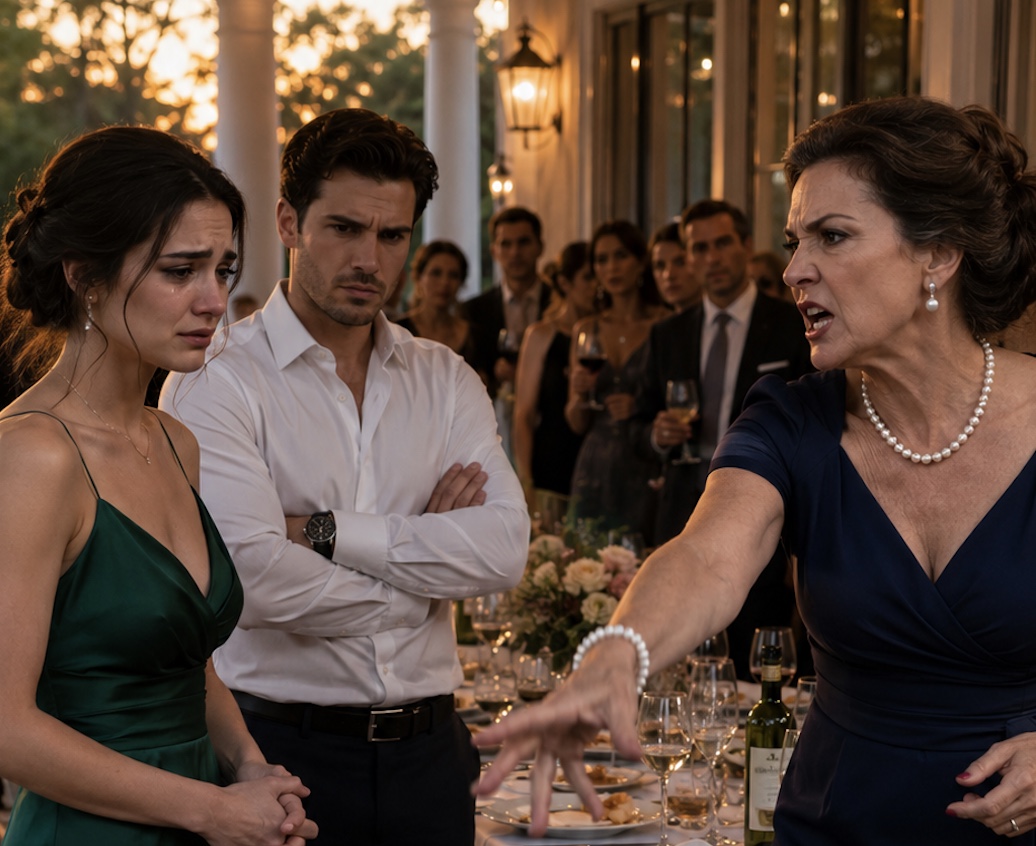
— Put it back where you found it, Tanechka, — Inna Valeryevna did not even turn her head toward me, continuing to pour collectible wine into the glasses. — Between baked sea bass and farm-raised duck, that little trinket of yours looks… excessive.
I stood on the terrace, clutching the small box in my hand. The velvet was cheap and stiff, but inside was something I had saved for three months to buy. Real silver, old craftsmanship, with a tiny piece of turquoise the color of a faded sky over Tagil. My talisman. I had bought it for myself with my first bonus at the bank, after I closed the most difficult debt recovery case. Then I decided to give it to her. After all, it was her anniversary. Sixty years old.
Only then did Inna Valeryevna finally deign to turn around. Her gaze slid over my dress, paused on my shoes, and delivered its verdict. Slowly, with two fingers, she picked up the brooch.
— Turquoise? — she raised one eyebrow so high that the wrinkles on her forehead folded into a neat little accordion. — Are you serious? In my house, people give gifts with substance. And this…
She made a short, disgusted flick of her hand. The box flew into the plastic trash bag standing near the edge of the buffet table. There was a quiet “thud” as the velvet landed on a half-eaten caviar sandwich.
— Cheap junk! — my mother-in-law declared loudly, making sure every guest could hear.
Pavel, my husband, was standing beside me. At that moment, he was studying the bubbles in his glass with great concentration. He always did that whenever his mother started “educating” me. He had an extraordinary gift: whenever scandal was in the air, he turned into part of the furniture.
— Mom, why would you do that? — he muttered without lifting his eyes. — Tanya tried.
— One should try in respectable society, Pasha, not in the debt-collection department, — Inna Valeryevna snapped. — Go and check whether the catering team has brought the second round of appetizers. And you, Tanya, fix the napkin holders. They’re crooked.
I moved my handbag from my left hand to my right. Three times. My fingers were icy, even though the July heat hung thick in the air.
Fine, I thought. Let them be crooked.
I walked over to the table and began adjusting the napkins. Slowly. I counted to myself: one, two, three. The guests laughed. That house in the suburbs had always seemed to me like a monument to her vanity. A high fence, wrought-iron gates, decorative plasterwork that had started suspiciously peeling after only two years in our climate. But Inna Valeryevna never noticed the cracks. She lived in a world where she was queen, and everyone else was an unfortunate misunderstanding.
— Tanya, don’t take it to heart, — Pasha whispered as he passed by. — Her blood pressure is up, she’s on edge. You know how much this house means to her. It’s her fortress.
I looked at the back of his head. He remembered that his mother loved sea bass. He never remembered that I had not eaten fish since childhood.
My job at the bank had taught me one important thing: behind every beautiful façade, there is always a profit-and-loss statement. And most often, it shows losses. People in Nizhny Tagil love pretending to be richer than they are. It is a local sport. Buying a Lexus on credit while living in a Khrushchev-era apartment in Vagonka. Installing gold toilets while owing money for utilities.
— Tanechka, why are you standing there? — my mother-in-law’s voice reached me along with the smell of expensive perfume. — Bring ice from the kitchen. And don’t frown. It doesn’t suit you. It makes you look even more… working class.
I nodded. Nothing was all right. Inside me, a strange cold calm began to grow. It was the same feeling that helped me at work whenever some debtor on the other end of the line started shouting about his rights while conveniently forgetting his obligations. In Hard Collection, the ones who cry do not survive. The ones who know how to wait do.
I went into the kitchen. It was cool there. On the enormous refrigerator, which Inna Valeryevna called “my German friend,” hung a collection of magnets from countries she had visited on borrowed money. I opened the freezer. Ice clinked against the glass bucket.
Interesting, I thought, watching the water tremble in a glass on the table. How much does this ice cost if you subtract the arrogance from it?
The evening went on. Toasts, congratulations, flattery, thick as molasses. Inna Valeryevna glowed. She told the guests about the new irrigation system and how she was planning to order marble statues for the garden.
I sat in the corner of the terrace, away from the light. My brooch lay in the trash. I could see the edge of the blue box under an orange peel.
— Tanya, you’re in a terrible mood today, — Inna Valeryevna came over to me near the end of the evening, when the guests had begun leaving. — You couldn’t even give a proper toast. Sitting there in silence like an owl.
— I’m listening, Inna Valeryevna, — I looked her straight in the eyes. — I’m listening to you very carefully.
She snorted and walked away. If only she had known that the next morning, an updated list of enforcement proceedings for our district would appear on my desk at the bank. But she did not know. She was too busy trying to seem flawless.
Monday in the debt recovery department always smelled of cheap coffee and adrenaline. I entered the office at eight in the morning. My desk stood in the far corner behind a partition. My colleagues were already making noise, headsets on, the air vibrating with standard phrases: “When do you plan to make the payment?” “The bailiffs will come to your registered address.”
I turned on my computer. The monitor blinked as the system loaded. Password, login, verification. Tables floated before my eyes. Red lines meant overdue by more than ninety days. Orange meant almost there.
I opened the “basket” for my sector. These were the cases that had already passed the soft-negotiation stage and entered forced collection. Usually, I did not look at names first. I looked at amounts and collateral. But today, my hand moved to the search bar on its own.
“Lopukhina Inna Valeryevna.”
The system thought for one second and produced a result.
I stared at the screen and slowly adjusted the collar of my blouse. My hands were steady, but inside me something clicked like the shutter of an old camera.
Four loans. Two consumer loans for “representational expenses,” as she probably imagined them. One car loan. And the cherry on top: a mortgage secured by that very country house. The total debt, including penalties and fines, exceeded the value of the property in its current condition. Overdue period: one hundred and twenty days.
Court ruling dated March 14. Writ of execution transferred to the bank’s recovery service. Preparation for sale of pledged property.
I leaned back in my chair. The office was noisy; one of the guys was loudly explaining to a debtor that “temporary difficulties” were not a legal reason to stop paying. And I stayed silent.
Did Inna Valeryevna know about it? Of course she did. Letters had arrived by the stack. But most likely, she had simply thrown them into the same place as that “cheap junk” — the trash can — believing that her status, her connections in town, and her flawless façade would protect her from reality. In Nizhny Tagil, many people think that if you ignore the bank, the bank will disappear.
The bank does not disappear. It simply changes the color of the lines in the table.
— Tanya, why are you frozen like that? — Lena, my colleague, came over to me. — Difficult client?
— No, — I closed the tab. — Just a familiar face.
— Ah, that happens. Yesterday my upstairs neighbor popped up in my files. Turns out he hasn’t paid for his car in three years. And he always says hello so politely.
I nodded. Polite. Inna Valeryevna was not polite.
At lunch, Pasha called.
— Tanya, listen, something came up… Mom called. She wants to gather everyone next week. Says there’s some new garden project to discuss. She found a designer from Yekaterinburg.
— A designer? — I stirred my tea. There was no sugar in it. Pasha always put two spoons in mine, forgetting that I had been drinking it bitter for five years. — Pash, where is she getting money for a designer?
— Well, she says she saved it. She knows how to manage a budget, unlike us. Tanya, please don’t start, okay? Come, sit for an hour. She’s still offended about that brooch. She said you could have chosen a better gift for a house of that level.
I looked out the window. In the parking lot stood our system administrator’s old Lada.
— All right, Pasha. I’ll come.
Of course I would come.
All day I worked like a machine. My numbers were the best in the department. I knew how to find the right words. The kind that strip a person of illusions while still leaving them room to maneuver. Inna Valeryevna had no room left. The procedure had already been launched. The auction was scheduled for the end of the month.
That evening, I stopped by the shopping mall. I needed to buy a new dress. Strict, dark, without unnecessary details.
I went into the jewelry accessories section. In the display case lay a brooch very similar to mine. I stood there for a minute, looking at it.
Cheap junk, my mother-in-law’s voice echoed in my head.
I turned around and left. At home, my jewelry box was empty. I never took my brooch out of the trash. I did not want to dirty my hands in the leftovers from her velvet-covered table.
On Thursday, we went to her house.
The house blazed with lights. Inna Valeryevna greeted us in a silk robe that cost as much as two of my monthly salaries. There was caviar on the table again, expensive cheeses again. She looked triumphant.
— Come in, children. Pasha, darling, pour your mother some juice. Tanechka, sit down. I’ve been thinking… — she paused, dramatically smoothing the folds of her robe. — The garden needs to be expanded. I spoke with the neighbor; he is ready to give up a strip of land.
I said nothing. I watched her move a vase of flowers. Three centimeters to the right. Then to the left.
— Inna Valeryevna, — I said quietly. — When was the last time you checked your mail?
She froze. Her eyes narrowed for a second, then widened with theatrical surprise.
— Mail? What mail? Advertising garbage? I throw it away immediately. Pasha, did you hear that? Your wife is worried about my mailbox. How touching.
— There may be important notices there, — I continued. — From government agencies. From banks.
— Banks? — she laughed. Loudly, unpleasantly. — My dear girl, I decide when and with whom I communicate. Everything is under control. My lawyer is handling my affairs.
Lawyer, I thought. The one you have not paid in six months, who has stopped answering your calls.
— Mom, Tanya is right, — Pasha inserted uncertainly. — There are so many scammers these days…
— Scammers are people who sell cheap little trinkets as silver, — Inna Valeryevna stared straight at me. — And my house is my property. Unshakable.
I picked up my cup of tea. It was cold. My mother-in-law had not even bothered to heat the kettle before our arrival.
— Property is something that has been paid for down to the last ruble, — I said softly.
Inna Valeryevna set her glass down so hard that the stem almost cracked.
— What are you implying? In my house! You, a girl who lives in a mortgaged one-room apartment and counts every kopeck until payday! How dare you…
She began speaking faster, red blotches spreading across her face. That was layer one: the body revealing fear hidden behind aggression. She started tugging at the edge of the tablecloth.
— Mom, calm down! — Pasha jumped toward her. — Tanya, apologize right now!
I stood up. Calmly, I smoothed my dress.
— There’s nothing to apologize for, Pasha. I’m simply stating facts. Inna Valeryevna, in two weeks you will have the chance to discuss the garden design with the new owners. If, of course, they decide to keep you here as… let’s say, a housekeeper.
The silence on the terrace became so thick it could have been cut with a knife. My mother-in-law opened and closed her mouth, unable to find words.
— Let’s go, Pasha, — I said.
— You… you… — Inna Valeryevna finally found her voice. — Get out! I don’t want your shadow in this house! Pauper! Cheap little thing!
I walked to the gate. Pasha ran after me, shouting something, but I could not hear him. I was thinking about one very important status in the debt recovery system.
Realization.
That is when illusions end and arithmetic begins.
Two weeks passed like one long train whistle. Pasha barely spoke to me. He went to live with his mother, “to support her during a difficult time.” He did not see any difficulty. Inna Valeryevna continued playing the role of mistress of life, even though notices about the auction had already been pasted onto the house fence twice. She tore them down in the mornings before the neighbors could see them and burned them in the fireplace.
At the bank, I recused myself from the case. Conflict of interest. But I could still see how the documents were moving. My colleague Maxim was handling lot No. 42.
— Strange woman, — he said over lunch. — We call her, and she picks up and says, “You have the wrong number, this is the Lopukhin residence.” What residence? The debt with all penalties is already over ten million. The house has been listed with a price reduction.
I nodded. I knew that tactic. Denial. Inna Valeryevna believed that if she refused to acknowledge reality, reality would be too embarrassed to enter through her door.
The morning of the auction was cloudy. In Nizhny Tagil, days like that are normal. A gray cement sky, low clouds.
I arrived at the house an hour before the start. The bailiffs’ car was already parked by the gate. Nearby stood two foreign cars belonging to potential buyers. The house looked beautiful. Even the peeling decorative plaster, in the morning fog, seemed like noble patina.
I got out of the car. I was wearing that same new dark dress. In my hand was a small handbag.
Pasha stood at the gate. He looked terrible. Gray face, red eyes. He had not slept.
— Tanya… Why are you here? To gloat? — his voice trembled.
— No, Pasha. To see how the law works.
— What law? — he almost shouted. — They’re about to throw Mom out onto the street! You knew, Tanya! You work at the bank! Why didn’t you say anything? Why didn’t you help?
I looked at him. At his expensive watch, bought with money he had taken from his mother. At his well-groomed hands.
— I did tell you, Pasha. Two weeks ago. And before that, I hinted at it. But you preferred to drink wine and listen to fairy tales about designers from Yekaterinburg. It was convenient for you to live on borrowed money. It was convenient for you to call me cheap because I know the value of every thousand I earn.
Inna Valeryevna came out of the house. She was dressed to perfection. A three-piece suit, pearls, flawless hair. Only her hands betrayed her. She was gripping the handle of her designer handbag so hard that her knuckles had turned white.
— What is going on here? — she swept the people present with a regal look. — Pasha, remove these people from the gate. This is private property.
A bailiff approached her. A young man in uniform who cared absolutely nothing about her pearls.
— Inna Valeryevna Lopukhina? Here is the protocol on the auction results. The property has been sold. The new owner assumes rights as of today. You have three hours to collect your personal belongings.
She did not turn pale. Instead, she suddenly began to laugh. A quiet, dry laugh.
— You must be insane. My lawyer…
— Your lawyer submitted notice of termination of the contract three days ago due to unpaid fees, — I said calmly, taking a step forward.
She fell silent. The laughter broke off. She looked at me, and there was no rage in her eyes anymore. There was emptiness. The very emptiness she had tried for so long to fill with expensive things.
— You… — she hissed. — You arranged all this.
— No. You arranged all this when you decided image was more important than obligations. The bank does not care what brand your sofa is. The bank cares about numbers.
The new owner, a heavyset man in a leather jacket, walked up to the bailiff.
— Where are the keys?
Inna Valeryevna stood motionless. Pasha fussed beside her, trying to prove something, but no one listened to him.
An hour later, boxes began coming out of the house. Not the pretty ones from boutiques. Ordinary cardboard boxes that Pasha had hastily bought at the nearest market.
My mother-in-law sat on the wrought-iron bench by the gate. The very same place where, two weeks earlier, she had thrown my gift into the trash.
I walked up to her.
— Inna Valeryevna.
She did not raise her head. She was staring at her shoes. They were dusty; no one had cleaned the garden path in those two weeks.
— My brooch, — I said. — It’s still there, in that bag. You never took it out.
She jerked one shoulder.
— Who needs your cheap junk, — she whispered, but there was no old strength in her voice.
— I do, — I smiled. — Because it is real. Unlike this house.
I turned around. Pasha stood by his car, loaded with bundles and suitcases.
— Tanya… — he called. — What about us? Where do we go now?
— You go to your mother, Pasha. Into her new reality. And I’m going home. To my one-room apartment. At least there, every wall belongs to me.
I got into the car. Started the engine. In the rearview mirror, I saw the new owner hang his lock on the gate. Heavy, iron, with no decorative plasterwork.
I exhaled.
My phone lay on the seat beside me. The screen lit up with a notification.
Deposit: Quarterly bonus. 42,000 rubles.
I put the phone in my bag.
Behind me, the house grew smaller and smaller until it became a gray dot against the background of Tagil’s smokestacks.