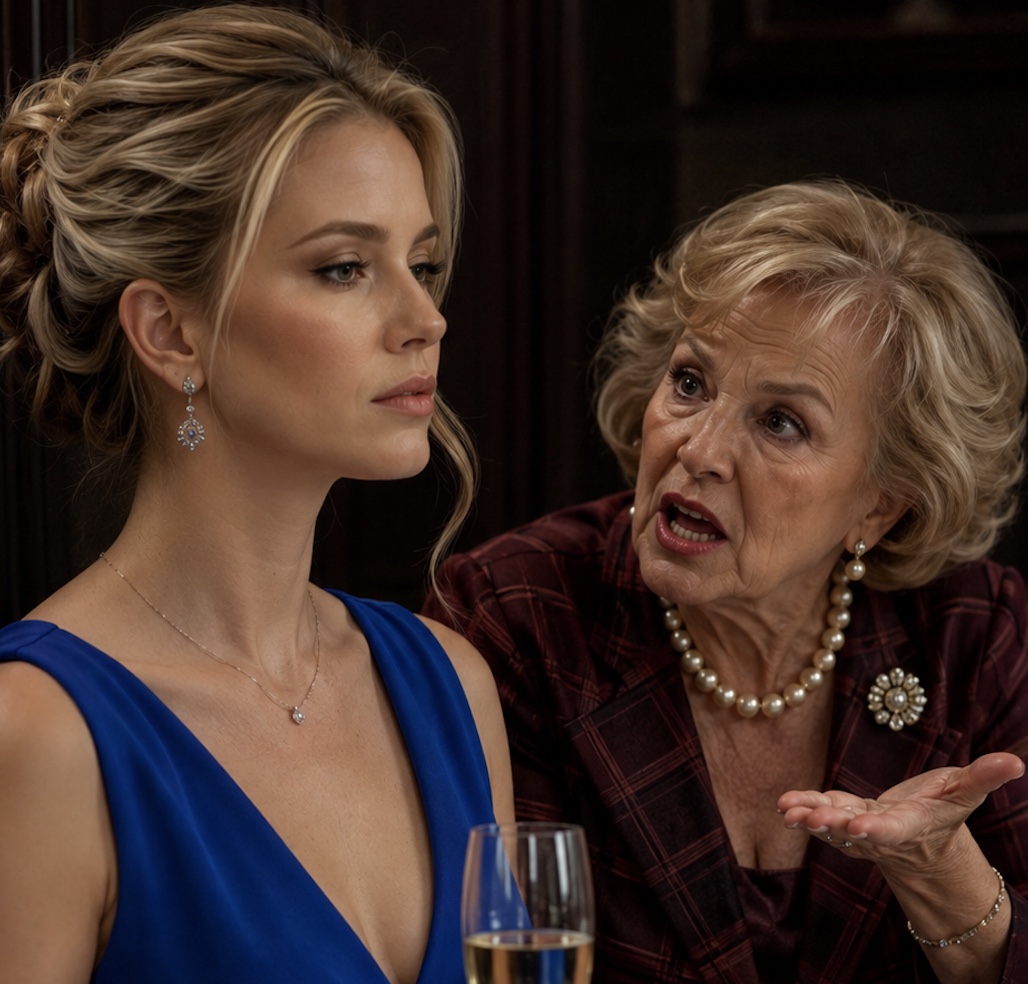
Natasha would often think back to that morning afterward — how ordinary it had seemed at first, smelling of coffee and hurried preparations, and how everything had turned upside down because of one forgotten folder of papers. The folder she came back for, opening the door quietly, almost without a sound — simply because she was in a rush and didn’t want to disturb anyone.
She had not meant to eavesdrop. In fact, she thought there was no one in the apartment at all.
That morning had begun like a hundred others. Natasha got up at half past six while Zakhar was still asleep, washed her face, drank her coffee standing by the window, looking out at the gray courtyard where the janitor was lazily sweeping leaves with a broom. She packed her bag, threw on her coat, kissed her husband on the temple — he mumbled something warm and sleepy — and left.
Valentina Petrovna, her mother-in-law, had not yet gotten up at that hour. At least, that was how it seemed: the door to her room was closed, and not a sound came from behind it. Natasha walked past on tiptoe, as she did every morning — a habit formed over three years of living together. The unspoken rule was simple: do not wake Valentina Petrovna before she wakes up on her own.
She had already gone downstairs, already reached the bus stop, when she suddenly went cold. The contract she had worked on all evening, already printed, was still lying in its folder on the kitchen table. Without it, the meeting that day would be pointless.
Natasha turned around and almost ran back.
She opened the apartment door with her own key — quietly, as usual. In the hallway, she stopped to take off her shoes so she wouldn’t track dirt inside, and at that moment her mother-in-law’s voice drifted from the kitchen. Lively, energetic, not sleepy at all — the voice of someone who had been awake for a long time and had been talking about something of her own for just as long.
Natasha froze.
“No, Lusya, you don’t understand! I’ve already thought it all through. Everything!”
Valentina Petrovna’s voice sounded exactly the way it always did when she was especially pleased with herself — with that unmistakable tone of a victor who had just revealed her cards and was waiting to be admired.
Natasha stood in the hallway. The folder was in the kitchen. All she had to do was walk in, take it, and leave. That was what she intended to do — she even took one step forward. But what she heard next pinned her to the spot.
“Natashka will pay, don’t you worry. She won’t get out of it. I know her — she won’t want a scene in public!”
The kitchen in their apartment was separated from the hallway by a short corridor with a turn. Natasha stood behind that corner, pressing her back against the wall, and listened.
Her mother-in-law was speaking loudly and cheerfully — the way people speak when they are certain no one can hear them.
“I’m telling you: Zakhar and Natashka offered to celebrate my birthday at a restaurant. As a gift, so to speak. Of course, I didn’t refuse!” She gave a short laugh. “So I thought, if they’re paying, why not invite some company? You’ll come, Rimmka will come, Zina too… A table for six, proper and festive!”
A pause. Apparently, her friend was saying something in response.
“Lusya, don’t be childish! Awkward for her? What’s awkward about it? Natashka was recently promoted to a new position. She’s making good money now. And besides, I know she and Zakhar have already saved up for a down payment on an apartment. They won’t go broke!”
Another pause. Valentina Petrovna’s voice dropped a little, becoming more confidential.
“You see, they’ll move out soon. Once they take out a mortgage — that’s it, they’ll start their own life and forget I exist. Young people, what can you expect from them? So while they’re still living here, while I still sort of have them under my hand, I have to make use of the moment. It’s the last chance, you could say. After that, you won’t be able to squeeze anything out of them!”
Natasha felt something slowly, almost physically, tighten in her chest. It was not anger — no, the anger came later. At first, it was something closer to confusion. The feeling of staring at a painting for a long time and suddenly realizing it is hanging upside down, and that you had simply grown so used to it you stopped noticing.
Squeeze anything out of them. That was the phrase she had used.
“Oh, stop worrying!” her mother-in-law continued with the same cheerful confidence. “Natashka won’t make a scandal in the restaurant. She’s quiet, well-mannered. I’ll say it’s a surprise, and she’ll smile. Like always. Where would she go? You know, she’s a little afraid of me. She always has been.” Another chuckle, soft and self-satisfied. “So she’ll pay like a good girl! She won’t get out of it!”
Natasha stood there for several more seconds without moving. Then quietly, very quietly, she took a step back toward the door. The folder with the contract remained in the kitchen.
She went out onto the stairwell and called work, letting them know she would be a little late. Then she took out her phone again and wrote to Zakhar:
Don’t leave yet. We need to talk. It’s important.
Zakhar opened the door already dressed, a mug of coffee in his hand — he had read the message and had been waiting by the entrance.
“What happened?”
Natasha stepped inside, took off her coat, and silently walked into their room. From the kitchen came her mother-in-law’s voice — she was still on the phone, now with someone else. Natasha closed the door.
“Sit down,” she said. “I’m going to tell you something, and first you’re going to listen until the end. Agreed?”
He looked at her with the guarded expression people get when they sense they are about to hear something they do not want to hear.
“Natul, is it something with Mom?”
“Your mother is fine,” Natasha replied, her voice completely even. “Please sit down.”
She told him everything. Calmly, almost without emotion, word for word. About the folder, about quietly opening the door, about the voice coming from the kitchen. About Lusya and Rimma and Zina. About “squeezing something out of them” and “she won’t get out of it.” About “she’s a little afraid of me” — that phrase she pronounced especially clearly.
Zakhar listened, staring into his mug.
“Maybe you…” he began when she fell silent.
“No,” Natasha interrupted. “I didn’t mishear. I didn’t make it up. I stood there and heard everything from beginning to end.”
“Mom always kind of… exaggerates. She might have just been chatting, not really thinking about what she was saying.”
“Zakhar.”
He looked up at her.
“She invited three friends. At our expense. In advance. Without telling us. And she knows we won’t say anything because, and I quote, I’m ‘a little afraid of her.’” Natasha paused. “You don’t have to believe me. But soon you’ll see it for yourself.”
He was silent for a long time. Behind the door, her mother-in-law said goodbye to the person she was speaking to and, judging by the sound, walked toward the bathroom. An ordinary morning. An ordinary apartment, where everything was not quite what it had seemed.
“What do you want to do?” Zakhar finally asked.
Natasha looked at him calmly and answered:
“I want to celebrate your mother’s birthday. Just as we promised. And pay for her restaurant dinner. Just as we promised.” She smiled faintly. “I’ll tell you the rest later. Right now I need to get to work.”
The restaurant was a good one — Natasha had chosen it herself because her mother-in-law had said, “Only somewhere decent, not some cheap café.” A quiet dining room, starched tablecloths, proper lighting.
Valentina Petrovna arrived dressed up, wearing a new dress and the expression of someone who had come to receive what she rightfully deserved. She looked over the table, said nothing, but Natasha noticed the glance she threw at the clock.
Exactly twenty minutes later, they walked into the room.
Lusya — a large woman in a colorful jacket, with a booming laugh and an immediate desire to study the menu. Rimma — lean, wearing glasses, with the air of a person who evaluated everything and was rarely satisfied. Zinaida Borisovna — the quietest of the three, but also the most observant. She was the first to look over the table, then at Natasha, and something flickered in her eyes — not guilt, no, but something close to an uneasy premonition.
“Here are my girls!” Valentina Petrovna blossomed and clapped her hands like a birthday girl being presented with a cake. “Natashenka, Zakhar — these are my friends! We’ve known each other forever!”
Zakhar looked at his wife. Natasha smiled at him — the kind of smile that said, I told you so — and stood up.
“I’ll be right back,” she said. “Please, sit down.”
The waiter was young, quick, with intelligent eyes. Natasha said something to him, pointing toward their table. The waiter did not show the slightest surprise.
“Of course,” he said.
Natasha returned to the table.
The evening moved along as expected. Her mother-in-law’s friends felt wonderful — exactly the way people feel when they believe the evening is being paid for by someone else. Lusya studied the menu with the concentration of someone examining not just dishes, but possibilities. Rimma ordered an appetizer, then another, then asked about the house specialties. Zinaida Borisovna, although more modest, still could not resist a main course that cost as much as a small festive dinner for two.
Valentina Petrovna was glowing. She told stories, laughed, clinked glasses. It was obvious she was pleased. From time to time, she glanced at Natasha with the quiet, proprietary satisfaction of a person who had calculated everything correctly.
Zakhar hardly spoke. He ate, watched, and Natasha could see how with every new order from the women, something in his face became a little more still.
Dessert. Coffee. Cognac — Lusya insisted, saying that a birthday without cognac was not a birthday at all.
At the end of the evening, the waiter appeared with a tray.
On the tray were six small bill folders. He placed them carefully, precisely, each one in front of the right person — as if he had spent his whole life doing nothing else.
Valentina Petrovna picked up her folder. Opened it. And Natasha saw the birthday woman’s expression slowly, almost majestically, slide from her face — like a mask that no one was holding in place anymore.
“What is this?” she said quietly.
“It’s the bill, Mom,” Zakhar answered. His voice was completely calm.
“But…” Valentina Petrovna raised her eyes to Natasha, and in that look there was something of a person who had stumbled on perfectly level ground — confusion mixed with offense. “Natasha, what is this supposed to mean?”
Natasha folded her hands on the table. When she spoke, her voice was steady, quiet, without the slightest hint of triumph — that mattered.
“Valentina Petrovna, Zakhar and I invited you to a restaurant in honor of your birthday. We will gladly pay for your evening — that is exactly what we promised, and exactly what we will do.” She paused. “But we did not invite your friends. You did. So you are responsible for their dinner.”
The silence at the table changed in quality.
“Natashenka,” Valentina Petrovna said, no longer smiling, her voice taking on that hissing tone Natasha had come to know well over three years, “are you trying to make a scene on my birthday? Right here?”
“No,” Natasha said. “There will be no scene. There are simply four separate bills for each person. And if you invited your friends, then you pay for their bills. Just as we will pay for yours, because we invited you.”
Lusya stared down at the tablecloth. Rimma twisted a spoon between her fingers. Zinaida Borisovna looked straight ahead with the expression of someone who had wanted to stand up and leave for a long time but did not know how.
“Valentina,” Zinaida Borisovna suddenly said without lifting her eyes, “she’s right.”
“What?!” Her mother-in-law turned to her.
“You invited us. You said you were treating us for your birthday. The children are paying for your dinner — that’s your gift. But you invited us on your own behalf.” Zinaida Borisovna finally raised her eyes, and there was something tired in them. “I thought this would turn awkward. I told you so.”
Valentina Petrovna opened her mouth, then closed it again. Lusya began studying her own bill folder with exaggerated interest. Rimma sighed quietly and reached into her handbag for her wallet.
“I heard your conversation,” Natasha said, and now her voice became a little firmer. “That morning, when I came back for my documents. I heard everything. About how I would ‘pay like a good girl,’ and about how I was ‘a little afraid’ of you.” She held her mother-in-law’s gaze without looking away. “I’m not afraid of you, Valentina Petrovna. I’m simply not used to making scenes. Those are two different things.”
Zakhar covered her hand with his on top of the table.
Valentina Petrovna looked at both of them for a long moment — with the expression of someone whose mind was working very quickly and very tensely. Then she lowered her eyes to the bill in her folder.
The silence lasted, perhaps, a full minute. Then her mother-in-law took out her wallet.
“And don’t forget the tip,” Natasha reminded her with a smile. “You did enjoy everything, didn’t you?”
Valentina Petrovna paid. For Lusya, for Rimma, for Zinaida Borisovna — silently, without a single word, wearing the face of someone who had swallowed something terribly bitter and had no right to complain about it because she had put it into her own mouth.
When the waiter collected the last folder, Lusya was the first to stand.
“Thank you for the evening, Valya,” she said with the awkwardness of people who want to leave quickly. “Happy birthday.”
They left almost all at once. Zinaida Borisovna, already on her feet, turned back and looked at Natasha — long and seriously. Then she gave a barely noticeable nod. Not in condemnation. Almost as if she understood.
The three of them rode home in a taxi. Valentina Petrovna sat in the front seat and stared out the window. Not a word the entire way.
At home, she went to her room and shut the door.
Natasha and Zakhar stood in the kitchen, and Zakhar looked at his wife for a long time with the expression people get when they admit something uncomfortable.
“You were right,” he said at last.
“I know,” Natasha replied. Not triumphantly. Just stating a fact.
“I didn’t think she would…” He stumbled over the words. “I didn’t want to think it.”
“That’s different.” Natasha poured herself some water and took a sip. “Zakhar, we need our own apartment.”
He was silent.
“We can do it now,” she said. “We have enough money for the down payment. We just need to decide.”
She did not say, Your mother was right, we need to leave before it’s too late — although that was exactly what it was. She simply said, We need our own apartment.
Zakhar nodded.
They submitted the mortgage documents two weeks later. The bank approved them. The apartment was found quickly — small, overlooking a courtyard, smelling of fresh plaster and feeling like a clean slate.
Valentina Petrovna did not comment on the move. Maybe she understood that she had said too much — not to Natasha, but to that invisible audience that had suddenly turned out not to be invisible at all. Or maybe it was something else. She and Natasha never spoke directly about that evening. There had only been the scene in the restaurant, and the silence in the taxi.
Sometimes silence is the conversation.
On moving day, Natasha stood in the middle of the empty room — the room she and Zakhar had shared in his mother’s apartment — and looked at the rectangle of light from the window lying across the floor. Three years. For three years she had walked quietly, opened doors carefully, spoken softly. For three years she had thought it was politeness. Then she heard the word “afraid” — and realized that perhaps she had been confusing one thing with another.
She was not afraid. She simply did not want conflict. Those were very different things — she repeated it to herself once more, silently now, in the empty room with the sunlit rectangle on the floor.
Zakhar came in carrying the last box.
“Everything?” he asked.
“Everything,” Natasha answered.
They walked out together.
Valentina Petrovna stood in the hallway — straight-backed, wearing a house robe, with an expression that was hard to read clearly. Not anger, not resentment, something more complicated.
“Call,” she said.
“We will,” Zakhar replied.
Natasha put on her shoes and picked up her bag. Then she turned back to say goodbye.
“Valentina Petrovna,” she said, “happy belated birthday.”