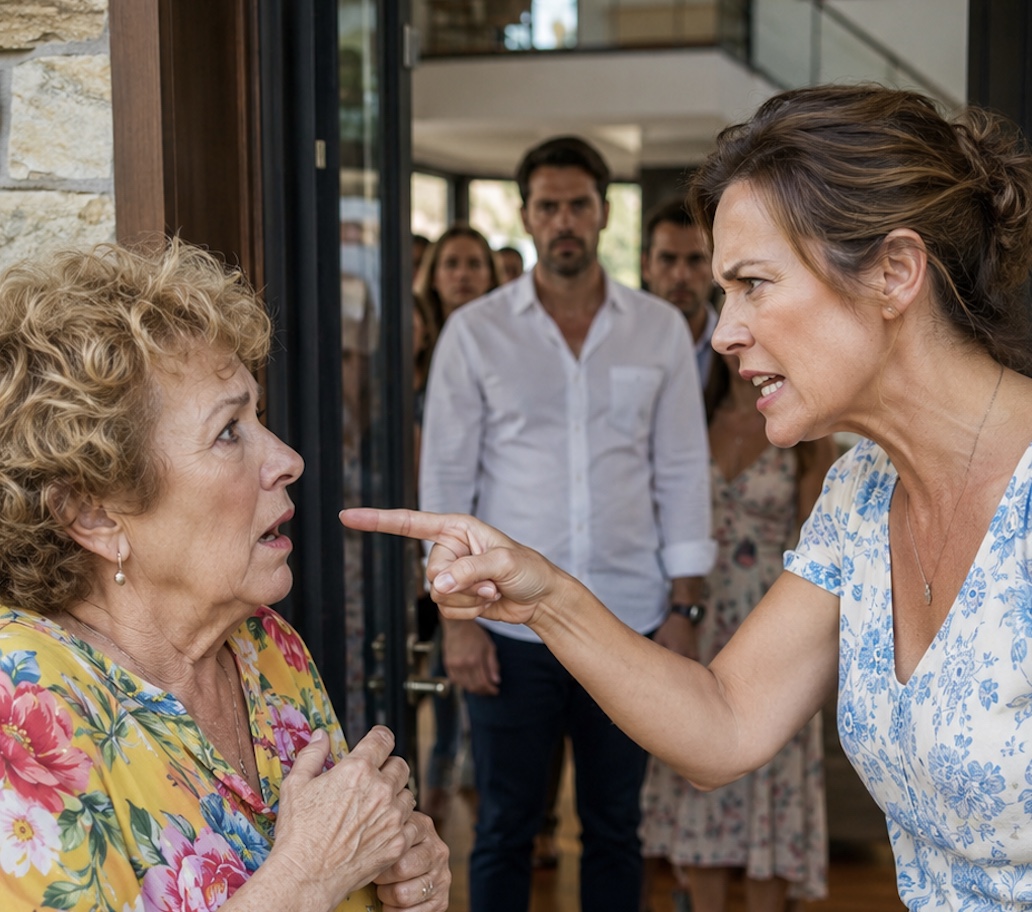
Raisa had never imagined she would feel so calm during the most scandalous moment of her life. She stood in the middle of the spacious living room — the one she and Pasha had spent years building — and looked at the faces of their relatives: confused, offended, flushed with shame or anger. Her hands did not tremble. Her voice did not waver either when she asked everyone to gather right there, in that large room with wooden beams across the ceiling — Pasha’s pride — and pots of geraniums on the wide windowsills — hers.
She looked at them and thought: how long it had taken her to reach this moment. And how good it was that she had finally reached it.
But let’s start from the beginning.
The apartment on Sovetskaya Street was so small that whenever Pasha spread his tools across the kitchen table — and he did it constantly, because there was simply nowhere else — Raisa could no longer put her flowerpots there to air out.
They lived in cramped conditions, noisily, sometimes taking offense at each other — when Pasha accidentally knocked her favorite violet off the windowsill, or when Raisa moved his unfinished wooden bear figurine somewhere out of the way, and Pasha spent half an hour searching for it afterward. But they lived with warmth and laughter, with conversations that lasted until midnight, and with one shared dream.
That dream was simple: a house of their own.
In the evenings, Pasha would draw it on squared notebook paper. A spacious living room. A workshop in an extension. A garden. A large porch where they could sit on summer evenings. Raisa would look over his shoulder and add her own details: flowerbeds along the path, climbing roses by the fence, and a winter garden right inside the house — even if it was small, even if it was only a corner filled with light.
“We’ll build it,” Pasha would say confidently.
“We’ll build it,” Raisa would agree, though deep down, one fear still remained: with what money?
Money. That became their first real test.
Their savings barely covered a third of what they needed. Pasha calculated it — the result was discouraging. Raisa calculated it again — and it came out even worse. They exchanged a look and decided to ask for help.
That was difficult. Both of them were proud people, the kind who would rather give up many things than ask anyone for anything. But to them, a house was not a luxury. It was a necessity.
First, they turned to their brothers and sisters — both Pasha’s and Raisa’s. The conversations were almost identical, as if copied from the same script. At first there was sympathy in their voices, understanding nods. Then came the heavy sigh.
“You understand, we really can’t right now. We’re barely managing ourselves.”
“Oh, if we had the money, of course we would.”
“If only it were another time…”
Raisa nodded, thanked them, and left. A week later, she heard that Pasha’s brother had bought a new car — large, shiny, with a leather interior. A month later, she learned that Raisa’s sister had flown to Turkey with her family, sending photos from there: the sea, cocktails, sunsets. Beautiful.
Raisa looked at those photos for a long time. Then she put her phone away and went to water her flowers. That calmed her.
Pasha said nothing about the money. But one evening she saw him sitting at the table, staring at one spot, with that same notebook of house sketches lying in front of him.
She sat down beside him and took his hand.
“We’ll ask our parents,” she said.
Pasha was silent for a second. Then he nodded.
Their parents turned out to be worse than their siblings. At least the brothers and sisters had hidden behind polite excuses. The parents — both his mother and Raisa’s father and mother — immediately began passing judgment.
Pasha’s mother, Nina Andreevna, came to their apartment the very evening she heard about their plans. She sat on the sofa, lips pressed tight, looking from Pasha to Raisa as if they had announced they were planning to fly to the moon.
“This is reckless,” she said without any preamble. “Do you understand that? It’s reckless. With what money? Do you have money? You don’t. Will you take out a loan? Then you’ll be paying it off until old age. And what if something happens? What if you lose your job? Pasha, do you think at all?”
Pasha did think. He thought things through very well, but explaining that to his mother was useless.
“Mom, we’ve calculated everything,” he said patiently.
“Calculated!” she threw up her hands. “Young people always think they’ve calculated everything. And then — bang — everything goes wrong. Drop this nonsense, Pasha. Buy a normal, larger apartment. That I can understand.”
Raisa’s parents were softer in tone, but just as firm in meaning. Her mother shook her head and said it was very risky. Her father stayed quiet, and then, already in the hallway, said softly to Raisa:
“Think carefully, daughter. This isn’t a game.”
Raisa thought. She thought all the way home, all night, and for several days after. And the more she thought, the stronger her decision became.
“We’re taking the loan,” she told Pasha one morning as they drank tea in their tiny kitchen, his elbow touching hers, as usual.
Pasha looked at her. Then he smiled — slowly, warmly.
“We’re taking the loan,” he agreed.
The construction stretched over several years.
They spent the first summer in a tent on the plot — back then it was nothing more than a field with a crooked little shed. They laid the foundation. Pasha worked himself, hired helpers for the heaviest tasks, then worked himself again. Raisa was beside him — handing things over, holding things in place, counting expenses, cooking on a small gas stove, talking to the foreman, reading construction forums until three in the morning.
Relatives called sometimes. They asked how things were going.
“Fine, we’re building,” Raisa would answer.
“Oh, good for you. We would come help, but we’re so busy…”
Busy. Raisa heard that word so often that eventually she stopped noticing it. Busy. Everyone was busy. Pasha’s brother was busy — although Raisa knew he went fishing on weekends. Pasha’s sister was busy — although she regularly posted photos from cafés and picnics. Everyone else was busy too, the moment the conversation touched on needing actual help.
Other people helped. Two of Pasha’s friends, Seryoga and Dimka, came several times, worked until dark, refused money, and left happy and covered in dust. Raisa fed them, poured tea for them, thanked them — and felt how that “thank you” carried a completely different weight from the one she gave relatives in response to their “we’re busy.”
They borrowed money from those same friends — Seryoga and Dimka — and also from Raisa’s friend Marina, who gave it without questions and only said, “Pay it back when you can.”
That was how they built.
The second summer brought the walls. The third — the roof, windows, and interior partitions. Then came the finishing work, long and painstaking, which seemed as if it would never end.
Pasha made everything wooden himself. The staircase to the second floor — himself. The carved wooden trim around the windows — himself. The beams in the living room, which became the true decoration of the house — himself. He worked with wood the way he spoke to people close to him: attentively, without haste, with respect for every knot and every curve.
Raisa took care of the garden and the home itself. She knew everything about plants — or almost everything — and the plot gradually transformed under her hands. Vegetable beds, flowerbeds, currant bushes along the fence, young apple trees that had already managed to grow by the time of the housewarming. Near the porch stood the climbing rose she had imagined back in their city apartment.
Inside the house, by the largest south-facing window, she created a small winter garden. Pots on shelves, something trailing up a wooden trellis — Pasha had made it specially — a soft green canopy beneath the ceiling. When she placed the final pot there for the first time and stepped back to look, she suddenly began to cry. She simply stood there and cried — quietly, without sobbing. Pasha came up behind her, held her, and said nothing.
There was nothing that needed to be said.
They set the housewarming for the end of summer.
Raisa called everyone herself — relatives, parents, friends. She kept her voice even. When someone asked how to get there, she explained patiently. When someone asked what to bring, she said, “Whatever you think is right. The main thing is, come.”
And they came. All of them. Those who had not been able to find time for years — every single one of them found time for the housewarming.
Raisa watched them walk around the property. Watched them stop, look around, lift their heads to examine the house. Watched something change in their faces — first surprise, then admiration, which they tried, rather unsuccessfully, to hide.
“Well, would you look at that…”
“Did they really do all of this themselves?”
“It’s beautiful. Truly beautiful.”
The guests moved through the house, peeking into rooms, touching the wooden railing of the staircase, stopping by the winter garden. Pasha’s brother — the one with the new car — stood for a long time in the workshop, looking at the tools and the unfinished owl figure on the workbench.
“Pash, listen, did you make all of this yourself?” he asked, his voice filled with a mixture of envy and genuine amazement.
“I did,” Pasha said shortly.
Outside, at the long table under the canopy, plates were already being set out. Raisa carried dishes from the kitchen and caught fragments of conversations.
“…we’ll have to come here sometime. The fishing must be great around here — the river’s nearby…”
“…with the kids in summer, this is perfect. So much space…”
“…I’d grill kebabs here every weekend…”
She listened and smiled — slightly crookedly.
Nina Andreevna inspected the house last, and with special thoroughness — like an auditor. She looked into the pantry, checked how the windows closed, measured rooms with her steps. Raisa followed her at some distance.
Several years earlier, this woman had called their idea reckless and foolish. She had said they would lose money, nerves, and time. She had said they would have been better off buying an apartment.
Now she stood in the middle of the second floor and slowly turned in place, examining the high ceiling, the wooden floor, and the window overlooking the garden, then beyond it — the meadow and the dark line of forest.
“Well, you’ve built yourselves a palace!” she said loudly. A pause followed. “And where will my room be?”
Raisa stopped.
She stood in the doorway and looked at her mother-in-law.
Nina Andreevna turned, saw Raisa’s face, and became slightly flustered. She began to explain.
“Well, I mean — for when I visit. A guest room, of course. I could live here in the summer, help you with the vegetable garden. We’ll put up a greenhouse — I know a thing or two about greenhouses. And there’s so much space here…”
“Nina Andreevna,” Raisa said calmly. “Let’s go downstairs. I’d like to say something to everyone at once.”
She gathered them in the living room.
They stood or sat — on the sofa, on chairs, someone leaned against the wall — and looked at Raisa and Pasha, who stood together by the fireplace. Pasha took her hand. She felt his fingers — warm, firm, slightly rough from work.
“We’re glad you came,” Raisa began. “Truly glad. The house turned out… well, you can see for yourselves. We’re happy. It took us a very long time to get here.”
She paused. Her eyes moved across the faces. Pasha’s mother. Her parents. Brothers and sisters. Uncles and aunts. Cousins. Everyone watched her expectantly and with a little caution — apparently, they had sensed something in her tone.
“When we were just beginning,” Raisa continued, “we asked for help. Which of you was here?” She gestured around at the walls. “No one. Not one of you came even once. You were busy. We asked to borrow money. We were told you didn’t have enough for yourselves. And then we found out that someone had bought a car, someone had gone to the seaside. I’m not judging — it was your money, your choice. But I remembered.”
The room became very quiet. Outside the window, a bird was singing something in the garden — persistent and peaceful.
“We took out a loan,” Pasha said. His voice was steady. “We borrowed from friends. We worked ourselves. For years. And now — here it is.”
“And now, here it is,” Raisa repeated. “Everyone has come. Almost everyone came empty-handed, by the way — but that’s not the point. The point is that plans are already being made. Someone wants to come fishing. Someone wants to bring the children. Someone wants weekend barbecues. Someone has already asked where her room is.”
Nina Andreevna made an uncertain sound and looked away.
“So,” Raisa continued in the same calm voice, without malice, without hysteria. “Forget your plans and your claims. We built this for ourselves. We will be happy to welcome the people who helped us. As for the rest of you — we’re glad you came today. But there is no ‘own room’ here for anyone who, when things were hard, found a thousand reasons not to come.”
She stopped. Exhaled.
“That’s all. The party is over. Thank you for coming.”
They left slowly — because people caught off guard always leave slowly. They needed to gather their things, find their keys, put on their shoes, and during all that time, they could keep talking — quietly, to the side, under their breath.
“Well, this is just…” Aunt Valya muttered, searching for her other shoe.
“Is that any way to treat family?” Pasha’s uncle shook his head.
“We came with good intentions,” Pasha’s sister said, wearing an offended expression.
“Some people have no shame at all,” someone muttered in the hallway.
Nina Andreevna was the last to leave. She stopped on the porch and looked back at Raisa.
“I didn’t mean to offend anyone,” she said. There was something like confusion in her voice. “I only asked.”
“I know,” Raisa said gently. “Have a nice evening, Nina Andreevna.”
Her mother-in-law stood there for another second. Then she stepped down from the porch and walked toward the car, where Pasha’s father was waiting for her. He had been silent all evening, and he remained silent now.
When the last car disappeared around the bend, Raisa stepped out onto the porch. Pasha was already there, sitting on the steps and looking into the darkness. The sky above the meadow was vast and full of stars, the kind of sky the city never had.
She sat down beside him. Shoulder to shoulder.
“They’re angry,” Pasha said.
“They’re angry,” Raisa agreed.
“Did we do the right thing?”
She thought for a moment. She looked at the climbing rose by the porch — in the darkness it was only a shadow, but Raisa knew exactly what it looked like because she had planted it herself. She looked at the windows of the house, where the silhouettes of the pots in the winter garden could be seen behind the glass. Then she lifted her eyes to the wooden canopy, the one Pasha had spent three weeks building and had carved along the edges with a simple wave pattern.
“Yes,” she said. “We did.”
They sat there for a long time. The wind gently moved the leaves of the young apple trees.
Seryoga called around midnight.
“How are you two holding up?”
“We’re good,” Raisa said. “Come next weekend. We’ll really be waiting for you.”
“We’ll come,” Seryoga said simply. “Good night.”
“Good night.”
Pasha stood and held out his hand to her.
“Let’s go to bed. There’s a lot of work in the garden tomorrow.”
She took his hand and stood up. They went inside the house and closed the door behind them.
Raisa walked across the wooden floor, listening to the way it creaked slightly under her feet — Pasha always said that was exactly how a good house should sound — and thought that she did not feel sorry at all for those who had left offended that evening. She only regretted the time she had spent waiting for their help. But time could not be returned.
And the house — there it was, standing.