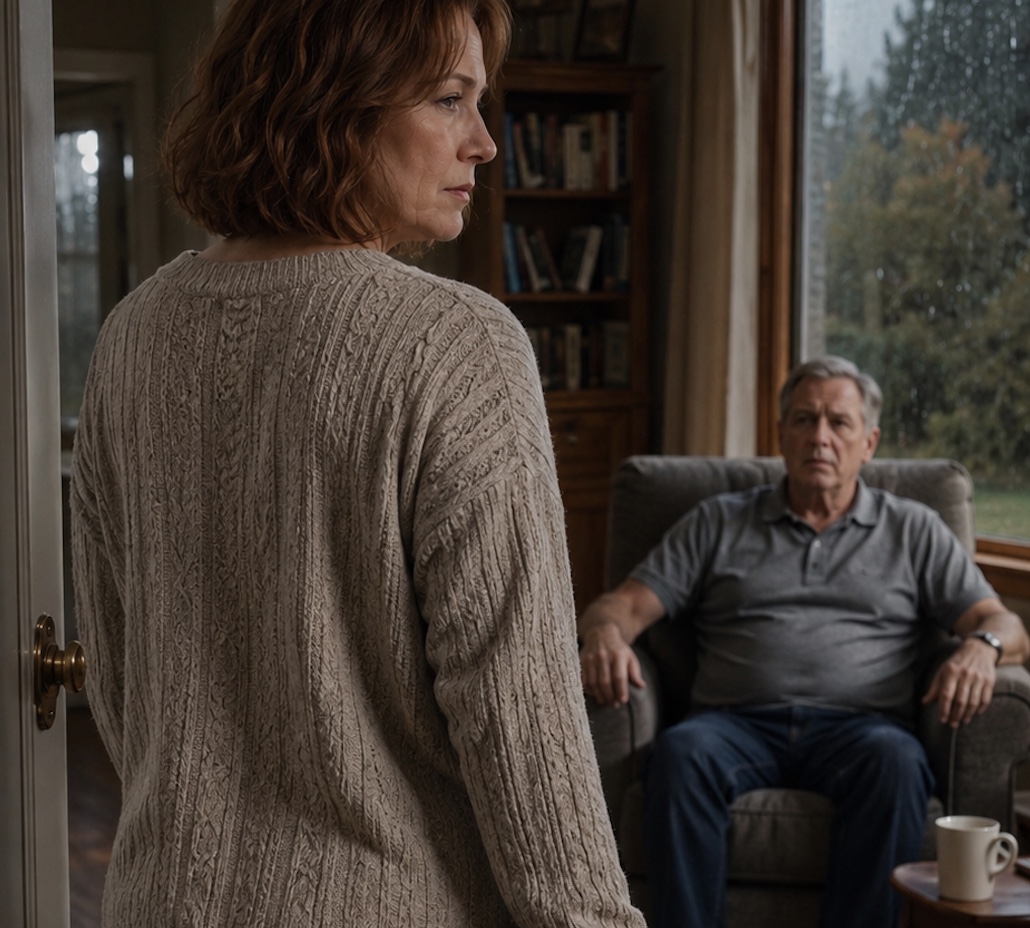
Lidia stood by the window, watching Viktor sit in his armchair with the remote control in his hand.
Sixty-five years old. Gray at the temples, soft hands, and the look of a man who had grown used to someone else deciding everything for him. She knew that look by heart. She had seen it for forty years. Every morning. Every evening.
Outside, a thin October rain was falling. The drops crawled down the glass slowly, almost reluctantly. Lidia sighed. On the table lay the utility bill — overdue. Beside it was a list of errands she had written back on Monday. Viktor had not noticed it. Or he had noticed it and decided it would somehow sort itself out.
Somehow.
Everything always sorted itself out.
Because there was Lidia.
She stepped away from the window, picked up the bill, and placed it directly on top of the remote.
“Vitya. This is the third reminder.”
He raised his eyes. Blinked.
“So pay it. You know how.”
“I do know how,” she said evenly. “And so do you. You have a phone. You have the app. I’ve shown you three times.”
“Well, something’s wrong with my password…”
“Vitya.”
She said his name quietly, but something inside her tightened. Not from anger — from exhaustion. That special kind of exhaustion that comes when you realize you are no longer living beside a person. You are dragging him behind you.
“I’m sixty-two years old. I’m tired of being the engine.”
He looked at her with mild surprise, the way people look at someone who has suddenly started speaking a foreign language.
“Come on, Lida, why are you—”
She did not let him finish.
She took her coat and went out into the hallway. She did not slam the door. She simply left.
Outside, the rain grew heavier. She walked over the wet leaves without looking where she was going, thinking only one thing:
This cannot go on.
Everything began three weeks later, after a conversation with her daughter.
Irina came over on Sunday, as usual, carrying a cake and a handful of news. Forty years old, divorced for two years, raising her son alone — and somehow still managing to look as though life was a joy to her. Lidia had always envied that a little. Quietly. Without bitterness.
“Mom, did you pay Dad’s internet bill again?”
“Well, he couldn’t figure out—”
“Mom.”
Irina put down her fork.
“Do you understand that as long as you keep doing everything for him, he will never start doing anything himself?”
Lidia said nothing.
“You don’t respect him,” Irina said softly. “You think you’re helping him. But really, you don’t believe he can manage.”
That hurt.
It hurt deeply, because it sounded too much like the truth.
That night, Lidia lay in the dark and thought. Not about how tired she was. But about the possibility that maybe she herself had created this helpless version of Viktor — by taking away his right to make decisions year after year.
By doing everything better, faster, more correctly.
By telling him without words, again and again:
You won’t manage.
What if she tried something different?
What if she let go?
The decision came suddenly, the way long-ripened decisions often do. She would stop dragging him forward. She would start handing things over. She would praise him. Step aside. Give Viktor the chance to feel like a support — and maybe then, one day, he would become one.
Lidia closed her eyes. The rain whispered outside the window. Somewhere in the next room, her husband breathed softly in his sleep.
She did not yet know that her experiment would slip out of her control.
For the first two weeks, Lidia held herself together with the last of her strength.
When Viktor forgot to buy bread, she said nothing and went to the store herself. But the next day she asked him again — calmly, without irritation.
“Vitya, please, today it’s your turn.”
He frowned, but he went.
He came back pleased with himself, carrying a loaf of bread and, for some reason, a pack of cookies.
“Here,” he said, laying everything on the table. “Got them on sale too.”
“Well done,” Lidia said.
And she smiled sincerely.
She noticed how he straightened a little. Just a little — but she noticed.
Then came the utility bill. She placed the phone in front of him, already opened to the right app, and said:
“Vitya, I don’t have time today. You’ll handle it, won’t you?”
He handled it.
He puffed, poked at the screen, called once to ask where the “confirm” button was — but he paid it. Himself.
And later, at dinner, he said as if casually:
“By the way, I paid the utilities today.”
“I saw. Thank you,” Lidia answered simply.
“There was also a phone bill. I paid that one too.”
She looked up at him.
He was staring at his plate, but a small smile hid in the corner of his mouth. That same boyish smile she had almost forgotten.
By the end of the first month, Viktor had changed noticeably.
He began getting up earlier. He made coffee — first only for himself, then he started placing a cup for her as well. He booked the car inspection that had been postponed for six months. He finally fixed the bathroom faucet — not with his own hands, true, he called a plumber — but he arranged it, supervised it, and paid for it.
Lidia watched all of this with quiet amazement.
She had not expected it to happen so quickly. She had not expected that beneath all those years of softness there was something else — something that simply had never been allowed to wake up.
Irina came by in mid-November and found her father studying offers for new windows.
“Dad, what are you doing?”
“I’m thinking we should replace the windows. There’s a draft from that side. I’m comparing three companies — prices, warranties.”
Irina looked at her mother.
Lidia shrugged like a woman who was just as surprised.
“Well, Dad…” was all Irina managed to say.
After her daughter left, Lidia caught herself feeling something she had not felt in a long time.
Lightness.
Not joy exactly. Lightness.
As if someone had taken a backpack off her shoulders — one she had carried for so long that she had stopped noticing its weight.
But somewhere around the sixth week, something began to change.
At first, it was small things.
Viktor stopped asking her opinion about the windows. He simply announced which company he had chosen. She wanted to say she had seen better reviews elsewhere, but he was already dialing the number.
She kept quiet.
She told herself: let the man do it — don’t interfere.
Then he came back from the market and informed her that he had made an arrangement with the neighbor about the garage. From now on, they would store his sister’s things there.
“Which sister?” Lidia asked.
“Tamara’s, of course. She’s moving. She needs a place for a couple of months.”
“Did you ask me?”
“Lida, it’s the garage. My garage.”
She looked at him carefully.
He was already looking at his phone.
By December, his tone had changed — a little firmer, a little louder. He started ending arguments with a phrase he had never used before:
“I’ve decided. That’s it.”
The first time, she thought it was almost funny.
The second time, she thought it was tolerable.
The third time, something inside her tightened, cold and warning, the way the air tightens before a storm.
Lidia understood: she had awakened something alive in her husband.
But that living thing was beginning to grow without control.
And she still did not know what to do with what she had raised.
It happened on a Sunday.
An ordinary, unremarkable Sunday, while Lidia was baking an apple pie and listening to the radio.
Viktor entered the kitchen with the expression of a man who had already made up his mind. Lidia noticed it from the corner of her eye. Over the past weeks, she had learned to recognize that look.
Straight shoulders.
A slightly lifted chin.
Eyes looking past her, into space.
“Lida, we need to talk.”
She lowered the heat under the pan and turned around.
“Tamara is moving,” he said. “With Kolya and the children. I told them they could stay with us.”
The silence in the kitchen became thick, almost physical.
“How many of them?”
“Tamara, Kolya, and the two grandchildren. The youngest is three.”
“Vitya.”
Lidia placed the spatula on the edge of the pan. Slowly. Carefully.
“You said ‘moving.’ That doesn’t mean coming for the weekend.”
“Well, temporarily. Until they find an apartment.”
“For how long?”
He shrugged. Just like that. As if they were discussing some tiny inconvenience.
“A month. Maybe two.”
“Two months. Four people. In our two-room apartment.”
She spoke quietly, almost without intonation.
“And you decided this alone.”
“I’m the man. I’m the head of this house.”
He said it without aggression — calmly, as if stating something obvious.
“Or am I not?”
Lidia looked at him for a long time.
She saw right through him — this new Viktor with his straight back and borrowed words. She saw how poorly this role fit him. How he did not even realize he had not put on strength, but a caricature of it.
“You’re the head of the house,” she said at last. “All right.”
And she returned to her pie.
For the next three days, she was silent.
Not demonstratively. Simply silent. She did what she had to do, answered briefly, smiled at Viktor over dinner.
He took it as agreement.
Tamara was supposed to arrive on Friday.
On Thursday evening, Lidia called Irina.
“Can you take me in for a while?”
A pause.
“Mom, what happened?”
“Nothing happened. Your father will have a full house now. Let him run it.”
On Friday morning, when Viktor went to the market to buy groceries for his sister’s arrival, Lidia packed a suitcase.
Not a large one. A medium-sized one.
She took what she needed: documents, medicine, her favorite sweater, and the photograph that had stood on the dresser since their wedding day.
She placed the suitcase by the door and wrote a few lines on a piece of paper.
No accusations.
No explanations.
Just this:
“Vitya. You are the master of the house — so live like one. Without me. Lidia.”
She put the note on the table and held it down with the sugar bowl so it would not blow away. She thought for a second — then placed the pie beside it, the one she had finished baking that morning, covered with a towel.
Then she left, closing the door gently behind her.
Viktor returned an hour later.
At first, he noticed the suitcase was gone — and did not immediately understand what it meant.
Then he read the note.
Read it again.
Sat down at the table without even taking off his coat and stared at one spot for a long time.
Then he called her.
“Lida. Are you serious?”
“Absolutely.”
“Because of Tamara? She’s family, this is—”
“Vitya,” she interrupted calmly. “The head of the house manages on his own. You’re the head, aren’t you?”
And she ended the call.
At six in the evening, Tamara arrived with Kolya, two children, three bags, and one large checkered duffel.
Viktor met them at the door with the expression of a man who had just been run over by a tram.
“Where’s Lida?” Tamara asked first.
“She left,” he said.
“Where?”
He was silent for a moment.
“To our daughter’s.”
Tamara exchanged a glance with Kolya.
Kolya politely studied the ceiling.
“Well,” Tamara said, taking off her coat, “you’ll sort it out. Come on, show us where everything is.”
And Viktor, the master of his own house, went to show them.
The first week was unexpectedly easy for him.
He even felt something close to satisfaction. There — he was managing. He bought groceries, figured out a folding bed for the children, made an arrangement with the neighbor about a parking spot for Kolya’s car. Tamara praised his dinner — he had cooked soup for the first time in many years.
The soup was not very good, but Tamara said it was tasty, and Viktor believed her.
In the evenings, he called Lidia.
She answered — briefly, evenly, without reproach.
“How are you?”
“I’m fine, Vitya. Ira feeds me. Don’t worry.”
“Maybe you’ll come back?”
“Not yet.”
He would hang up and stare at the ceiling.
In the next room, Tamara’s youngest grandchild was crying for the third hour in a row.
By the second week, chaos began.
Tamara turned out to be a woman with character — something Viktor had somehow failed to notice in his former life. She rearranged the pots. Then she moved the armchair. Then she announced that there was “no order at all” in the refrigerator and redistributed the shelves according to her own system.
“Tamara,” Viktor said one morning, after discovering that his favorite mug had been moved to the top shelf, where he could not reach it without a stool. “This is still my apartment.”
“Vitenka,” his sister replied sweetly, “you invited us yourself. Didn’t you?”
He fell silent.
Kolya was not working — “temporarily, I’m looking” — and spent entire days in front of the television, changing channels with such methodical persistence that Viktor began flinching at the sound of the remote.
The children raced down the hallway on a toy car that made the sound of a real horn.
Every twenty minutes.
At night, Viktor lay on his side of the bed — large and strangely empty — listening to someone else’s life inside his own apartment.
In the third week, Tamara announced that they had not found an apartment yet, but they were “very close.”
In the fourth week, she said the realtor had let them down, but it would be “soon.”
On the twenty-eighth day, Kolya asked Viktor to lend him money.
“How much?” Viktor asked.
“Thirty thousand. Not for long.”
“I don’t have thirty thousand.”
“Well, maybe a loan?”
Viktor looked at him for a long time.
Then he stood up, put on his coat, and went outside.
Just like that.
With no destination.
He walked through the November city and thought.
He thought about how, a month earlier, he had said the words “I’m the head of this house” with the feeling that he had finally found something of his own.
He thought about the way Lidia had looked at him then — not with anger, but with quiet sadness.
He had mistaken that sadness for weakness.
Now he understood: it had been knowledge.
She had simply known how it would end.
And she had not tried to explain.
He took out his phone.
Irina opened the door and silently looked at her father for several seconds. He stood on the threshold with his head uncovered — he had apparently forgotten his hat — and looked like a man whom life had just taught a short and very clear lesson.
“Is Mom home?” he asked.
“She is.”
Irina stepped aside.
“Come in.”
Lidia was sitting in an armchair by the window with a book. She raised her eyes. Said nothing.
Viktor sat down across from her. He was silent for a long time — truly silent. Outside, the city hummed. In the next room, the television murmured softly.
“Lida,” he began at last. “I thought strength meant commanding. Having the last word. Deciding.”
He shook his head.
“Turns out strength is taking responsibility. For everything. For every word.”
She looked at him closely — without triumph, without pity.
“And you thought I carried all of that for forty years just for fun?”
“No. I didn’t think.”
He met her gaze.
“That was the problem. I didn’t think.”
The silence between them was different now.
Not the cold silence that had remained in their apartment.
This one was alive.
“Tamara needs to move out,” he said. “I’ll talk to her myself. We’ll help them find something, help however we can — but they have to leave.”
“All right.”
“And no more decisions alone.”
He said it without drama — simply, tiredly, honestly.
“I don’t want to be the master. I want to come home.”
Lidia closed the book. She stood, walked to the window, and looked out for a long time — at the wet rooftops, at the streetlights that had already come on in the early winter dusk.
“I’ll come back,” she said finally. “But listen carefully, Vitya. No more ‘I decided.’ No more ‘I’m the head of the house.’ It’s either us — or nothing.”
“Us,” he repeated.
Irina stood in the doorway, pretending to study the wallpaper.
But she was smiling.
Lidia came home on Saturday.
Tamara moved out a week later. Viktor spoke to her himself — calmly, without a scandal — and even helped find a rental apartment and move their things. It required effort from him. Real effort, not showy effort.
Lidia saw it and said nothing.
The armchair returned to its place.
The mug came down from the top shelf.
One evening, Viktor made soup again — better than the first time. He placed a bowl in front of her.
“Try it.”
She tasted it.
“Needs a little salt.”
“Mhm.”
He sat down across from her.
“I’ll remember that next time.”
They ate dinner together, barely speaking.
But the silence was warm.
The silence of two people who no longer needed to prove anything to each other.
Outside, snow was falling — the first snow of the year.
Lidia watched it and thought that forty years was a very long time, and at the same time not long at all, if you finally learned to walk beside each other instead of dragging or commanding.
Just beside each other.
Lidia never explained to her husband exactly how she had managed not to break down.
Not to shout.
Not to humiliate him.
Simply to leave — and let him grow into responsibility on his own.
Maybe that is what real wisdom is.
Not trying to remake a person.
But finally refusing to live their life for them.