The house came to Olga from her parents, whom she lost only six months apart. Her father died first. Her mother followed soon after, unable to survive the grief. The inheritance was finalized six months after her mother’s death. A two-story home with an attic, a wide yard with apple trees and garden beds, and a bathhouse in the back—all of it now belonged solely to their daughter.
Olga worked as a manager at a small construction company and rented an apartment on the edge of town. Once all the paperwork for the house was finally complete, she began thinking seriously about moving in. City life had worn her down, and the thought of living in a home of her own gave her comfort. Besides, it was only a thirty-minute minibus ride from work.
By then, Olga had been dating Dmitry for eight months. He worked as an engineer at a factory and rented a room in a dormitory. Their relationship was steady, not fiery or dramatic, but built on mutual respect. When Olga suggested they marry and move into the house together, Dmitry agreed almost at once.
“Fresh air, your own land—that sounds perfect,” he said, studying the photos of the property. “I’m tired of all these concrete boxes.”
They had a modest wedding, attended only by their closest people. Dmitry’s mother, Raisa Stepanovna, came from a nearby district where she lived alone in a small private house. She was energetic, talkative, and showed an unmistakably keen interest in the home her son and his bride were about to live in.
“It’s a good house, strong and solid,” she said after walking through the rooms. “A little neglected, maybe. But that can be fixed.”
Olga kept quiet. The house truly did need attention—her parents had been ill for years, and repairs had not been a priority. Still, the essentials worked: the heating, the plumbing, the roof.
The newlyweds moved in around mid-September. Olga took a week off work to settle in. Dmitry helped in the evenings after work. They unpacked boxes, arranged furniture, washed the windows. Little by little, life seemed to be falling into place.
Two weeks after they moved in, Dmitry came home looking troubled. He sat down at the kitchen table, stayed silent for a long moment, and finally said:
“Mom called. They’ve started repairing her roof. She’s asking if she can stay here for a couple of weeks until the workers finish.”
Olga raised her brows.
“Her house is big, isn’t it? Can’t she sleep in another room?”
“They’ve torn everything open. She says the dust is unbearable. And it’s noisy from morning till evening—you can’t even sleep,” Dmitry said with a helpless shrug. “Just two weeks, tops. She’ll help around the house too. Maybe she can tell us what we still need to buy.”
Olga sighed. It felt awkward to refuse her mother-in-law, especially so early in their married life. Besides, Raisa Stepanovna really could help with the garden—Olga knew almost nothing about country living.
“All right. Let her come,” she said at last. “But make it clear it’s only temporary.”
Raisa Stepanovna appeared on the doorstep the very next day. She brought two enormous suitcases, three bags full of groceries, and a box of flower seedlings.
“Well, here I am,” she announced briskly as she stepped inside. “Dima, carry my things upstairs. The room up there gets more light.”
Olga froze. The upstairs room was the largest in the house, with wide windows and its own balcony door. She and Dmitry had planned to turn it into their bedroom one day, but they had not gotten around to it yet.
“Raisa Stepanovna, maybe the room downstairs would be better?” Olga suggested. “It’s smaller, but warmer.”
“Oh, nonsense, Olechka. I’m used to having space. I’ll even put my own television in there so I won’t disturb you in the evenings,” her mother-in-law replied, already climbing the stairs.
Dmitry silently followed behind with the suitcases. Olga remained in the entryway, trying to make sense of what had just happened.
At first, things were relatively calm. Raisa Stepanovna woke early, cooked breakfast, worked in the yard. Olga came home from work to a tidy house and dinner on the stove. On paper, it all looked convenient. And yet something about it unsettled her.
Little by little, Raisa Stepanovna kept moving more things into “her” room. First a floor lamp, then an armchair, then a chest of drawers. One evening, when Dmitry went upstairs to help his mother move a wardrobe, Olga finally spoke up.
“Why does she need so much furniture? She’s only here for two weeks.”
“What’s wrong with her being comfortable?” Dmitry muttered, disappearing upstairs again.
Olga bit her lip. Saying more felt petty. After all, the woman really was helping around the house.
A month passed. Raisa Stepanovna never again mentioned the roof repair. Instead, she threw herself into managing the property. First she planted flowers by the porch. Then she arranged for ten chickens to be delivered through some acquaintances and had a makeshift chicken coop built in the yard from old boards.
“Raisa Stepanovna, we never discussed chickens,” Olga said carefully.
“Oh, Olechka, this is what a proper household needs! We’ll have our own eggs, fresh hens. And it gives me something to do,” her mother-in-law replied, waving her hand dismissively before returning to the enclosure.
Whenever Olga voiced concern, Dmitry answered vaguely.
“Mom’s doing this for us. Isn’t it a good thing that the household is growing?”
Olga felt the ground slipping beneath her feet. The house was becoming less and less like her home and more and more like her mother-in-law’s domain. Raisa Stepanovna gave orders as though she owned the place—deciding what to plant, where to put the outdoor furniture, which neighbors to invite over for tea.
One evening, Olga came home and found a brand-new sign hanging on the veranda: Our Home. The letters had been painted carefully in oil paint, neat and deliberate.
“Doesn’t it look lovely?” Raisa Stepanovna asked, stepping out of the kitchen and drying her hands on her apron. “I painted it myself. Let the neighbors know there’s a real family living here.”
A rush of heat flooded Olga’s face, but she forced herself not to snap.
“I don’t mind the sign,” she said evenly. “It’s just hanging crooked. Could you straighten it?”
Her mother-in-law nodded and called for her son. Dmitry came out, adjusted the nail in silence, and never so much as looked at Olga.
By the end of the first year, Olga finally had to admit the truth: Dmitry’s mother had no intention of leaving. More than that—she had fully settled in. Her room now held a giant television, a new carpet, even a small refrigerator so she would not have to go downstairs for food. Out in the yard stood rabbit cages she had installed without asking permission.
“Dima, we need to talk,” Olga said one evening, intercepting him outside their bedroom. “Your mother said she’d stay a couple of weeks. It’s been a year.”
“So what?” he said, slipping off his shoes without looking at her. “Are you suffering? The house is in order, there’s always food, the place is thriving.”
“This is my house,” Olga said quietly. “I inherited it from my parents. It belongs to me.”
“So what? We’re a family now,” he said at last, lifting his eyes to hers. “Or do you want to throw my mother out onto the street?”
“I want us to live on our own. Like we planned,” Olga said, clenching her fists.
“We’ll live on our own later. Right now Mom has nowhere else to go. Her repairs are taking longer than expected.”
“What repairs, Dima? It’s been a year!” Her voice trembled.
“Then she hired bad workers. That’s not my fault,” he said, turning away and heading for the bathroom.
The conversation ended there. Olga stayed where she was, standing in the middle of the room, feeling like a stranger inside the house her parents had left her.
A second year passed. Raisa Stepanovna acquired a goat, built a shed to store feed, and started selling extra milk to the neighbors. Naturally, she kept the money herself.
Any attempt Olga made to talk about the situation ended in shouting. Her mother-in-law screamed that she was the one keeping the household running while the young couple went to work, that the house stood only because of her, and that Olga was selfish and ungrateful.
Dmitry always sided with his mother.
“Do you have any idea how much energy she puts into this place? And all you do is complain.”
“My place!” Olga would shout back. “My house!”
“Our house,” Dmitry would answer coldly before walking away.
By the third year, the situation had become unbearable. Olga no longer felt like the owner of anything. Her mother-in-law decided what would be cooked, when things would be cleaned, which guests would be invited over. Olga lived there like a tolerated tenant.
The final straw came when Raisa Stepanovna announced she intended to build a greenhouse and start selling seedlings from the property.
“That’s enough!” Olga burst out. “This is my land, my inheritance. I never agreed to chickens, or goats, or rabbits—and now a greenhouse too?”
Raisa Stepanovna straightened up and looked down at her with cold contempt.
“I’ve been running this place for three years. I’m the one keeping everything in order. And all you do is go to work and complain. Ungrateful girl.”
“I want you to leave,” Olga said firmly.
“What?” her mother-in-law narrowed her eyes.
“Please move out of the house,” Olga said, trying to keep her voice steady though her hands were shaking.
At that moment Dmitry entered the room. He heard the last words and stopped in the doorway.
“What’s going on here?” he asked.
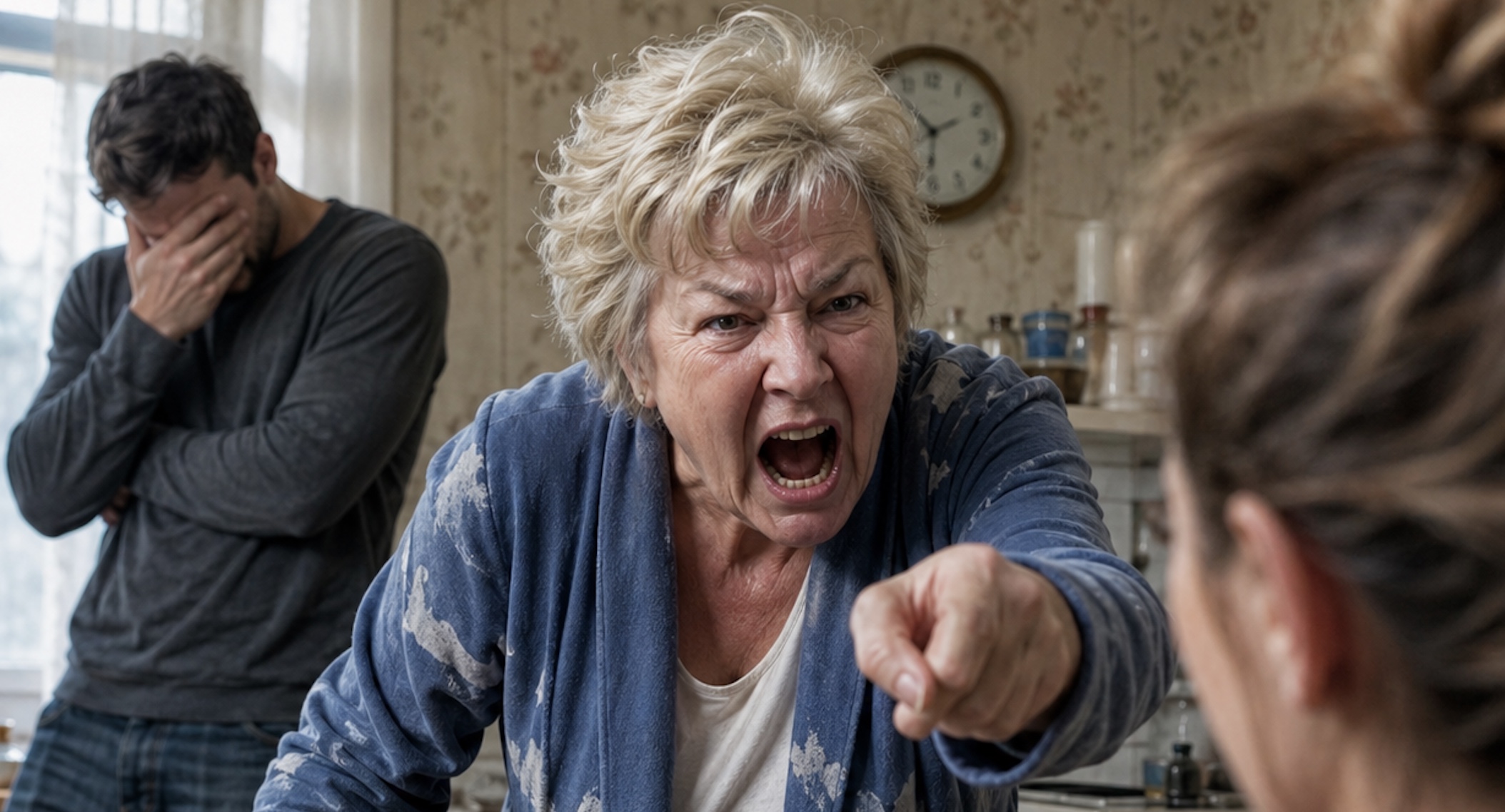
“Your wife is throwing me out,” Raisa Stepanovna said, pointing at Olga. “After everything I’ve done for you.”
Dmitry slowly turned to his wife.
“You’re serious?”
“Yes,” Olga answered, lifting her chin. “Your mother said she was staying for two weeks. It’s been three years. I want us to live separately.”
“Mom is the one holding this place together. Without her, the house would fall apart,” he said, folding his arms.
“It’s my house! My parents left it to me!” Olga nearly shouted.
Raisa Stepanovna gave a contemptuous snort and said the words that made everything go dark before Olga’s eyes.
“Oh, go to hell! We’ve been living here for free for three years, fixing everything up, and now you want to kick us out?”
Olga stared at her, unable to believe what she had just heard. The words hit harder than a slap. Dmitry stood beside his mother, glancing between them, saying nothing.
“What did you just say?” Olga asked slowly.
“You heard me,” Raisa snapped, lifting her chin. “I’ve lived here for three years, worked my hands to the bone, built this place up. You just go to work and complain. Who the real mistress of this house is—that’s still debatable.”
Olga turned and walked out of the room. She went upstairs, opened the wardrobe, and took out a folder of papers. Her hands were trembling, but her thoughts were suddenly crystal clear.
She came back into the living room, where Raisa Stepanovna was already ranting to her son about the ingratitude of modern young people.
Without a word, Olga placed the documents on the table. Certificate of inheritance. Property registry extract. Proof of sole ownership. Everything was in her name.
“These papers,” Olga said calmly, pointing at them, “state exactly who owns this house. Read them carefully.”
Raisa snatched the top sheet from the stack, scanned it, and threw it back down.
“So what? Just paperwork! I’ve been the one working here for three years, getting everything back on its feet. Without me, this house would have fallen apart.”
“Raisa Stepanovna, you came here for two weeks. I agreed to that. It has now been three years. I am asking you to leave the property,” Olga said, her voice firm and even.
“Leave?” Raisa sprang from the sofa. “How dare you! Dima, do you hear what your wife is doing?”
Dmitry finally stirred.
“Olya, maybe don’t be so harsh? Mom really has done a lot for this house.”
“A lot?” Olga turned to him. “Dmitry, this is my inheritance. From my parents. I allowed her to stay here temporarily. Three years is not temporary.”
“But Mom invested herself here…”
“She invested herself in someone else’s property without permission!” Olga raised her voice. “She brought in chickens, goats, rabbits, and now she wants a greenhouse. I never asked for any of it!”
Raisa grabbed a mug from the table and hurled it onto the floor with all her strength. The ceramic shattered, pieces flying across the room.
“Heartless girl!” she screamed. “Throwing a mother out into the street! My own house is unlivable, and you still want me gone!”
“Your house?” Olga frowned. “Three years ago, you said it was just a roof repair. What is actually happening there?”
“Everything is happening there! The roof, the floors, the walls—everything needs to be redone!” Raisa flung out a hand.
“So you were planning to stay here long-term from the very beginning,” Olga said slowly. “You lied to us.”
“Dima, start packing!” Raisa barked, turning to her son. “We’re leaving. I refuse to endure this ingratitude another minute!”
Dmitry looked helplessly from his mother to his wife. Blood rushed into his face, revealing the struggle inside him.
“Mom… maybe maybe it really is time to move back? You do have your own house…”
“My own house?” Raisa exploded. “It’s impossible to live there! And besides, I built everything here—this is my house now!”
Something inside Olga finally snapped for good. She took out her phone and called the police.
“What are you doing?” Raisa lunged toward her.
“I’m calling the district officer,” Olga replied calmly. “You’re living in my house without registration and refusing to leave. That’s against the law.”
“Dima!” Raisa grabbed her son’s arm. “Stop her right now!”
He stood frozen, unable to move. Olga was already speaking into the phone, calmly explaining the situation. A minute later, she ended the call.
“The officer will be here within the hour,” she announced, placing the phone on the table.
Raisa went pale, then flushed red, then turned pale again. She opened her mouth several times, but no words came out. Finally she asked in a hoarse voice:
“You’re serious?”
“Completely,” Olga said, folding her arms.
Raisa spun around and stormed upstairs. The heavy pounding of her footsteps echoed through the house, followed by the sounds of cupboard doors flying open and furniture being dragged around.
Dmitry still stood in the middle of the room, staring at his wife with silent reproach.
“You could have handled this differently,” he said quietly.
“How differently, Dima?” Olga sat down on the sofa. “I endured this for three years. Three years of asking, hinting, explaining, begging. And what do I get? Your mother saying this is her house.”
“Mom just expressed herself badly.”
“Badly?” Olga lifted her eyes to him. “She said, we’ve been living here for free for three years. We, Dima. That means you knew.”
He looked away, unable to answer. The silence spoke louder than any confession.
The district officer arrived forty minutes later. He was a tired-looking man in middle age with calm manners. He listened carefully to Olga, asked for the house documents, and reviewed them.
“I understand,” he said with a nod. “Where is the woman staying here?”
“Upstairs. Packing,” Olga answered, pointing to the staircase.
The officer went up, knocked on Raisa’s door. Loud arguing followed at first, but after a while the voices dropped. Ten minutes later he came back downstairs.
“She confirms that she has been living here for three years without registration or a rental agreement. The homeowner is demanding that she vacate the property. I’ll draw up a report,” he said, pulling out forms.
Dmitry stepped forward.
“She’s my mother. She truly has nowhere to go.”
“Does your mother have a home of her own?” the officer asked.
“Yes, but it’s being repaired…”
“Then she does have somewhere to go,” the officer said, continuing to fill out the paperwork. “She has until the end of the day. If she does not leave voluntarily, further action will be taken.”
Raisa Stepanovna came down the stairs dragging a suitcase. Her face was dark red, her eyes glistening with furious tears.
“That’s what you get for helping people,” she said bitterly as she came down. “You work for them, you try for them, and in the end they throw you out like trash.”
“You do have a house,” the officer reminded her politely. “That is where you will be staying.”
“You can’t live there! It’s all torn apart!” she shouted, dropping the suitcase with a bang.
“Then rent a place or find another solution. But you cannot remain here without the owner’s permission,” he replied, finishing the report and handing a copy to Olga.
Raisa snatched up her phone and started calling someone, loudly complaining about her ungrateful daughter-in-law. Dmitry silently went upstairs to help his mother with the rest of her things.
Olga stood by the window, staring out into the yard. The chickens wandered through the grass. The goat chewed hay. Rabbits moved restlessly in their cages. A whole household she had never asked for, yet now had to deal with.
Two hours later, the car was packed. Raisa Stepanovna was the last one to walk out of the house, throwing murderous looks at Olga.
“Remember my words,” she hissed at the door. “This won’t end well. Dima, let’s go.”
Dmitry took a few steps after his mother, then turned back.
“Olya, we’ll talk later.”
“Of course,” Olga replied quietly.
The front door slammed. The car started and drove away. Olga remained standing in the hallway, listening to the silence. For the first time in three years, the house was truly quiet.
The next morning, she woke up early and immediately called a locksmith to replace the locks. He arrived within the hour and finished quickly. Olga took the new keys and hid the spare set somewhere safe.
Then she went out onto the veranda, took down the sign that said Our Home, and carried it into the shed. In its place she hung another sign she had bought the evening before: Private Property. Do Not Enter Without Permission.
It hung straight. The lettering was sharp and clear. Olga stepped back and looked at it. For the first time in a very long time, she felt the house was hers again.
Dmitry called that evening. His voice was tense.
“Mom has nowhere to stay. Her house really is in bad shape. Olya, maybe you could let her come back, at least for a while?”
“No,” Olga answered calmly. “She can rent an apartment or repair her own house. She has no place here anymore.”
“You’re heartless,” he snapped, and hung up.
Olga set the phone down and walked out into the yard. The sun was sinking behind the trees, painting the sky orange and rose. The chickens were gathering by the coop, the goat half asleep in its pen. She still had to decide what to do with all of it.
Over the following week, she found people willing to take the animals. A neighbor bought the chickens. A local farmer took the goat. The rabbits were rehomed through an online ad. Olga dismantled the cages and enclosures and had the remains hauled to the dump.
Dmitry showed up ten days later. He knocked on the door, and Olga opened it.
“Can we talk?” he asked, standing on the porch with a defeated look in his eyes.
“Come in.”
They went into the kitchen and sat at the table. Dmitry was silent for a long time, then let out a breath.
“I don’t know what to do. Mom won’t talk to me normally anymore—she just blames me. And you don’t understand me either.”
“Dima, I spent three years as a stranger in my own house,” Olga said, looking directly into his eyes. “Your mother made every decision for me. I couldn’t say a word. And you stayed silent and backed her.”
“I was trying to keep the peace…”
“You were trying not to upset anyone. And in the end, the only person you hurt was me,” Olga said, shaking her head. “Your mother said that you had lived here for free for three years. That means this wasn’t an accident. You both planned to stay.”
Dmitry lowered his head. His silence told her everything.
“That’s what I thought,” Olga said, rising from her chair. “Dima, I need time. To think about us. About this marriage. About what comes next.”
“So you want a divorce?” His voice trembled.
“I want to understand whether I can go on living with a man who deceived me for three years,” she answered, folding her arms.
Dmitry stood, walked to the door, and turned back one last time.
“Olya, I truly never wanted it to end like this.”
“I know,” she said softly. “But this is how it ended.”
He left. Olga locked the new door behind him, went into the living room, and sat by the window. The house was empty and still. But this silence was no longer frightening. It was freedom.
A month later, she filed for divorce. They met at the registry office, signed the documents quietly and without a scene. Dmitry apologized. Olga nodded. There was nothing left to discuss.
Little by little, life began to settle. She restored the yard, painted the fence, and planted flowers where the vegetable beds had once been. In the evenings, she sat on the veranda with a book and let herself enjoy the peace.
One day, a neighbor stopped at the gate and asked if Olga was planning to sell the house. Olga shook her head.
“No. I’m not selling it. It’s what my parents left me. I’m staying here.”
The neighbor nodded and walked away. Olga stood by the gate for a long while afterward, looking at the sign that read Private Property.
The house was hers again.
Only hers.
And that was exactly how it should be.