Elena was digging dried buckwheat out of the narrow gap between the stove and the countertop. The grains had fused into old grease so stubbornly that she had to scrape them loose with a knife. Nina Ivanovna’s kitchen always smelled faintly sour and stale—like a rag gone bad or old oil trapped in the range hood. Elena scrubbed, scraped, and listened to the familiar muttering drifting in from the next room.
“Seryozhenka, tell her she put the pot back in the wrong place again. Now my whole system is ruined.”
Sergey answered with a vague “uh-huh,” never looking up from his phone. Elena tightened her grip on the knife until her knuckles turned white.
Three years.
For three years, every Tuesday and Thursday evening had been spent in this apartment, taking care of his mother while her husband lay on the couch. And her own mother, Valentina Lvovna, she saw barely once a month—and even then only in snatches, always under his irritated comments:
“You’re going to see her again? What, can’t she manage on her own?”
The phone in Elena’s pocket vibrated.
Mom.
“Lenochka,” Valentina Lvovna’s voice sounded weak, muffled somehow. “I’m sorry to bother you. My blood pressure’s been all over the place since yesterday. I can’t get out of bed. I’m out of medicine, and I can’t make it to the pharmacy—my head keeps spinning. Could you come by?”
Elena’s heart dropped.
Her mother never—never—complained. If she was asking, it meant she was truly in bad shape.
“Of course, Mom. I’m leaving right now. Just hold on.”
She wiped her hands on a towel, stepped into the living room, and stopped in the doorway.
“Seryozha, I need to go. My mom is sick.”
Her husband didn’t even lift his head.
“Again? Lena, this is getting ridiculous. Last week it was her back, now it’s blood pressure. She’s getting older, get used to it. My mother is supposed to have her feet washed today. You promised.”
“Your mother is walking around the apartment just fine,” Elena snapped, pulling on her jacket. “Mine can’t even stand up. I’m going.”
Nina Ivanovna threw up her hands.
“So this is gratitude? I treat her like my own daughter, and she abandons me! Seryozhenka, do you hear this?”
At last Sergey looked up from his phone. His face flushed dark red.
“You’re not going anywhere,” he said quietly, but with steel in his voice. “We had an agreement. First my mother, then dinner, then home. Your mother just wants attention. She’s jealous that you help decent people.”
“Decent?” Elena gave a short, sharp laugh. “Seryozha, for three years I’ve been serving your mother, who is healthier than I am. My mother hasn’t asked me for anything—not once, do you hear me? Not even to come by for a visit, because she didn’t want to be a burden. I’m going.”
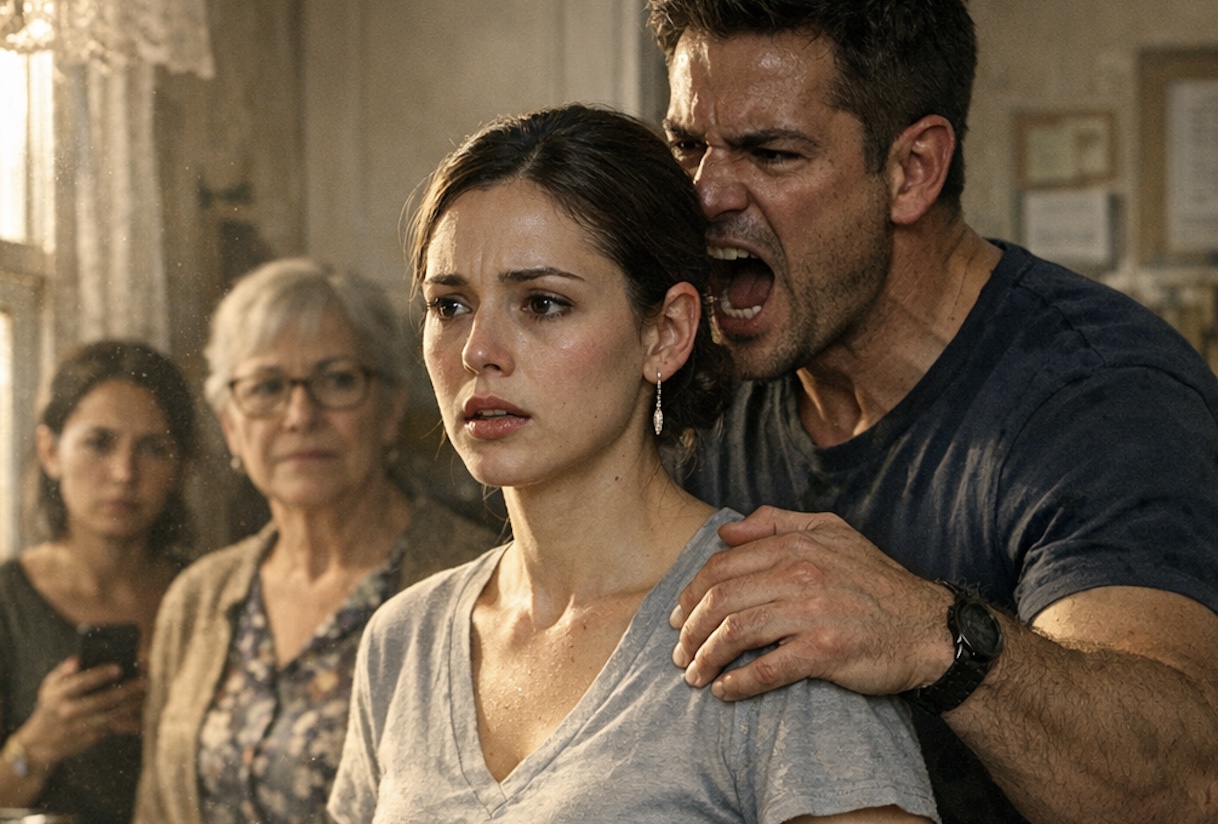
Sergey jumped to his feet and crossed the room in two strides, blocking the door. His eyes narrowed.
“If you walk out that door, don’t bother coming back. I mean it. I’m sick of you putting your whims above your family. Choose. Either me or your mother.”
The words hung in the air.
Elena stopped.
She looked at the man she had spent ten years with. At his face twisted with anger, at his clenched fists. And suddenly she understood something: she was no longer afraid.
All she felt was disgust—and a bottomless weariness.
“Fine,” she said calmly. “I choose my mother.”
She stepped around her stunned husband, opened the door, and walked out. Behind her, Nina Ivanovna was wailing something about ingratitude, but Elena was no longer listening.
It took her forty minutes to get to Valentina Lvovna’s apartment. Her hands shook so badly she had to grip the steering wheel harder. Her mother really did look awful—pale, damp with sweat on her forehead—but when she saw her daughter, she managed a weak smile.
“I’m sorry, sweetheart. I dragged you away… Sergey didn’t get angry, did he?”
“No, Mom. Everything’s fine,” Elena lied as she pulled out the blood pressure monitor. “I’m going to stay with you for a while. We… had an argument.”
Valentina Lvovna studied her daughter carefully, but didn’t press. She only sighed heavily.
The first two days passed in silence. Elena kept her mother on medication, made light soups, and for the first time in a long while slept normally—eight full hours a night. Sergey didn’t call.
At first, she kept expecting him to cool off, to apologize. But day after day passed, and the phone stayed silent.
On the evening of the third day, just as Elena was falling asleep, a text message from the bank lit up her screen:
“Withdrawal: 89,450 rubles. Balance: 1,203 rubles.”
She bolted upright, heart racing.
She opened the banking app.
It was true. Nearly all of her salary from the previous month—the money still sitting in her account—had been transferred to another account.
His account.
A cold wave swept through her.
A year earlier, when they were paying utility bills and she hadn’t been able to log into the app from work, Sergey had said, “Let me use your phone and pay it, or we’ll forget later.” She had handed it over. He had entered the password, paid the bill.
And apparently memorized her login. Or saved it on his own device.
At the time, she hadn’t thought twice about it. He was her husband.
Now it mattered.
The next morning she tried calling him.
No answer.
She messaged him.
Read—no reply.
She called the bank.
“The transaction was made from your registered device,” the support specialist explained. “The login was completed using a saved profile. To protect the account, change your password and enable two-factor authentication.”
“Can I get the money back?”
“Only if you can prove the transfer was made without your consent. But if the login came from your device or from saved credentials… it will be difficult.”
Elena hung up.
There was barely more than a thousand rubles left in the account, and payday was still two weeks away. She opened her wallet.
Three thousand rubles in cash.
That was it.
That evening, Sveta—her best friend—called.
“Len,” Sveta’s voice was cautious, almost guarded. “Listen, I don’t want to get involved in your business, but Sergey called me. He… well, he said all kinds of things. About you. Said you abandoned your family, that you took the money from the card…”
“Sveta, that’s not true! I’m with my mother, she’s sick! And he took the money from my account—not me!”
“Lenka, I don’t know…” Sveta hesitated. “I just want to stay out of it. You two need to sort it out yourselves. You understand, don’t you? I can’t take sides…”
“Sveta, we’ve been friends for ten years…”
“Exactly. That’s why I don’t want to ruin my relationship with either of you. I’m sorry. Bye.”
The line went dead.
Elena stared at the phone.
Sveta hadn’t believed Sergey—not really. But she hadn’t defended Elena either. She had simply washed her hands of it.
And that hurt even more than open betrayal.
A week later, it started at work.
At first it was little things: colleagues whispering, avoiding her eyes. Then her manager, Ivan Petrovich, turned colder with her.
Ten days later, he called her in.
“Elena Viktorovna,” he said, staring at the paperwork instead of at her, “an unpleasant situation has come up. We received a complaint from a client. Anonymous, but very detailed. It says you made an error in the calculations that caused losses. We checked—there was no error. But the complaint exists. Then another one came in. Then a phone call from your husband—he said… frankly, some outrageous things. I understand you have personal problems, but it’s affecting the atmosphere in the office.”
“This is slander, Ivan Petrovich!” Elena clenched her fists. “My husband and I are getting divorced. He’s doing this on purpose—”
“I’m not saying you’re guilty,” he cut in. “But until all this settles down, it would be better if you… took unpaid leave. Three weeks or so. Get things in order. Deal with your family situation. Then come back.”
Elena understood.
This was the beginning of the end.
“Unpaid leave” was just a softer phrase for what would come next. Sooner or later, they would forget her—or find a reason to let her go.
“Alright,” she said quietly. “I’ll write the request.”
That evening she came back to her mother’s apartment and sat in the kitchen. Valentina Lvovna poured tea and took the chair across from her.
“Tell me everything.”
Elena told her all of it: the money, Sveta, the trouble at work. She spoke in bursts, almost choking on the bitterness.
“He always kept saying you were turning me against him!” Lena cried, pacing the tiny kitchen. “That you were selfish, that you wanted to break us apart! And now he’s destroying me just to prove he’s the one in control! Why does he hate you so much, Mom? We never did anything to him!”
Valentina Lvovna sank heavily into her chair. Her face had gone very serious.
“Sit down, sweetheart. It’s time you knew something. I stayed silent for years. I thought it was for the best—for your marriage. But silence only made things worse.”
Elena froze.
“Do you remember five years ago, when Sergey wanted to open an auto repair shop? With a partner?”
“I remember. He said the banks turned him down and the whole thing fell apart. He was depressed for months.”
“The banks had nothing to do with it. He came to me. For money.”
“To you?” Elena stared. “But you…”
“I had it. I sold the dacha and your grandmother’s apartment. It came to almost five million rubles. I put it into a five-year deposit at a good rate, with no early withdrawal. I was saving for a little house in Krasnodar Krai. Remember how I dreamed of moving closer to the sea? Sergey knew about that money. He came and asked me for two and a half million. ‘Family help,’ he called it. No receipts, no paperwork.”
Elena said nothing.
“And you refused?” she finally whispered.
“I made inquiries,” her mother said evenly. “His ‘partner’ was a con man. He’d already served time for fraud. I told Sergey, ‘The business plan is bad, the partner is unreliable—you’ll lose the money. I won’t give it to you. But when the deposit matures, I can help with a down payment on a mortgage for you and Lena.’ He refused. He wanted cash immediately.”
Valentina Lvovna gave a bitter little smile.
“The way he screamed. He stomped, turned red, spat as he shouted. He called me a greedy old woman and said I didn’t care about my daughter’s happiness. When he left, he said, ‘You’ll regret this. You’ll rot alone, and your daughter won’t remember you.’”
Elena covered her face with her hands.
Now it all made sense.
“That’s why…” she whispered. “That’s why he started planting those thoughts in my head: ‘Your mother is manipulative,’ ‘your mother doesn’t respect us,’ ‘why go see her.’ He was isolating me. Out of revenge.”
“And calculation,” her mother added. “He thought if you drifted away from me, I’d break. That I’d buy you back with money just to get my daughter close again. Or that I’d die, and the inheritance would go to you both.”
“Why didn’t you tell me?”
“Because I was afraid,” Valentina Lvovna lowered her eyes. “Afraid you wouldn’t believe me. That you’d say I was poisoning you against your husband. He would have used that. And besides… I thought that as long as I still had that money, you were safe. If anything ever happened—if he threw you out, if you were left with nothing—you’d still have somewhere to come. I kept that deposit untouched all these years. It was my safety net. For you.”
Elena remembered everything: the “forgotten” family invitations, Sergey’s sour expression every time her mother came up, the guilt he wrapped around every phone call.
It hadn’t been random.
It had been a cold, calculated strategy.
“I was such a fool, Mom.”
“No. You loved, and you trusted,” Valentina Lvovna said, covering her daughter’s hand with hers. “But enough tears now. He thinks you’re weak. He thinks once the money runs out, you’ll come crawling back. He doesn’t know whose daughter you are.”
A hard, steely light flashed in her mother’s eyes.
“So. What are we going to do?”
“First, we’ll have dinner. Then we’ll make a plan.”
The next morning, Elena started at the bank. She changed every password, enabled two-factor authentication, opened a new account, and arranged for her salary to be sent there from now on.
Then she went to see a lawyer—an old acquaintance of her mother’s.
“Right,” he said, taking notes. “He withdrew the money using your banking app, but without your consent. Technically that’s difficult to prove, but we’ll try. We’ll file a police report—not guaranteed they’ll open a case, but it needs to be on record. Then we file for divorce and division of property. Tell me: did you invest any money in his apartment? Renovations? Furniture?”
“Yes,” Elena nodded. “Three years ago we did a full renovation. I paid for most of the building materials and the furniture.”
“Do you still have the receipts?”
Elena went still.
“No. We paid the workers in cash, bought things from different stores… I never thought I’d need them…”
The lawyer sighed heavily.
“And that’s the problem. Without receipts, the court won’t treat it as proven investment. We can try witness statements, but that’s weak. The apartment was in his name before marriage—it’s legally his. If you can prove substantial improvements that increased its value, you might be entitled to compensation. But again: you need evidence.”
“So I poured money into his apartment and now I walk away with nothing?”
“Unfortunately, yes. There are hundreds of cases like this. That’s why I always tell people: keep your receipts.”
A week later, Sergey finally called.
Elena was ready.
She turned on a voice recorder on a second phone before answering.
“So what, Lenka, had enough?” he said smugly. “Money running out? Starting to get hungry?”
“Why did you take my money, Seryozha?”
“Our money. You’re my wife. Everything you have is mine. Did you really think you could run to Mommy and everything would be fine? I’ll teach you. You’ll lose your job, your friends will turn away from you, and you’ll come crawling back on your knees. And your mother… that old hag will pay for keeping that money from me back then. You’ll see.”
“So you’re deliberately destroying my reputation?”
“I’m putting you back where you belong! You need to understand your place!”
“Thank you, Seryozha. That’s all I needed to hear.”
She ended the call.
The recording was saved.
With the lawyer, they prepared a formal statement for the police. Not under some vague label like “economic abuse,” but as unauthorized access to a bank account and threats.
The district officer accepted it reluctantly.
“Family drama,” he muttered. “We’ll see. If anything else happens, come back.”
Elena had no illusions. She knew the case would probably go nowhere.
But the recording existed.
The report existed.
It was something.
The divorce dragged on for eight months. Sergey fought over every trivial item, shouted in court, demanded compensation for “moral suffering.” Elena produced bank statements and transfer records. But the court remained unmoved: the apartment was his. The renovation couldn’t be proven without receipts.
In the end, Elena got half of the jointly acquired property—kitchen cabinets, a refrigerator, a washing machine.
Everything she could physically move.
She lost her job. After her “leave,” they offered her a mutual separation agreement.
“You understand,” they told her, “the atmosphere… it would be uncomfortable for you as well.”
Elena signed.
She had no strength left to sue.
A year passed.
Elena sat in her mother’s kitchen, stirring tea while a fine autumn rain tapped against the window. Valentina Lvovna, much recovered now, was slicing apples for a pie.
“Sveta called yesterday,” Elena said quietly.
“And?”
“She apologized. Said Sergey is living with a younger woman now. Sveta saw him shouting at her in a store. She said, ‘Lenka, forgive me. You were right.’”
“And did you?”
“I forgave her. But I don’t want her close again. You know, Mom… it feels like I got out of prison.”
Elena looked at her mother.
She looked so much better now—color in her cheeks, life in her eyes. It turned out her blood pressure problems had come not from age, but from constant fear for her daughter.
“The only thing I regret,” Elena said, “is not choosing you sooner. Letting him steal so many years.”
Valentina Lvovna smiled and gently stroked her daughter’s hair.
“Manipulators steal reality, Lena. They make you see the world through their eyes. But the important thing is—you woke up. You didn’t just choose me. You chose yourself.”
Elena nodded.
She remembered that day: her husband’s twisted face, the ultimatum hanging in the air. At the time, it had felt as though the world were collapsing.
Now she understood: that was the day her world began to rebuild itself.
Elena found a new job—simpler, paying half as much, but free of gossip and judgment. She lived with her mother, helped around the house, and saved money. Slowly, piece by piece, she was putting together a new life.
“By the way,” Valentina Lvovna said, narrowing her eyes playfully, “the deposit matured last month. With interest, it came to almost six million. If we want, in a year or two we could buy a small little house. In Anapa, maybe. Or Gelendzhik. Nothing fancy, but ours.”
Elena laughed—really laughed—for the first time in a long while.
“We’ll do it, Mom. Absolutely.”
She took a sip of tea.
It was hot and smelled of mint—the kind of scent freedom has in a home where you are truly loved.
Thanks for reading