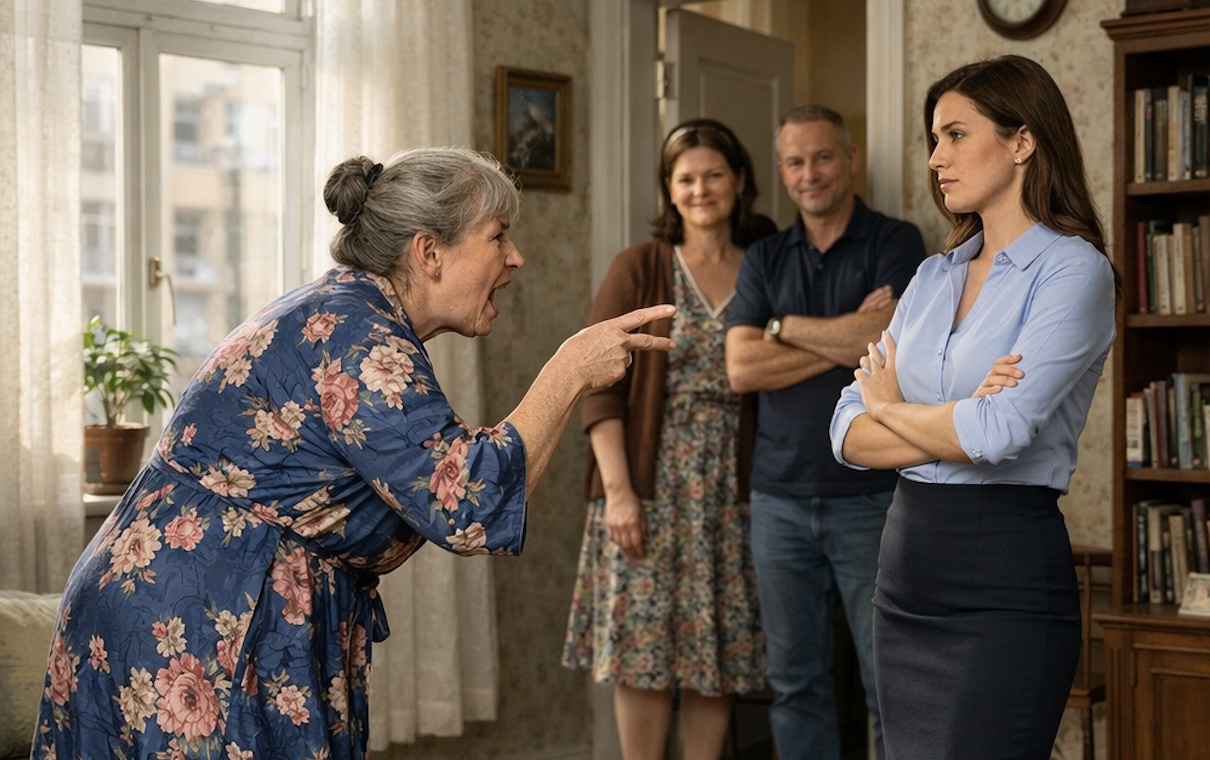
The heavy front door slammed so hard that the keys hanging in the hallway gave a pitiful jingle. I had barely managed to set my mug of cold tea down on the counter when an entire delegation came pouring into the corridor. At once, the air filled with the mixed smells of wet wool, street grime, and the cloying, sharp perfume my mother-in-law, Taisiya Pavlovna, practically bathed in before every public outing.
“Take your shoes off, Kostya, the floors are delicate,” she ordered like she owned the place, peeling off her bulky puffer coat and dropping it straight onto my pale upholstered bench.
Behind her shuffled Aunt Lyuba, forever borrowing money until payday and forever forgetting to repay it, along with Uncle Kostya, famous in the family for one failed business scheme after another. A couple of my husband’s more distant relatives hovered at the threshold too, openly gawking at the expensive finishings in the entryway.
I folded my arms over my chest, feeling a cold anger rise inside me. I was thirty-three, head of regional development. My life was a nonstop cycle of flights, negotiations, and putting out fires under pressure. I knew how to keep my composure. But life had not prepared me for a whole caravan of in-laws barging into my apartment unannounced.
“Taisiya Pavlovna. Lyuba. Konstantin,” I said slowly, letting my gaze move across them. “Why didn’t any of you warn me you were coming?”
My mother-in-law waved the question away, stomped into the living room, and dropped heavily onto the sofa. The others filed after her in a line, spreading themselves around the room.
“We need to talk, Ksenia. Sit down,” Taisiya Pavlovna commanded in the tone of a strict school principal.
I stayed where I was, leaning one shoulder against the doorframe.
“You can say it from there. I hear perfectly well.”
She pursed her lips in irritation, exchanged a glance with Aunt Lyuba, and launched into what was obviously a rehearsed speech.
“You’ve been in our family nearly four years now. Time keeps passing, but this house is still empty. You’re always running around on business trips, always glued to your phone. We talked it over, and we’ve decided a woman’s duty is to keep the hearth. Our Stas works, so there’s enough money for groceries. Quit your job or get divorced!” my mother-in-law declared, lifting her chin. “Tomorrow you go to your boss, hand in your resignation, stay at home, and cook soups for your husband. Otherwise Stas will file for divorce. We have no use for a daughter-in-law who doesn’t value family!”
Aunt Lyuba immediately nodded, adjusting the beret that had slipped sideways.
“Taya’s absolutely right! A woman should stand behind her husband. But you keep trying to act like a man. And give your salary card to Stas too, he should control the budget. Instead you waste money on your lipsticks while his brother Vadim still can’t pay off his student debts!”
Stas’s income? I almost laughed in their faces. My monthly mortgage payment on this very apartment was higher than his entire salary. Add the underground parking, groceries, appliances, vacations—I carried all of it. My earnings were on an entirely different scale.
I didn’t raise my voice. I simply took my phone out of the pocket of my lounge pants, unlocked it, switched on the voice recorder, and placed it on the coffee table.
“And what exactly is this supposed to be, Taisiya Pavlovna? An ultimatum?” I asked. My voice was even, almost gentle. “So I’m supposed to quit and hand over my card?”
“Exactly!” she barked, glancing at the phone without realizing it was recording.
I turned to the others.
“Aunt Lyuba,” I said, looking directly into her darting little eyes, “six months ago you asked me for a large sum to replace the roof on your village house. You promised you’d pay me back in the fall after selling your harvest. I never saw the harvest. I never saw the money either.”
Aunt Lyuba flushed a deep red, nearly blending into the burgundy sofa.
“Well, I… it was a dry year…”
“Uncle Kostya,” I continued, turning to the hunched man, “you borrowed money from me to buy a used truck for hauling freight. The truck was wrecked within the first month, the money vanished, and now you’ve come into my home to lecture me about life using funds that were mine?”
A sticky silence settled over the room. The only sound was the steady hum of the refrigerator in the kitchen. Their confidence collapsed in an instant.
“This apartment was in my name before I ever walked into the registry office. I make every payment myself. And now, out. I want both your opinions and your footprints gone from my hallway in the next two minutes.”
Taisiya Pavlovna hauled herself up with difficulty, blotches of color spreading across her face.
“You insolent little wretch! When Stas gets home, he’ll show you who’s boss here!”
They spilled back into the corridor, muttering and grumbling, the elevator door slamming behind them. I locked the top bolt, walked to the window, and threw it open. Cold air hit my face, driving the scent of чужого perfume out of the room.
Stas came home close to midnight. His jacket smelled, as always, of gasoline and cigarettes. He kicked off his shoes, threw his briefcase onto the bench, and stormed into the kitchen.
“What the hell was that?” he shouted, waving his arms. “My mother called me in tears! Why did you throw my family out? Have you completely lost it because of your fancy position?”
I was sitting at the kitchen island in front of my open laptop. The screen glowed with a long spreadsheet.
“Sit down, Stas,” I said without raising my voice.
“I’m not sitting down! You owe my mother an apology! She’s thinking about our future!”
“Our future?” I turned the laptop toward him. “Take a look. These are statements from my accounts covering our entire marriage. Transfers for your mother’s expensive dental treatment. Payments to cover your brother Vadim’s microloans. A spa voucher for your parents. The total would have been enough to buy a studio apartment on the outskirts of the city. I was supporting your entire clan.”
Stas froze. His eyes darted across the numbers, his lips moving soundlessly as he searched for an excuse.
“That… that was for family. We’re family…” he muttered, all his swagger gone.
“We would have been family if you hadn’t been transferring money to them from my card behind my back while I was asleep or in the shower.”
I pulled open a drawer, took out a slim plastic folder, and dropped it on top of the keyboard.
“This is the divorce petition. I’ve already signed my part. We have no jointly owned property. Your car was bought before the marriage, and so was my apartment. Now listen carefully.”
I picked up my phone.
“An hour ago, I blocked the secondary card you’d been using. Your access to my income is permanently cut off. You have until morning to pack your things.”
A couple of days later, I met my old university friend Darina. She had long since become a lawyer specializing in family disputes. We sat in a quiet café that smelled of toasted bread and strong coffee. Darina studied the printouts, tracing the lines with her pen.
“Ksyusha, this is a gift,” she said, looking up at me. “The transfers to his mother and brother were made from your personal savings account without your consent. We’ll recover it as unjust enrichment. They’ll have to answer for every penny.”
But Stas’s family decided the best defense was to attack. In the middle of the workweek, Taisiya Pavlovna showed up at my office. In the spacious lobby of the business center, where the only usual sounds were heels clicking and hushed conversations, her shrill voice made everyone turn.
“There she is! Take a good look!” she screamed, waving her arms in front of a baffled security guard. “That’s your boss! She threw my son out into the street, treats his own mother like dirt! A snake!”
I came down to the first floor with my phone in hand. By then a crowd of employees had already gathered. The moment Taisiya Pavlovna saw me, she drew in a huge breath, ready to continue.
I said nothing. I simply tapped the screen.
Her own voice rang out from the recording, loud enough for the whole lobby to hear: “And give your salary card to Stas too, he should control the budget. Instead you waste money on your lipsticks while his brother still can’t pay off his debts!”
Laughter rippled through the crowd. A few people openly grinned. Taisiya Pavlovna froze with her mouth hanging open, suddenly unable to say a word.
“Please escort this woman out,” I told security calmly. “She is interfering with people’s work.”
The court hearing dragged on for hours. The hallways smelled of old paint and dust, and the wooden benches creaked with every movement. Stas had hired a slippery lawyer who from the very start tried to twist everything upside down.
“Your Honor,” he began, theatrically shuffling his papers, “my client is the true victim here. In fact, we have discovered that the plaintiff deliberately concealed marital assets. A month before filing for divorce, she transferred a huge sum to the account of one Darina Viktorovna. We demand that this transaction be declared fictitious!”
He pointed triumphantly at my friend. Darina did not so much as raise an eyebrow. She stood, walked forward, and handed the judge a thick folder.
“This is a notarized trust management agreement. I am acting as my client’s financial consultant. All taxes have been paid, and the funds were legally invested. This is open, lawful information. Unlike the defendant’s secret transfers to his relatives.”
Stas’s lawyer grew visibly nervous, but he pulled out what he thought was his final trump card.
“Then listen to this! The real reason for the divorce is the plaintiff’s improper relationship!” He played an audio file on his tablet.
Through a wash of static came my voice, cooing with some man. Phrases like “When will we meet?” had been spliced together so clumsily that even the court clerk stopped typing. They claimed the man on the recording was my boss, Leonid Sergeyevich.
Darina smiled faintly.
“Your Honor, we anticipated this sort of stunt. Leonid Sergeyevich is waiting outside and is prepared to testify. And here is an independent forensic report. The defendant’s recording is a crude edit pieced together from Ksenia’s work calls with couriers and call-center operators. The male voice was generated with software.”
When the judge read the ruling, Stas sat staring at the floor. The court ordered him to repay every illegally diverted ruble, and his lawyer, for submitting falsified evidence, received a formal reprimand serious enough to threaten his license.
Of course, Stas had no money to repay me. But his parents owned a solid house in the suburbs, registered in his father’s name.
A month passed. The chaos subsided, and I was settling back into a normal rhythm of life. Then one late evening my phone lit up with Uncle Kostya’s number.
“Ksyusha…” His voice was soft, ingratiating, and bitter at the same time. “You know the bailiffs are coming for Taisiya soon to inventory property, right? Well, she’s not nearly as broke as she pretends. Under the floor in the summer kitchen, in an old tin tea box, she’s hidden a pretty large stash. She’s been saving it in secret from everyone. Take it. Let her learn what it feels like when family keeps things from you.”
He was taking revenge. Simple as that. She had refused to lend him money from her secret reserve when creditors came after him.
Darina immediately passed the information on to the enforcement officers. When we arrived in the settlement for the inventory, the air was damp and smelled of rotting leaves and smoke from stoves. The officers went straight to the summer kitchen and pried up the creaking floorboards with a crowbar.
Taisiya Pavlovna erupted, trying to stop them, screaming herself hoarse. But the hardest blow for her was not losing the hidden cash. It was the look on her relatives’ faces as they gathered by the gate. The very people for whom she had been siphoning money from our family turned away from her the instant they learned she had been hiding savings from them for years.
The end of their family played out exactly as you might expect. Stas, drowning in debt and refusing to comply with enforcement orders, eventually received a real prison sentence for fraud involving other people’s bank cards. His brother Vadim was caught stealing electronics from a store and followed him there. Taisiya Pavlovna, stripped of her home, moved in with distant relatives in a half-abandoned village. Trying to survive, she handed over her last scraps of money to telephone scammers. Her health gave way under the weight of it all, and before long she quietly passed away. Only strangers were there to bury her—neighbors from the village.
Two years later, I stood on the balcony of a rented villa by the sea. The warm wind tangled my hair, and the surf murmured below. I had давно been promoted, moved my parents closer to me, and forgotten that former life like a bad dream.
The phone on the table buzzed briefly. Unknown number.
“I’m listening,” I said, watching the sun sink toward the horizon.
“Ksyush… it’s me. Stas.”
His voice was hoarse, broken, unfamiliar.
“I’m listening.”
“I got out. I’m trying to get back on my feet. I’m working as a laborer in a warehouse. It’s hard, things are really bad for me right now… Listen, Ksyush. We weren’t strangers once. Could you lend me a little money? I can’t even pay for my room in the dorm. I’ll work it off, I swear!”
I looked out at the darkening water. Nothing stirred inside me—no pity, no satisfaction. My pulse was steady, calm.
“No, Stas,” I said. “We are strangers.”
I ended the call, added his number to the blacklist, and set the phone face down. The wind carried the taste of salt. Every debt had been paid, every account settled, and ahead of me stretched only my own life—one in which I answered to no one but myself.