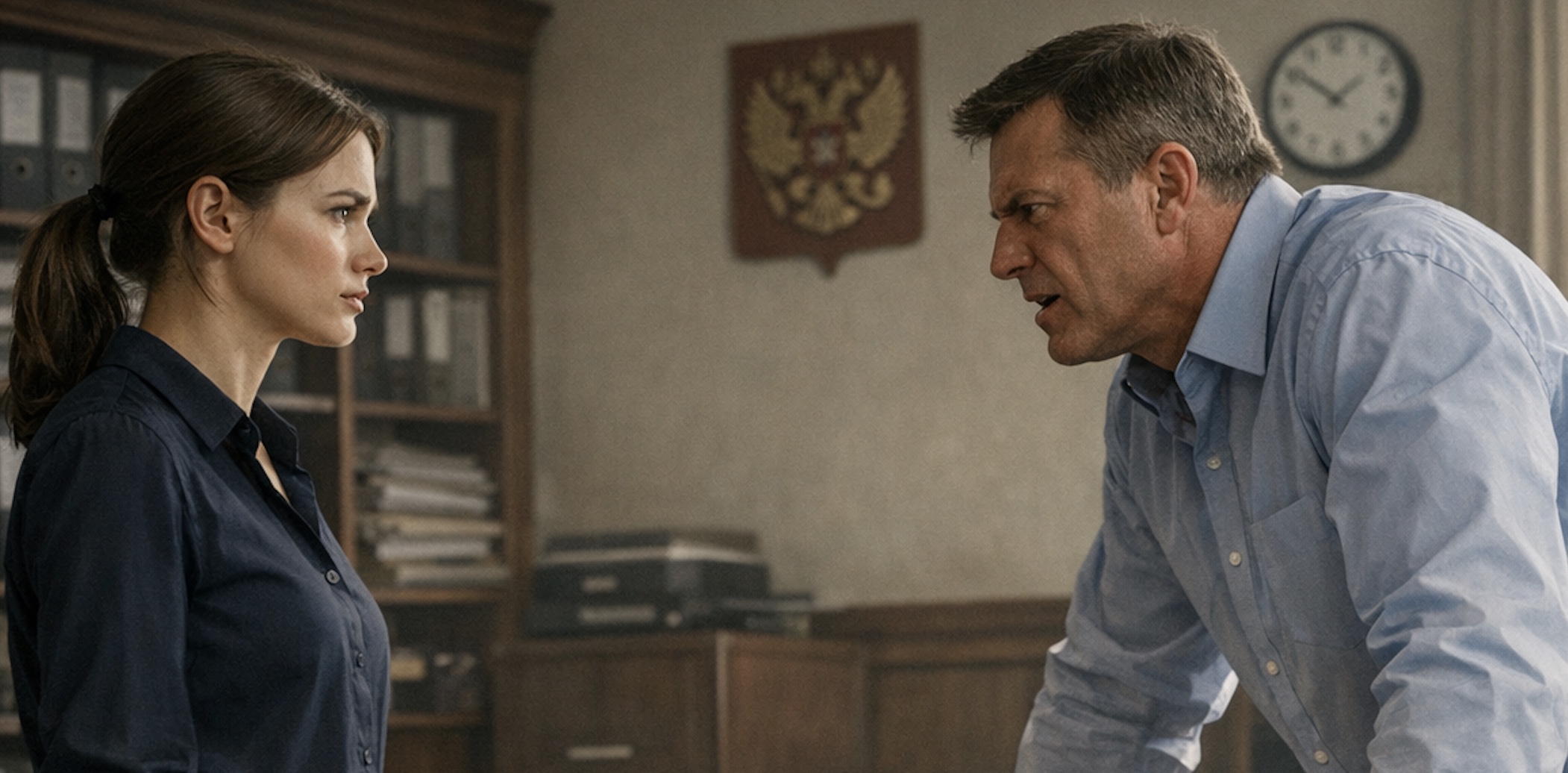
“Sit up straight, Albina. You’re not at your inspection office,” Roman said, barely moving his index finger as he pointed to the chair. “And put that case away. It’s an eyesore.”
I looked down at my hands. The cracked plastic eyeglasses case—cheap, grayish-brown, chipped along one edge—bit painfully into my palm every time I held it. I had bought it five years earlier from an underground kiosk near Alye Parusa, back when we counted every last ruble until payday. Now Roman carried a leather case worth forty thousand in his pocket, and his brand-new SUV was cooling outside the notary’s office. My old Lada was parked farther off, squeezed against a battered curb by some other client’s oversized Mercedes.
“All right,” I said.
But there was nothing all right about any of it. The air in the waiting room felt thick, like the industrial dust I was trained to record in safety reports. I was a workplace safety inspector, and after twenty years my mind had learned to spot danger before disaster struck. An unsecured shelf. Missing grounding. An expired extinguisher. In our marriage, the expiration date had passed about three years earlier, when Roman stopped coming home for dinner and started calling it “business expansion.”
I set the eyeglasses case on the edge of the desk. The plastic gave a faint, miserable creak. Roman winced, pulled out his phone, and began scrolling as if I had already vanished from the room. To him, I was part of the furniture now—a machine worn past usefulness, ready to be scrapped. The apartment on Oktyabrsky Prospect, the dacha in Poroshino, the bank accounts—he had already moved all of it into the pocket of a future where there was no place for the woman who had known him when he was still a lieutenant with holes in his pockets.
“Albina Stepanovna? Please come in,” said the notary’s assistant, a young woman with perfect posture as she opened the heavy oak door.
Roman rose first. He walked ahead without looking back, fully certain I would trail obediently behind him. In his world, the hierarchy was simple: whoever controlled the assets controlled the rules. What he had never understood was that safety wasn’t only about helmets and barriers. Sometimes it was about knowing exactly where the support beam had started to rust.
The notary’s office in central Kirov was furnished in that ponderous style meant to inspire awe: a massive desk, leather chairs, shelves lined with law books stamped in gold. The notary himself, a man in his fifties with tired eyes, nodded toward our seats.
“So,” he began, adjusting the cuffs of his shirt, “we are here to formalize a property division agreement by mutual consent. Roman Viktorovich, you provided the draft. Albina Stepanovna, have you reviewed it?”
“Yes,” I said, touching the case in my jacket pocket again. “I have.”
“It’s completely fair, Albina,” Roman cut in, staring out the window instead of at me. “The apartment is yours, the car is yours. I’m taking the dacha—I need it for meetings. And the business, naturally, stays with me. That’s only right. I built it from nothing. You had nothing to do with it.”
I said nothing. A report from the previous quarter drifted through my mind. Violation of Article 212 of the Labor Code. Failure to provide safe conditions. Roman believed his business consisted of his signature on contracts and his own ambition. He had conveniently forgotten that for the first two years I handled all his paperwork while he ran from site to site. He had forgotten how many inspections I got him through using my knowledge of regulations and my contacts in oversight agencies.
“Do you agree with this allocation?” the notary asked, peering at me over his glasses.
“No,” I said quietly.
Roman turned so sharply I saw the muscles in his thick, reddened neck tighten.
“What do you mean, no? We discussed everything on Saturday. You said the apartment would be enough for you.”
“On Saturday I didn’t know about the warehouse complex in Novovyatsk,” I said, placing a document on the table, “or the two hectares of development land transferred to your sister a week after we took out a loan against our jointly owned dacha.”
Roman gave a short, smug laugh. It was the same smile he used on employees who had made some obvious mistake.
“That’s none of your business, Albina. My sister’s land is my sister’s land. And the warehouse has nothing to do with you. Stop making this difficult. Sign the papers and let’s part decently. You understand,” he said, leaning closer until I caught the scent of the expensive cologne he had picked out with that other woman, “you are nobody here. Legally, you’ve just been a dependent wife for the past five years.”
He said it as casually as if he were reading a fire safety briefing to temporary workers. No emotion. Just a statement.
I looked at the notary. His face remained perfectly neutral, but something flickered in his eyes—interest, perhaps. He must have seen scenes like this every week. In this room, people shed their humanity more often than they did in court.
“Roman Viktorovich,” the notary said mildly, “your wife has the right to review all assets acquired during the marriage.”
“There are no other assets,” Roman snapped, slapping the armrest. “I divided everything honestly. The rest is personal property. Albina, stop pretending you’re on an inspection. This isn’t a construction site. This is life.”
I took out the eyeglasses case again. The broken edge scraped my finger, and the sharp sting cleared my mind. At that exact moment, I understood something: for years, I had been violating the most important protocol of all—the one for self-preservation. I had allowed him to dismantle my boundaries piece by piece until I was standing alone on raw concrete under an open sky.
“You know, Roman,” I said evenly, in the same tone I used at staff briefings, “every workplace keeps a log of accidents. Everything goes into it—from scratches to fatalities. You’re trying to register this divorce as a minor abrasion. But this is a major breach of operating rules.”
He rolled his eyes. “Operating rules? There you go again.”
“Property division rules,” I said, turning to the notary. “Gennady Arkadyevich, I have another folder. I’d like you to review it before we go any further with Roman Viktorovich’s idea of a fair settlement.”
I took a plain gray envelope from my bag. Not blue, not red—just an ordinary recycled-paper envelope, the kind we used for official notices requiring violations to be corrected.
Roman snorted.
“What is that? Your certificates for years of service? Or those poems you used to write?”
He had no idea. He truly had no idea that for the last three months I hadn’t simply been “going to work.” I had been investigating. I was an inspector, Roman. I knew how to find what people hide behind double walls and fake records. I had found every blind spot in his schemes.
The notary opened the folder, and I fell silent as his long fingers lifted the first page.
The room grew so quiet I could hear a trolleybus braking outside on Lenin Street. The squeal of the wheels filled me with a strange sense of relief.
Gennady Arkadyevich read slowly. He didn’t skim. He examined each page the way a scholar might study an old manuscript containing a map to buried treasure. Roman lounged in his chair, but his confidence had already begun to crack. Not fear—yet. Just irritation. The delay irritated him. The envelope irritated him. My calm irritated him.
“Well?” he finally said. “What is it, Gennady Arkadyevich? What nonsense has she handed you? Albina loves paperwork, especially the kind with nowhere to stamp it.”
The notary did not answer. He looked up at Roman, and now there was something different in his expression. Assessment. The look you give someone who has just stepped onto thin ice despite the warning sign.
“Roman Viktorovich, these are copies of purchase agreements for industrial equipment for your company. Five CNC machines acquired last year through an offshore intermediary. And…” He paused. “A deed of gift transferring to you a share in the charter capital of the Globus shopping center, from a certain Mr. Saveliev.”
Roman froze. His fingers, which had been tapping lazily on his knee, went still.
“So what?” he said, but his voice had gone dry. “Those were gifts. Personal property.”
“Saveliev is my cousin, Rom,” I said, watching the back of his neck. “Remember him? The one you helped get a license five years ago. He ‘gifted’ you that share out of gratitude. Only there’s a catch: the transaction took place during our marriage, and the funds for that ‘gift’ came out of our joint savings account at Khlynov Bank. I pulled the archived statements yesterday. Did you really think I’d never notice where the two million we set aside for our daughter’s education had gone? You told me you put it into stocks and lost it all. You didn’t lose it. You turned it into a stake in a shopping center.”
I saw a vein throb in his neck. Roman had always considered me slightly dim—reliable, honest, dull little Albina the inspector. He liked to say that I only knew how to find errors in ledgers and journals, that I had no sense of “the bigger picture.”
“You were digging behind my back?” he said, turning toward me. His face did not go pale. It turned the color of wet asphalt. “You? After eating from my hand all these years?”
“I wasn’t digging, Roman. I was conducting an audit. That is my job. Do you know what happens when hidden structural defects are found in a foundation? The building gets sealed, and the responsible parties get fined. I spent three months collecting those defects. You didn’t even bother to change the password on the home computer. You assumed I would never look beyond the folder labeled Recipes.”
“There was a password!” he shouted.
“Yes,” I said. “The date of your first major contract. You were always so predictable when it came to your pride.”
Roman jumped up and began pacing the office. The notary watched in silence. Many people had paced that room before him, I was sure, but few as hopelessly.
“This is bluffing!” Roman burst out. “She won’t prove any of this in court. Those documents could be fake.”
“Article 327 of the Criminal Code,” I reminded him. “Forgery. I would never gamble with my reputation like that. Every copy has been certified by the bank. I have the original statements. And Saveliev is willing to confirm the transaction was a sham. I spoke to him last night. Apparently he doesn’t enjoy being used in the dark either.”
I remembered that conversation with my cousin. We sat in his kitchen in Chistye Prudy, drinking strong tea. He could barely look at me. “Alka, I thought you knew. He said it was all part of your shared plan.” I didn’t cry. I simply marked another line in my mental report: Violation No. 48—betrayal by family. Penalty: total confiscation of trust.
“You…” Roman faltered. “You want to take everything?”
“No. I want what is mine. Fifty percent of all of it. The warehouse in Novovyatsk, the share in Globus, and the accounts you opened in your mother’s name in Kirovo-Chepetsk.”
“What does my mother have to do with this?” he shouted.
“She has to do with the fact that two hundred thousand rubles landed on her pension card every month from your LLC. Quite a pension, isn’t it? The tax office would probably find that interesting too, though I’ve kept that information in reserve for now.”
Roman sank back into his chair. Suddenly he looked deflated. His expensive jacket now seemed too large across the shoulders. He stared at the gray envelope in front of the notary as if it were an explosive already counting down.
“Albina, let’s work something out,” he said, and for the first time his voice sounded pleading. “Why drag this through court? It could take years. Lawyers, expenses… we’re not strangers. We have a daughter. Yulka is applying to university this year…”
“Yulka is going to St. Petersburg,” I said. “We already discussed it. And the money for her tuition will come from your little ‘pension reserve’ in Chepetsk. That is not up for debate.”
I reached into my bag and pulled out another document—a settlement draft prepared by my lawyer. The lawyer I had hired with my own savings, tucked away over years of work. I didn’t buy myself fur coats, Roman. I didn’t fly to Dubai with my friends. I saved for a black day—the very kind you had spent years preparing for me.
“This is my version,” I said, sliding the pages toward him. “Everything is accounted for. The property is divided equally. The business stays with you, but you pay me compensation for my share over two years. And you formally disclose all concealed assets.”
“Twelve million?” Roman skimmed the figures and stared. “Have you lost your mind? Where am I supposed to get that?”
“Sell the warehouse. Sell the Mercedes. Sell the apartment you rent for your assistant on Grin Embankment. That should cover your first payment nicely.”
The notary cleared his throat.
“Roman Viktorovich, I strongly recommend that you review this proposal carefully. If this goes to court and concealment of marital property is established, your share could be reduced. Not to mention the reputational damage to your business.”
Roman said nothing. He looked at me as if seeing me for the first time. Maybe he was. He had lived beside a woman of his own invention—convenient, quiet, predictable. And now he was facing the collapse of his own project because he had miscalculated the load it was built to bear.
“I’m not signing today,” he said at last, but the force had gone out of his voice.
“Of course not,” I replied. “You have three days. Friday at ten, I’ll be here. If you don’t come, the entire file goes to court. And to the prosecutor’s office too, regarding your tax fraud. It’s all very clear, Roman. Just the way I like it—charts, arrows, the whole thing.”
I stood, straightened my jacket, and picked up my cracked glasses case from the table.
“Albina!” he called when I was already at the door. “You always said order was what mattered. That you liked everything done by the rules.”
“Exactly,” I said. “I do value order. And when a site becomes dangerous, when disorder threatens lives, the site gets shut down for reconstruction. Goodbye, Gennady Arkadyevich.”
I stepped back into the waiting room. The same young assistant with the perfect posture sat at her desk. She gave me a professional but unexpectedly warm smile. I nodded in return.
Outside, the city was loud and ordinary. Kirov continued with its day. People hurried to shops. Cars honked at intersections. I walked to my Lada, opened the door, and sank into the worn driver’s seat.
What Roman had never understood was that the hardest part of my job was not issuing penalties. The hardest part was making people understand that regulations are written in blood. Our family had been written in something very much like that, only I had refused to see it for far too long.
I took out my glasses and wiped the lenses with the edge of my scarf. The case pinched my hand again. I looked at the crack. It had widened.
I started the engine. The car answered with its familiar rumble. Three days of waiting lay ahead, but I knew he would come. Roman valued his comfort too much to gamble everything on pride. And I… I had finally finished the inspection.
Friday arrived quickly. I lived those three days on a schedule of my own making: work, swimming pool, dinner with my daughter, sleep. Yulka didn’t ask questions. She saw everything in my face. Only once, while we were clearing the table, she touched my hand and said, “Mom, if I need to, I can stay here and go to the polytechnic on a budget place. I don’t have to go to St. Petersburg.”
I hugged her—she smelled both young and grown at the same time—and said, “You’re going exactly where you planned to go. Safety measures are in place.”
At 9:55, I entered the building. Roman was already there. He sat in the same chair in the waiting room, but this time he wasn’t scrolling his phone. He was staring blankly at the wall. He wore a different suit, more severe, and his face looked gaunter. When I walked past, he didn’t even lift his head.
“Please come in,” the assistant said.
Gennady Arkadyevich had already laid everything out. Two copies of the agreement rested on the desk. Beside them lay a heavy pen with a gold nib.
“Good morning,” said the notary. “Do both parties confirm that they are ready to sign?”
“Yes,” I said.
“Yes,” Roman echoed. His voice was flat.
We began to sign. One page after another. Sheet after sheet. The soft rustle of paper was the only sound in the room. My signature flowed across every line—broad, sure, unwavering. Albina Stepanovna Kolycheva. Inspector. Wife. Now simply Albina Kolycheva.
When the final page was done, the notary pressed down his seal. The heavy metallic thud placed a final period at the end of our twenty-year history.
“Congratulations,” Gennady Arkadyevich said with a nod to both of us. “The agreement takes effect immediately.”
Roman stood up. He looked at me, and what I saw in his face was not anger but bafflement. As though until the last possible second he had been unable to believe that this small woman in a gray blazer was capable of seeing it through.
“You won, Albina,” he said as he headed toward the door. “I hope you’re happy standing on your ruins.”
“These aren’t ruins, Roman,” I said. “This is cleared ground for new construction. You just failed the inspection.”
He left without shutting the door behind him. I stayed in the office another minute while the notary gathered the papers.
“You are an unusual client, Albina Stepanovna,” he said unexpectedly. “Most people cry or scream in here. You didn’t.”
“I’ve seen too many consequences of ignored safety rules, Gennady Arkadyevich. Emotions interfere with documenting violations.”
I stepped into the waiting room and stopped in front of the mirror. I straightened my collar, reached into my bag for my glasses, and found the old case lying at the bottom. I took it out and walked to the trash bin by the entrance.
The plastic cracked one last time when I clenched it in my fist. Then I opened my hand. The broken pieces dropped to the bottom among receipts and shredded paper.
I walked out onto the steps. Roman had already left. The space where his SUV had been parked stood empty now. I headed to my car.
I took out the keys. Slid one into the lock. Turned it. The door clicked open. I sat behind the wheel, rested my hands on it, and looked at the dashboard. Half a tank. Oil normal. Brakes checked.
I put the car in first and pulled away smoothly. Merging into the traffic moving toward the bridge over the Vyatka, I saw the rest of the day stretching ahead of me: a report on the furniture factory, then an evening with my daughter.
I moved my phone from my right pocket to my left. Adjusted the rearview mirror. Pressed the gas.
And drove on.