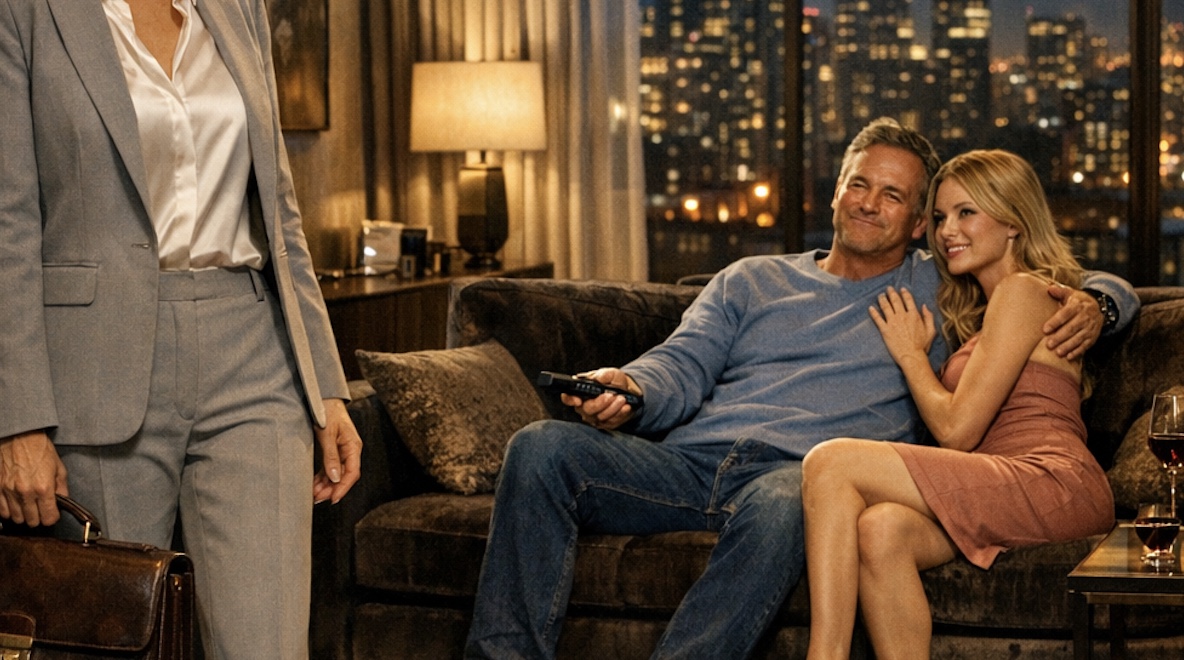
“Take off the ring, Inna. It never suited you anyway—too delicate for hands used to blueprints,” Kirill said without even bothering to rise from the sofa.
He sat there with one leg crossed over the other, lazily stroking Angelika’s knee. The very same “assistant girl” I had hired into our design studio myself three months earlier. Angelika looked at me with that peculiar blend of pity and superiority only women possess when they believe youth is a lifetime pass to paradise.
“Are you serious?” I set my bag down on the console table in the entryway. “Like this? On a Wednesday evening? In front of her?”
“When else?” Kirill yawned. “Angel and I are serious. She inspires me, you know? With her, I feel like an artist, not just some project manager. But you… you turned into a function, Inna. A foreman in heels. Estimates, budgets, the constant smell of plaster. I’m sick of it.”
“That ‘foreman’ paid for your new Mercedes and this apartment,” I replied, forcing my voice not to shake.
“The apartment is in my mother’s name. You know that,” he smirked, and there was so much venom in that smile I physically felt nauseous. “So legally, you’re just a guest here. I’m giving you one hour. Pack the essentials. You can collect the rest later, when Angel and I leave for vacation.”
Angelika let out a smug little laugh and pressed herself against his shoulder.
I stared at them and no longer saw the people I had worked with and lived beside. They were strangers now—two people who had decided they had the right to rearrange my life as they pleased. Ten years. Ten years of dragging our studio out of debt, finding clients, sleeping on construction sites while Kirill “built connections” in expensive restaurants. His father, Boris Arkadyevich, had always said, “Inna, you’re the foundation. Kirill is a weather vane. Just make sure the foundation never cracks.”
Boris Arkadyevich had died six months earlier. He was the only loss I had truly mourned. He had been closer to me than my own father.
“Did you hear me? Your hour started already.” Kirill tossed my favorite Murano glass vase into my empty suitcase. It didn’t shatter, only thudded against the bottom, but the sound was like something inside me splitting open.
I didn’t cry. I didn’t scream or beg. I just walked into the bedroom.
My dresses still hung in the closet. My shoes were lined up below them. I packed mechanically. Jeans, a couple of sweaters, my laptop. The most valuable things weren’t there. The most valuable things were locked in the safe—the code Kirill had never bothered to remember because, in his words, “paperwork is boring.”
I pulled out Boris Arkadyevich’s old leather briefcase. He had handed it to me a week before he died, in the hospital.
“Inna, there are documents in there for the house in the countryside, along with some personal papers of mine. Don’t open it until Kirill shows his true face. I know him. I raised him. The moment he feels untouchable, he’ll try to hurt you. In that briefcase is your insurance.”
At the time, I had thought the old man was delirious. Bitter at his son, maybe, disappointed by his carelessness. It turned out he had seen everything with perfect clarity.
“Done packing?” Kirill appeared in the doorway just as I zipped the suitcase shut. “Leave your keys on the nightstand. And don’t even think about coming to the office tomorrow. You’re fired, Inna. I already signed the order as генеральный директор.”
“You can’t fire me, Kirill. I’m a co-founder.”
“Forty percent, sweetheart. I have sixty with my mother. We held the meeting yesterday. So now you’re a free artist. You can go back to your mother in that little district town of hers—maybe paint fences there.”
I said nothing. I lifted the suitcase. It was heavy, but I didn’t feel the weight.
As I passed Angelika, I noticed the pendant around her neck—a gold teardrop. Boris Arkadyevich had given it to me for my thirtieth birthday. Kirill must have gone through my jewelry box while I was out on site.
“Beautiful pendant,” I said softly. “Wear it, Angelika. It’ll do you good to get used to things with history. Soon enough, you’ll have plenty of history of your own.”
I walked out of the apartment. Behind me I heard Kirill laughing and some sharp comment from Angelika that I didn’t catch.
Outside, the air was cold. I got into my car—the only thing still registered in my name. I threw the suitcase into the back seat and placed the briefcase beside me.
My fingers shook as I slid the key into the ignition. One sentence pounded through my head: You’re a guest. Ten years of life erased with a single flick of the hand.
I didn’t drive to my mother’s. I drove to a small hotel on the outskirts where our contractors used to stay. I needed somewhere I could open the briefcase in peace.
The hotel room smelled of stale smoke and was barely bigger than a closet, but I didn’t care. I sat on the bed without taking off my coat and laid the briefcase in front of me.
There were no gold bars inside. No bundles of cash. Just a folder of documents and a yellowed envelope sealed with wax. On the front, in Boris Arkadyevich’s handwriting, were the words: To Elena. Personal delivery only.
Elena—that was me. On paper, I was Elena, though everyone in the family had called me Inna because my mother thought it sounded more refined.
I broke the seal.
“Dear Lena,
If you are reading this, then my son has finally become the disgrace I always feared he would. I’m sorry you had to live through that. But know this: I never once considered him the rightful master of our business. Kirill consumes. You create.
Most people think the building where your studio operates belongs to the municipality or is leased through some public foundation. It does not. It belonged to my company, Vector, which I deliberately kept separate from your studio. And that building—along with all the equipment and the land rights beneath it—I leave to you.
But that is not all. Look at the second document.”
My hands trembled as I pulled out the next sheet. It was an official extract from the shareholder registry of the holding company that owned the majority stake in our studio. It turned out Kirill and his mother only controlled those shares while Boris Arkadyevich was alive. His will clearly stated that if his son ever committed “actions damaging to the family’s reputation or aimed at violating the rights of fellow co-founders,” his share would automatically pass to a designated trustee.
That trustee was me.
Attached was a legal report documenting the violation. Boris Arkadyevich had hired lawyers long ago, and they had already collected evidence of Kirill laundering company money through shell businesses set up under Angelika’s name.
I read it all and could barely believe what I was seeing. Boris Arkadyevich had built this trap over years. He had known Kirill would steal from his own wife. He had known he would bring a mistress into our home.
I closed my eyes. In my mind I saw Kirill again, tossing that vase into the suitcase.
“Well then, Kirill Borisovich,” I whispered, “since you decided I’m only a guest, let’s find out who the real owner is.”
The next three months I spent in silence.
I didn’t answer calls. I didn’t show up at the office. I didn’t post angry messages online. Kirill celebrated what he thought was victory. He uploaded photos from our office with Angelika sitting at my desk. They launched a new campaign—A renewed studio, a new vision.
What they didn’t know was that my lawyers were working the entire time. We filed claims in three separate courts. We initiated a tax investigation into the shell companies. We prepared the forced removal of the general director.
The hardest part was staying quiet. Watching them destroy everything I had built piece by piece. In only two months Kirill managed to lose two major contracts because he had no idea how to work with technical plans, and Angelika’s only real talent was choosing curtain colors to match her manicure.
Clients began calling my private number.
“Inna, what is going on? They sent us a project full of structural errors! Kirill says it’s all your fault, but we know better…”
“Just hold on a little longer,” I told them. “Everything will be back where it belongs soon.”
The breaking point came when Kirill decided to sell the studio building to cover the debts he had racked up at a casino. Yes, my “creative” husband had found himself a new hobby.
He put the building up for auction without the faintest idea that it had never belonged to him. He was so certain of his own impunity that he had never even bothered to check the ownership documents. In his mind, if it had been his father’s, it was automatically his.
The day was set for Monday.
Kirill gathered potential buyers and bank representatives in the office conference room. He sat at the head of the table in his best suit, while Angelika, in a new dress bought no doubt with company money, poured champagne.
I stepped into the building at exactly ten o’clock. At my side was my attorney and two bailiffs in dark formal suits.
“Inna?” Kirill nearly choked on his champagne. “What are you doing here? I told you, you don’t work here anymore. Security!”
“Security isn’t coming, Kirill,” I said calmly as I walked to the table and laid a folder in front of him. This time it wasn’t Boris Arkadyevich’s old leather portfolio but a brand-new file stamped with an official seal. “They have new instructions now. Just like the rest of the staff.”
“What kind of circus is this?” He jumped to his feet, knocking over his glass. “Gentlemen, forgive me—this is my ex-wife. She’s not taking the divorce well…”
“The ex-wife is perfectly fine,” my attorney said coolly. “You, however, attempted to sell property that does not belong to you. In addition, you are under investigation for embezzlement on a particularly large scale.”
Angelika went white. She slowly set the bottle on the table and began backing toward the exit.
“Stay where you are,” one of the bailiffs said, stepping in front of her. “We’ll need to ask you a few questions about your businesses.”
Kirill snatched the papers out of the folder. As he turned the pages, the color drained from his face. It was the same face I had seen the night he threw me out—except now there was no smugness in it. Only raw animal fear.
“This is fake!” he shouted. “My father would never! He would never do this to me!”
“He didn’t do anything to you, Kirill. You did it to yourself.” I stepped closer. “You said I was just a function. A foreman. Fine. That function is gone now. And you can explain to these gentlemen where all their advance payments disappeared to—and why the building you tried to sell belongs to me.”
Kirill’s ruin was not quick. It was slow and methodical, like dismantling an unsafe structure brick by brick.
As the legal machine gained speed, it became clear that in just three months he had not only drowned himself in debt but also gotten tangled in a murky scheme involving government grants.
When everything started collapsing, it came out that Angelika had inspired him not only creatively but financially as well—encouraging him to transfer every asset into her name. The problem was that there were no assets left to transfer. Thanks to the clause in Boris Arkadyevich’s will, all of Kirill’s shares had passed to me the moment the first theft from the company had been officially documented.
“Lena, please,” he said when he came to see me six months later.
I was sitting in my new office. The entire building had been renovated. The studio was thriving. Old clients had returned, doubling their budgets.
Kirill looked pitiful. Cheap jacket. Greasy hair. Nothing remained of the polished “creative genius” he had once pretended to be.
“Angelika left me for that banker,” he muttered, staring at the floor. “She took everything I’d managed to give her. My mother’s apartment has been frozen over debts. I have nowhere to live. Lena, you’re kind. You remember how good things were between us, don’t you? Remember our wedding?”
“I remember you throwing a vase into a suitcase, Kirill,” I said without looking away from my screen. “And telling me I was a guest.”
“I wasn’t myself! I lost my mind!”
“No, Kirill. The devil had nothing to do with it. You simply decided the foundation could be thrown away and the roof would stay standing on its own. It doesn’t.”
“What am I supposed to do?” He was almost crying.
“The same thing I did that night. Pack your things—if you still have any. And go. Anywhere but my studio and my life.”
When he left, I felt something strange. Not joy. Not pain. Just silence. As if a broken machine had been humming in the room for years and someone had finally switched it off.
I opened my desk drawer and took out the same pendant—the gold teardrop. The bailiffs had recovered it from Angelika’s apartment and returned it to me as stolen property. I turned it over in my hand. The gold felt cold.
That evening I left the office. The city was lighting up around me. My driver was waiting at the entrance—something I could now afford, so I no longer had to waste time on the road and could devote myself entirely to work.
I told him to take me to the “village” Boris Arkadyevich had once mentioned. It turned out not to be some modest country house at all, but a vast estate on the shore of a lake framed by ancient pines. The old man had planned to build a retreat there for architects, but he had never lived long enough to see it happen.
I stood by the water, listening to the gentle crash of the lake. My phone buzzed in the pocket of my coat. A message from my mother:
Lenochka, when are you coming? I’m making your favorite pies.
I smiled.
What my father-in-law left me was never just money or land. It was a lesson. He taught me that justice is not something that falls from the sky. It is something you design yourself—calculating every load, every beam, every bolt.
Kirill believed he owned life because he had “connections.”
I knew I was the one in command because I had the plans.
I took the pendant from my pocket and threw it into the water. The golden drop flashed once in the moonlight, then vanished into the black depth below. I no longer needed reminders of the past.
I had a future.
And in that future, there was no place for “guests.”
Only for the owner.
Tomorrow would be a hard day. We were starting work on that architect’s retreat by the lake. I could already see where the main building would stand, and how the light would fall through the windows of the panoramic studio.
I got back into the car and said to the driver,
“Let’s go home.”
He didn’t ask where that meant. He already knew.
Home was the place from which no one could throw me out.
The place where I made the rules.
The papers in Boris Arkadyevich’s briefcase were no longer my insurance.
They had become my success story.