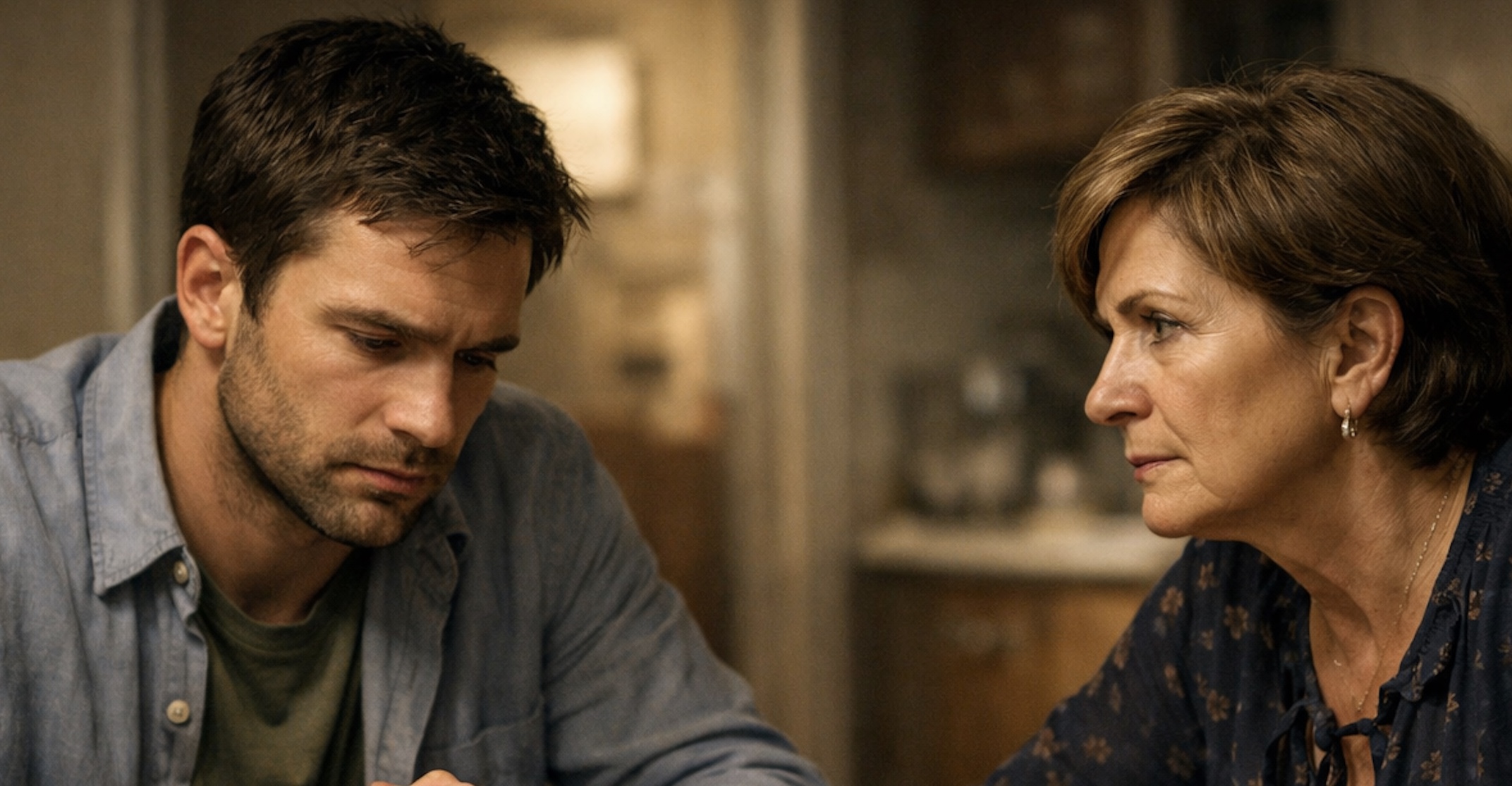
The Sunday morning was bright and deceptively calm. The kitchen smelled of freshly ground coffee and hot toast. Wrapped in a soft robe, Katya carefully spread cream cheese onto a slice of bread. She tried to move quietly, stretching out that fragile silence for as long as she could.
At the large table sat the unquestioned rulers of the weekend: Lyudmila Stepanovna, her mother-in-law, with the proud bearing of an empress, and Nikolai Ivanovich, buried in his newspaper. They had been living with the young couple for five years now, firmly settled into Katya’s three-room apartment. The routine felt less like cohabitation and more like a quiet, confident occupation.
Dmitry, Katya’s husband, nervously stirred the spoon in his empty coffee cup. His gaze slid over the familiar scene: his mother unwrapping yet another candy, his father noisily turning pages, his wife trying to make herself invisible. His throat was tight. Today he was about to break the fragile balance.
“Lyudmila Stepanovna, would you like some toast?” Katya asked, holding out the plate.
“What? No, I don’t,” her mother-in-law said with a disdainful grimace. “Your toast is dry. Where’s the caviar? Dima brought home excellent caviar yesterday, nice and grainy.”
Katya glanced at the jar in the middle of the table. Her parents had brought it from St. Petersburg, an expensive gift.
“It’s right there on the table,” Katya said softly.
Lyudmila Stepanovna reached for the jar and slowly spooned caviar onto the edge of her plate, as if she were doing everyone a favor.
“You should’ve put real butter with it, not this plastic-tasting cheese,” she muttered, spreading the caviar with a knife. “But it’ll do.”
Katya noticed a few dark gray eggs fall onto the tablecloth. Her mother-in-law didn’t even notice. Dmitry saw it too. His fingers clenched around the spoon until his knuckles turned white. It was such a small thing, but so revealing. Careless waste. Contempt for what mattered to someone else.
“Mom, Dad,” he said, his voice slightly hoarse. He cleared his throat. All eyes turned to him. “Katya and I need to talk to you about something. Something serious.”
Nikolai Ivanovich lowered the newspaper, suddenly alert. Lyudmila Stepanovna slowly finished chewing her caviar without taking her eyes off her son.
“We’ve been thinking a lot,” Dmitry began, staring at his hands. “About the future. We want to start saving. Really saving. For growing our family. For having a child of our own.”
A pause fell over the kitchen. Katya froze, the knife still in her hand. She knew what would come next, but that silence still made her chest tighten.
“That’s good, son,” Nikolai Ivanovich said first, though there was no joy in his voice, only caution. “A child is important.”
“Yes, that’s wonderful!” Lyudmila Stepanovna brightened, but her eyes narrowed. “But what does that have to do with ‘talking’? Save all you want. Does our little bit of help bother you? I help around the house.”
Katya barely held back a sigh. Her mother-in-law’s “help” mostly involved criticizing the cleaning and rearranging Katya’s things however she pleased.
“It’s not about help, Mom,” Dmitry said, lifting his head. In his eyes appeared the firmness he had spent so long searching for. “It’s about how we run this household. Chaotically. And we’ve decided that starting on the first of next month, we’re moving to a separate budget. Clear. Transparent.”
Lyudmila Stepanovna stopped chewing.
“What kind of nonsense is that?” she asked, her voice turning cold.
“It’s simple,” Dmitry continued, feeling goosebumps run down his back. “Each of us will have our own card. Shared expenses—utilities, major purchases—we’ll split evenly through an app. Separately. I’ll transfer a fixed amount to you every month, Mom and Dad. For groceries and your personal needs. A set amount. You’ll plan your own spending.”
The silence became absolute. Even the wall clock seemed to go quiet. Nikolai Ivanovich flushed red. Lyudmila Stepanovna slowly, very slowly, set her knife down on the plate. The clink rang out like an alarm bell.
She looked around the table as if seeing it for the first time. Then she stared at the refrigerator—that majestic symbol of common abundance from which she could take anything, anytime. Her cheese, her sausage, her fruit. Katya’s yogurts too, which she considered pointless indulgences. Now all of it was going to have an owner and a price tag.
Her face twisted not with anger, but with deep, genuine incomprehension. She looked at her son as if he had betrayed her by speaking nonsense.
“Son,” her voice trembled, not with tears but with rising, bubbling fury, “then where’s the food?!”
It wasn’t a question. It was a cry over the collapse of the natural order. How could there be “where’s the food”? It had always been here, in the fridge. Free. Shared. Hers by right—as mother, as homemaker, as the senior woman in the house.
Katya watched the scene, feeling everything inside her draw into a tight, cold knot. She met Dmitry’s eyes and saw both pleading and support there. She took a small, nearly invisible breath.
And shrugged. Lightly. Almost casually, as if the answer were obvious.
“In the store, Lyudmila Stepanovna,” she said in a quiet but clear voice. She didn’t add “like everyone else.” It hung in the air anyway. “In the store.”
The week after that Sunday conversation felt like walking through a swamp. On the surface, everything seemed calm, but every step threatened to drag them down into another petty clash.
Lyudmila Stepanovna treated Dmitry’s announcement not as a new rule, but as one of Katya’s temporary whims, something her son would surely stop indulging soon enough. “She’ll make a fuss and then calm down,” she told a friend on the phone, and Katya happened to overhear it from the hallway.
The first incident came on Wednesday. Katya returned after a long day at work and several doctor’s appointments, craving quiet and a light dinner. The day before, she had bought herself expensive goat cheese with truffle and some pears—not as a luxury, but on her gastroenterologist’s strong recommendation. Those foods were part of her diet, her medicine, and a small source of comfort.
When she opened the fridge, both the cheese and the pears were gone. On the shelf was an empty plate with greasy smears and crumbs. In the trash bin nearby, she saw the branded wrapping paper from the cheese.
In the dining area, in front of the television, sat Lyudmila Stepanovna.
“Lyudmila Stepanovna, have you seen the cheese that was here in foil? And the pears?” Katya asked, trying to keep her voice steady.
Her mother-in-law didn’t even look away from the screen.
“Oh, that moldy thing? I tried a piece. Didn’t like it. Bitter. I threw it out so it wouldn’t take up space. And those pears were juicy—I left them for Dima, he likes them.”
Katya closed her eyes for a second. She pictured that woman grimacing as she ate her “disgusting” cheese, bought with Katya’s own money from her own personal card—money Katya had set aside by denying herself other things.
“That cheese cost two thousand rubles,” Katya said quietly. “It was bought specifically for my diet.”
“Oh, here we go!” her mother-in-law finally turned from the television. “Making a scene over some cheese! I’ll buy you more with my pension if you’re that desperate.”
Katya didn’t argue. She understood now: words meant nothing to Lyudmila Stepanovna. For her, the only fact that mattered was that the refrigerator was shared, and therefore everything inside it was her territory. The boundaries Dmitry had tried to set were, to her, just smoke and mirrors.
The next day Katya made a quiet, methodical move. She ordered a compact but roomy mini-fridge online. It was delivered while Dmitry’s parents were out. Dmitry silently helped carry it in and set it up in their bedroom, tucked into the corner behind an armchair. His face was dark. He saw exactly where this was heading and felt ashamed it had come to this.
Then Katya did one more thing. She took a magnetic whiteboard she had once bought for planning and attached it to the big refrigerator door. In neat, almost calligraphic handwriting, she drew three columns: “L.S. Products,” “Shared,” and “Katya’s Products.” Under “Shared” she wrote “Milk, bread, eggs, butter.” Under her own column, nothing yet. Then she hung a capped marker beside it.
It wasn’t just an act of frustration. It was the systematizing of war. Turning a chaotic conflict into a regulated standoff.
That evening, when the family gathered in the kitchen, Nikolai Ivanovich was the first to notice the board. He stared at it, grunted, and turned away as though he had seen something indecent. Lyudmila Stepanovna noticed it later, when she went for kefir.
She froze in front of the fridge, reading the labels. Her back tightened. Slowly she turned toward Katya, who was calmly washing dishes.
“And what exactly is this little insult?” her mother-in-law asked, her voice like shards of ice. “‘L.S. Products’? Is that supposed to be me? I’m no longer family now, just some initials on your inventory list?”
“It’s for order, Lyudmila Stepanovna,” Katya replied without turning around. “So there won’t be any confusion. You do agree with the separate budget, don’t you? Well, here it is. Clearly laid out.”
“Clearly laid out?” her mother-in-law exploded. “This is an outrage! Signs in my own house like some dormitory! And…” her gaze darted toward the half-open bedroom door where the corner of the new white appliance was visible. “What is that? Is that a second refrigerator?!”
She strode across the kitchen and flung open the bedroom door. When she saw the brand-new mini-fridge, she let out a sound somewhere between a groan and a harsh laugh.
“A second refrigerator in my own house?!” she shouted now, at the universe, at Dmitry, who had come in at the noise. “What am I, a lodger here? Am I supposed to eat in the hallway now? Your wife has shoved me into a corner in my own apartment! She’s hidden things away from me like I’m some thief!”
Dmitry stood there with clenched fists. He saw Katya’s face—tired, pale, but unshaken. He saw his mother’s outburst for what it really was: not pain, but performance.
“Mom, this isn’t your apartment,” he said quietly but very clearly. “It’s Katya’s. She bought it before we got married. And that refrigerator is her personal property. Just like the food inside it. We tried to get through to you nicely. It didn’t work.”
Lyudmila Stepanovna went silent. The words “it’s Katya’s apartment” seemed to hit her harder than anything else. She looked at her son with bewilderment and hurt, as if he were speaking some foreign language. Then her eyes fell on the neat writing on the whiteboard. That cold, orderly bookkeeping was more frightening than any argument. It meant the end. The end of her unchecked power over that space, over that food, over those people.
She said nothing. She simply turned, slammed the door to her room, and left. But it wasn’t defeat. It was only a pause before the next attack. The war over the refrigerator had only just begun, and Lyudmila Stepanovna understood that the rules had changed for good.
The silence that settled after the refrigerator scene was thick and sticky. Lyudmila Stepanovna shifted to passive aggression. She pointedly stayed out of the kitchen whenever Katya was there, sighed loudly every time she passed their bedroom, and now lived almost entirely on cheap dumplings and pasta brought from the store by Nikolai Ivanovich, as though she were starving herself in protest.
But Katya could feel it—this calm was false. The main blow would come from somewhere else. And she was right.
Late Friday evening Dmitry came home exhausted from work. He quietly ate the dinner Katya had left for him in his section of the shared fridge, washed his plate, and went into the living room, where his father was, as usual, watching the news.
“Dima, come here for a minute,” came Nikolai Ivanovich’s calm but firm voice. “We need to talk.”
Dmitry exchanged a quick glance with Katya. There was worry in her eyes; in his, tired readiness. He nodded and followed his father into their room.
Nikolai Ivanovich shut the door. The room the parents occupied was crammed with their old furniture, making it feel like a foreign island embedded permanently into the apartment. It smelled of medicine, lavender, and old books. The father sat down in his armchair by the window and gestured for Dmitry to take the stool. Dmitry chose to remain standing.
“Well then,” Nikolai Ivanovich began, lighting a cheap cigarette even though smoking was forbidden in the house. “You’ve driven your mother to tears. To hysteria. She’s practically living on starvation rations now, on my miserable pension. Well done.”
“Dad, I transfer more to you than your pension,” Dmitry replied coldly. “And we discussed it. It’s a fair amount for groceries and your needs. Mom’s tears are because she was denied the right to control what belongs to someone else.”
“Someone else?” his father exhaled smoke. “Whose ‘someone else,’ son? Yours? We’re family. Or are you so whipped by your wife that you’ve forgotten who put you on your feet?”
Something twisted in Dmitry’s chest, something familiar and ugly. Guilt, heavily laced with irritation.
“I haven’t forgotten anything. And I’m grateful to you. But gratitude is not a lifelong bond certificate. For five years I’ve been paying for your life here. Utilities, food, medicine, clothes. Isn’t that enough?”
“No,” Nikolai Ivanovich cut him off. The weariness vanished from his voice, replaced by steel. “Because there are debts money doesn’t cover. You think your mother and I should be grateful that you’ve let us stay here? That’s your duty. Your obligation. And instead of fulfilling it, you’ve started this bookkeeping circus with apps and refrigerators.”
“What obligation?” Dmitry felt anger rise hot and bitter in his throat. “I’m an adult. I have my own family. You’re adults too. We help you. But we cannot support you entirely while denying ourselves everything. We have plans.”
“Plans!” Nikolai Ivanovich smirked, and it was unpleasant. “Saving for a child, are you? And who saved for you, huh? Who worked themselves to the bone so you could get into that technical school that started your career? Who bought you your first name-brand sneakers when no one else in the yard had any, so you wouldn’t feel ashamed? You’ve forgotten all that?”
“Dad, that was twenty years ago! The sneakers, the school—I am grateful! But I’ve repaid you many times over!”
“No, you haven’t!” his father snapped. He stood abruptly, crossed to the old dresser, and pulled out the bottom drawer. From it he took a worn school notebook with graph paper. “Here. Count it. You haven’t repaid a thing.”
He threw the notebook down on the table in front of Dmitry. With a bad feeling tightening in his chest, Dmitry opened it. The pages were filled with his father’s neat accountant’s handwriting. Dates. Items. Amounts.
“1998. Nike sneakers for Dima (equivalent of $300 at the time). Adjusted for inflation and interest today: 150,000 rubles.”
“2002–2005. Math tutor, 120 hours. Rate at the time: 500 rubles an hour. Total 60,000 rubles. Adjusted for current service prices: 300,000 rubles.”
“2006. Help with buying a used Lada—200,000 rubles (including moral depreciation and lost opportunity cost).”
The list went on: a jacket, a computer, money toward a down payment for an apartment they never ended up buying. Every line was cold, soulless arithmetic. His childhood, his youth, his needs, their parental help—all translated into rubles, multiplied by absurd formulas, and presented as a debt.
Dmitry began to shake. He looked at those numbers, at that cynical ledger, and felt everything inside him turn over. Affection, gratitude, warmth of memory—it all shattered against those icy columns of figures.
“What… what is this?” he forced out.
“It’s the bill, son,” Nikolai Ivanovich said calmly. “Our investment in you. We’re not asking you to return all of it. We’re just showing you that your help isn’t charity on your part. It’s repayment. A tiny part of the debt. So demanding ‘transparency’ from us, putting your mother on rations—that’s the height of ingratitude. You owe me. Do you understand? You owe me!”
The last words he shouted, stabbing a finger at his own chest, and his usually restrained face twisted with open, naked malice.
Something snapped inside Dmitry. Years of pressure, guilt, and exhaustion from being forever treated like a debtor burst out all at once.
“I don’t owe you anything!” His voice crashed through the room, drowning out even the television in the next room. “Did you sell me my own life? Every piece of bread, every shirt—turned into an IOU? You’re my parents! That was your responsibility! And I… I’ve spent five years of my life, my money, my nerves, on you! And that doesn’t count to you? That means nothing? No, Dad! You owe me! You owe me thanks for how much Katya and I have tolerated! You owe us respect for our boundaries! You owe us, damn it, at least the effort to understand!”
He was breathless. Tears stood in his eyes—not from hurt, but from helpless fury. He saw his father recoil from the shout, but there was no remorse in the old man’s face, only offended confusion and anger.
The door flew open. On the threshold stood Lyudmila Stepanovna, pale, and behind her Katya, her face showing both horror and readiness to fight.
“Dima! How dare you shout at your father!” his mother shrieked.
But Dmitry no longer heard her. He looked at his father, at the stupid notebook, at his mother, and understood one simple, terrible thing. Dialogue here was impossible. They did not hear. They only counted. Counted what they had given, while forgetting everything they had taken.
Without a word, shoulders hunched, he pushed past his mother, walked past Katya into the hallway, grabbed the first jacket he saw, and left the apartment, slamming the door behind him.
In the silence that followed his departure, only Nikolai Ivanovich’s heavy breathing could be heard. Katya said nothing. She turned and went into the bedroom, to that little refrigerator that had become the first line of defense in a war where even love and family ties had been reduced to dry, merciless numbers.
Dmitry returned at dawn, smelling of cold wind and cigarette smoke. He hadn’t smoked since his student days, but an old pack had apparently been left in one of his coat pockets. He silently took off his shoes, went into the bathroom, and stood under the running water for a long time, trying to wash away the feeling of having been dragged through something dirty and degrading.
Katya wasn’t asleep. She lay in the dark listening as he carefully opened the door, and she felt anger and pity fighting inside her. Anger toward those who had brought him to this state. Pity for him—for that strong man whom the machinery of his father’s manipulation had once again turned into a lost little boy.
The next morning the apartment was locked in an icy truce. Everyone avoided everyone else. Lyudmila Stepanovna, pale and with smeared makeup, came out for breakfast only to drink a glass of water in pointed silence and retreat again. Nikolai Ivanovich didn’t leave the room at all.
The silence broke around noon with a long, insistent ring at the door. Katya, working on her laptop in the bedroom, flinched. Dmitry, trying to focus on a report, lifted his head grimly.
“Who could that be?” Katya asked quietly.
Dmitry shrugged and went to answer the door. On the threshold stood his sister Olga, and behind her, her husband Igor, carrying a gift bag with a cake inside. Olga’s face wore the symmetrical, fixed smile of a peacemaker.
“Hey, brother!” she chirped, squeezing into the hallway and kissing Dmitry on the cheek. “Mom called and said the atmosphere here feels like a thunderstorm about to break. So we thought we’d drop by and lighten things up. Igor, put the cake in the fridge.”
Igor, always slightly awkward and silent, obediently headed for the kitchen. Olga slipped off her boots and walked into the living room, surveying the place with the gaze of someone entitled to every inch of it. Her eyes paused for a moment on the magnetic board attached to the fridge. Her lips twisted briefly, but she restored her smile at once.
“Katya, where are you? Come out, don’t hide!” she called.
Katya came out, feeling like an unwelcome guest in her own home. She greeted them politely but coolly. Olga hugged her with the force of a best friend who had never in fact been one.
“So, tell me,” Olga said, settling comfortably on the couch, “what exactly happened here? Mom’s in tears, Dad’s silent as a partisan, Dima looks miserable. I hear rumors about some separate budget and refrigerators. Have you all lost your minds?”
Her tone was light, almost joking, but there was a hard, evaluating gleam in her eyes.
“We just set boundaries, Olya,” Dmitry said tiredly, sitting down in the chair opposite her. “And no one wants to respect them.”
“Boundaries, boundaries,” Olga waved a hand. “This is family, not two neighboring states. Okay, maybe Mom overdoes it with the food. She’s from another generation. You should have handled it gently, like family. But what have you done? What is this? Starvation? Accounting?”
“She was offered a clear, sufficient amount,” Katya cut in, sitting beside her husband. “And the chance to decide for herself what to buy. That’s normal.”
“Normal for whom?” Olga narrowed her eyes. “For strangers, maybe. But Mom? She’s constantly worried, constantly under pressure. She can’t be expected to think about money—her blood pressure shoots up. She needs care, not financial reporting.”
Dmitry sighed heavily.
“Olya, we’re not talking about taking away care. We’re talking about reasonable distribution of resources. We have plans too.”
“Plans, plans,” Olga interrupted again, her voice gaining a metallic edge. “You know, Dima, I understand everything. But put yourself in our shoes. Mine, for example. Mom calls me crying, saying you’re throwing them out into the street. What am I supposed to do? Rush here and soothe everyone? I have my own problems—mortgage, kids. I can’t take them in, we barely have room ourselves. So by introducing your ‘boundaries,’ you’re creating a problem for the entire family.”
Silence filled the room. Igor, who had come back from the kitchen, stared at the floor. Katya felt a wave of nausea rise from the logic of it. The problem wasn’t the broken boundaries. The problem was that no one else found those broken boundaries convenient anymore.
“I have a compromise,” Olga announced triumphantly, seeing that her words had landed. “Maybe separate budgets are the right idea, but it was too abrupt. Mom can’t process it. Let’s do this: keep the household budget shared, like before. But so Katya doesn’t worry about being shortchanged, I’ll handle the accounting. Honestly and impartially. I’ll be your family accountant, so to speak. A monthly summary. Every receipt, every expense. Mom will be calm, and you two will have transparency. Peace in the family.”
She smiled, pleased with herself. It sounded so reasonable. So mature. But Katya saw the trap immediately. Impartial? Olga, who had thought from day one that her brother had married beneath himself? Olga, who always backed the parents no matter what because it was easiest to placate them and leave the burden on Dmitry?
Dmitry hesitated. His exhaustion and longing for some kind of peace were beginning to show. The proposal sounded logical on the surface.
“I… I don’t know, Olya. I need to think.”
“What’s there to think about?” Olga laughed. “It’s for peace. Mom will stop crying. Dad will stop growling. You and Katya will know where every penny goes. Perfect.”
At that moment Lyudmila Stepanovna came out of her room. The second she saw her daughter, her face lit up with genuine joy.
“Olechka, you came! My dear girl!” she exclaimed, rushing to hug her. “Talk to them, make them see reason! They’re driving me into the grave!”
“Mom, don’t worry, we’ll sort everything out,” Olga patted her back, throwing a victorious look at her brother. “Everything’s going to be fine. We’ve already found a solution.”
Later, when the parents had gone into the kitchen with Igor to drink tea with the cake, Olga caught Dmitry alone by the window.
“Dima, listen,” she began softly but insistently. “I know this is hard for you. But be a man, okay? Let it go. Let them eat what they want. Let them take what they want. In terms of your salary, this is nothing. But in return we get peace in the family. And honestly, if you don’t keep them here, they’ll start drifting toward me. And I…”—she lowered her voice to a whisper—“I’ve got enough problems with Igor already, and that mortgage is crushing us. I can’t afford to support them too. You don’t want your sister going broke because of your principles, do you? Think about the people close to you.”
She patted him on the shoulder and went back into the kitchen to their mother, leaving Dmitry standing there in stunned confusion. His sister had just openly admitted that her peacekeeping was really about protecting her own wallet. She didn’t want peace. She wanted the old arrangement preserved, with all the burdens still resting on him.
Katya came up and silently took his hand. She didn’t ask anything. She had heard it all from behind the door.
“She offered to do the accounting,” Dmitry said dully.
“I know,” Katya replied. “And I know that in her accounting my yogurts will become ‘pointless luxuries,’ while your mother’s three-hundredth face cream will be a ‘necessary expense.’ That isn’t a solution, Dima. It’s surrender. Just gift-wrapped.”
Dmitry closed his eyes. He felt trapped. On one side—his hysterical mother and his father with the debt notebook. On the other—his sister, manipulating his guilt and sense of duty. And in the middle of it all—Katya, his wife, and the future he had promised to protect. And he understood that the choice he made now would determine everything. Not just daily life. The very essence of their family.
Olga’s proposal lingered in the air like an unrealized threat. To his sister’s irritation, Dmitry never gave an answer, only a vague “we’ll think about it.” Olga left behind the aftertaste of a heavy misunderstanding—and the half-eaten cake, sitting on a shelf in the shared refrigerator like a silent reproach.
Having failed through her daughter, Lyudmila Stepanovna changed tactics. If she could no longer be the lady of the house, she would become its martyr. The most miserable one. The one no one could ignore.
The performance began small. She started complaining of dizziness and weakness. She sat in her room with a dim, exhausted voice, refusing the food Nikolai Ivanovich brought her, sighing loudly whenever Katya passed.
“That’s it, I’ve got no strength left,” Katya heard her moaning into the phone to a friend. “I don’t know what’s happening to me. I can’t go on. I can’t get a bite down. Probably from starvation. And there’s no one here even to hand me a glass of water.”
Katya and Dmitry pretended not to notice the spectacle. They stuck strictly to the rules: on Sunday Dmitry transferred the agreed amount to his father’s card. Nikolai Ivanovich, looking dark as a storm cloud, went to the store and filled their section of the refrigerator with cheap sausages, pasta, and canned stew. Lyudmila Stepanovna looked at those groceries as if they had brought her carrion.
The climax came Tuesday evening. Katya had just come back from the pharmacy, where she had gone for vitamins. In the hallway she ran into the neighbor from their floor, Aunt Zina, who loved gossip. The woman looked at her with obvious curiosity.
“Katenka, is everything all right at your place?” she whispered. “Your mother-in-law, Lyudmila Stepanovna, looked so pale in the stairwell, barely dragging her feet. She says she feels awful. You should keep an eye on her.”
Katya thanked her with an icy smile and went inside. Silence. Then from the parents’ room came a muffled but distinct groan, followed by a thud as if someone had fallen. Then Nikolai Ivanovich’s frightened voice:
“Lyuda! Lyuda, what’s wrong? Hold on! I’m calling for help!”
Katya rolled her eyes. She put down the pharmacy bag and walked firmly toward the living room. Dmitry, hearing the noise, stepped out of the office, his face twisted with alarm.
“Dima, hurry!” his father shouted, rushing out of the room. “Your mother’s unwell! Call an ambulance!”
Dmitry, pale, reached for his phone. But Katya was quicker. She calmly took his hand.
“Wait. Let me look first.”
She went into the parents’ room. Lyudmila Stepanovna was lying on the bed in a melodramatic pose, one hand thrown across her forehead. She looked pale, but Katya noticed the darting movement of her eyes beneath her closed lids.
“Lyudmila Stepanovna, what happened? Where does it hurt?” Katya asked in a neutral tone.
“Everything… everything hurts,” her mother-in-law whispered without opening her eyes. “Weakness… darkness before my eyes… probably hunger… you’ve starved me…”
“I’m calling the ambulance,” Dmitry said firmly from the doorway. This time Katya did not stop him.
The arrival of the medics became theater inside theater. The moment Lyudmila Stepanovna heard the doorbell, her moaning grew even more pitiful. Nikolai Ivanovich launched into his script as soon as he met them.
“Please help, doctor! My wife nearly fainted! She doesn’t eat, she has no strength! It’s all because of these new rules—they’ve put her on starvation rations!”
Two women entered: a doctor in her fifties with a tired, intelligent face, and a young paramedic. The doctor gave the room a quick glance, pausing on Katya and Dmitry, who stood in silence, and on the supposedly weeping Lyudmila Stepanovna.
“What happened?” she asked, approaching the bed.
A flood of complaints followed: dizziness, nausea, weakness, black spots before the eyes, no appetite at all. Everything was laced with hints of mistreatment. Nikolai Ivanovich made sure to add, “They keep their food separately, in a locked fridge!”
The doctor said nothing. She measured blood pressure, listened to the heart, shone a light into Lyudmila Stepanovna’s eyes. The readings were almost ideal for her age. Slight tachycardia—from agitation.
“When did you last eat?” the doctor asked.
“Oh, I… I hardly eat at all…” the mother-in-law whimpered. “A bit of tea with dry crusts, that’s all…”
The doctor looked up and met Katya’s eyes. There was neither judgment nor sympathy in her expression. Only professional fatigue and curiosity.
“And where is this… ‘locked’ refrigerator?” she asked.
“It isn’t locked,” Katya said clearly. “It’s just separate. The shared one is in the kitchen. Please.”
She led the doctor out. The paramedic remained behind. In the kitchen, Katya gestured toward the large refrigerator, the whiteboard with its columns still attached to the door. The fridge was packed. The parents’ section was stuffed with sausages, cold cuts, cheese, yogurts—everything Nikolai Ivanovich had bought.
“The patient complains of malnutrition and hunger fainting,” Katya said calmly as she opened the door. Her voice was stripped of emotion, like a narrator’s. “Here is their section with their food. You may inspect it for signs of starvation or vitamin deficiency.”
The doctor silently examined the shelves piled with food. Her gaze passed over the board and its tidy labels. Then she turned and went back to the room. Katya followed.
“Well, doctor?” Nikolai Ivanovich asked anxiously.
The doctor packed her case.
“Objectively, I see no serious нарушения—no serious problems,” she said. “Blood pressure is normal. Heart rhythm is steady. Weakness and dizziness may be stress-related. I recommend rest, avoiding stress, and”—she paused briefly—“regular, proper meals. There is clearly enough food in the home for that. If the condition worsens, call again. Goodbye.”
She headed for the door. Katya walked her out. In the hallway, while putting on her coat, the doctor paused for a moment. She looked straight at Katya. In her tired eyes there was something like understanding, like solidarity between women worn thin.
“My dear,” she said quietly, low enough that no one in the rooms could hear, “I get three calls like this a day, all for different reasons. Hang in there. Don’t give in. Boundaries are not cruelty. They’re hygiene. Mental hygiene.”
She nodded and left, closing the door behind her.
Katya remained standing in the silent hallway. From the parents’ room came dissatisfied whispering. The performance had failed. The doctor refused to play along. But that brief, firm support from a complete stranger meant more to Katya in that moment than any words from her husband. It was confirmation from the outside world: she was not going crazy. She was not cruel. She was protecting her home.
She took a deep breath and went back into the living room. Dmitry was looking at her, and in his eyes she saw relief mingled with shame.
“That’s it?” he asked.
“That’s it,” Katya answered. “The show is over. But”—she glanced toward the closed door of the parents’ room—“the intermission won’t last long.”
For a week after the ambulance visit, the apartment was wrapped in funeral silence. But it was not the silence of reconciliation. It was the tense, metallic hush before a siege. Humiliated by the failure of her little performance, Lyudmila Stepanovna barely left her room. Nikolai Ivanovich moved through the apartment darker than a storm cloud, and when his eyes happened to meet Katya’s or Dmitry’s, they were heavy with accusation. Katya could feel the pressure building, condensing into something dense and dangerous.
She chose not to wait for the next blow. After the doctor’s words about “mental hygiene,” something inside her settled for good. She understood that while the shock of the failed act was still fresh, she had to secure her position. She spent two evenings after work calmly, methodically doing something at the computer that had nothing to do with her normal tasks.
And then, on Friday evening, while Dmitry, worn down after a hard week, was trying to unwind in front of the television and Katya was making tea, Nikolai Ivanovich stepped into the living room. He stood there for several seconds, looking at his son’s back, and then said in a voice stripped of all former passive aggression. There was only cold, honed steel in it.
“Enough. The games are over.”
Dmitry turned. Katya froze with the kettle in her hand.
“What do you mean, Dad?”
“I mean exactly that. Your mother and I have discussed it. These childish games with budgets and refrigerators are humiliating and we’re done with them. We live here. We are registered here. And we are not going to let ourselves be blackmailed with food like some beggars.”
“No one is blackmailing you,” Dmitry said tiredly, rubbing the bridge of his nose. “We set rules. Fair ones.”
“Fair?” Nikolai Ivanovich snorted. “Fair is when a son respects his parents. Not when he puts them on an allowance like poor relatives. And as I see it, the apartment was bought during the marriage. Maybe not with our money, but still—that makes it common property. And we have at least a moral share in it. And since we’re registered here, our rights are solid. You can’t throw us out just because you feel like it. Or do you think we’re just going to silently endure your wife treating us as if we aren’t people?”
Dmitry sprang to his feet, his face flushed with anger and helplessness.
“Dad, is that a threat? Are you going to start ‘defending your rights’ now? After everything we’ve done for you?”
“We’re defending our dignity!” Nikolai Ivanovich barked. “And our legal right to housing! If you don’t want to live with your parents the way a son should, then fine. We’ll go all the way. To court if we have to. Let the court decide who’s right here and who’s sitting under his wife’s heel.”
The word “court” hung in the air like sudden thunder. Dmitry went silent. He had expected hysteria, resentment, arguments. But not this direct legal blackmail. Not this. He felt the floor slipping beneath him. Registration, court… it sounded so serious, so frighteningly adult.
And then Katya spoke. She did not raise her voice. She set the kettle down on the table with a soft but distinct click. All eyes turned to her. She was pale, but utterly calm.
“Nikolai Ivanovich,” she said clearly, as if giving a lecture, “you’re mistaken on several key points. Let’s go through them so there are no illusions.”
She walked out from behind the kitchen counter and into the bedroom. A moment later she returned carrying a thick blue document folder. She placed it on the coffee table as if it were a chessboard and she were making the final move.
“First. The apartment is not marital property. I bought it three years before I married Dmitry. The funds came as a non-refundable monetary gift from my grandmother. Here”—she opened the folder and placed the first document on top—“is the state registration certificate. Sole owner: me. And here”—she laid down a second paper—“is the notarized deed of gift for the funds from my grandmother to me, specifying their intended purpose: the purchase of this apartment. The amount matches the apartment’s value at that time.”
She spoke evenly, without theatrics. Nikolai Ivanovich stared at the documents, and the confidence in his face began to crack. Dmitry looked from his wife to the papers, astonished.
“Second. Registration—permanent address registration, to be precise—does not create ownership rights,” Katya continued, pulling out several more printed pages. “It only confirms the fact of residence. And that right can be challenged in court by the owner if cohabitation becomes impossible.”
She laid down excerpts from housing law, highlighted in marker.
“You are violating my right to peaceful enjoyment of my home, which is constitutionally protected. You have systematically and deliberately created an environment in which living together has become impossible: scandals, false emergency calls, psychological pressure, damage to my personal property,” Katya listed it all without changing her tone. “I have already collected evidence. Statements from neighbors about the noise and disputes, documentation of the ambulance call that revealed no medical cause, photos of damaged belongings. All of this is enough to support a legal claim for deregistration and removal of residents who have lost the right to use the premises.”
She fell silent, letting the words sink in. Nikolai Ivanovich stood there, eyes lowered to the folder. His face had gone from flushed to gray. He had not expected this. He had counted on fear, on retreat at the sound of big words like court. He had not expected a prepared, legally informed defense.
“You… you were planning to take us to court?” he croaked, no longer looking at Katya but at Dmitry, searching his son’s face for betrayal.
“I was planning to protect my home, my family, and my mental health,” Katya corrected him. “Your threat simply accelerated the process. I don’t want a court case. But I am prepared for one. And believe me, my position is much stronger. The ownership is mine. The rights violations are on your side. The evidence is mine.”
She closed the folder. The sound was quiet, but in that silence it landed like a verdict.
“So choose,” she said, very softly now. “Either we find a way to coexist peacefully while respecting the boundaries that have been set. Or we move forward with legal action, and in the end you will still have to find another place to live—only then without my help with the deposit, and with the relationship ruined forever.”
A silence fell so complete that the hum of the kitchen refrigerator could be heard. Nikolai Ivanovich no longer looked at them. He looked at the floor, absorbing the collapse of all his plans. His bluff had been seen and crushed.
Dmitry looked at his wife, and in his eyes, along with shock, something new appeared. Respect? Yes. But also a faint, cold fear. He was seeing Katya for the first time not as a victim, not as a tired woman, but as a formidable, unyielding force. A force that knew her rights and was prepared to defend them to the end. And he understood that in this fight for their shared future, he had, in a way, failed to rise to her level. He felt ashamed—and bitterly so.
For three days after that legal reckoning, the apartment was sunk in dead silence, but of a different kind now. Before, the silence had been tense, electric with the expectation of another explosion. Now it was heavy and hollow, like a house after its owners had moved out. The parents barely left their room; only muted whispering drifted from behind the door now and then. Nikolai Ivanovich, after such a crushing defeat, seemed to have shrunk inward and aged. Even Lyudmila Stepanovna stopped her demonstrative moaning.
But the biggest change was in Dmitry. He moved around the apartment like a ghost—silent, withdrawn, dark circles under his eyes. He barely spoke to Katya, answered in monosyllables, and at night tossed and turned before going out to smoke on the balcony. Katya saw that a civil war was raging inside him, one more terrible than any fight with his parents. He was being pulled apart between his duty as a son and his duty as a husband, between pity for aging parents and the cold, unmistakable understanding that his future with Katya was in danger.
Katya did not pressure him. She simply stayed near. She cooked his favorite meals, wordlessly placed a cup of coffee in front of him when he sat staring into nothing. She understood that he had to make this choice himself. And that it would be the hardest choice of his life.
The turning point came Thursday evening. After three days in hiding, Nikolai Ivanovich came into the living room, where Dmitry was watching football alone. He sat down across from him and said, without any introduction, eyes fixed not on his son but on the screen:
“So this is how we’re going to live? Like a cat and a dog? Are you satisfied? Your mother is wasting away, crying quietly so she won’t disturb you. But you held your ground. Good for you. A real man. You chose your wife and abandoned your parents.”
Dmitry did not answer at once. He turned the television off with the remote. The room went quiet.
“I didn’t abandon anyone, Dad. You’re fed, you’re sheltered, money is transferred to you every month. Where exactly is the abandonment?”
“In your heart!” the old man struck his chest with a fist, and his voice finally cracked, ringing with genuine old pain. “In your heart, son! We are not neighbors in a shared apartment! We are your flesh and blood! And you treat us… like strangers. Through papers, through laws. Even your wife—at least she’s honest in her hatred. But you… you simply turn away.”
The words landed exactly where they were meant to—in the raw wound that had been tormenting Dmitry for days. He wasn’t turning away. He was betraying someone. Slowly, silently, through his own inaction, he was betraying either his parents or Katya. And that thought was driving him mad.
He got up without another word and went into the bedroom. Katya was lying there reading. He sat down on the edge of the bed with his back to her and buried his head in his hands. His shoulders trembled slightly.
“That’s it,” he exhaled, his voice ragged and cracked. “That’s it. I can’t do this anymore.”
Katya gently laid a hand on his back. He flinched, but he did not move away.
“I’ve become the kind of person I always despised,” he whispered. “I’m throwing my own old parents out. Into the street. I’m a monster.”
“You’re not throwing them into the street,” Katya said quietly but firmly. “You are offering them a decent alternative. You’re giving them freedom, and you’re giving us a chance. That is not monstrous. It’s an adult, painful decision.”
“They’ll never understand that.”
“They don’t need to understand it. They need to accept your decision. As the head of the new family you created.”
He raised his head, and Katya saw his face wet with tears. Not sobbing—just quiet, masculine, desperate tears.
“I love you,” he said simply. “And I want us to have children. Our own home. Our own life. And with them… with them that will never happen. They’ll consume everything. Our love, our nerves, our money, our future. They’ve already almost consumed it all. I can see it. And if I don’t stop this now, then you and I… there will be no us left.”
He spoke with such bitter clarity that Katya felt her own throat tighten. This was not an outburst, not a burst of angry resolve. It was more like a sentence he had finally passed on himself.
“What do you want to do?” she asked.
“I want to let them go. And free myself… free us.”
He ran a hand over his face, wiping away the tears, and stood up. There was a resolve in his movements now that had been missing before. He went into the living room, where his father still sat, and asked him to call his mother.
Ten minutes later, they were all seated in the living room. The parents on the sofa, tense and wary. Dmitry and Katya across from them. Dmitry began without emotion, almost monotonously, as if reading from a prepared text.
“Mom, Dad. Katya and I have thought everything through. We cannot go on living like this. Not us, not you. We are all suffering. So I’ve made a decision.”
Lyudmila Stepanovna grabbed at her chest, but Dmitry continued without reacting.
“I will continue helping you financially. Every month you’ll receive a fixed amount from me. More than you’re receiving now. It will be enough to rent a small but decent apartment in this same neighborhood, pay for food, and live on. I’m prepared to help with the deposit for the first month. But we are not going to live together anymore.”
Silence struck the room, and then it shattered under Lyudmila Stepanovna’s scream.
“You’re throwing us out! Throwing us out, old people, into the street! I knew it! She got what she wanted!” She jabbed a finger toward Katya, her face distorted with raw hatred.
“Mom,” Dmitry’s voice cracked through the room like a whip. “This is my decision. Mine alone. No one made me do it. And no one is throwing you into the street. You will have a roof over your heads and money to live on. More than many pensioners get. But it will be your life. Separate from ours.”
“We’re not going anywhere!” Nikolai Ivanovich shouted, leaping to his feet. “We are registered here! This is our home!”
“Dad,” Dmitry looked at him tiredly. “After your threats about court, and after Katya showed you the documents, there’s no point pretending otherwise. Either you start looking for a place within the next month, and we do this civilly, with my help. Or”—he took a deep breath—“we really do go to court. And you leave anyway. Only then it will be without my help, without the deposit, and with the relationship destroyed forever. The choice is yours.”
He said it not as a threat, but as a fact. And in that calm certainty was frightening power. His parents saw in his eyes something they had never seen before: finality. A period at the end of the sentence.
Lyudmila Stepanovna stopped shouting. She stared at her son, wide-eyed. At first there was incomprehension in her face, then horror, and then a cold, all-consuming disappointment.
“So that’s it…” she whispered. “It’s over. We don’t have a son anymore.”
She got to her feet and, without looking at anyone, walked to her room. The door clicked shut softly, and that soft click sounded louder than any slam.
For several seconds Nikolai Ivanovich looked at Dmitry as though trying to find in his features the little boy for whom he had once been a hero. He did not find him. Silent and hunched over, he shuffled after his wife.
Dmitry remained sitting alone in the living room. Katya wanted to go to him, but he stopped her with a gesture.
“Please. Give me a little time. Alone.”
He sat like that for nearly an hour, unmoving, staring into the darkening window. Then he rose and went into the bathroom. He locked the door, turned on the water, and Katya, listening, heard not sobs but strange, muffled sounds—as if he were screaming into a folded towel so no one would hear how his heart was being torn apart.
When he came out, his hair was wet and his eyes were red, but his gaze was straight. He walked to Katya, pulled her into an embrace, and held her so tightly she could hardly breathe.
“I’m sorry,” he whispered into her hair. “Sorry for all of this. For letting it drag on so long. For allowing it to get this far.”
“Don’t apologize,” she said, holding him just as tightly. “Just stay with me. From now on. In our life.”
He nodded without letting her go. They stood there in the middle of the living room, in an apartment that was finally, at the cost of immense pain, becoming their home again. But victory in this war did not smell like triumph. It smelled like ashes. The ashes of burned hopes for one big happy family, the ashes of childhood illusions, and the ashes of that notebook where parental love had been itemized in rubles.
Half of the month Dmitry had given them to find housing had already passed, but it felt as if time in the apartment had frozen. Outwardly, his parents seemed to have accepted the decision. Nikolai Ivanovich even browsed rental listings, demonstratively showing Dmitry absurdly overpriced apartments or places in distant districts.
“See, Dima, what your rental money buys? Slums,” he grumbled. “And your mother needs to be close to the clinic, close to the stores. You can’t give more, can you?” It was just another layer of manipulation now, but Dmitry, though he clenched his jaw in anger, remained firm.
“Dad, the market is the market. Keep looking. Or you’ll have to consider cheaper areas. That’s your choice.”
Lyudmila Stepanovna, meanwhile, had sunk into a dark, almost theatrical silence. She had stopped even pretending to do housework. She simply sat in her room or watched television, radiating cold offense at the entire household. But Katya, who had learned how to read silence, felt that this calm was deceptive. In her mother-in-law’s eyes, whenever she thought no one was watching, Katya caught not grief but concentrated, calculating malice. The look of a child who, after being punished, is already planning some petty but painful revenge.
The first sign appeared on Wednesday. Katya was getting ready for an important meeting with potential clients—her small design studio was close to landing a major contract. For the occasion she had taken out her favorite dress: elegant, wool, deep sea-green, bought years ago with her first bonus. It hung neatly on the wardrobe door, ready to wear.
After showering, she reached for it and her fingers brushed something rough on the fabric. She turned the dress toward the light. Right in the most visible place, across the chest, there was an ugly brown burn mark about the size of a coin. The fabric around it had fused and puckered. It smelled of scorched wool.
Katya froze. The dress was ruined beyond repair. Slowly she turned. The iron stood on its base by the ironing board in the corner of the bedroom. Beside it lay a damp cloth for steaming that had not been put away. It all looked like an accident: someone had forgotten to switch off the iron, brushed the dress… But Katya knew she had not ironed the day before and had not left anything plugged in. Dmitry hadn’t either.
She silently hung the damaged dress back in place, put on another one, and went to the meeting. It went well—the contract was nearly hers—but inside she burned with a cold, lucid fury. It had not been an accident. It was a shot in the back. Quiet, petty, carefully aimed at something that mattered to her.
She said nothing to Dmitry that evening when he asked how the meeting had gone. “Fine,” she answered. She did not want to give them the satisfaction of another scandal. But her vigilance sharpened to its limit.
The climax came on Saturday. Dmitry had left in the morning to meet with a realtor—he had decided to actively help his parents find a place, if only to speed things up. Katya planned to spend the day working and then, as she did every autumn, make something cozy. She remembered a small jar of cherry preserves—the last jar she had made with her mother five years ago, during the last peaceful summer before her mother’s serious illness. It was not just food. It was the taste of childhood, the smell of their summer kitchen, her mother’s laughter, her warm hands sorting cherries. Katya had saved that jar for a special moment. And today, in that atmosphere of grief and broken ties, she suddenly needed that thread back to the past, to a world where love was not measured in money and not destroyed with irons.
She went into the kitchen to get the jar from the back of the cupboard—and stopped in the doorway.
Lyudmila Stepanovna stood at the sink with her back to her. In her hands was that very jar, with its familiar blue checkered lid. Katya froze as she watched the older woman slowly unscrew it. Then, with a stone-cold, expressionless face, she tipped the jar over the sink. Thick, dark ruby preserves with whole cherries still intact began to pour into the drain, slowly, almost ceremonially. The fruit clogged in the metal grate, leaving blood-red streaks on the white enamel.
Lyudmila Stepanovna set the empty jar on the counter and turned to rinse it out. And then she saw Katya. There was no fear on her face. No remorse. Only cold, defiant satisfaction. You caught me—so what?
Katya did not scream. She did not lunge at her. She walked slowly into the kitchen, stepped up to the sink, and looked at the preserves spreading over the porcelain. It looked like a symbol of everything that had been ruthlessly destroyed in this house: trust, memory, tenderness.
“Why?” Katya asked quietly, without taking her eyes off the sink.
“It had gone bad. Smelled weird. Took up space,” Lyudmila Stepanovna replied indifferently, rinsing the jar.
“It hadn’t gone bad. It was sealed. And it smelled like cherries. And summer. You knew it was the last jar I made with my mother.”
Her mother-in-law shrugged and placed the clean jar in the drying rack.
“You’re too sentimental. Junk should be thrown out in time. Like anything unnecessary.”
That was too much. Too cynical, too deliberate. Katya slowly raised her eyes. There were no tears in them. Only that same icy, crystalline clarity that had appeared the day she brought out the blue folder.
“You know, Lyudmila Stepanovna,” she began so quietly that the older woman had to listen carefully, “I spent a long time thinking about what it is you really want. Food? Comfort? Attention? No. That was all just cover. You were trying to take far more from me than space in a refrigerator.
“You tried to take my husband away from me. First through guilt, then through blackmail. It didn’t work. You tried to take my home by threatening court and playing games with registration. That didn’t work either. And now, when nothing else is left, you’re trying to take my memories. My things. My connection to my mother. Because you cannot bear the thought that I have something of my own, something valuable that has nothing to do with you. Something you cannot control.”
Lyudmila Stepanovna opened her mouth to insert something, to put on that contemptuous face of hers, but Katya didn’t let her speak.
“No. Be quiet. Right now this is not your daughter-in-law speaking. This is the owner of this apartment. And I am telling you for the last time: this little sabotage theater is over. The ruined dress, the poured-out preserves—these are childish acts of spite. They change nothing. They only confirm for me and for Dmitry exactly who you really are.
“You have two weeks left. You can leave peacefully, accept your son’s help, and preserve at least some decency in this relationship. Or you can leave in scandal, through court, with police involvement if you decide to stage one more destructive scene—and with your reputation ruined before every relative we have, because I will personally make sure they know why we were forced to take those measures. Choose.”
She turned and walked toward the kitchen doorway. At the threshold she stopped, without looking back.
“And one more thing. The preserves. You didn’t need them. I did. You’ve taken away the taste. But you will never take away the memory. And you certainly won’t take away my right to decide what happens in my own home. Remember that.”
And she left, leaving Lyudmila Stepanovna alone in the kitchen before a sink streaked with sticky, sweet, senselessly spilled red.
For the first time in the entire conflict, there was neither anger nor resentment on the older woman’s face. Only empty, stunned confusion. She had delivered what she believed was her cruelest blow. And her opponent had not even flinched. She had simply looked at her with the gaze of a rightful owner staring at a harmful little pest that had finally become impossible to tolerate.
And in that moment, with chilling clarity, Lyudmila Stepanovna understood that she had lost. Completely and beyond repair. All her methods—tears, hysteria, blackmail, quiet sabotage—had shattered against that impenetrable wall of dignity and legal right. She was no longer the queen of this house. She was not even a guest. She was a problem being solved.
Slowly, as if she had suddenly aged years, she wiped her hands on a towel and shuffled back to her room, unable even to wash away the sticky traces of her own petty, worthless revenge from the bottom of the sink.