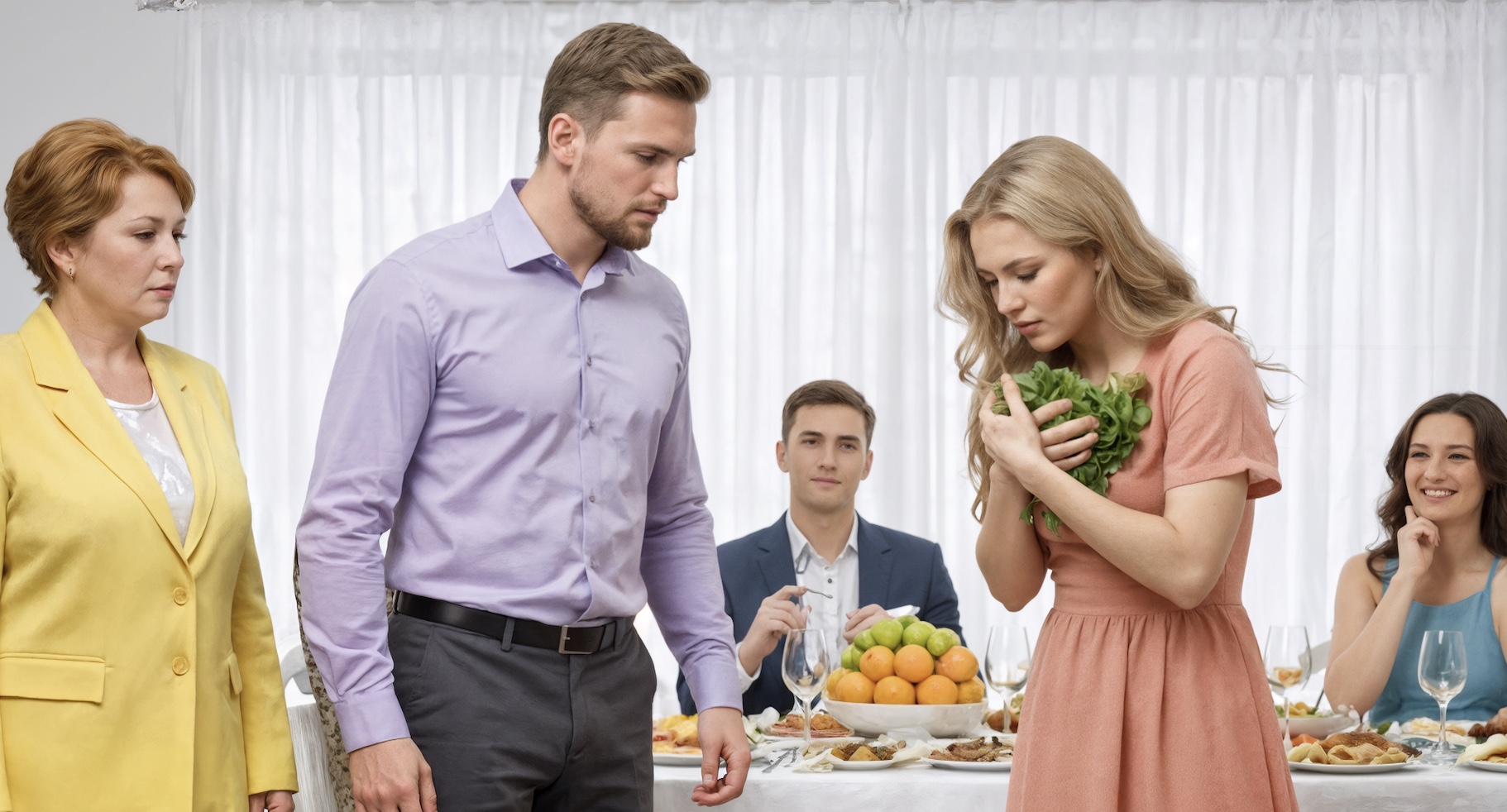
A heavy winter boot flew past my ear and slammed into the coat rack with a dull thud. The coat hanging there slid to the floor as if someone had ripped it down on purpose.
“Are you deaf?” Oleg stood in the doorway to the living room, unfastening the top button of his shirt. His face was flushed, and a vein pulsed in his neck. “I said get out. I don’t want you here in five minutes!”
I stood there clutching a salad bowl to my chest, not having had the chance to put it on the table. My hands were shaking so badly that the glass gave off a faint ringing sound. From the room where loud music was blaring and drunken laughter spilled out, Nadezhda Vasilievna appeared. She adjusted the large brooch on her chest and pressed her lips together in disgust.
“Ksyusha, have some shame,” she said in that sugary voice of hers that always made me sick. “It’s a man’s birthday, thirty years old. Important guests are here, respectable people, and you’re stomping around with a sour face. You’ve ruined everyone’s appetite. Let my son relax for once. Go… take a walk.”
“A walk?” My voice dropped to a whisper. “It’s twenty below outside. It’s night. Where exactly am I supposed to go?”
“I don’t give a damn!” Oleg barked, stepping closer. He reeked of alcohol and that heavy cologne his mother had given him. “Go to your father. To the train station. To some basement. You ruined my celebration! Did I ask for a proper table? I did! And what did you make? Some weeds, some bland fish… My friends are laughing, saying my wife put me on a diet!”
He yanked the bowl out of my hands. I jerked instinctively, but I couldn’t hold on to it. The crystal shattered on the floor. Fragments scattered everywhere, mixing with the arugula and shrimp salad.
“There!” Oleg kicked a shard aside with the toe of his shoe. “This is my home! I’m the one in charge here! I decide who lives here and who gets thrown out. Put your keys on the table!”
I looked at him.
Three years.
For three years I had convinced myself we were a family. That his outbursts were just stress from work. That his mother’s visits “for a week” that somehow stretched into a month were only temporary. That all of this was some trial we would get through.
That very morning, I had transferred him my last forty thousand rubles, money I had been putting aside for a doctor’s appointment. He had said, “We need the table to look good. Larisa and her husband are coming. I can’t embarrass myself in front of them.”
Larisa.
His old school crush.
She was sitting in the living room right now in a red dress, probably hearing every word.
Slowly, I took my down coat off the hook. It was cold to the touch; icy air had been blowing through the cracks in the front door for months. Oleg had promised since October that he would seal them, but he never did.
“All right,” I said quietly. “I’ll go.”
“And make it fast!” Nadezhda Vasilievna snapped, nudging my handbag with her foot where it lay by the door. “And don’t you dare take any food. My son paid for that!”
I pulled on my boots and threw on my coat. My hat was somewhere in the closet, but searching for it under their eyes felt unbearable. I opened the door and stepped into the darkness of the stairwell.
Behind me, the lock clicked.
Twice.
Like a sentence being pronounced.
Outside, a blizzard was raging. February wind lashed my face with sharp grains of snow. I made it to the bench near the entrance, brushed the snow off with my hand, and sat down.
There was nowhere to go.
My parents lived in a village forty kilometers away. The buses had already stopped running. A taxi would cost at least fifteen hundred, and I had only two hundred rubles left on my card.
I pulled out my phone. The screen glowed in the darkness: 9:15 p.m.
My fingers were stiff from the cold, but I found the only number that mattered.
Dad.
One ring. Two. Three.
“Yes, Ksyusha?” My father’s voice was calm, but I could hear the strain in it. He always knew when something was wrong.
“Dad…” I tried to hold back the sobs, but they came out in broken, ragged breaths. “He threw me out.”
“Who?”
“Oleg. He and his mother… they kicked me out. Said the apartment is theirs and I’m nobody. I’m outside, Dad.”
The silence on the other end was terrifying. Not the empty silence of a dropped call, but the kind charged with something heavy, like the sky before a storm.
“Are you still by the building?” he asked at last. His voice had gone low, rumbling.
“Yes.”
“Go into the twenty-four-hour pharmacy around the corner. Sit there. I’m coming.”
“Dad, don’t, the road is awful, there’s a blizzard—”
“I said wait.”
I sat in the pharmacy on a plastic chair, staring at a shelf full of vitamins. The pharmacist, an older woman in glasses, kept glancing at me but said nothing. Only once did she offer me some water. I refused.
I wasn’t trembling from the cold anymore.
I was shaking from humiliation.
I remembered how, barely an hour earlier, Larisa had laughed loudly at my dress. “Oh, Ksyusha, is that from the last century? Nobody wears that anymore.”
And Oleg had laughed with her.
Forty minutes later, my father’s black SUV screeched up outside the pharmacy. Stepan Ilyich had bought it six months earlier for fishing trips, but right now it looked more like a tank.
He came inside, brushing snow off his shoulders. He wore his old but sturdy sheepskin coat. The moment he saw me—tear-swollen eyes, coat half open—his jaw tightened.
“Get up, daughter.”
“Dad, please, let’s just go to your place…” I whispered.
“No,” he said. “We’re going home. To your home.”
We climbed to the apartment. Music still poured through the door of what they had started calling “their” apartment.
My father didn’t ring the bell.
He took a key from his pocket.
I had forgotten he still had a spare set—“just in case, to water the flowers if you two go away.”
The click of the lock disappeared under the music.
We stepped inside.
The scene was almost absurd.
Oleg was dancing with Larisa, holding her far too close. Nadezhda Vasilievna sat at the head of the table like a queen, serving herself cake—the very same cake I had baked the night before until two in the morning. Oleg’s coworkers, already well drunk, were arguing loudly about politics.
“Well, well!” Oleg noticed us first. He let go of Larisa and swayed. “You came back? I told you I wouldn’t let you in! And you dragged your daddy here too? Stepan Ilyich, maybe you should take your daughter home. She’s not herself today. Started a hysterical scene over nothing.”
The music stopped. Someone had enough sense to switch off the speaker.
My father walked into the middle of the room without even taking off his boots. Wet, dirty prints marked the pale laminate floor I had polished the day before.
“I threw her out!” Oleg repeated suddenly, almost proudly, turning to his guests. “So what? I have every right! My house, my rules! She’s not going to ruin my party with that miserable face!”
Nadezhda Vasilievna hurriedly swallowed her bite of cake and stood, dabbing her lips with a napkin.
“Come now, why are you barging in like this?” she said. “Young people quarrel, young people make up. Ksyusha just likes to show character. She doesn’t respect her husband. We’re trying to teach her.”
“Teach her?” my father repeated.
He spoke quietly, but the room went so still that you could hear the refrigerator humming in the kitchen.
Stepan Ilyich unbuttoned his coat and pulled out a thick folder.
“Oleg,” he said, “it seems you’ve forgotten the conversation we had before the wedding. Three years ago.”
“What conversation?” Oleg frowned, trying to focus.
“You remember the keys. You said it was a gift. That we could live here.”
“I said, ‘Live here while you are a family.’ I let you into my apartment.”
My father took out a document stamped with blue ink.
“Can you read? Certificate of ownership. Voronov Stepan Ilyich. Purchase date: November 10, 2021. No deed of gift. No shared ownership. Nothing.”
Larisa, who had been standing by the wall, suddenly started fumbling for her handbag.
“Oh, I really need to go, my taxi is waiting—”
“Stay where you are!” my father barked, and she practically shrank in place. “The show isn’t over.”
He turned back to Oleg, whose face was beginning to drain of color.
“So,” my father went on, “you shouted that you were the provider? The owner? That Ksyusha was living off you?”
He pulled out another sheet—bank records.
“I wasn’t too lazy. I got a full printout of Ksyusha’s transfers. Every month—forty, fifty thousand into your ‘shared’ account. And here’s your credit history, son-in-law. Three loans? A fancy phone, a car, and… what’s this? A trip for your mother? All of it paid off with household money while my daughter walked around in an old down jacket?”
Nadezhda Vasilievna clutched at her chest and dramatically rolled her eyes.
“Oh, I feel faint… My medicine… You’re going to kill me…”
“Don’t bother,” my father cut in. “If we call an ambulance, they’ll figure out fast enough that you’re pretending. But I have already called the police. The district officer will be here in five minutes.”
“The police?” Oleg shrieked. “We’re registered here!”
“Your temporary registration expired a week ago,” my father said evenly. “You asked me to extend it. I said, ‘later.’ Well, now it is later. Right now you are strangers occupying someone else’s property illegally. Add property damage”—he glanced at the salad all over the floor—“and, judging by the mark on Ksyusha’s face, assault.”
The guests began to disappear.
Quietly, sideways, grabbing their coats and slipping into the hallway. No one said goodbye to the “master of the house.”
Larisa was the last to leave, throwing Oleg one final look full of contempt.
“Stepan Ilyich…” Oleg suddenly dropped to his knees. Right into the salad on the floor. “Forgive me! The devil got into me! I love her! Ksyusha, tell him! Come on! We’re family!”
I looked down at him.
At his expensive trousers smeared with mayonnaise.
At his sweaty face.
And I felt nothing.
No shock.
No rage.
Only disgust, the kind you feel when you’ve stepped into something filthy.
“You threw me out into a blizzard, Oleg,” I said. “You told me I was nobody. You were right about one thing—I am nobody to you.”
I turned to my father.
“Dad, make them leave. Now.”
“You have ten minutes,” my father said, checking his watch. “Take only your personal belongings. Don’t touch the electronics—I have the receipts, I know what I bought and what Ksyusha bought. Put the dishes back where they belong.”
What followed was pathetic.
Nadezhda Vasilievna darted around the apartment trying to stuff her jars of pickles into bags.
“Leave the jars!” my father ordered. “They’re heavy. You’ll hurt yourself.”
Oleg shoved his things into a gift bag that read Best Man Ever. His hands were shaking.
When they finally stood at the door, loaded down with bags, his mother turned and her face twisted with hate.
“May you be cursed! Choke on that apartment! Everything comes back around! Ksyusha, you’ll regret this when you realize nobody wants you!”
“Get out,” my father said calmly, taking one step toward her.
They bolted down the stairwell.
My father slammed the door and locked the night latch.
“Tomorrow I’ll change the lock cylinder,” he said matter-of-factly.
Then he looked at me, and the harshness in his face softened.
“Come here, little girl.”
I buried my face in his rough wool sweater that smelled of tobacco and frost, and finally cried.
Really cried.
Leaving those three years of lies behind me.
Six months passed.
I was sitting in the kitchen with a cup of coffee. The windows were thrown wide open, letting in the warm August breeze. The heavy smell of greasy food was gone from this place. Now it smelled of fresh pastry—I had been learning how to bake croissants.
I had done a lot in those months.
Thrown out the old couch Oleg used to lounge on.
Repainted the walls a soft beige.
Filed for divorce.
At court, Oleg looked pitiful. He tried to claim part of the property, demanded compensation for renovations he had supposedly done “with his own hands,” even though my father had paid a crew to do everything. The judge shut him down quickly once she saw the documents.
A few days ago, I ran into a mutual acquaintance. She told me Oleg and his mother were renting some shabby apartment on the outskirts of town. Larisa had left him two weeks after that birthday party—it turned out she had no interest in a man buried in debt and still tied to his mother. Oleg lost his job too. Word of the scandal had spread, and apparently his employer didn’t need someone like that on staff.
The doorbell interrupted my thoughts.
I went to the door and looked through the peephole.
A tall man wearing glasses stood on the landing with a toolbox in his hand. It was Saveliy, the new neighbor downstairs. We had met a week earlier after I accidentally drenched his balcony flowers.
“Hi,” he said with a smile when I opened the door. “You mentioned your faucet was leaking. I was passing by and thought, since it’s my day off… Hope I’m not bothering you.”
“Hi,” I said, smiling back. “Not at all. Come in. The pies aren’t ready yet, though.”
“I can wait. I’m patient.”
He came in, took off his shoes neatly, and set them straight by the mat. Then he went into the kitchen and got to work right away, without asking for a feast or demanding praise.
I watched his calm back, the sure movements of his hands, and understood something simple:
Life goes on.
And there is no room in it for people who can shove someone they claim to love out into the freezing night.
That evening, a message came from an unfamiliar number.
“Ksyusha, maybe we can start over? I sent Mom to the village. I’ve changed. Life is terrible without you.”
I read it, gave a small amused smile, and hit Block.
Then I set my phone aside and went back into the kitchen, where Saveliy was finishing his tea and telling me some funny story about his cat.
“Sava, want some more?” I asked.
“Yes, please. It’s delicious. You’ve done wonderfully, Ksyusha.”
I poured him more tea.
For the first time in a very long while, this home was filled not with fear, but with simple human warmth.
And that was worth far more than any performance put on for guests.
“Grandma was a magpie—she kept dragging junk into the shed,” Auntie laughed.
The granddaughter cried. Instead of an apartment, all she had been left was an old shed.
But the neighbor leaned in and whispered, “Valya carried things in there for five years. At night. Alone. And she used to cry in the kitchen, saying, ‘I won’t let them have it.’”
The granddaughter looked down at the shed floor.
The nails were shining.
New.