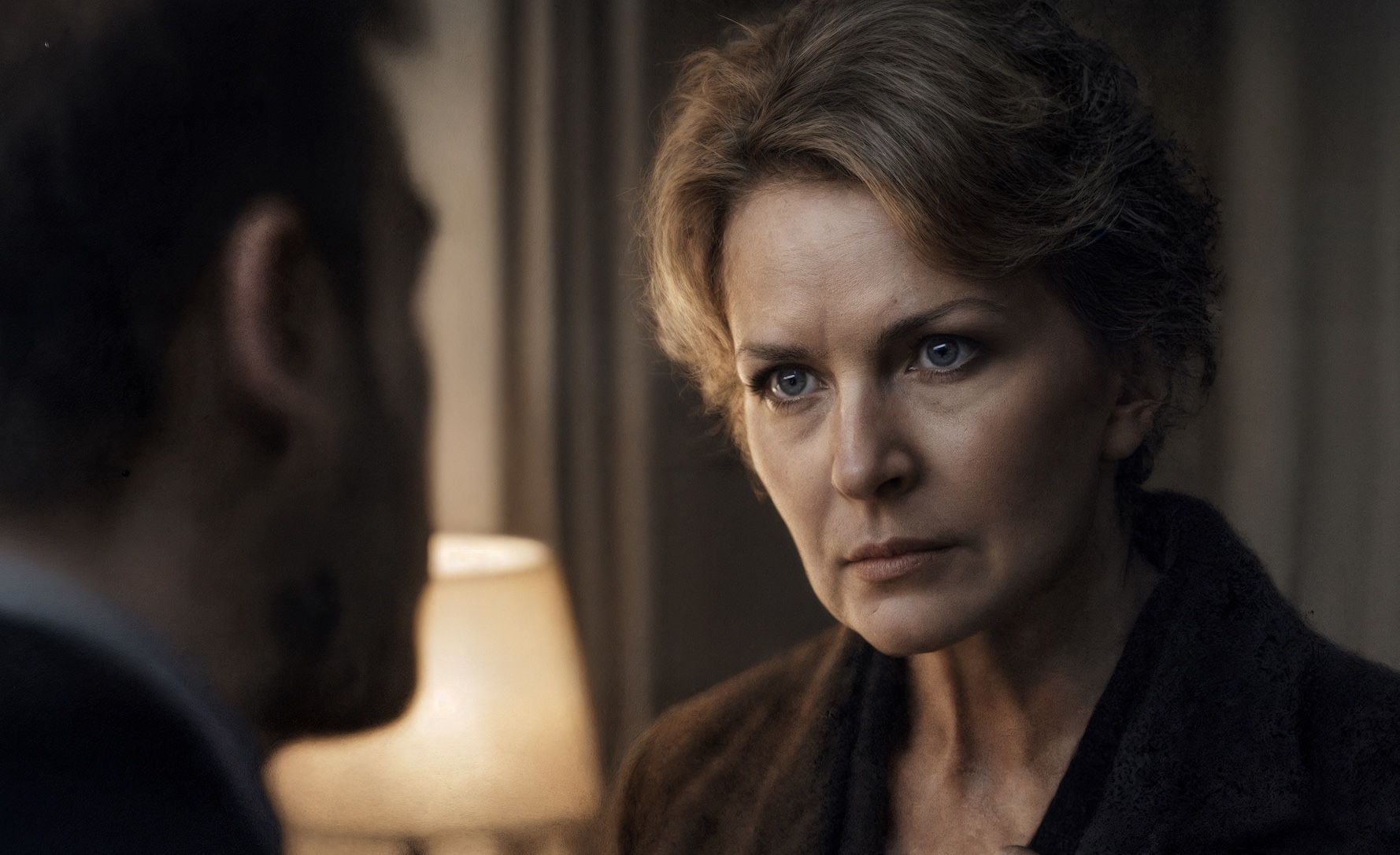
The workshop smelled of old wood, varnish, and time gone still. Makar loved that scent. It reminded him that even the most intricate damage could be repaired with patience and the right tools. He restored antique automatons—mechanical dolls and clocks—an art that demanded icy composure. Yet today his hands trembled ever so slightly as he fitted a microscopic gear into the mechanism of an eighteenth-century gilded peacock.
The doorbell sliced through the silence. Makar slowly removed his jeweler’s loupe, laid his tweezers carefully on the velvet pad, and stepped into the hallway. He already knew who was there. He had seen them through the video peephole while they were still downstairs.
The door swung open, letting into the sterile quiet of the apartment a cloud of heavy perfume mixed with tobacco and face powder. Two women stood on the threshold. One was tall and imposing, with a severe face covered in makeup that sat on her skin like war paint. That was Inga Petrovna, his mother-in-law. The other was shorter, jittery, with restless eyes—her sister Polina, Varvara’s aunt.
“Well, hello there, family,” Inga boomed without even pretending to be polite. She stepped inside without waiting for permission and kicked off her shoes as though she owned the place. “Where’s Varya? Sleeping again? How long is she going to keep moping?”
Makar blocked her path to the living room. His lean frame in a work apron should have been no obstacle to a woman like her, yet there was such cold resolve in his eyes that she hesitated for a moment.
“Why are you here? To ask for help?” Makar did not know what else to ask, though he understood perfectly well why they had come. “To remind my wife what you said to her last time? Or to finish her off?”
“Oh, don’t be dramatic, son-in-law,” Polina snorted, slipping sideways past the coat rack. “This is a family matter. Urgent. We’re her mother and aunt, aren’t we? Of course our hearts ache for her.”
“Your hearts?” Makar echoed, steel ringing in his voice. “You don’t have hearts, Inga Petrovna. You have a pump that moves blood around. Varvara will not be speaking to you.”
“That’s not your decision,” Inga said, adjusting the massive brooch on her lapel. “Who are you here? A husband. I am her mother. That bond can’t be broken. Move aside. We came to discuss old Alevtina’s inheritance. Varya has no use for it now—there are no children, and with her health who knows if there ever will be. But we have to live.”
The words hung in the air, thick and suffocating. Makar felt a dull fury begin to boil inside him, but it was not the kind that bursts into shouting. It was a colder urge, one that wanted to destroy quietly. He remembered the day it had all begun. A month earlier.
It happened while Makar was in Vienna at an auction for parts used in rare chronometers. The trip had been planned for six months, and Varvara, radiant and glowing in her third month of pregnancy, had practically pushed him out the door herself.
“Go. This is your chance. I’ll be fine. Mom promised she’d check in,” she had said, stroking her still-flat stomach.
She had no idea that for Inga Petrovna, “checking in” meant taking over.
Inga appeared on the second day after Makar left. She needed money. Not just money, but a large sum for the “business venture” of her latest boyfriend. Varvara refused—gently, but firmly. That money had been saved for the clinic and for the baby’s birth.
So Inga switched tactics. Methodically, almost sadistically, she pressed on every wound she knew how to find. She came every evening. She told Varvara that Makar was not alone in Vienna, that he was a failure living off Varvara’s gift—Varvara was a brilliant perfumer, known for creating fragrances for private collectors. She said the baby was unwanted, would probably be born sick, because “everyone in your family is weak and doomed.”
The breaking point came on Thursday. Inga and Polina arrived with a few workmen and insisted that Varvara help move furniture, claiming an antique chest of drawers belonged to Inga and had only been “loaned out.” Varvara tried to stop the movers. She grew anxious, shouted, begged them to stop. Inga stood nearby smoking, flicking ash onto the carpet.
“Don’t make a scene. You’re selfish, just like your father. All you ever think about is yourself. But helping your mother? Suddenly you have morning sickness? Don’t make me laugh. Pick up the boxes—they’re light.”
Varvara lifted one box. A sharp pain tore through her lower abdomen. She went pale and sank to the floor.
“Mom… it hurts… call an ambulance…” she whispered.
Inga looked down at her daughter with open disgust.
“Oh, here comes the performance. Get up, actress. Nothing hurts. You just don’t want to work.”
They did not call an ambulance for forty minutes. They argued over who would have to pay if it turned out to be a “false alarm” and the “faker” was only pretending. Polina suggested valerian drops. When Varvara lost consciousness and a stain spread across the pale parquet floor, Inga panicked—but not for her daughter.
“Damn it, she ruined the rug,” was the first thing she said.
The baby could not be saved. Varvara spent three days in intensive care. Makar caught the first flight home, abandoning the auction, but he was too late. Varya did not cry. She stared at the wall with dry, inflamed eyes. Something inside her had died along with the child. Whatever tenderness she still held for her mother was gone.
Now Varvara was in her laboratory—the far room of the apartment, remodeled into a perfumer’s organ. Shelves were lined with hundreds of bottles filled with essences, absolutes, and oils. It did not smell like an ordinary perfume shop. It smelled of wet earth, ozone after a storm, bitter wormwood, and burnt sugar.
Beside her sat Yana, her longtime friend and colleague, the owner of a small gallery. Yana silently sorted blotter strips.
“This one smells like anxiety,” Yana said softly after lifting a strip to her nose. “Varya, are you sure you want to see them?”
Varvara stood with her back to the door, blending ingredients. Her movements were sharp, precise, almost mechanical. She wore a strict black dress, her hair pulled into a tight knot. There was nothing soft or domestic about her.
“I don’t want to see them, Yana. I want to destroy them,” Varvara said evenly, her voice stripped of all warmth. “They came for Grandfather Veniamin’s apartment. They think I’m broken. They think I’ll sign everything over just to make them leave.”
“And Makar? He won’t let them in.”
“Makar is too civilized. He’ll stay polite until the very end. Those creatures only understand force. Greed has robbed them of even the instinct for self-preservation.”
The door to the laboratory flew open. Inga stood in the doorway, with Polina hovering behind her, frightened but still greedy.
“So here you are! Locked away with your stinking little potions!” her mother barked. “We’ve been out there having pleasant conversation with Makar. Varya, we need to talk. Seriously.”
Varvara turned slowly. In her hands she held a heavy glass bottle filled with dark liquid.
“Out,” she said quietly.
“What?” Inga blinked, then immediately drew breath for a scandal. “Listen to how she talks to me, Polina. We come here with concern, with help, and this is what we get. So listen carefully. That apartment your father supposedly left you—it belongs to us by rights. I suffered through ten years with him. I raised you. And now, since there won’t be any grandchildren…”
“STOP TALKING!”
It was not a scream. It was the growl of a wounded animal.
Makar, standing behind the two women, twitched as if to step in, but remained still. He saw Varvara set the bottle down on the table. Glass striking wood sounded like a gunshot.
“No grandchildren?” Varvara moved until she stood inches from her mother. She was shorter, but in that moment she seemed to tower over Inga like a cliff face. “AND WHOSE FAULT IS THAT?”
“Well, your body is weak, maybe it’s genetic—” Polina started, but fell silent under her niece’s stare.
“Genetic?” Varvara laughed, and the sound was more terrifying than tears. “You killed my son. You. With your greed, your malice, your disgusting ‘she ruined the rug.’”
“Don’t you dare accuse us!” her mother shrieked, sensing she was losing control. “You brought it on yourself! Nervous, hysterical! We wanted what was best for you! Sign away the riverside apartment and we’ll go. We need money for Polina’s treatment. She has… um… signs of something very serious!”
“She has signs of a missing conscience,” Makar said coldly.
“Be quiet, freeloader!” Inga snapped.
Suddenly Varvara stopped shaking. Her face became a mask of pure contempt. She walked to the table, picked up a red folder that Polina had been eyeing hungrily, and flung it onto the floor at her mother’s feet.
“You want money? You want the apartment?” Varvara’s voice thundered, gathering force. “YOU PARASITES! You spent your whole lives feeding off my father, then off me! Did you think I’d lie in bed crying forever? NO!”
She snatched up a blotter strip, dipped it into some reactive liquid, and hurled it toward her aunt. Polina recoiled. This was not ordinary anger anymore. It was raw, primal aggression.
“I HATE YOU!” Varvara shouted, her face twisted with revulsion. “You are not a mother! You are an incubator who imagined herself a goddess! You came here to finish me off? You thought I was weak? I AM STRONG! Stronger than your miserable little brain could ever understand!”
Inga Petrovna stepped backward.
“Varya, darling, calm down, this isn’t good for you…” Polina babbled.
“SHUT UP!” Varvara slammed her palm against the table, making the bottles clink. “GET OUT! I won’t give you a single coin! Not one square meter! You will rot inside your own spite! Get out before I throw you out myself!”
“You—” Inga hissed, her nerve beginning to return. “You’ll end up alone! Who needs a barren woman like you? Your husband will leave you in a year! A mother is sacred! We’ll take you to court! I’ll sue you for support! You are obligated to provide for me!”
At that moment, the front door in the hallway slammed. Heavy, assured footsteps followed. A figure appeared in the doorway to the workshop—the one person Inga Petrovna feared more than anyone else.
It was Veniamin Andreevich, the father of Inga’s late husband and Varvara’s grandfather. He leaned on a cane with a silver handle, but stood straight as an old oak. Beside him was his wife, Agata Sergeyevna, a tiny sharp-eyed woman who looked frail only at first glance.
“There will be no court case, Inga,” Veniamin Andreevich said calmly. “And no support payments either. Those are for parents in genuine need. Swindlers receive prison terms. But we’ll be merciful. We’ll simply cut off the air supply.”
Inga went so pale that her powder looked like plaster.
“Veniamin… what are you doing here? This is women’s business…”
“This is family business,” the old man cut in. “Varvara, you did well. I am proud of you. Anger is fuel. You burned the bridges, and rightly so. Now you two listen carefully.”
He stepped into the middle of the room without sparing his former daughter-in-law even a glance and turned to Makar.
“Show them the document.”
Makar opened a drawer and pulled out not the red folder, but a plain blue envelope. He took out a single sheet of paper.
“Inga Petrovna, you’ve been living all these years in that three-room apartment on Prospekt Mira. You thought it was yours, correct?” he asked with a polite smile.
“It is mine! My husband left it to me!” Inga declared.
“No,” Agata Sergeyevna said. “Our son, God rest him, was kind—but not foolish. The apartment was placed in a trust. Varvara is the beneficiary. You, Inga, have been living there as… let us say, a guest. Under a no-rent use agreement that renewed automatically every year.”
“Only for as long as Varvara wished,” Veniamin added. “We tolerated you while you still played the role of mother. But after what happened a month ago… Varvara, sign.”
Varvara took the pen he handed her. Her hand no longer trembled. She signed the paper with one hard sweep.
“What is that?” Polina croaked.
“Notice of termination of the agreement,” Makar explained. “You have twenty-four hours to vacate the property. The locks will be changed tomorrow at noon. Building security has already been informed. Your access passes will be canceled.”
“You have no right! I’m registered there!” Inga screamed.
“Your temporary registration expired three days ago,” the grandfather said coolly. “I checked. You forgot to renew it while you were so busy scheming to take the summer house. By the way, the apartment you were demanding today—the riverside one—was sold by Varvara a week ago. The money has already been transferred to a foundation that helps premature infants.”
A funeral-like silence fell. The only sound was the ticking of the many clocks hanging along the workshop walls. Tick-tock. Tick-tock. Inga Petrovna’s time had run out.
“Where am I supposed to go?” Inga asked suddenly, sounding lost, almost childlike. All her arrogance, all her shameless armor, collapsed into dust. She looked, for the first time, like nothing more than a bitter old woman nobody wanted.
“To your sister,” Varvara said, nodding toward Polina. “To that very same little two-bedroom on the outskirts. You’re so close, after all. Live there together. On your pension. Because the allowance I’ve been sending you every month ends today.”
“Varya! My girl!” Inga lunged toward her, trying to grab her hands. “Forgive me! I was led astray! I’m your mother!”
Varvara stepped back. Her face showed only disgust, as though something slimy had tried to touch her.
“Don’t come near me,” she said. “I have no mother. She died the day she pitied a rug more than her grandson.”
Makar opened the door.
“The exit is there. Don’t make me use force. I restore fragile things for a living, but I take out the trash without hesitation.”
The two women fled the apartment, hissing curses, but terror swam in their eyes. They understood it was no bluff. They had lost everything: comfort, status, money, and above all, their hold over the victim who had once fed their egos.
When the door slammed shut behind them, Varvara exhaled and leaned against her husband’s shoulder.
“I did it?”
“You were magnificent,” Makar whispered, kissing the top of her head, which smelled faintly of wormwood.
“Wicked as a witch,” Agata Sergeyevna said with a smirk. “Thank God for that. Goodness needs fists sometimes… or a sharp tongue.”
“Veniamin Andreevich, what about the apartment?” Yana asked. “Are you really throwing them out?”
“Of course,” the old man said, adjusting his glasses. “The movers are already there. Packing up their junk into garbage bags. Inga always liked seeing other people’s belongings handled carelessly. Now she can enjoy the feeling herself.”
Varvara looked down at her hands. They were clean. The pain had quieted, leaving behind a ringing emptiness that would one day be filled with new life, new fragrances, and the love of those who truly were family.
She walked back to the table, picked up the same blotter strip she had thrown earlier, and breathed in its scent.
“You know, Yana,” she said thoughtfully, “I’m going to call this perfume Liberation. It will need plenty of pepper. Black pepper. Hot, biting pepper. And salt. Like dried tears.”
“It’ll be a success,” Makar said with certainty.
Outside, evening was beginning to fall, but inside the workshop it was warm and bright. The clocks continued ticking, measuring out the first hours of a new era for a family that no longer had room for traitors. Down by the entrance of the luxury building, Inga Petrovna stood in the wind trying to call a taxi, only to discover there was not enough money left on her card. She did not yet know that her frozen accounts were one more parting gift from Grandfather Veniamin, a man who never forgave anyone who hurt his beloved granddaughter. She stared at the phone screen in horror, unable to believe it.
Her world had collapsed.
And it had collapsed because of the very people she had always considered weak and insignificant.
This was the end. Absolute and final.