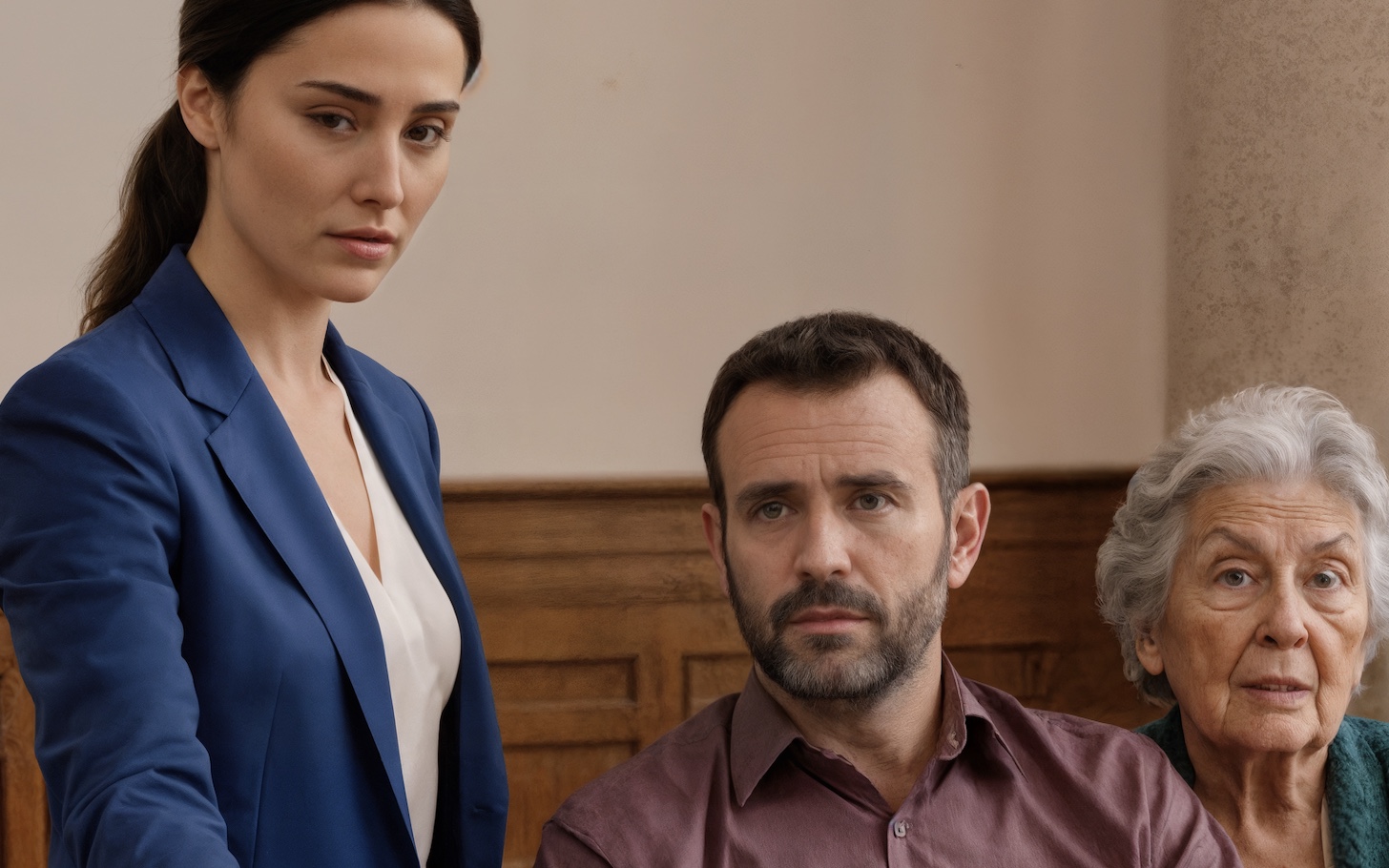
“It’s my mother’s property. You won’t win a thing in court,” Kirill said, flinging the folder of documents onto the table.
Dina lifted her eyes.
Her mother-in-law was sitting beside him with her arms folded, wearing the very same smile she had worn at the wedding eight years earlier. Back then, she had quietly asked her son, “Are you sure this is really going to last?” — and turned away when Dina held out her hand to greet her.
“The land was transferred into my name two years ago,” Olga Pavlovna said in a flat, emotionless voice. “Everything built on it belongs to me. You can file three lawsuits if you want. It won’t change anything.”
Dina said nothing. She stared at the boundary plan, then at the registration date.
Two years ago.
Back when they were still choosing bathroom tiles together. Back when he kissed her and said, “This is our home — for us and for Dima.”
“Do you have any conscience at all?” she breathed.
“And you do?” Kirill leaned toward her. “You live in an apartment your parents paid for, and then you tell me what belongs to me and what doesn’t?”
She stood up and picked up her bag. The lawyer tried to stop her, but she shook her head.
“All right,” she said quietly. “We’ll see.”
Eight years earlier, when they first met, Dina had only just opened her design studio. She had three clients, a rented workspace, and the constant fear that nobody would pay her.
Kirill came in with his arm in a cast after a traffic accident. He asked her to design a renovation project for his parents’ place. He spoke with confidence and looked at her as if he saw her, not just someone doing a job.
“You’re talented,” he told her while flipping through her sketches, “but you doubt yourself too much. It shows in your eyes.”
She laughed. He was right.
Six months later, they got married.
Two years after that, Dima was born — lively, stubborn like her, with his father’s smile. They lived in a tiny rented one-room apartment, and every night Dina counted money to make sure there would be enough for everything.
When their son turned five, her parents came over and said simply:
“We sold the apartment. Buy a place of your own. Just register it in our names for safety.”
Kirill exploded.
“What am I supposed to be — some outsider? Living in my mother-in-law’s apartment?”
“Kirill, it’s only a formality. Don’t insult them.”
“A formality? That’s humiliation.”
Dina spent three days trying to calm him down. She reminded him that they had nothing of their own, that Dima needed stability. In the end, he agreed.
But from that moment on, he changed. He became sharp, irritable, as though something inside him had cracked.
They started building the house two years later.
The plot had come to Kirill from his grandmother — a small, overgrown piece of land with a view of the forest.
“Let’s invest in it together,” he said. “It’ll be ours.”
By then, Dina’s studio was bringing in steady income. She paid for the materials, the workers, the equipment. Kirill contributed less, but she never kept score. They were family — why would she?
The construction dragged on for four years. It was a large house, two stories, with panoramic windows. Every month Dina transferred money, drove out to inspect the work, checked on progress. Kirill promised he would handle the paperwork.
“We’ll register everything when it’s finished. No point doing it before then,” he kept saying.
She didn’t insist. She had no reason not to trust him.
Then, in September, her mother called.
“Dina, Kirill has someone else,” she said. “Marina saw him with a young woman from the art school where Dima studies. They were leaving a café arm in arm.”
Dina hung up and sat in the kitchen staring at the wall. Her mother never said things like that without reason.
The next day, her mother suggested, “Tell him you’re having money problems. Let’s see how he reacts.”
Dina didn’t think it would work. But she tried.
“Kirill, I’m in trouble. The studio is collapsing, my clients are gone. I need help — at least for groceries until I sort things out.”
He looked at her for three seconds. Then he stood up, took his jacket, and said,
“I’m tired of your problems. Deal with them yourself.”
“Kirill, I’m serious.”
“So am I. I’m not an ATM.”
He walked out. An hour later, he sent a message: I’m moving into the house. I need to be alone.
Dina sat on the couch, feeling everything inside her turn cold.
A week later, she drove there without calling, without warning. She left the car by the road and walked across the property. The door was slightly open, and from the second-floor window came the sound of bright female laughter.
Dina climbed the stairs and pushed open the bedroom door.
Kirill was sitting on the bed she had chosen herself. Beside him was a barefoot young woman of about twenty-five, wearing his shirt. It was the art teacher — the very one who had spent six months praising Dima’s drawings and smiling so warmly at his mother.
“You’ve got some nerve,” Kirill said, standing up without the slightest embarrassment. “Bursting in here without permission?”
“In the house I built?”
“This is my land. End of story.”
“You got that land while we were married. Everything on it is ours.”
He smirked. The girl watched the scene with open curiosity, as though she were watching a show.
“You don’t have anything here that’s yours.”
Dina turned and walked out. Her hands were shaking so badly she could barely start the car. The next day, she filed for divorce.
The district court hearing was scheduled two months later. Dina brought every receipt, every bank statement, every contract with the workers. Her lawyer was optimistic — her financial contribution was obvious, the land had been received during the marriage, and half should legally be hers.
But Kirill showed up with his mother.
Olga Pavlovna placed the survey plan on the table.
“The land was transferred into my name two years ago. My son gifted it to me, and everything built there belongs to me.”
The judge studied the papers. Dina looked at the date — the transfer had happened in the middle of construction. Her mother-in-law spoke calmly, with icy confidence.
“I invested money into the construction. I have written receipts from my son.”
“What receipts?” Dina burst out. “I paid for everything!”
“You gave money to your husband, and he passed it on to me,” her mother-in-law said with a smile. “It was a family matter. We built it together.”
The district court ruled in Olga Pavlovna’s favor.
Dina walked out of the courtroom feeling as if the ground had disappeared beneath her feet. Her mother put an arm around her shoulders.
“We’re appealing.”
The appeal took three months to prepare. Dina gathered everything — testimony from workers, statements from neighbors who had seen her coming to the construction site every week, records showing that she had transferred the money herself, not Kirill. She included screenshots of conversations with the site manager where she discussed details and payments.
Dima kept asking why she looked sad. She would stroke his hair and tell him everything was fine. But inside, she kept thinking: If I lose, how do I explain that our home is no longer ours?
The appeal hearing lasted two hours.
Kirill sat stiff and tense. His mother looked as calm as ever. When the judge began reading the decision, Dina felt air return to her lungs.
“The district court ruling is hereby declared invalid. The claimant is awarded half the value of the residential house. The defendants’ counterclaims are denied.”
Kirill went pale. Olga Pavlovna pressed her lips together but said nothing.
Dina stood up with a copy of the decision in her hand and walked over to them.
“It’s my mother’s property. You won’t win a thing?” she repeated softly, echoing Kirill’s words. “Here are the documents. Go ahead — read them.”
She placed the folder in front of them.
Her mother-in-law snatched the papers and skimmed them. Her face twisted. Kirill tried to say something, but she cut him off sharply.
“Shut up. You ruined everything.”
Dina turned and walked away. Her mother walked beside her, holding her hand tightly.
Six months later, Dina stood on the porch of the house with panoramic windows and a view of the forest.
Half of it officially belonged to her now.
Kirill had tried to challenge the decision and lost at every level. His mother never called again.
Dina renovated her part of the house — a bright living room, a creative studio for Dima. On weekends, the two of them came there together. Kirill tried to show up once, but she didn’t open the door. She simply stood by the window and watched him turn around and drive away.
Her studio was thriving now. Clients came one after another. Dina no longer doubted herself. She knew her worth. She knew she could defend what was hers.
Dima ran in from the other room carrying a new drawing.
“Mom, look! It’s our house. Here’s the window, the forest, and us.”
She hugged him.
In the picture, the two of them were standing side by side, holding hands. No Kirill. No extra people. Just the two of them.
“It’s beautiful,” she said. “Really beautiful.”
And for the first time in a very long while, there wasn’t a trace of doubt in her voice.