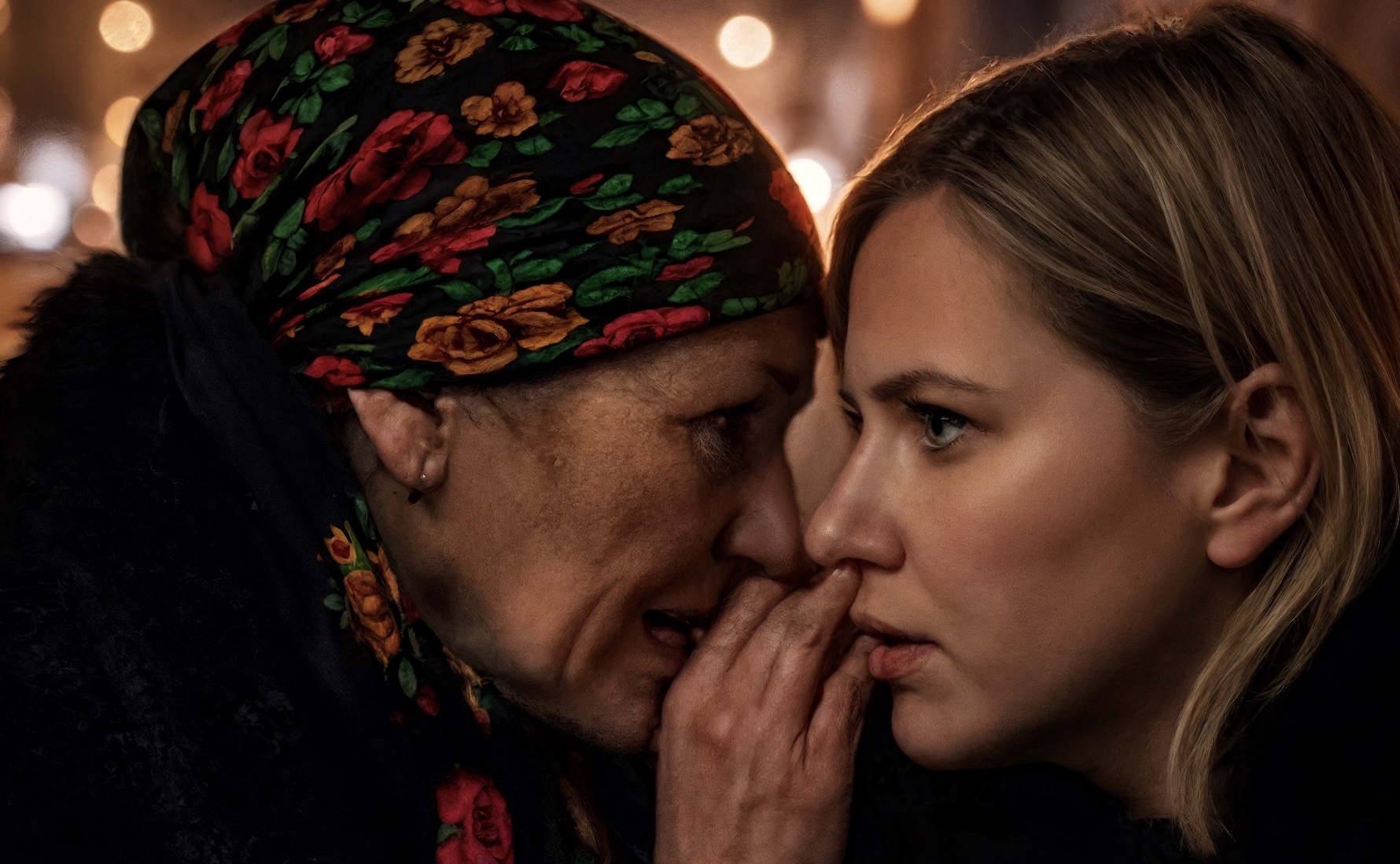
The minibus kept lurching over the potholes on Leningradsky Prospekt, and I’d already started regretting not just taking a taxi.
Inside, the air was sharp and ugly—a mix of exhaust, cheap air freshener, and human sweat. The driver mumbled to himself, occasionally spitting out curses at other cars.
“Stop after the light,” an elderly Roma woman asked from across the aisle. Against the rattling and roar, her voice sounded oddly gentle.
“Ninety rubles,” the driver barked without even turning his head.
She dug through a worn-out bag, pulling out coins. She shuffled them in her palms, confused, but it was obvious she didn’t have enough. People around her sighed impatiently. A taxi behind us was already honking, demanding we clear the stop.
“I’ll cover it,” I said, leaning forward and handing the driver the money. “For me and for her.”
The woman looked at me. Her eyes were startling—young, dark, almost black, with an unnerving shine.
“Thank you, daughter. May God protect you,” she said, getting to her feet. “And you protect yourself. When you get home, check the top shelf in your husband’s closet.”
I laughed.
“Well, of course. A classic prediction as thanks for the fare.”
She didn’t react. But as she stepped out, she glanced back.
“Check it, daughter. And don’t forget—truth is always better than a pretty lie.”
The minibus jerked forward again, and I immediately pushed the whole moment out of my mind, focusing on my phone instead. I still had another half hour before home, so I decided to use the time to reply to messages.
Anton had sent a photo of his lunch from some sushi place.
“The meeting dragged on, but I’m thinking about you nonstop. Miss you,” he wrote under the picture.
I smiled and replied:
“I already bought the ingredients for your favorite cake. So a sweet surprise is waiting for you at home.”
He answered instantly with heart emojis.
Anton had always been thoughtful, even in tiny things. We’d been together four years, yet he still sent me photos of his meals when he ate without me, told me how his day went, asked about my plans.
My friends envied me. They said their husbands turned into silent couch-dwellers after a year. With us, it wasn’t like that.
His IT job, of course, drained him—especially now, during the final push before launching a new project. Anton came home exhausted, but still found the energy to ask how things were going at school, and even help me check notebooks if I had too many.
And on weekends we always went somewhere together: a play, an exhibit, or simply a walk through the city like two students in love.
“Maybe on Saturday we can go see your parents?” I texted. “Mom called—she misses us.”
His response came right away:
“Of course, sunshine. We’ll stop by Pyaterochka and pick up something tasty.”
At home, I took out the groceries for Napoleon cake. Anton had said recently that he was craving homemade baking—the kind his grandmother used to make.
I asked my mother-in-law for the recipe and decided to try. The dough was finicky, but I managed. The layers were cooling on the table, and the cream was resting in the fridge.
Around ten, a message came in:
“Baby, I got completely buried in work. I’ll be home in about an hour and a half, no later. Tomorrow I’ll make you breakfast in bed to make up for it.”
I replied:
“I’ll be waiting—with our cake. It turned out almost like your grandma’s, just missing that special little touch.”
“Your special touch is you,” he wrote back immediately.
Smiling, I shook my head. Even tired and overwhelmed, my husband still knew how to be romantic.
As I fell asleep alone, the woman’s words suddenly resurfaced.
“Check the top shelf in your husband’s closet.”
Ridiculous, obviously. What could possibly be there? Old sweaters he never wore, boxes of random cables and chargers. Anton never threw out anything tech-related.
But why had she spoken so confidently about truth and beautiful lies? And that look… as if she truly knew something.
Still…
I woke to the sound of keys in the lock. Anton came home even later than he’d promised. It was already half past midnight.
I pretended to be asleep, listening as he quietly took off his shoes in the hallway, trying not to make noise. Then he peeked into the bedroom, came closer, and softly kissed my forehead.
“Sleep, sunshine,” he whispered. “We’ll talk tomorrow.”
I smiled into my pillow. That was one of the reasons I loved him: even half-dead from exhaustion, he still found the strength to be gentle.
In the morning, Anton really did make breakfast. Cottage-cheese blintzes, fresh-squeezed orange juice, and coffee—exactly the way I like it, not too strong. Sitting in the kitchen in my favorite cat-print pajamas, I watched him bustle around the stove in nothing but his boxers—messy, ridiculous, and strangely cute.
“Sorry about last night,” he said, setting a plate in front of me. “This project is eating my brain. But the presentation is coming up soon, and things will finally calm down.”
“It’s okay,” I said, spreading sour cream on a blintz. “At least I managed to bake the cake. Want to try it?”
His eyes lit up like a kid’s. We cut two slices, and Anton let out an exaggerated moan of delight.
“Lena, you’re a magician! This is even better than my grandma’s, honestly. I feel like the happiest little boy in the world. Wow!”
“Flatterer,” I laughed.
But after that line, the familiar heaviness slipped back into the air, like a shadow creeping into a bright room.
Another month had passed. Another nothing. I’d stopped buying pregnancy tests—why bother, when the outcome was always the same?
“Isn’t it wonderful when there’s no competition and all your attention goes to me, instead of some little selfish brats?” Anton suddenly burst out laughing. “Our life is so good right now! We can travel, grow, spend time on each other. Perfect, right?”
I nodded, trying to hide the sting in my chest.
We’d been married four years. The subject of children surfaced more and more between us. At first he said, “Let’s wait until we’re stable.” Then, “Until we solve the housing issue.” Now he’d found a new phrasing.
“Sure,” I said. “Everything has its time.”
But inside, everything tightened.
I was twenty-eight already. My biological clock wasn’t whispering anymore—it was pounding.
At school, I was surrounded by children all day, and I couldn’t stop imagining what ours would be like. Anton’s dark eyes. My stubborn streak…
“That’s my smart girl,” he said, slipping an arm around my shoulders. “We’re happy as we are, aren’t we? Why change anything?”
He was rushing to work. On Saturday he had an important call with clients in Germany. I walked him to the door, and he kissed me hard goodbye.
“Tonight I’ll try to get free earlier. We’ll sit at home and talk. I miss our conversations.”
Saturday deep-cleaning was our family tradition, but Anton was busy, so everything landed on me. I vacuumed, mopped, threw laundry in, cleared the pile that had built up.
But the thoughts of a baby wouldn’t leave me alone.
We’d both been checked at a clinic six months earlier. Everything was fine with me, and fine with him.
“Sometimes it happens,” the doctor had said. “Don’t panic. Stress, fatigue, a thousand factors. Relax, and it’ll happen.”
Relax. Easy to say… when every month you’re waiting for a miracle and getting disappointment instead.
Tears rose, but I forced myself to breathe and went to the bedroom.
While dusting, I remembered the Roma woman again.
“Check the top shelf in your husband’s closet.”
Yesterday it sounded stupid. Today… I don’t know—maybe because I was restless, maybe because the sadness made me reckless—I decided to look.
The shelf was high, so I had to stand on a chair. Up there were old sweaters, boxes of wires, winter hats. I moved things around without much interest—just to distract myself from the ache in my head.
And then my fingers found something small, tucked behind a stack of T-shirts: a tiny dropper bottle and a piece of paper.
I unfolded it—and froze.
My hand shook as I read the handwritten note, neat and unmistakably Anton’s.
“Dosage schedule: 3–4 drops into morning coffee, daily. Do not skip! Adds bitterness, but milk covers the taste. Works gently; the body won’t notice. One-hundred-percent protection against pregnancy.”
I read it again. And again. Not believing my eyes.
The bottle was half empty. No label, no brand, no markings—just plain medical glass with a dropper cap. So it was some homemade concoction poured into a regular pharmacy bottle.
My heart was pounding so loudly it felt like the neighbors downstairs should be able to hear it. I sank onto the chair, still clutching the cursed vial.
Four years.
For four years I’d tortured myself, convinced something must be wrong with me. I went to doctors, took tests, read forums full of desperate women. I cried into my pillow whenever another month ended in nothing.
And he… he’d been slipping this filth into my coffee every morning—some witch’s brew from who-knows-where.
“Relax, sunshine, it’ll happen,” his voice echoed in my mind. “Don’t obsess. We’re happy as we are.”
While day after day, he calmly poisoned me with a mystery liquid.
I remembered how he always got up before me and made coffee. How lovingly he brought me a cup in bed on weekends. How he’d worry if I drank coffee at a café:
“Home coffee is better. I’ll make you something much tastier.”
Everything clicked into place with horrifying clarity.
My phone buzzed. A message from Anton:
“How are you, baby? Miss you. Tonight we’ll have a romantic dinner—candles, wine, just the two of us.”
A romantic dinner. After four years of deception.
I stood and went to the kitchen.
On the table was my morning cup of half-finished coffee—Anton had made it before leaving. Normally I always drank it, but today I’d been distracted by cleaning.
I took the cup and poured it into the sink. The dark-brown liquid swirled down the drain.
How many cups like that had I swallowed over the years? A thousand? More?
Then I remembered the thermos on the counter.
“Take coffee with you when you go to the mall,” Anton had texted that morning.
Such a caring husband. I let out a sharp little breath, unscrewed the thermos, and poured it out too.
I needed somewhere to put the fury rising inside me. I pulled on my jacket and left the apartment. My feet carried me along familiar streets toward the park where Anton and I often walked in the evenings.
Fragments of memories spun through my head—me telling him about my students, speaking dreamily:
“When we have a baby…”
And him listening, nodding, hugging me—while continuing his dark routine.
The doctor’s words at the clinic:
“Just be patient. Nature will take care of it.”
How I blamed myself, hunted for reasons in my lifestyle, my stress, my age. How I signed up for yoga “to prepare for motherhood,” took vitamins, switched to a special diet.
And every morning Anton poured a few drops of some unknown potion into my coffee.
Who made it for him? Where did he find such a monster? On what site, in what corner of the internet did he search for ways to keep his wife from becoming a mother?
On a bench in the park sat a young mother with a stroller. Her baby slept while she read a book, glancing down at the child every so often.
So ordinary. So natural. And for me… an unreachable dream, stolen by the person closest to me.
I pulled out my phone and started typing a reply to Anton. I wrote “I know everything,” then deleted it. I wrote “You bastard,” deleted that too.
No. Conversations like this don’t happen by text.
Instead, I sent: “Great. I can’t wait for our special romantic dinner!”
Special… that part was true. You’ll see, darling, what it feels like—to be lied to.
I came home with a clear plan. But first I needed to know what this stuff was and where Anton had gotten it.
I turned on his laptop immediately. I knew the password—we never hid things like that from each other. The irony almost made me choke.
I started with browser history, but found nothing suspicious. Either Anton was careful, or he’d handled it all on his phone.
I picked up the bottle again and examined it more closely: ordinary medical glass, no labels, no identifying marks. The liquid inside was clear with a faint herbal smell. Definitely not factory-made.
From the note, it was obvious this “miracle drops” came from some healer or herbalist.
But how did he find her? Through whom? And most importantly—how long had this been going on?
I tried to remember when Anton started being so lovingly responsible for my morning coffee. We used to have breakfast together—whoever got up first made it. And then suddenly he developed that sweet habit:
“Sleep, sunshine, I’ll make your coffee.”
It seemed to have started about three years ago—right when I began talking seriously about children.
A coincidence? Not a chance.
By evening, my plan was fully formed. Anton was going to learn a lesson he wouldn’t forget.
For dinner I cooked his favorite seafood pasta, chilled a bottle of white wine, and lit candles. I created the romantic atmosphere he claimed he wanted.
At seven, I heard his familiar footsteps. I was sitting on the couch in a beautiful dress, smiling.
“Wow,” Anton whistled as he walked in. “What is this—trying to seduce me?”
“Why not?” I asked coyly. “Is it working?”
He came closer and kissed me hard—my husband, the man I’d loved for four years. The man who’d lied to me for four years, methodically and without blinking.
“How was your day?” he asked, slipping off his jacket. “What did you do?”
“Cleaned. Thought about us,” I said. “And I found something interesting.”
“Yeah?” He was already heading to the bathroom to wash his hands. “What did you find?”
“I’ll tell you later. After dinner.”
We ate by candlelight, drank wine, talked about nonsense. Anton was in a fantastic mood: the project had finally shipped, and the German clients were happy.
“You know,” he said, pouring himself a second glass, “I thought about kids today.”
I froze with my fork halfway to my mouth.
“And what did you think?”
“Maybe it really is time,” he said, taking my hand. “I’m thirty-one, you’re twenty-eight. It’s a good time to start a family.”
The nerve of him—saying it to my face, while betraying me behind my back.
“Really?” I acted thrilled. “You’re serious?”
“Completely. We’ll start tomorrow!” he winked. “Or we could start tonight.”
“That’s wonderful,” I said sweetly. “Then I’ll make us coffee. Special coffee—celebration coffee.”
In the kitchen, I took out the little bottle and set it beside the mugs.
“Coffee’s ready!” I called, carrying the tray into the living room.
It was time to start the real conversation.
I set the tray down on the coffee table in front of Anton. Two cups of fragrant coffee. A sugar bowl. A little pitcher of milk. And next to them… the small dropper bottle.
“Mmm, that smells amazing,” Anton said happily, reaching for his cup.
Then his eyes dropped to the vial.
His face changed instantly. His hand froze in midair.
“And I think it leaves a slightly bitter aftertaste,” I said calmly, sitting down across from him.
For a few seconds we stared at each other. Anton went pale and leaned back into the couch. In his eyes, I finally saw what I’d been waiting for—fear.
“Sweetheart, I can explain…”
“Then explain,” I said, lifting my own cup. “We have time. All evening.”
He dragged a hand down his face and exhaled heavily.
“It’s not what you think.”
“And what do I think, Anton?”
“I… I just wasn’t ready for kids. Not yet. And you wanted it so much, you kept pushing…”
“Pushing?” My voice trembled, but I held myself together. “Four years of marriage and I was pushing?”
“No, not like that… I did it for us! For our happiness! Look at our life—we’re free, we can afford things, we travel…”
“For our happiness,” I repeated. “Interesting wording. Want to know what I did for four years? I blamed myself. I thought something was wrong with me. I went to doctors, took tests, read forums for infertile women. I suffered. I broke inside—month after month. And you know what you did? Every morning you slipped this garbage into my coffee.”
“Baby…”
“Don’t. I’m not done. Where did you get this poison? From who?”
Anton shifted, avoiding my eyes.
“There’s a woman… an herbalist. Aunt Zina. She lives outside Moscow…”
“How did you find her?”
“Online. She mailed it,” he said, trying to reach for my hand, but I pulled away. “Please understand, I never wanted to hurt you. It’s natural herbs, harmless…”
“Harmless?” I let out a sharp, hysterical laugh. “You fed me a mystery potion for four years, stole my chance to become a mother, made me think I was defective—and that’s harmless?”
“I thought you’d get used to it. You’d realize we can be happy without kids.”
“And if I hadn’t found it?” I asked. “You planned to keep doing this?”
Anton said nothing. And his silence answered more than words ever could.
“Answer me!” I shouted.
“I don’t know,” he admitted quietly. “Probably… yes. You were happy. We were happy…”
“I wasn’t happy,” I said. “I was living on hope. I prayed and begged God for a child. Didn’t you notice?”
I stood and walked to the window. Outside, it was dark; lights glowed in the neighbors’ apartments.
“So what happens to us now?” Anton asked, voice small and guilty.
I turned around. He sat hunched over, staring at the floor—pathetic, lost. And I felt no pity at all.
“What should happen?” I said. “You lied to me about the one thing that mattered most. You took away my choice. You stole years from me—years I could have spent finding someone who actually wanted a family with me.”
“But I love you,” he said, lifting his head. Tears flashed in his eyes.
“Love?” I picked up the bottle and rolled it between my fingers. “Love is honesty. Love is respect. Love is compromise—not secretly deciding everything for your partner.”
“Please,” he begged. “Give me a chance to fix it. We can start over. We can have kids…”
I laughed, bitterly.
“Seriously? And how am I supposed to believe you now? How do I plan a future with someone I can’t trust?”
Anton didn’t answer.
“I’m going to my mom’s,” I said. “For a week. I need to think.”
“And after that?”
“After that—we’ll see. Maybe we’ll survive this. Maybe we won’t.”
I went to the bedroom to pack. Anton stayed alone in the living room.
As I left, I looked up at our windows. Four years of what I’d thought was a happy life ended in one enormous betrayal.
The old woman had been right… truth really is better than a beautiful lie.
Even when that truth cuts deep.