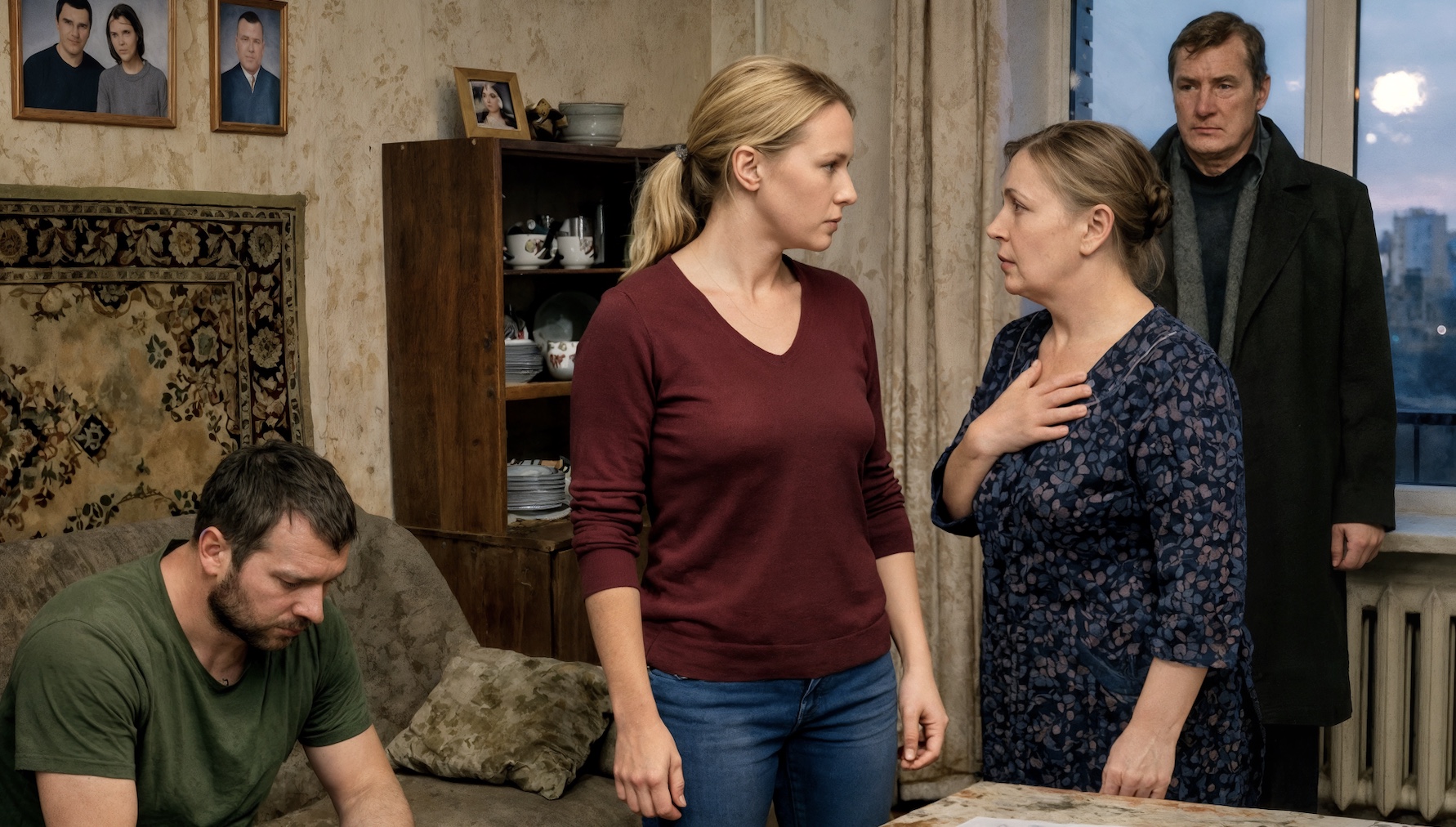
“Leave him, Oksana. Before you fade into a shadow.”
Sveta—my only friend I was still somehow “permitted” to see—was looking at me with such naked pity that I wanted to slide under the table and disappear. We were sitting in a tiny coffee shop on Oktyabrsky Prospekt, and I kept my hands with their chipped polish hidden beneath the tabletop. Outside, Pskov was being lashed by rough March sleet, gray and biting, just like my mother-in-law’s nature.
“Sveta, where would I even go? Misha is seven. School is about to start. Vadim… he’s just tired.”
“He’s not tired, Oksana. He’s gotten arrogant. And Rimma Olegovna is eating you alive. One bite at a time. Probably swallowing you whole with her precious homemade pastries.”
Sveta was right. But the truth is like an ice-cold shower in February: it wakes you up, but it can also leave you with pneumonia.
I came home at seven in the evening. The hallway smelled of fried onions and trouble.
“Burden!”
Rimma Olegovna’s voice slashed across my ears before I even had time to take off my boots.
She stood in the kitchen doorway, hands on her hips. My husband, Vadim, was sitting at the table, absently scraping his fork across his plate. He didn’t lift his eyes. He didn’t even flinch.
“Rimma Olegovna, I just got off work. I’m tired. Let’s do this tomorrow…”
“There is no tomorrow!” my mother-in-law shrieked, her voice rising into a near-ultrasonic pitch. “Vadim has already decided everything. We are no longer going to feed a freeloader. This apartment is mine, isn’t it? Mine. And who are you here? A hanger-on. You keep talking about the law? Then try proving how much you put into this place when every receipt is in my hands!”
She darted into the bedroom. I froze, leaning against the cold wall. At last Vadim looked at me. There was no anger in his eyes. What I saw was worse—boredom.
“Oksana, honestly. Go stay with your mother in Ostrov. You’re not wanted here. Mom is upset. Her blood pressure is up.”
Two minutes later, my first suitcase—with its cracked handle—came flying out through the open entrance door. For a woman who constantly complained about her “pressure,” Rimma Olegovna moved with the grace of a discus thrower.
“Get out!” she screamed across the courtyard. “Look, good people, look! Six years sitting on my son’s neck and not a kopek brought into this house!”
I stepped out onto the front stoop. Our courtyard was a typical Pskov apartment block enclosure. Evening. People coming home from work, walking their dogs. I counted them automatically, the same way I count trucks at work when I assign them to terminal bays. One, two… five… eight. The local busybodies from the third entrance froze near the playground. The men by the garages stopped rattling their tools.
Eighteen people.
Exactly eighteen neighbors watched as my things—sweaters, Misha’s children’s books, my old coat—spilled from the second suitcase when it burst open on impact and landed straight in the muddy spring slush.
“There are your rags!” Rimma Olegovna cried triumphantly, stabbing a finger in my direction. “And don’t you dare set foot here again! Vadim will take Misha on Friday—through the courts. He has a place to live, and you’re nothing but a drifter!”
Inside me, nothing “snapped.” It all just went very quiet. The way it does at the dispatch station when the signal cuts out and you instantly know: either you fix this now, or there will be a head-on collision.
I took out my phone. My hands weren’t shaking. Surprisingly.
I dialed a number I had kept in my memory for ten years, but had never once dared to call.
“Hello. Dad? It’s Oksana. Yes… Pskov. Rizhskiy Prospekt. Come get me.”
I looked at the screen. 6:42 p.m.
Rimma Olegovna was still yelling something. Vadim had stepped out onto the balcony and lit a cigarette, deliberately staring over my head as if I no longer existed. The neighbors whispered among themselves. Someone let out a snide laugh.
“She finally got what was coming to her, that dispatcher girl.”
I sat down on the edge of the park bench near the entrance. The mud on my boots had already started drying.
“In nineteen minutes,” I said into the empty air.
“What are you mumbling there?” my mother-in-law shouted from the first-floor window. “Waiting for Smirnov to show up in his old Logan? He blocked you this afternoon—I checked!”
Nineteen minutes is a very long time when you’re waiting for a dentist.
And incredibly short when it’s the last stretch of your old life.
At exactly 7:01 p.m., a black SUV slid slowly into the courtyard archway, like a heavy cruiser entering a narrow channel. Huge. Gleaming. With license plates that even the laziest traffic officer in our city would think twice about stopping. Another car followed behind it, lower to the ground but just as dark.
The SUV came to a halt directly across from the heap of my belongings. The men near the garages dropped the crowbar they were holding. In the window, Rimma Olegovna choked on her next insult.
A man stepped out of the vehicle. Tall, wearing an expensive coat, with a face that looked as if it had been carved out of gray granite.
Mikhail Arsentyev. Owner of the largest logistics holding in the Northwest. My father.
A man Rimma Olegovna had only ever seen on the news, and whose name Vadim’s boss feared like a thunderclap.
He did not even glance at the building. He walked straight to me, brushed an invisible speck from my shoulder, and asked:
“Is all this yours?”
I nodded toward the suitcases in the mud.
In the window, my mother-in-law slowly opened her mouth but no sound came out. She knew exactly who he was. Her face turned the same sickly gray as the pastries she used to taunt me with.
“Load it up,” my father told the drivers. “And you, Ksyusha, get in the car. We have a lot to do.”
I stood up. I looked toward the balcony. Vadim had dropped his cigarette onto his own trousers, but he didn’t even notice. He was staring at my father as though he had just seen a ghost carrying a tax audit.
Nineteen minutes. That was all it took for Pskov to stop being a trap.
Inside the SUV, the air smelled of expensive leather and cold composure. I looked at my hands: the polish on my thumb had caught on the zipper of the suitcase and peeled off completely. My father said nothing. He had always known how to keep silent in a way that made the silence heavier than any shouting ever could.
We drove to his office in Pskov—a gray building by the embankment. He nodded to the secretary, and within a minute a cup of hot tea in delicate porcelain was set before me. Not in my chipped mug, the one Rimma Olegovna was forever threatening to throw away, but in something real, nearly weightless.
“Drink,” my father said shortly. “Then open your laptop. You’re a logistics specialist, Ksyusha. So map the route for me—how exactly did you end up in this ditch?”
I pulled up the bank statements from Vadim’s accounts and mine. For three years I had worked at the port, one and a half shifts, picking up overnight duty to cover his so-called “business problems.” Vadim kept saying his transport company was barely staying afloat. That we had to hold on a little longer. That I was his support system.
And you know what? No, it wasn’t funny. What hurt wasn’t being thrown out.
What hurt was realizing how professionally I had been robbed.
I typed numbers into the spreadsheet automatically, the way I did on shift. My fingers flew across the keys while in my mind the full logistics chain of the deception took shape. Here was my salary—sixty-five thousand rubles. Here was his—supposedly thirty. And here was Vadim’s hidden account, which my father had “opened up” with a single phone call to the bank’s security service.
Every second day of the month.
Neat as a commuter rail schedule.
Forty-five thousand rubles transferred from Vadim’s account to Rimma Olegovna’s card. For three years.
One million six hundred twenty thousand rubles.
I stared at the screen and felt my back straighten on its own. My stomach, which for the last six months had tightened into a hard knot every time I heard a key turn in the lock, suddenly unclenched. I was not a burden.
I had been financing someone else’s audacity.
“He was stealing from his own son,” I whispered. “We couldn’t afford a speech therapist for Misha, so I kept taking double shifts, and he… he was paying for his mother’s pastries.”
I wanted to tell my father I was sorry for not listening when, ten years ago, he told me Vadim was a petty predator. But I looked at him and only nodded.
He understood.
“You have three days,” he said. “My lawyers will prepare the division papers. But you must take back what is yours yourself. You’re a dispatcher, Ksyusha. You should know how not only to send shipments, but to reclaim them.”
I slipped off my wedding ring. It came off easily—I had lost so much weight over the last two weeks from stress that it was loose on my finger. I set it down on the edge of the desk.
The next morning, I blocked every card Vadim still had access to. It was my first truly expensive decision. Everything inside me trembled as I pressed the button in the banking app, but my finger stayed steady.
Two hours later, my phone began exploding. Vadim called forty times. Then the WhatsApp messages started pouring in.
“What the hell are you doing? I have no money to fuel the trucks!”
“Oksana, give the money back, this is a criminal offense!”
“Mom is crying! She’s having an attack because of you!”
I did not reply.
I was sitting on a bench in Finnish Park—the same bench where I had waited for rescue the day before. Only now I wasn’t waiting anymore.
I was planning.
Misha was with my mother in Ostrov. She took him in without a single question, only sighing into the phone, “So you finally endured enough.” I felt guilty toward my son—for letting him see those suitcases in the mud. But that guilt no longer paralyzed me.
It had become fuel.
The most humiliating part was that I had known. Somewhere deep inside, I had seen that Vadim bought himself new gadgets while I mended Misha’s tights. I was simply too afraid to admit that I had made the wrong choice.
On the third day, at 2:05 p.m., I walked into the courthouse.
I filed the petition.
My father’s lawyer, a dry, precise man in a flawless suit, leaned toward me and murmured:
“We will request division of the hidden accounts. Your husband will be very surprised when he learns that we know about his ‘payments to mother.’”
I stepped out onto the courthouse steps. At last, the air in Pskov felt like spring. It smelled of thawed water and gasoline.
The next day, I would return to that apartment.
Not as a hanger-on.
Not as a burden.
As a dispatcher coming back to shut down an unprofitable route.
I opened the door with my own key. The lock resisted at first—Rimma Olegovna had apparently tried to jam something into it, but had not yet managed to call a locksmith. The hallway still smelled of those same pastries I had now come to hate on a physical level.
Vadim was sitting in the living room. On the table stood an empty bottle and a mound of cigarette butts. When he saw me, he jumped to his feet, but the moment he noticed my father and the two men in dark coats behind me, he dropped back onto the sofa.
“Oksanochka…” Rimma Olegovna drifted out from the kitchen, clutching a dish towel to her chest. “We’ve been waiting for you. Vadik has been so worried, he hasn’t known where to put himself. You have to understand, I lost my temper, my blood pressure spiked, you know how it is…”
“I know,” I said, crossing to the table and pushing aside the ashtray. “I know everything now, Rimma Olegovna. Even how much your monthly ‘treatment course’ costs when it’s paid for with my money.”
I set the printout on the table.
One million six hundred twenty thousand.
The figure, underlined in thick red marker, looked like a sentence handed down by a judge against the flowered tablecloth.
“What is this?” Vadim tried to sound confused, but his voice cracked into a squeak.
“This,” I said, “is your theft from your own family, Vadim. We calculated everything: my night shifts that were supposedly going toward your ‘cash-flow gaps,’ and your transfers to your mother. By law, that is marital property you concealed.”
My father’s lawyer silently placed a second document beside it—the claim for division of assets.
“The apartment is registered in Rimma Olegovna’s name,” he said evenly. “But the renovation, furniture, and appliances totaling three million rubles were paid for from Oksana Mikhailovna’s account. We have all the receipts. Either we divide shares in this apartment through the court, or…”
“Or you return the money now,” I cut in. “My share. Right here.”
Vadim looked at his mother. Rimma Olegovna went pale. She had assumed the “burden” had walked away with two suitcases and vanished into the fog. She had no idea that in nineteen minutes I had regained more than my father.
I had regained my voice.
“We don’t have that kind of money…” my mother-in-law croaked.
“Yes, you do.” I looked her straight in the eyes. “In the very account where Vadik has been sending your ‘retirement money.’ Withdraw it. Right now. Use the app.”
The silence in the room grew so thick it felt solid enough to cut. The only sound was the drip of the kitchen tap—the same one Vadim had promised to fix six months earlier.
I watched his trembling fingers stabbing at the phone screen. He was transferring the money back—to my new personal account. I tracked every figure. One sum, then another… The digital money dropped into my new life with the dry little chime of notifications.
One million.
Another seven hundred thousand.
Almost everything they had managed to siphon off.
“Now my things,” I said when the phone chimed for the last time.
I walked into the kitchen. On the shelf stood my favorite blue mug with the chipped rim. I had bought it in the first week of our life together. Back then I had been happy. Truly happy. I thought I was building a home, but it turned out I was only erecting stage scenery for someone else’s comfort.
I picked up the mug, looked at the chip, and then set it back down.
“Drink from it yourselves, Rimma Olegovna. It doesn’t suit me anymore.”
In the hallway, Vadim tried to grab my hand.
“Ksyush, maybe… for Misha’s sake? I’ll change.”
I didn’t yank my hand away. I simply looked at him the way I look at a cargo ship that has broken schedule coming into port: with the cold interest of a logistics specialist who has already issued the penalty and forgotten the vessel’s name.
“Misha will live with me in the new apartment. And you… you’ll just pay child support. On time. My father’s lawyers will make sure of it.”
We stepped outside. I sat down once more on that same park bench to fasten my boot. The mud had dried, and the sun—bright, hard, springlike—flooded the courtyard. The eighteen neighbors had already dispersed into their apartments, but I knew that by tomorrow the whole yard would know how the “freeloader” had driven away in a black SUV.
My father was waiting by the car.
“All done?” he asked.
“All done.”
The strangest thing was, I did not feel sorry for him. I felt sorry for the Oksana who had spent eight years counting every ruble and believing that love meant simply not being beaten.
It turned out love means being able to breathe.
I got into the car. We rolled slowly out of the courtyard. I did not look back at the balcony where Vadim was probably still smoking his last “free” cigarette.
That evening I would pick Misha up from Ostrov. We would choose a bed for his new room. Blue or green? It didn’t matter.
What mattered was that I would be the one choosing.
At home, it was quiet.
Truly, beautifully quiet.