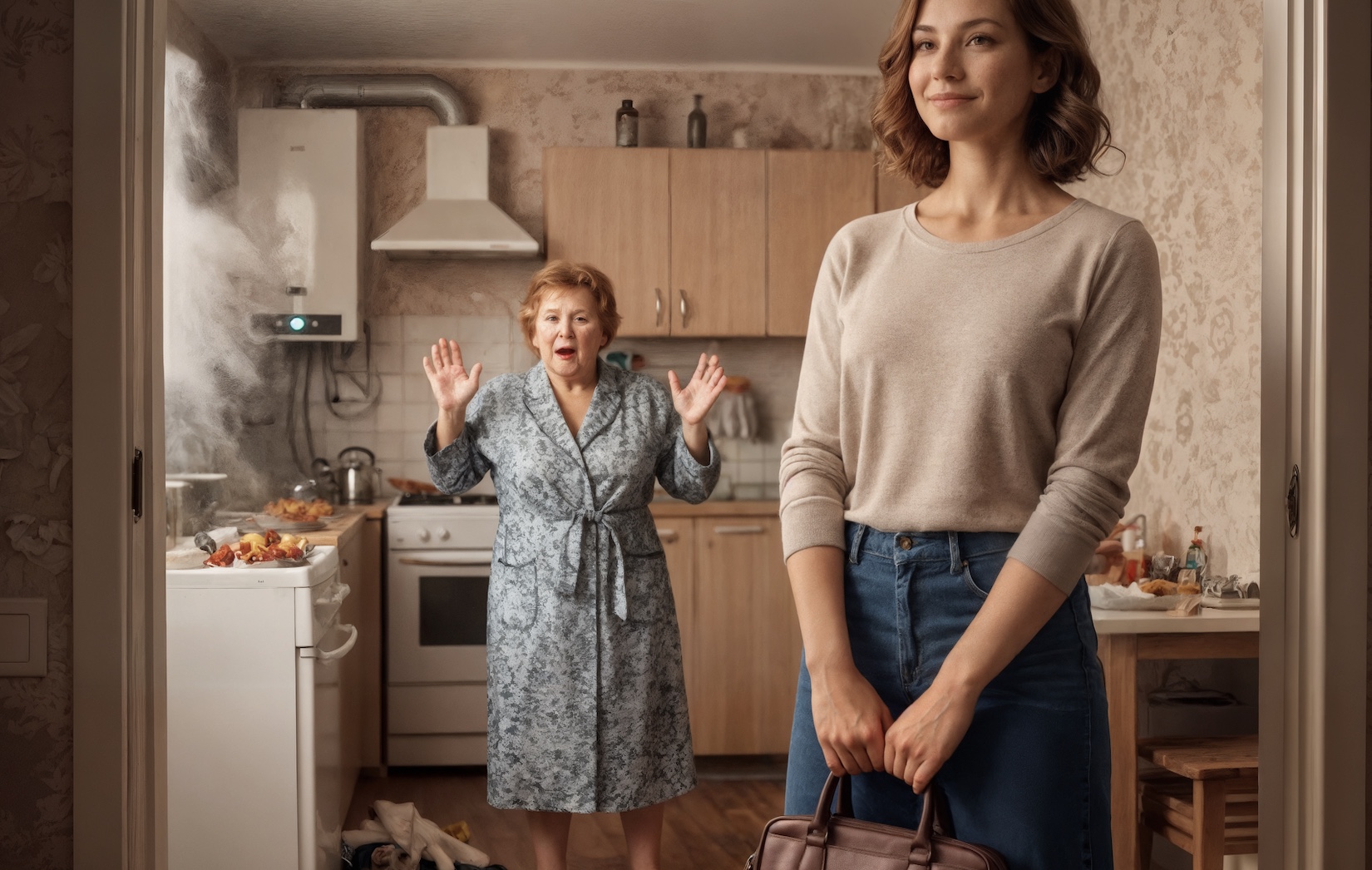
“You’re useless, Alisa! Completely useless!” Tamara Igorevna’s voice rose to a shrill pitch, making the fine china cup in her hand tremble. “You’re as helpful in this house as a goat is in a dairy. You do nothing but take up space and eat through the groceries. My son must have married you during some total lapse of judgment!”
I kept washing the frying pan in silence. The grease clung stubbornly under the weak stream of lukewarm water — the water heater in our so-called “family estate” was malfunctioning again.
“Tamara Igorevna, today I cooked lunch for six people, vacuumed twice, filled the refrigerator using your shopping list, and helped Igor finish his report,” I said calmly, drying my hands on a towel. “Which part of that exactly makes me ‘useless’?”
“All of it!” she snapped, slapping her palm against the counter. “That’s normal. That’s the minimum. Any woman does those things without making a spectacle of it. But you walk around as if you’re doing us some grand favor. Leave. I don’t even want to look at you. Igor! Come here and tell your wife we no longer need her… services!”
Igor stepped into the kitchen, doing his best not to meet my eyes. He was hunched, as always, as if shrinking under the weight of his mother’s anger.
“Al… well… Mom’s right, things have gotten tense at home. Maybe you really should stay with your parents for a couple of weeks? We could all cool down, get some space.”
I looked at him. At the wrinkled shirt I had ironed for him at six that morning. At the overgrown hair on the back of his neck — I had been asking him for a week to book a haircut, but in the end I had trimmed his temples myself with clippers.
“A couple of weeks, Igor? Fine. But let’s agree on one thing: I’m taking all my belongings. Everything. And this little ‘break’ is going to last a very long time.”
Packing took almost no time at all. It turned out that in that huge two-story house, where I had spent three years of my life, everything that was truly mine fit into two suitcases. Everything else belonged to “us,” “Mother,” or some “family heirloom.”
“And don’t forget to return the pantry key!” Tamara Igorevna shouted after me. “My preserves are in there. You’ve got no business touching them!”
I placed the keys on the hallway table. Next to them was a note with the intercom code, the orchid watering schedule, and the phone number for Uncle Vasya the plumber — the only man who knew exactly where to hit the pipe in the basement to make the hot water start running again. I paused for a second, then crumpled the note and slipped it into my pocket. If I was so useless, then my knowledge was useless too.
I got into the car, tossed the suitcases onto the back seat, and drove away. In the rearview mirror, I could see Tamara Igorevna standing on the porch with her hands on her hips, triumphant. She looked like the captain of a ship who had finally thrown the extra ballast overboard.
For the first week, I mostly slept. My parents’ apartment was quiet, warm, and — miracle of miracles — nobody asked why I had bought 2.5% milk instead of 3.2%.
On the eighth day, my phone rang. Igor.
“Al, hi… listen, where’s my blue tie? The one with the little ducks on it, the one you gave me for our anniversary. I’ve got an important meeting today.”
“In the box with the winter shoes, Igor. In the cabinet up on the top shelf. I put it there after cleaning it so it wouldn’t get dusty.”
“In the shoe box? Why? …Okay, found it. Listen, what is Mom supposed to feed the cat? He’s been screaming since yesterday and won’t touch the pollock.”
“The cat has urinary stones, Igor. He can’t eat pollock. In the cabinet under the sink, all the way in the back, there’s a bag of prescription food. It has to be soaked in warm water or he won’t be able to chew it.”
“Got it. Thanks. How are you?”
“Useless, Igor. Resting.”
I hung up.
An hour later, I got a text from my mother-in-law: “Where is the password for the electric utility account? We got a shutoff notice! Did you change it on purpose?!”
I replied with one line: “The password is taped to the back of the router. On the piece of paper you used to call an ‘ugly sticker.’ Have a nice evening.”
After two weeks of “rest,” reality started striking back at the family mansion.
Tamara Igorevna’s house was old, temperamental, and held together almost entirely by my patience and a thousand tiny repairs. I knew that if you didn’t tighten the nut on the upstairs toilet tank every three days, it would start leaking. I knew the washing machine could only be run while the kettle was off, otherwise the fuses would blow. And most importantly, I knew the water heater’s secret.
On Saturday evening, Igor called again. In the background, there was a thunderous racket that sounded like construction work with a jackhammer.
“Alisa! Help! Everything is… it’s all bad! Mom got into the shower, something clicked, and now steam is coming out of the faucet while the toilet tank is filling with ice-cold water! And that noise… I think the house is about to take off!”
“That’s cavitation in the pipes, Igor. You need to switch off the main breaker and release the pressure through the kitchen tap.”
“I don’t know where the pressure valve is! Mom is screaming, she’s standing there in a towel covered in soap! Uncle Vasya isn’t answering!”
“Uncle Vasya goes fishing every Saturday. He won’t be back before Monday. Call emergency repair.”
“They said they won’t get here for three hours! Al, please…”
“Igor, I’d love to help, but I’m useless, remember? I’d hate to confuse such an experienced woman as your mother with my advice.”
I ended the call and went to drink tea with raspberry jam.
Three weeks later, I stopped by to pick up the rest of my odds and ends — a few books and my yoga mat.
What I saw looked like something out of a surrealist painting. The front lawn, which I used to rake by hand, was overrun with weeds and dandelions. Empty pizza delivery boxes were piled up on the porch — apparently the “basic standard” of cooking lunch for six had collapsed.
Inside the entryway, the air smelled of dampness and feline rebellion.
“Oh, look who’s here!” Tamara Igorevna marched out of the living room. She was wearing an old robe, with a towel twisted around her head. “Just look at what you’ve done! You left, and everything fell apart! The water heater burned out, the washing machine is jumping all over the place, and Igor’s walking around in dirty clothes because that stupid machine keeps shredding his shirts!”
I glanced at the washing machine.
“Tamara Igorevna, you simply forgot to remove the underwire from the drum. I used to do that once a month. And the water heater burned out because no one cleaned the filters. I did that every Saturday while you watched your soap operas.”
“Why didn’t you tell us?!” she shrieked.
“I did tell you. You said I was ‘wasting time on nonsense’ and ‘pretending to be busy.’ Remember?”
Igor emerged from the kitchen. He looked worn out — dark circles under his eyes, a scorched frying pan in his hands.
“Al,” he said quietly, “we got the water bill. It’s fifty thousand. Turns out the toilet upstairs had been leaking for two weeks, and we never noticed.”
“Not ‘we,’ Igor. You. I noticed. I changed the washer in the valve every two weeks. It took five minutes and cost almost nothing. But you said all I did was ‘waste food.’ Apparently I was also saving water.”
Tamara Igorevna did her best to keep up appearances. She even hired a “professional housekeeper,” but the woman quit after three days, saying, “Working in that hell is impossible — the pipes have a life of their own.”
Then Igor started coming to my workplace with flowers and the expression of a thoroughly beaten dog.
“Al, let’s come back together. I explained everything to Mom. She… she’s willing to apologize.”
“Igor, do you know what the funny part is?” I said with a smile, picking up my yoga mat. “Being useless feels amazing. My hands don’t ache from cleaning chemicals anymore. I have no idea what toilet valve gaskets cost these days. And my phone no longer explodes with screaming about burnt dinners.”
“But what about the house? It’s going to fall apart!”
“A house is just walls, Igor. The thing keeping it alive was the same ‘useless’ woman you threw out the door. Let your mother try being the foundation herself. She has so much experience, after all.”
I got into the car.
“Oh, and one more thing, Igor. Tell your mother the orchids on the window are fake. I swapped them out six months ago because the real ones died within a week under her care. They don’t need watering. Otherwise your windowsill will rot next.”
I pressed the gas pedal, leaving behind what had once looked grand and solid, but was now rapidly decaying. In the rearview mirror, I saw Igor staring in confusion at the artificial flower in his hand.
It turned out that a house without love or care is nothing more than a pile of bricks with failing plumbing. And “uselessness” can be a very expensive service — one people only learn to value after they’ve been getting it for free for far too long.