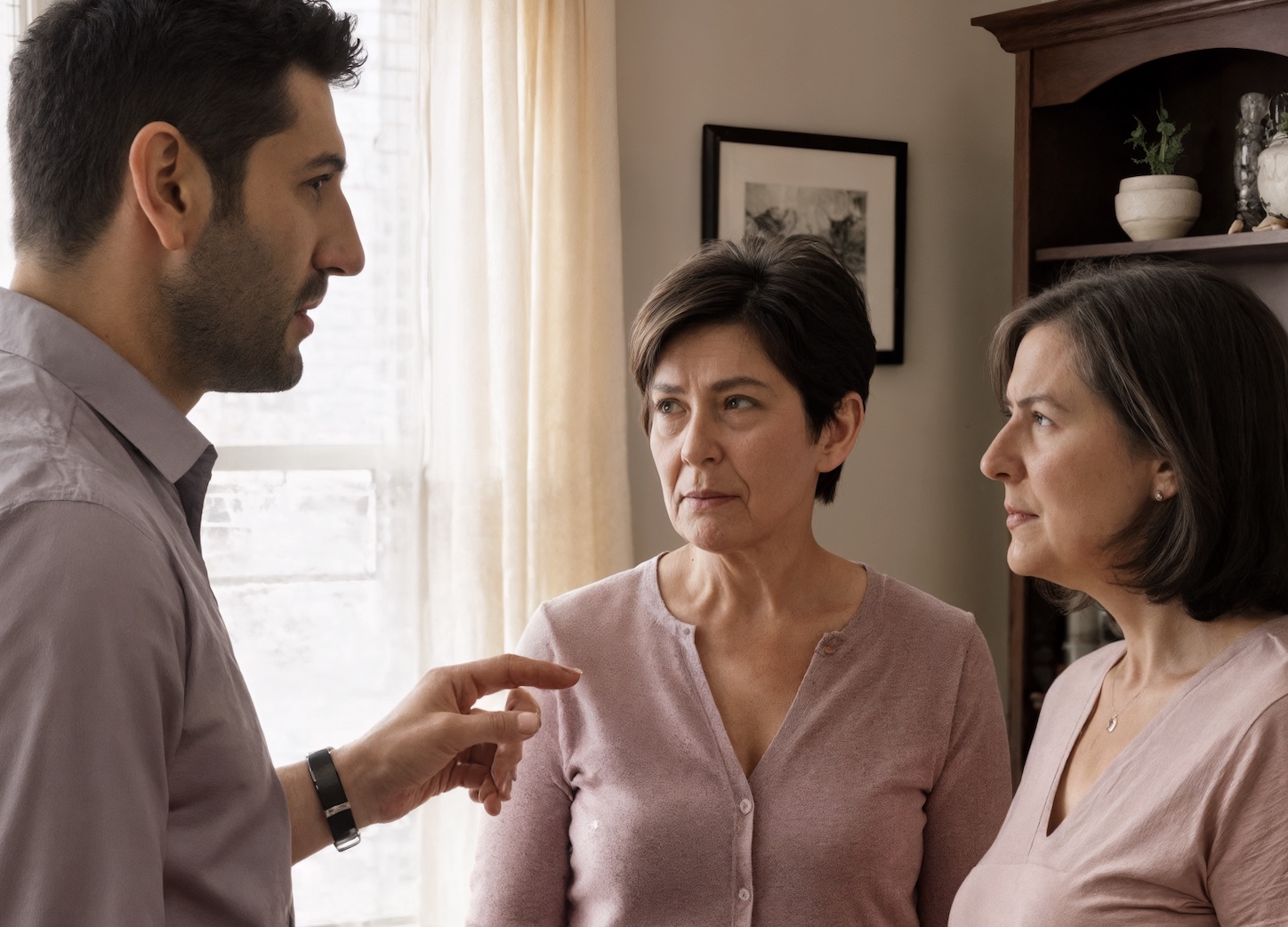
Dmitry tossed the line out without looking at his wife, staring into a plate of dinner that was still warm. The words settled over the kitchen—dense and heavy, like the smell of stew that had caught at the bottom.
“What?” Anya asked under her breath. Her fingers slackened on their own, and the spoon dropped onto the table with a dull thud.
“You heard me.” At last he lifted his eyes to her. There was no rage there—only a tired, stone-hard resolve. “Starting with this paycheck, we’re doing separate finances. I’m sick of supporting you.”
She didn’t speak. The hum in her ears swallowed the clock’s ticking. Supporting. The same word her father once used to shame her mother for buying an extra pack of butter. The word Anya had always dreaded.
“I’m not lounging around, Dima,” her voice quivered. “I work. It’s just…”
“It’s just that your ‘work’ doesn’t bring in even a third of my salary,” he finished for her. “And we spend equally. Or rather—you spend my money. Time to grow up, Any.”
He stood, carried his plate to the sink without turning back. The door to his office creaked—his personal fortress, the room she entered only with a tidy stack of freshly washed laundry.
Anya stayed seated, staring at her half of dinner. The food went cold. She felt as if she’d been shoved out of a boat in the middle of a lake and told, “Swim on your own—I’m tired of towing you.”
That was how the Great Separation began, as Anya named it in her head.
The next day Dmitry, brisk and calm, printed out a chart: utilities, mortgage, groceries, gas—everything split perfectly down the middle. His paycheck was five times larger than her modest earnings from web design and illustration? Irrelevant. The market. Fairness.
Anya pushed aside the children’s book project she’d been building at night—if it wasn’t paying right now, it was a luxury. She took two extra rush jobs for landing pages she would’ve refused before: formulaic, dull work. By midnight her eyes ached.
The first week was hell made of calculations. “You ate more yogurts—pay the difference.” “That movie night was your idea, so your ticket is 650 rubles.” Their home turned into a branch office of accounting.
But then something strange happened. Inside that ruthless saving, inside the squeaky mechanism of “you owe me, I owe you,” the outline of something she’d forgotten began to reappear—herself.
Once she stopped waiting for Dima to “bring money into the house,” she started hunting for it on her own. She tracked down an old client who’d launched an online shop and needed a full-time designer. Anya proposed new terms—double what she used to charge. The client respected her nerve and agreed.
For the first time in years, Anya bought herself boots that weren’t on sale—because they were beautiful and comfortable. No asking permission. No guilt. She simply transferred her own hard-earned money from her account and paid.
Dmitry noticed. Quietly. He’d been waiting for her to crack, to come back apologizing, to talk about love and “their future.” Instead, Anya sealed herself inside financial independence like a cocoon. She cooked dinner only for herself when it wasn’t her scheduled “turn” to cover the grocery budget. She washed her clothes separately. Her laughter—once frequent and ringing—grew rare, and when it did appear, it was usually through the phone while she talked to clients or friends.
One evening he found her in the living room. She sat with a laptop open; on the screen were sketches filled with light and warmth—nothing like her old commercial work.
“What’s that?” he asked, working to keep his voice steady.
“Mine,” Anya answered simply, eyes still on the screen. “Not yours. Not shared. Mine.”
There was such unreachable distance in that single word that something tightened inside him. And with sudden, piercing clarity he realized: he’d gotten what he asked for. He no longer “supported” her. She’d separated. Completely. And in that separation she was beautiful, calm—and didn’t need him at all.
“Any…” he started.
She closed the laptop and looked at him. The same gaze he used to admire—clear, direct. But now there was no question in it. No waiting. Only a quiet statement of fact.
“Yes, Dima? Do you need to discuss the electricity share? I think I overpaid last month.”
He wanted to shout, “Forget the electricity!” He wanted to rip up his ridiculous spreadsheet, tell her he’d been wrong, that he was exhausted and scared and stupid.
But the words he’d released into the world had already done their work. They’d built a wall. And now he stood on his side of it—alone, money in his pocket, ice-cold emptiness all around. He’d won separate finances, and along with the money he’d split their lives. It turned out that what they had was the most valuable thing of all—and he himself had put a price tag on it.
Anya picked up her mug and walked to the kitchen. A cupboard door creaked, the light switch clicked. Ordinary sounds of a home that hadn’t become чужой yet, but had already stopped being shared.
Dmitry remained in the middle of the living room, staring at the soft light leaking from under the kitchen door—toward the place where she was, and where no one was waiting for him.
The light under the kitchen door was warm, yellow. Dmitry stood there, unable to move. That plain rectangle of light felt like an unbreakable border now. To step across it, you needed a pass. And his pass—his right to walk in without asking, to drop a casual “I’m home,” to kiss her at the back of the neck while she cooked—had been revoked. By his own hands.
The word “mine,” the way she’d said it, burned inside him. He remembered the beginning: her, a design student with bright eyes, showing him sketches—clumsy, vivid, alive. Him, a young analyst with a promising career, already earning well. “Don’t stress,” he’d tell her. “Do what you love. I’ve got us.” And “us” had sounded solid, indivisible. Then came the mortgage, renovations, the desire to “provide.” His salary climbed. Her creative work remained uneven—“pin money.” Somewhere along the way, “I’ve got us” became “I’m carrying this,” and then—“I’m sick of supporting you.” When had the shift happened? He hadn’t even noticed.
A spoon clinked against porcelain in the kitchen. The sound was lonely. She used to drink tea wrapped in a blanket on the couch, resting her cold feet on his lap. Now she drank it alone, at the kitchen table, probably staring at her phone or a book—in her separate life.
He took one step, then another, reached the door and laid his palm on the smooth wood. He couldn’t bring himself to open it.
The next day Dmitry came home earlier than usual. In his hands were two bags from the gourmet shop where Anya used to pick out cheeses and strange sauces—things he always grumbled about: “Why overpay for a label?”
The kitchen smelled like cinnamon. Anya was baking something. When she saw him, she only nodded toward the table. “The utility papers are there—I’ve already calculated everything.”
“I’m not here for that,” his voice broke. He set the bags down. “I… I bought dinner. Your favorite goat cheese. And that Italian truffle sauce.”
She pulled a tray of apple strudels from the oven. Homemade. His favorite. She used to make them on Sundays for tea.
“Thanks,” she said politely, as if to a neighbor. “But I have plans tonight. I’m having dinner with Masha. And this…” She flicked her hand toward the strudels. “I was just heating the oven. It’s an order. For a client.”
For a client. His strudel was now a product she made for money. For strangers.
“Anya, we need to talk. Without numbers.”
She set down the oven mitt and turned. He searched her eyes for a spark—anger, hurt, anything. Instead he saw calm fatigue, the same fatigue that had once lived in his own gaze.
“About what, Dima?” she asked. “I’ve nearly put together next month’s budget already. The mortgage payment—”
“Damn it, enough with the mortgage!” he burst out. “I don’t want to talk about the mortgage! I want to talk about us!”
She studied him for a long moment, then exhaled slowly.
“You started talking about ‘us,’ Dima, when you turned everything into money. You reduced everything to bills. I just learned how to answer you in that language. Now there is no ‘us.’ There are two people sharing square meters and utility payments. Exactly like you wanted.”
“That’s not what I wanted!” he shouted, panic finally breaking through. “I wanted… I wanted fairness. I wanted you to put in effort too!”
“I always put in effort,” she said quietly. “You just stopped seeing it. You stopped seeing me. You saw a dependent. Now you see a co-payer. Congratulations—your goal is achieved.”
She grabbed her bag and neatly packed the strudels into a container.
“I’ll be home late. Don’t wait.”
The door closed. Dmitry stood alone in a spotless, perfectly clean kitchen that smelled of cinnamon and loneliness. He walked to the table and unfolded her spreadsheet. Every line, every figure was flawless. She was playing by the rules he’d created—perfectly.
Playing to win her freedom from him.
Then his eyes caught the corner of the page. Next to the dry columns of numbers she’d drawn a tiny, barely noticeable ornament—a branch with apples. The same kind she used to doodle on his bookmarks, on their first little cards to each other. A sliver of that old, “irrational” self. A sketch.
He snatched up the page and left the kitchen. All night he sat in his office—but not over reports. He rummaged through old boxes, cloud folders. He found scans of their first movie tickets, ridiculous photos where she fooled around and he watched her like she was a miracle. He found her early drawings—awkward, but so full of hunger and joy they made his chest tighten.
He remembered laughing at her dream of making an author-illustrated children’s book. “Who needs that? The market wants something else.” He, the market expert, had squeezed her talent into narrow commercial frames. And when those frames started to suffocate her, he blamed her for not being efficient.
He walked to the sideboard where her vase stood—odd and lopsided, made at a pottery class. He always said it looked like a ruin. Now he looked at its crooked lines and saw character. Stubbornness. Unrepeatable beauty.
In the morning he didn’t go to work. He went to a flower shop, but standing before the bright piles of bouquets, he realized roses and tulips would be an insult now—just another money-gesture in their new system. Instead he went to an art supply studio and bought a set of expensive Japanese graphite pencils—the exact ones she’d sighed over two years ago, but never bought because “I don’t need ones that pricey; I don’t draw that much.”
When he returned, Anya was home. She sat on the balcony with her laptop.
“Hi,” he said, feeling like an idiot with a box in his hands.
She looked up. “You’re not at work?”
“I… took the day off.”
He held the box out. “This isn’t paying you back for anything. And it’s not a guilty apology gift. It’s just… I remember you wanted these. For your sketches. For… what’s yours.”
She took the box slowly and opened it. Her finger brushed the velvety surface of a pencil.
“Thank you,” she said, and for the first time in a month something in her voice shifted—like a wall that didn’t fall, but trembled. “They’re very expensive. You didn’t have to.”
“I did,” he breathed. “I needed to remember what you love. That it’s part of you. The part I… pushed away. Along with everything else.”
She closed the box and set it on the table.
“Dima, I can’t just forget,” she said quietly. “You have no idea how much it hurts to hear from the person you love that you’re a burden. That your presence in his life is ‘support.’ It destroys everything—trust, closeness, the feeling that you’re one.”
“I know,” he whispered. “I’ve already understood. I destroyed it. And now, when you stand in front of me whole, independent, strong… I realize what an idiot I was. I traded ‘us’ for an Excel illusion of fairness. And I’m terrified you won’t want to be with me anymore—not as a cost-sharing partner, but… just with me.”
He hadn’t cried since childhood. But now his eyes stung with sharp, helpless moisture.
Anya looked out over the city. The silence stretched so loud Dmitry thought it might break him.
“I don’t know if I can trust you again,” she said at last, very softly. “Trust that in a hard moment you won’t start calculating losses. That you won’t convert my love into an exchange rate. I learned how to live without that certainty. And I’m… almost calm.”
Almost. A single thin thread. He grabbed at it like a drowning man.
“Let’s try to start over,” he said, not daring to hope. “Not with a shared budget. With shared tea on the balcony. With conversations that aren’t about money. I’ll learn to see you again—if you give me a chance. Just one.”
Anya turned her face toward him. That clarity in her eyes frightened and mesmerized him at the same time.
“The finances stay separate,” she said firmly. “That’s my shield now. But… we can try having dinner together sometimes. And talking. About anything except bills.”
It wasn’t a bridge. It was a shaky plank thrown over a chasm he’d dug himself. But it was something.
“Yes,” he nodded, fighting the tremor in his voice. “Let’s. Can I cook tonight? Not from what I bought. Just… something. Pasta.”
The corner of her mouth moved—not a smile, but something close.
“You always overcook pasta.”
“I’ll learn not to,” he said. “I’ll learn.”
And he understood this would be the hardest and most important work of his life. Not for a shared bank account—but for the chance that one day she might say, like she did years ago, about something they’d made with their hands: “Ours.” And that “ours” wouldn’t be about a mortgage or a loan. It would be about something priceless—something you can’t split in half.
That dinner of overcooked pasta became the first step on the shaky planks. Awkward, almost comical. But it was no longer “mine” and “yours”—it was an attempt, clumsy but real, to create something shared again.
Dmitry kept his word. He didn’t bring up returning to a joint budget. And little by little—micron by micron—their life began filling with human exchanges instead of financial transactions.
He brought her tea when she’d stayed up late working—not because he had to, but because he noticed the light under the door to her room (their former bedroom, now hers alone) was still on. In return, she left a portion of soup in the fridge after she heard him coughing in the mornings. No comment. Just a container and a note: “You can heat this up.” A gift without strings. A gesture, not a debt.
One evening Anya came into the living room with her laptop.
“Listen,” she said hesitantly. “This is a draft. My children’s book. About a mouse who’s an astronomer.”
He set his book aside and looked not at the screen, but at her face. It had come alive; the sparks were back in her eyes—sparks he hadn’t seen in years. He read the text, studied the sketches—naive, warm, full of stardust and wonder. And he realized this wasn’t a product being sold to him. He was being invited into a treasure room.
“This is… brilliant,” he breathed. And it wasn’t flattery. He truly saw the magic.
“You think?” She watched him cautiously, searching for insincerity.
“I know. Go in this direction. Forget the landing pages for a month. I… I’ll cover the current expenses. Not as ‘support.’ As… an investment. In your talent. In a future bestseller.”
She shook her head—though the old harshness in her defenses was gone.
“No. The finances are separate. But… if you want, you can be my first backer on crowdfunding. When I launch the campaign.”
He nodded, swallowing the lump in his throat. She was accepting his help, but on her terms—as an equal, not a dependent.
Months passed. They still kept separate accounts. They still sometimes moved around each other like roommates. But on the living room shelf, their old photos returned—pulled from boxes by him. Anya didn’t remove them. Next to her crooked vase appeared a telescope model—his birthday gift to her, with no “practical” purpose, just because “the mouse-astronomer needs an instrument.”
One Saturday morning Dmitry woke to the smell of coffee and muffled, joyful sobs. He walked into the kitchen. Anya, wearing his old T-shirt, sat at the table with her head in her hands. In front of her lay a printed letter.
“Anya? What happened?”
She lifted her face—wet with tears, but shining like a thousand suns.
“The publisher… They’re taking it. My book. They’re taking my book!”
He froze, then surged forward without thinking, scooped her up and spun her around the kitchen. She laughed and cried—and she didn’t push him away. They became one whirlwind of happiness, where there was no “yours” or “mine,” only our “we did it,” our joy.
When he set her down, both of them breathless, he still held her hands.
“I’m so proud of you,” he whispered—each word earned, each word true. “So unbelievably proud.”
“Thank you,” she said, and her fingers tightened slightly around his. “Thank you for believing. Back then.”
That evening they celebrated with dinner. They bought champagne and expensive pasta—what Anya once called wasteful. They talked about plans, about stars, about a silly mouse conquering the universe—not about money.
After the dishes were washed and the bottle was empty, a silence settled—full and ringing, not awkward.
Anya went to the sideboard and took out the folder with their ridiculous spreadsheets. She walked to the fireplace (decorative, but still).
“You know,” she said, looking at the sheets with their columns of numbers and that tiny apple branch. “I think this experiment can be considered complete. Goal achieved.”
Dmitry’s heart dropped. Goal? What goal? Proving they could live apart?
She turned back, and in her eyes he saw not distance, but quiet, deep certainty.
“I proved to myself that I can,” she said. “That I’m not a burden. That I’m worth exactly what I decide I’m worth. And you… you proved you can see in me not a bank statement, but a person. A partner.”
She held the folder out to him.
“I don’t want to split everything into ‘mine’ and ‘yours’ anymore. But I also don’t want to return to what we had—where everything was ‘ours,’ but your contempt was hiding underneath. I want us to build a new ‘ours.’ Where each person has their own protected cosmos, their own stars. And where those universes—voluntarily, because they want to, not because they must—form a binary system. With shared gravity. With shared light.”
She tore the folder in half and tossed it into the fireplace. The paper didn’t burn, but the gesture said everything.
Dmitry stepped toward her—not rushing, giving her room to step back. She didn’t.
“I don’t deserve that chance,” he rasped.
“That’s not for you to decide,” she shot back. “Whether you deserve it or not. It’s my choice. I choose to try—with you. But with a new map.”
He didn’t kiss her. He didn’t make grand promises. He simply wrapped his arms around her—tight, like a drowning man who had finally found solid ground. She rested her cheek against his chest, and it felt like a truce. Not surrender—a new agreement.
They never went back to a single shared account. They created three envelopes instead: “Hers,” “His,” and “Ours.” Into “Ours” they put money for shared dreams—a trip to a real observatory, a big table for guests, the future. And that “Ours” wasn’t a burden—it was a savings jar for happiness.
A year later, at the presentation of her first book, as Anya signed copies for excited readers, Dmitry stood off to the side and caught her eye. She caught his gaze, smiled that old, trusting smile, and winked.
He walked up to the table, took a blank sheet of paper, and wrote:
“Investment proposal. Objective: shared life into deep old age. Dividends: shared stars, shared laughter, shared memory. Risks: total bankruptcy in loneliness. Ready to discuss partnership terms.”
He handed it to her. She read it; her eyes shimmered. She signed at the bottom:
“Partner agrees. No unilateral termination. Forever.”
And she added a tiny apple branch.
In the end, the accounting was simple: you can’t split trust, respect, and love in half. Either they exist—or they exist fully. And wholeness is the only budget that truly matters.